
A sermon at College Communion, Christ Church
11th June 2023
We’ve been watching the BBC series ‘Race Across the World’.

We love it. Pairs of travel companions travel thousands of miles over land (no planes allowed) between checkpoints to compete to reach the final destination and win £20,000. It’s a great blend of travelogue, competition, and personal human drama. The pairs are given a map, the cash it would take to fly there, and all technology, including phones, laptops, bankcards, are forbidden.
The best part is seeing each person change and grow through the journey. It’s also a long time to spend with one person. Most couples get on, but every now and then they annoy each other, and at times fall out. It’s a little window into human relationships. All the pairs realise at some point along the way that the destination and prize isn’t the main goal, but it’s what they learn from it, the experiences they have, and how they grow as people through it all.
This week sees the end of the academic year before the long vacation over Summer. Some in our chapel community are reaching the end of their journey here. Over the term we’ve been reflecting on ‘images of resurrection’. We’ve looked at the painting of the Emmaus Supper in St Edmund Hall, artwork depicting Miriam’s freedom dance, we’ve walked a labyrinth, and reflected on poetry by RS Thomas.
We end by going back to the beginning – to the early church and seeing what images of resurrection hope looked like to those who saw it 2000 years ago, and what they might mean to us today.
I have two images to leave you with, in hope they are encouraging.
The first is St Barnabas, whose feast day is today.
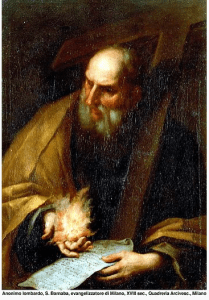
Barnabas and Paul were travel companions for much of Paul’s ministry. An early church Race Across the World partnership! Barnabas was actually named Joseph, and he was given a nickname to describe his character, as someone who encourages others.
36 Joseph, a Levite from Cyprus, whom the apostles called Barnabas (which means “son of encouragement”), 37 sold a field he owned and brought the money and put it at the apostles’ feet.
Acts 4. 36-37
He’s unassuming, generous, cheerful, and dependable. All great qualities to aspire to. When the early believers were (understandably) wary of Paul, Barnabas advocated for him and persuaded them he was sincere in his transformation. (Acts 9.27)
When there was a church with disagreements and they needed someone dependable to send… the apostles chose Barnabas. (Acts 15)
In the extract from Acts we’ve just read Barnabas is in Antioch, the crossroad of culture and trade – a thriving, cosmopolitan city. Here he sees potential in the fledgling church and encourages Paul to come and teach them. Above all:
‘He was a good man, full of the Holy Spirit and faith’
Acts 11.24
This would be a pretty good epitaph for any of us.
The second image is an extract from the Epistle of Mathetes (which just means disciple) to Diognetus, thought to be from around 2nd Century – one of the earliest depictions of the early church.
You can read Chapter V: The Manner of the Christian
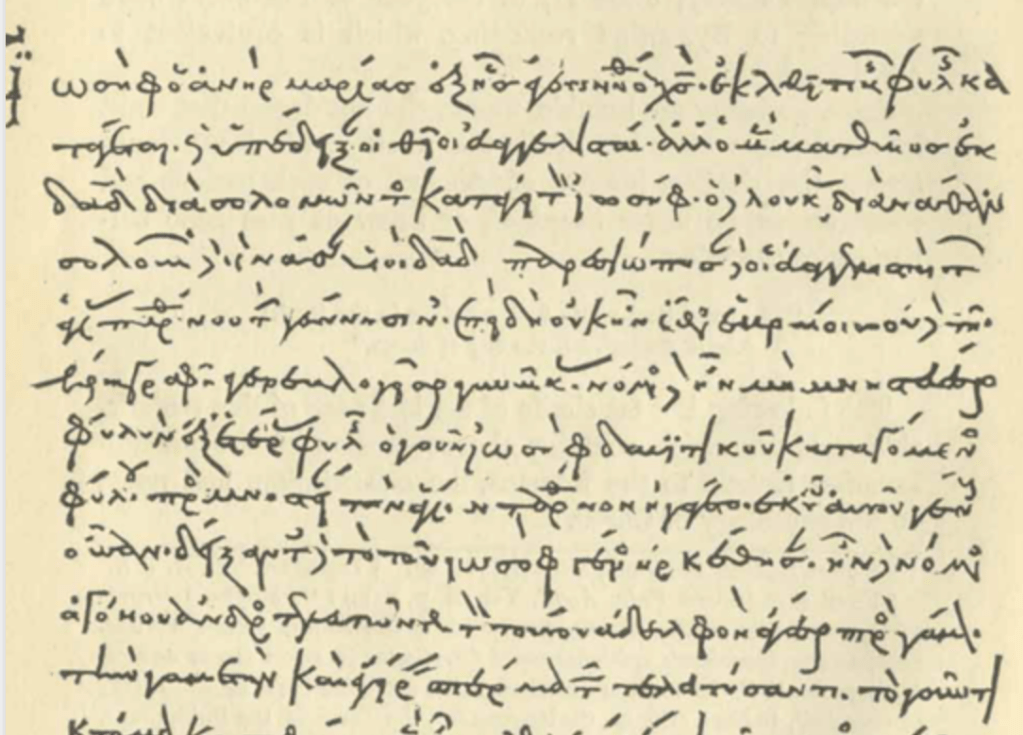
Notes: The epistle survived only in one manuscript. It was initially discovered in a 13th-century codex that included writings ascribed to Justin Martyr. The 13th-century manuscript was mostly intact, exhibiting damage only in one place, several lines in the middle of the text. It was first published in 1592, and attributed to Justin Martyr because of the context of its discovery. Unfortunately the original was subsequently destroyed in a fire during the Franco-Prussian War in 1870,[8] but numerous transcriptions of the letter survive today.
The paragraph that often inspires me is:
Christians are indistinguishable from other men either by nationality, language or customs. They do not inhabit separate cities of their own, or speak a strange dialect, or follow some outlandish way of life. Unlike some other people, they champion no purely human doctrine. With regard to dress, food and manner of life in general, they follow the customs of whatever city they happen to be living in, whether it is Greek or foreign….And yet there is something extraordinary about their lives.
From the Epistle to Diognetus
And he describes the way in which they live:
- As if passing through
- Sharing meals, not their wives!
- Obedient to laws, but transcending them
- Live in poverty, but are generous, and live in abundance
- They suffer, but they are not destroyed by this
It’s a deeply moving account and portrayal of the journey of faith and the way of life of followers of Jesus. It can be helpful to look back to heroes of faith, like Barnabas, and to the early church for inspiration.
However, a word of caution.
Just a few chapters on from this in Acts Paul and Barnabas fall out spectacularly.
They had such a sharp disagreement that they parted company. Barnabas took Mark and sailed for Cyprus, but Paul chose Silas and left, commended by the believers to the grace of the Lord.
Acts 15: 39-40
They have an argument over another member of the community, where Barnabas feels Paul is being too harsh in refusing to allow John Mark to accompany them. They part ways for a while. It’s all very human.
It is perhaps a mistake to hold up any one person or community as if they were perfect.
When I first came to faith I travelled to Rome to live and work with a wonderful Christian community. I met people of faith who lived their lives in a way that was different to what I’d encountered before. They spent their time serving the poor, meeting together to pray, living joyfully (pizza helped). It felt to me like the early church, and in many ways it was. This time had a profound impact on me.
However, as this community got bigger, problems emerged, disagreements grew. I have since learned that some elements of it were deeply manipulative, and some of my dearest friends were hurt by it.
It is deeply shocking and painful when a Christian community goes wrong, or when a leader we admire turns out to be all too human.
Christian communities, leaders, churches, can be signs of resurrection hope in our world, and have been ever since those first followers were called Christians at Antioch. I have some of my deepest, soul-healing and soul-inspiring friendships from amongst my church family and couldn’t imagine life without them.
But we are also human and sinful, and as such can be deeply disappointing and flawed, which is why we continually need to come back to this table to repent, be forgiven, and put back again.
We need to keep going back to Jesus’ command:
love one another as I have loved you
John 15.12
as it’s from that basis of love we can live out the next command…
and I have appointed you to bear fruit, fruit that will last
John 15.16
As we go from here we can be inspired by the ways these early Christians lived, and by Barnabas, the encourager, the loyal friend, the advocate.
Life is not just a race to get the prize at the end of it all (neither is our time at university, although a degree would be nice!) It’s about the journey – one where we can be distinctive and different, loving one another. We can be signs of resurrection hope in the world. We can live extraordinary lives, not because we are necessarily extraordinary in ourselves (we’re not!), but because of the quality of our relationships, the way we live and love, and the difference we make along the way.
Amen

 Consider the Lilies - Clare Hayns
Thanks so much Clare. Inspiring as ever.
Hope all goes well with you and the family.
Annie
<
div>X
Anne ChampnessSent from my iPad
<
div dir=”ltr”>
<
blockquote type=”cite”>
LikeLiked by 1 person
Thanks Annie – you too.
LikeLike
Loved this Clare.
LikeLiked by 1 person