Prayer in the Wilderness

A sermon for Advent 2
Mark 1: 1-8

I wonder if you can think back to a time when you were lost, really lost. That sense of wandering around alone waiting to be found.

It might be a time as a child when you lost your parents in a supermarket; on a hiking trip when your map reading skills failed you, or stuck in a strange city with no data left on your phone so you can’t use google maps.

I remember being lost in Clapham Common in the days before mobile phones. I was 19, at that time I didn’t know London at all but had gone to see a friend. I was early so I stopped off to go for a walk in the common. I parked my car, spent an hour or so walking around and enjoying the afternoon, and then I went back to my car.

I had no car keys. I’d dropped them somewhere, and my wallet was locked in the car.  I had no money, and was alone in a city I didn’t know. The sun was going down.

I retraced my steps. Nothing. I searched high and low. Nothing. I wandered round and round in circles and eventually sat down in the middle of the park, in the dark, and cried.

Wildernesses come in all shapes and sizes. Not many of us have experienced a physical wilderness, or true desert. Clapham Common is hardly a wilderness! But we do know what wilderness feels like. That sense of being lost, out of control in the unknown, of being without bearings.

Wilderness is an uncomfortable place.

Mark’s gospel opens dramatically in the literal wilderness with John the Baptist appearing as if out of nowhere, looking wild with his camel-hair clothing and honey and locust diet.

The gospel begins with words from prophets Malachi and Isaiah:

The voice of one crying out in the wilderness:
“Prepare the way of the Lord,
make his path straight.”

Mark 1.3

There had been prophetic silence for around four hundred years before this moment when John the Baptist bursts onto the scene. The last prophetic voice recorded in the Hebrew bible had been that of Elijah’s in the book of Malachi and since then, pretty much nothing.

And throughout that wilderness time of silence God’s people were waiting for the one they’d be promised, who would free them from oppression: The Messiah.

In the Bible, time in the wilderness isn’t to be feared; it’s a place of learning, transformation, and growth.

In Scripture we see over and over again of God’s people being led into the desert or wilderness in order to be taught something important. We remember Moses and Miriam leading the Israelites through the wilderness years as they learn to trust God’s provision; Hagar who hears God’s voice whilst sitting in desert in despair; Elijah, who is led into the wilderness before hearing God’s still small voice in the silence. And of course Jesus himself is led there after his baptism.
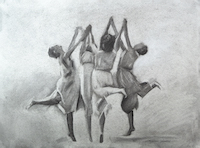
Miriam led the women in singing and dancing once they reached the safety of the wilderness having escaped Egyptian slavery. (Exodus 15) – Image by ©MicahHayns

And so it’s from wilderness that John bursts onto the scene proclaiming Good News.

Mattia Preti – San Giovanni Battista Predicazione, circa 1665

Someone is coming who is greater than I
Get ready for him
Turn around and make a path for him

Back to my story in Clapham Common

It was dark, I was vulnerable and alone. I had a very new Christian faith and realised I needed at this time, in that place, to exercise it.

So I sent up a quick ‘God, what do I do now’ prayer. And I had the strongest sense that what I needed to do was to get on my knees and pray. So, in the middle of the park, in the dark, I got on my knees and prayed. And as I did so I knew without a shadow of a doubt that my keys had been found. I knew it was going to be OK. And what I needed to do was to turn around and go back to the car.

So I walked back to the car and as I did so I saw a man walking towards me calling out to me:  ‘Excuse me, Miss, are these your keys’?

He’d seen me wandering around from the upper window of nearby flat, had come down from his home, and had searched around the undergrowth, and found the keys.

And in doing so had not only given me the means to get home, but also strengthened my faith at a time when I really needed it, and for years to come.

Advent is a time when we recognise our lost-ness, that we can’t find the way on our own, that we so often wander round and round in circles not quite knowing where we are heading.

In the biblical wilderness people are never left there for ever. They are called from the wilderness into something far better – into deeper faith, clearer vision, stronger resolve.

God, the creator of all, didn’t remain silent, and doesn’t just watch us wandering around from his high tower. Instead he came amongst us, as one of us, in the form of a child, to enter into our lostness and to show us the way through the dark. This is the Good News of Jesus Christ that Mark proclaims in his gospel.

Jesus was ‘God with us’ (Emmanuel) in human form for a while, and remains with us through his Holy Spirit until the time when he will return. And John the Baptist, like Elijah before him, and Isaiah before him encourage us to prepare the way for him.

God is with us, and is coming to be with us. How do we make a clear path for him? That is the task for Advent.

Repent. Stay awake. Clear out the obstacles which get in the way.

If you are in a wilderness stage of life, feeling like you are wandering around in circles, you are not alone. Perhaps we are invited to welcome the wilderness, to hear what God may be saying to us within it, or to listen to how God might be guiding us through it. God doesn’t always sent an immediate answer to prayer in the way that happened to me on Clapham Common – in fact I don’t think I’ve experienced anything quite as clear since then. But it sustains me nonetheless.

And so, this Advent, let us prepare the way to welcome Jesus, perhaps by getting on our knees to pray (maybe not in the dark in a park!), being prepared to sit in silence, by turning around…

and by being willing to be found.

Amen

Not what we might expect

Sermon given at Christ Church Cathedral, Oxford
3rd September 2023
Thirteenth Sunday after Trinity
Revd Clare Hayns, College Chaplain

Exodus 3. 3-15; Romans 12. 9-21; Matthew 16. 21-28

If any want to become my followers, let them deny themselves and take up their cross and follow me

Matthew 16.24
Taize 2023 – photo credit Ian Macdonald

A couple of weeks ago I joined a group from the Diocese of Oxford, with some students from ChCh to spend a week in Taizé in France. You may have heard of it? It’s a Christian community near Cluny established as a place of peace and ecumenism after the Second World War. It’s now a place of pilgrimage and prayer for thousands of predominantly young people from across Europe. As Chaplain at Christ Church I joined with a small group from the university. 

There was much of what you might imagine from being with several thousand 16 – 25-year olds. Late night singing in the bar, some strange game that looked a little like twister on benches, and lots of intense conversations and discussions about issues such as climate change, the challenges of mental health, and sexuality and gender.

Three times a day a bell sounded out and everyone there stopped what they were doing and gathered in the huge hanger-like chapel, joining in with the beautiful chants that are the communities’ particular charism*, and in the middle of which, for 10 minutes three times per day, we all sat in total silence.

The depth of prayer was palpable and hard to describe. We were on holy ground.

And on the Friday, the cross is taken down and laid on the floor in the centre of the chapel, and hundreds of young people silently lined up and then gathered round it, bowing their heads to the wood of the cross, some staying for a few moments, others for a long time.  

Some young people bowing before the cross in Taizé, France

It was awe-inspiring to see and unexpected, perhaps because we are so often led to believe that young people aren’t interested in faith any more, that the Christian faith is in decline, and that devotion of this kind is something relegated to past times.

I want to share that with you as we reflect on what it means to follow Jesus, to be a Christian, in the light of this mornings’ readings. If we began with the reading from Paul’s letter to the Romans we might think it’s about being good, decent human beings and loving one another. But is there more to it?

Following God might not be quite what we expect.

Rather than starting with Paul I’d like to look at both Moses and Peter and see what these two men can teach us about what it is to follow God. Both men are called for a particular purpose, both argue with the one that calls them, and both are led to a place they least expect.

For Moses, following God’s call means to first encounter God in the awe and holiness of the burning bush. Just before this passage in Exodus, Moses had fled Pharaoh’s palace after having killed an Egyptian in a fight and is now living as a shepherd in the mountains of Horeb. And it’s here on the mountain that he encounters God who reveals himself within the fire of a burning bush and calls him from within the fire. ‘Moses, Moses’. Moses realises he is on holy ground, takes off his sandals and hides his face in awe. And from that position of worship Moses is called to go the very place he’s fled from. He’s to go Pharaoh, to plead for the freedom of the Israelites and to lead them into that freedom.

His reaction? He reminds God that he’s just a normal human being:

who am I that I should go

Exodus 3.11

He later argues that he’s not eloquent enough, he doesn’t know what to say, and that he won’t be believed. All his pleas are simply answered with:

I will be with you

Exodus 3.12

For Moses, following God’s call was to first encounter God, and to then be prepared to obey the call to lead the Jews into freedom and away from their oppression.   

Following God might not be quite what we expect.

For Simon Peter, following Jesus had been going pretty well until this point. In the passage directly before this Peter had been on his own personal mountain-top. He had publicly recognised Jesus to be the Messiah, and as a result Jesus had given him a new name ‘the rock’, a new mission ‘on this rock I will be build my church’, and he had even been promised the keys to the kingdom of heaven (Matthew 16. 13-19). He must have been riding high.

And so can blame him that when Jesus starts talking about imminent suffering and death that Peter strongly objects:

God forbid it Lord! This must never happen to you

Matthew 16.22

Suffering and death wasn’t part of Peter’s plan for this Messiah he had found. Surely Jesus was going to save the Jewish people and lead them into freedom from the oppressors of the day. Surely Jesus would be like Moses and would lead them into a promised land.

But this wasn’t God’s plan. And for speaking up like this Peter the rock, had suddenly become Peter the stumbling block. Jesus even calls him a Satan, rebuking him strongly with ‘Get behind me, Satan’. We often think that Jesus here is calling Peter the Devil, but that’s not quite right. A Satan (here it is a noun not a proper name) is better translated as ‘the adversary’. A Satan is someone who opposes, normally an opponent in a court setting. Peter at this time was opposing Jesus.  Peter was standing in Jesus’ way, being like the tempter in the desert.

And so for this Jesus rebukes him with ‘get behind me’. In the light of what Jesus then goes on to say about following him I wonder if Jesus’ rebuke to Peter is a reminder to Peter that he needs to follow BEHIND Jesus, rather than from in front of him.

Following God might not be quite what we expect.

For Peter, following Jesus would eventually lead to glory and a promised land, the kingdom of heaven, but the way to that wasn’t what he expected at all. The way was through a Messiah who suffered, who denied self, who was taken through the streets of Jerusalem with a cross on his back, and who was nailed to that cross.

So, what does all this mean for us?

Following God might not be quite what we expect.

I think it’s unlikely any of us will be called like Moses to speak to an oppressive ruler to liberate a captive people. Or will be called, like Peter, to be the foundation of the Church.

So what does following Jesus’ way mean for ordinary people like us, with ordinary lives, ordinary struggles and ordinary challenges that come our way?

If any want to become my followers, let them deny themselves and take up their cross and follow me.

Matthew 16.24

To ‘deny yourself’ doesn’t mean forgetting about yourself, debasing yourself, or being a doormat for others to walk on. But it does mean putting Jesus first which is practice means not putting ourselves at the centre of everything, and putting others’ needs before our own.

One of the nation’s favourite songs for funeral services is Frank Sinatra’s ‘My Way’. You know the verse:

‘And more, much much more, I did it my way’.

It is the direct opposite of this! We are not called to do it our way, we are called to do it Jesus’ way.

We are not alone.  Jesus led the way for us. Jesus denied himself, refused to be tempted by Peter away from his call, and took up his cross, and with it he took all that is painful, sinful, wrong with the world, and it was nailed with him on that cross.

That is what I think I was seeing when I watched all those young people on their knees at the cross in the Taize Chapel. They were connecting their own story with God’s story. And from that place of reverence and awe, they, like each one of us, were sent out to live. To live lives shaped by the cross.

And this is why we end with Romans 12 rather than begin there. Because this passage in Romans is a wonderful description of what denying self, taking up our cross and following God looks like.  

It looks like ‘genuine love’, honouring one another, persevering in prayer, and living lives of radical hospitality.

So, when it comes to following God what should we expect?

Like Moses, we should expect God to challenge our view of ourselves in light of His call.
Like Peter, we should be challenged to set aside our own fixed ideas of who Jesus is.
And we should expect to live radical lives of service as a result, in the knowlege that Jesus is with us walking ahead of us on the way.

Amen

* This chant ‘Herre, visa mig vägen’, was a favorite of our group.


Awake, My Soul! – Psalm 57

Psalm 57

Linked verse: 1 Samuel 24

Awake, My Soul! – by @MicahHayns

This is the first of a series of posts on the Psalms, which we’re working on for a new book with BRF. Each post is illustrated with an original piece of art by Micah, and I’m working on prayers to accompany them as well.

Whilst we can’t be sure of the author of each of the psalms it is likely that this psalm is, as the introduction to it suggests:

‘Of David.. when he fled from Saul, in the cave’.

David, the young shepherd boy who had been anointed by the prophet Samuel, had caught the eye of King Saul because his ability with the lyre calmed Saul’s tormented soul. David became Saul’s musician, then his armour-bearer, and ‘Saul loved him greatly’ (1 Samuel 24.21).

He was given a prominent place in the royal household, and eventually even given the hand of Saul’s daughter Michal in marriage (you can read about their love/hate relationship here). However, Saul was a bitterly jealous man and as David began to grow in stature and prominence, particularly after seeing off the marauding rival Goliath with only his sling-shot and a few stones, Saul became consumed with resentment. He became increasingly violent in his rages towards his young prodigy and David had to dodge spears, was sent to the frontline of battle, and had to be protected from the Kings rages by two of Saul’s children, Jonathan and Michal. These eventually became so bad that David had to escape in the dead of night where he fled to a cave in the mountains.

Perhaps it was in this cave that David uttered the heartfelt prayer:

Be merciful to me, O God, be merciful to me

Psalm 57.1

The psalm speaks of a ‘soul.. bowed down’ (v.6) and in dire need of protection, ‘my soul takes refuge, in the shadow of your wings’. (v.1)

The psalmist’s prayer is answered in an extraordinary way, involving a seruptitious pee in the dark.

David remained in this cave hide-out for some time, developing a large following – ‘those who were with him numbered about four thousand’ (1 Samuel 22.2). Saul wasn’t going to give up easily and so set off with his men to seek out his enemy. On the way he stumbled across David’s cave and, without knowing his rival was inside, used the cave as a toilet! Whilst ‘he went in to relieve himself’, David snuck up behind him and snipped off a piece of his clothing, presumably to torment him with it. David immediately felt convicted by God, called off his men, and spared Saul’s life.

The two rivals were re-united in a powerful and beautiful scene – David bowed down to Saul recognising him as anointed by God, Saul ‘lifted up his voice and wept’ realising the error of his actions. (1 Samuel 24: 16-20)

We’re unlikely to have been hunted down by a jealous king, but we surely know what it is to be threatened or frightened to the point we would love to run away from the situation and hide in a cave. Similarly, perhaps there have been times when we’ve been so consumed by rage that we lose perspective and it seems our very soul becomes ‘bowed down’.

The psalmist reminds us that God will be with us, even in the darkness of the deepest cave: in fact we are given refuge under God’s protective wings ‘until the destroying storms pass by’ (v. 1). And when the storms pass, which they surely will, how wonderful it is to emerge from the cave into the glorious light, outstretch our arms in praise, and to say:

‘Awake, my Soul! Awake O harp and lyre! I will awake the dawn’

Psalm 57.8

Prayer

O Lord, you are with us even in the darkest cave; protect us when our souls are bowed down, our hopes are crushed, and all we want to do is hibernate. May we rest under the shadow of your wings until such time that we can emerge from the gloom, raise our arms, and our souls can sing once again. Amen

Psalm 57 (NRSV)

Be merciful to me, O God, be merciful to me,
    for in you my soul takes refuge;
in the shadow of your wings I will take refuge,
    until the destroying storms pass by.
I cry to God Most High,
    to God who fulfils his purpose for me.
He will send from heaven and save me,
    he will put to shame those who trample on me.
God will send forth his steadfast love and his faithfulness.

I lie down among lions
    that greedily devour human prey;
their teeth are spears and arrows,
    their tongues sharp swords.

Be exalted, O God, above the heavens.
    Let your glory be over all the earth.

They set a net for my steps;
    my soul was bowed down.
They dug a pit in my path,
    but they have fallen into it themselves.
My heart is steadfast, O God,
    my heart is steadfast.
I will sing and make melody.
    Awake, my soul!
Awake, O harp and lyre!
    I will awake the dawn.
I will give thanks to you, O Lord, among the peoples;
    I will sing praises to you among the nations.
10 For your steadfast love is as high as the heavens;
    your faithfulness extends to the clouds.

11 Be exalted, O God, above the heavens.
    Let your glory be over all the earth.

Welcoming the ‘wished for comer’

A sermon for Trinity 4:A
Christ Church Cathedral
2nd July 2023
Revd Clare Hayns, College Chaplain

Matthew 10: 40-42

‘Whoever welcomes you welcomes me, and whoever welcomes me welcomes the one who sent me’

Matthew 10:40

I hope that each and every one of you arrived today to a warm welcome from our lovely stewards team.

Over the past few days Christ Church has welcomed a LOT of people. On Wednesday and Thursday we had our College Open Days where we welcomed around 6,000 people – young prospective students and their parents. Each was welcomed by one of our undergraduates, and given a pen and a branded goodie bag (anything to show a warmer welcome than our rival colleges!). One young welcomer told me her face ached after two days of smiling so much.

Welcome/ Willcomen. The root of both the English and the German word is the Proto-Germanic word ‘wiljacumo’, which literally means ‘wished-for comer’ – someone whose coming you desire. To welcome is to invite another to cross the boundaries of your space, be it your college, home, church, meal table. It goes beyond obligation or toleration. It is to invite in the ‘wished for comer’.

We heard the word ‘welcome’ several times in today’s gospel; 6 times in just 2 small verses, to be exact. 

This little passage comes at the end of a section of teaching where Jesus sends his twelve disciples out as missionaries into the community around them. They are sent out with a job to do – to heal the sick, proclaim the good news, cast out demons –  but they are sent without everything they need as they are to rely on the kindness of strangers and to have faith in God’s provision.

And they’re warned that this wouldn’t always be easy – “I am sending you out like sheep amongst wolves” (Matthew 10:16) – they wouldn’t always be  welcomed.

If anyone will not welcome you or listen to you shake off the dust from your feet as you leave the house or town.

Matthew 10:14

I’m sure we all know what it is to be not welcomed. It’s painful, particularly when that involves a church or religious community.

Siobhan Garrigan, Professor of Theology at Trinity College, Dublin, wrote a book called ‘the Real Peace Process’[1] which documents Ireland around the time of the Good Friday Agreement. She writes about how the Irish peace process worked out in the reality of peoples’ homes and churches.

She tells a story that once she arrived for worship at a Presbyterian Church in Northern Ireland. She was greeted by two (seemingly) nice women at the door who began a conversation with her. They were welcomers of some sort. They asked her name and the first names of any other approaching strangers who came to morning worship. She then figured out what was happening. Their job was to question new-comers as they arrived. Those with protestant sounding names, such as Billy and Elizabeth, were shown to their seats; those with apparently Catholic names, the Mary’s, Patricks and Siobhan’s, were told they were surely in the wrong place and shown to the Roman Catholic church round the corner! This was not the dim and distant past – this was 1990s Northern Ireland.

But before we get too judgmental and think this could never happen here, we should remind ourselves of all the subtle and not so subtle ways in which we include and exclude people.

I remember turning up to a village Church not far from here with young child to be told by the welcomer that, ‘the family service is next week’. She was a well-meaning and kindly woman, but she gave me the impression that I didn’t belong.

And we (all of us – I include myself here) exclude in all sort of unconscious ways, be it due to not prioritising disability accessibility, assuming a level of academic ability or tutting if a child cries.

I’d like to pause to say that if any of you here have ever felt unwelcome here, then on behalf of the clergy team – sorry.

Jesus’ teaching reminds us that each person is made in the image of God, and when we welcome another, we welcome the person in whose image they are made. Jesus’ followers probably were quite uncomfortable hearing him talk about this kind of welcome.

In order to understand that, we have to take a step back into the Judea of the 1st century. In this context everyone was defined and identified by the groups they belonged to: family, tribe, religion, region, social status, profession. So people were usually identified by their family ties – think of James and John, the sons of Zebedee – or by their place of origin, like Mary of Bethany.

And in Jewish society of the time, who you welcomed in your home/synagogue mattered. Clear religious and cultural boundaries delineated who belonged, who was ritually clean, and who was part of the community.  

One of the main criticisms levelled at Jesus was that he kept breaking these rules. He kept welcoming, and allowing himself to be welcomed by, all sorts of unsuitable, unclean, unsavoury people.

He received a cup of water from the hands of a five times-married Samaritan woman by the side of a well in Samaria; – John 4: 7-15
He stayed at the home of the hated chief tax collector Zacchaeus – Luke 19: 1-10
He allowed his feet to be anointed by a ‘sinful’ woman – Luke 7:36-50

It’s no wonder the Pharisees and the scribes were grumbling and saying:

This fellow welcomes sinners and eats with them.

Luke 15:2

Jesus was constantly extending and expanding his welcome to bring in more and more people. What would it be like if our church community was a place which also extended welcome in this way?

There is a church notice board in Scotland which inspired me (which I’ve adapted slightly).

“WELCOME:
We extend a special welcome to those who are single, married, in a partnership, divorced, widowed, gay, confused, filthy rich, comfortable, or dirt poor. We extend a special welcome to wailing weans and excited toddlers.
We welcome you whether you can sing like Pavarotti or just growl quietly to yourself. You’re welcome here if ‘you’re just browsing,’ just woken up or just got out of prison. We don’t care if you’re more Christian than the Archbishop of Canterbury or haven’t been to church since Christmas twenty years ago.
We extend a special welcome to those who are over 60 but not grown up yet and teenagers who are growing up too fast.
We welcome those who are in recovery or still addicted. We welcome you if you’re having problems, are down in the dumps or don’t like ‘organised religion.’
We offer a welcome to those who think the earth is flat, work too hard, don’t work, can’t spell or are here because you are at a loose end. We welcome those who are inked, pierced, both or neither. We offer a special welcome to those who could use a prayer right now, had religion shoved down their throat as children or got lost and wound up here by mistake. We welcome pilgrims, tourists, seekers, doubters . . . and you! You are very welcome.”

Could we welcome others in this way? What might that look like? How might we begin to offer others this kind of radical welcome?

Because when we welcome others, we don’t just welcome them, we welcome those communities they belong to, and we welcome Christ in whose image they are made.

It’s not enough to just say ‘welcome’ if we then don’t act in a way that makes a person know that it is real. We can offer more than just a smile and a cup of cold water. And the reward will be great, in fact the reward will be eternal life. We could make a start.

But our human welcome will always be far inferior to the welcome that we receive from Jesus. Remember the story of the Prodigal Son, when the father runs out with open arms to invite his son back home? That’s the welcome we receive from the father.

The Return of the Prodigal Son, Rembrandt Harmensz van Rijn

Shortly we are about to be invited to the Eucharistic table. It’s a meal where everyone is invited and welcomed.  

I will end with some words by John Chrysostom preached on Easter Day in the 4th Century, which speak of the feast wherein we can all participate and experience this welcome,  where Jesus offers himself to us.  

Wherefore, enter you all into the joy of your Lord; and receive your reward, both the first, and likewise the second. You rich and poor together, hold high festival. You sober and you heedless, honour the day. Rejoice today, both you who have fasted and you who have disregarded the fast. The table is full-laden; feast ye all sumptuously. The calf is fatted; let no one go hungry away.[2]

From the Paschal Homily of St John Chrysostom

We are Jesus’ ‘wished for comer’ at his table.

Amen


[1] Garrigan, S. (2016). The Real Peace Process (1st ed.). Taylor and Francis. Retrieved from https://www.perlego.com/book/1567517/the-real-peace-process-worship-politics-and-the-end-of-sectarianism-pdf (Original work published 2016)

[2] https://orthodoxwiki.org/Paschal_Homily

A sermon for Barnabas: signs of hope on the journey

Acts 11: 19-end
John 15: 12-17

A sermon at College Communion, Christ Church
11th June 2023

We’ve been watching the BBC series ‘Race Across the World’.

We love it. Pairs of travel companions travel thousands of miles over land (no planes allowed) between checkpoints to compete to reach the final destination and win £20,000. It’s a great blend of travelogue, competition, and personal human drama. The pairs are given a map, the cash it would take to fly there, and all technology, including phones, laptops, bankcards, are forbidden.

The best part is seeing each person change and grow through the journey. It’s also a long time to spend with one person. Most couples get on, but every now and then they annoy each other, and at times fall out. It’s a little window into human relationships. All the pairs realise at some point along the way that the destination and prize isn’t the main goal, but it’s what they learn from it, the experiences they have, and how they grow as people through it all.

This week sees the end of the academic year before the long vacation over Summer. Some in our chapel community are reaching the end of their journey here. Over the term we’ve been reflecting on ‘images of resurrection’. We’ve looked at the painting of the Emmaus Supper in St Edmund Hall, artwork depicting Miriam’s freedom dance, we’ve walked a labyrinth, and reflected on poetry by RS Thomas.

We end by going back to the beginning – to the early church and seeing what images of resurrection hope looked like to those who saw it 2000 years ago, and what they might mean to us today.

I have two images to leave you with, in hope they are encouraging.

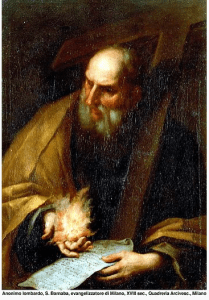
The first is St Barnabas, whose feast day is today.

Barnabas and Paul were travel companions for much of Paul’s ministry. An early church Race Across the World partnership! Barnabas was actually named Joseph, and he was given a nickname to describe his character, as someone who encourages others.

36 Joseph, a Levite from Cyprus, whom the apostles called Barnabas (which means “son of encouragement”), 37 sold a field he owned and brought the money and put it at the apostles’ feet.

Acts 4. 36-37

He’s unassuming, generous, cheerful, and dependable. All great qualities to aspire to. When the early believers were (understandably) wary of Paul, Barnabas advocated for him and persuaded them he was sincere in his transformation. (Acts 9.27)

When there was a church with disagreements and they needed someone dependable to send… the apostles chose Barnabas. (Acts 15)

In the extract from Acts we’ve just read Barnabas is in Antioch, the crossroad of culture and trade – a thriving, cosmopolitan city. Here he sees potential in the fledgling church and encourages Paul to come and teach them. Above all:

He was a good man, full of the Holy Spirit and faith’

Acts 11.24

This would be a pretty good epitaph for any of us.

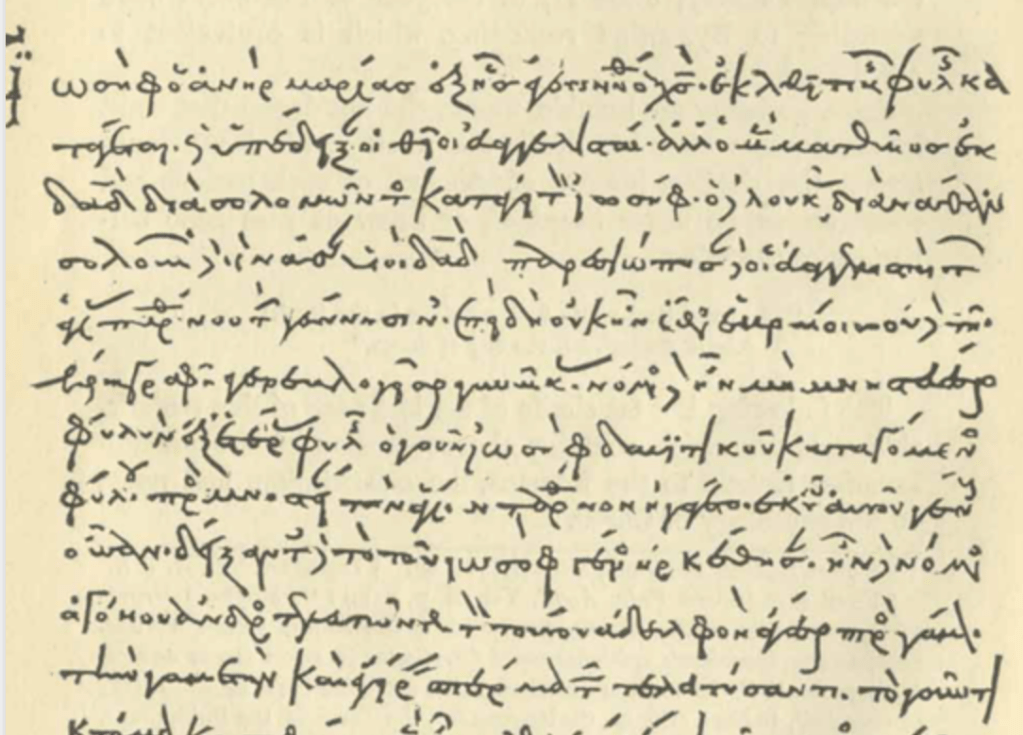
The second image is an extract from the Epistle of Mathetes (which just means disciple) to Diognetus, thought to be from around 2nd Century – one of the earliest depictions of the early church.

You can read Chapter V: The Manner of the Christian

Notes: The epistle survived only in one manuscript. It was initially discovered in a 13th-century codex that included writings ascribed to Justin Martyr. The 13th-century manuscript was mostly intact, exhibiting damage only in one place, several lines in the middle of the text. It was first published in 1592, and attributed to Justin Martyr because of the context of its discovery. Unfortunately the original was subsequently destroyed in a fire during the Franco-Prussian War in 1870,[8] but numerous transcriptions of the letter survive today.

The paragraph that often inspires me is:

Christians are indistinguishable from other men either by nationality, language or customs. They do not inhabit separate cities of their own, or speak a strange dialect, or follow some outlandish way of life. Unlike some other people, they champion no purely human doctrine. With regard to dress, food and manner of life in general, they follow the customs of whatever city they happen to be living in, whether it is Greek or foreign….And yet there is something extraordinary about their lives.

From the Epistle to Diognetus

And he describes the way in which they live:

  • As if passing through
  • Sharing meals, not their wives!
  • Obedient to laws, but transcending them
  • Live in poverty, but are generous, and live in abundance
  • They suffer, but they are not destroyed by this

It’s a deeply moving account and portrayal of the journey of faith and the way of life of followers of Jesus. It can be helpful to look back to heroes of faith, like Barnabas, and to the early church for inspiration.

However, a word of caution.

Just a few chapters on from this in Acts Paul and Barnabas fall out spectacularly.

They had such a sharp disagreement that they parted company. Barnabas took Mark and sailed for Cyprus, but Paul chose Silas and left, commended by the believers to the grace of the Lord.

Acts 15: 39-40

They have an argument over another member of the community, where Barnabas feels Paul is being too harsh in refusing to allow John Mark to accompany them. They part ways for a while. It’s all very human.

It is perhaps a mistake to hold up any one person or community as if they were perfect.

When I first came to faith I travelled to Rome to live and work with a wonderful Christian community. I met people of faith who lived their lives in a way that was different to what I’d encountered before. They spent their time serving the poor, meeting together to pray, living joyfully (pizza helped).  It felt to me like the early church, and in many ways it was. This time had a profound impact on me.

However, as this community got bigger, problems emerged, disagreements grew. I have since learned that some elements of it were deeply manipulative, and some of my dearest friends were hurt by it.

It is deeply shocking and painful when a Christian community goes wrong, or when a leader we admire turns out to be all too human.

Christian communities, leaders, churches, can be signs of resurrection hope in our world, and have been ever since those first followers were called Christians at Antioch. I have some of my deepest, soul-healing and soul-inspiring friendships from amongst my church family and couldn’t imagine life without them.

But we are also human and sinful, and as such can be deeply disappointing and flawed, which is why we continually need to come back to this table to repent, be forgiven, and put back again.

We need to keep going back to Jesus’ command:

love one another as I have loved you

John 15.12

as it’s from that basis of love we can live out the next command…

and I have appointed you to bear fruit, fruit that will last

John 15.16

As we go from here we can be inspired by the ways these early Christians lived, and by Barnabas, the encourager, the loyal friend, the advocate.

Life is not just a race to get the prize at the end of it all (neither is our time at university, although a degree would be nice!) It’s about the journey – one where we can be distinctive and different, loving one another. We can be signs of resurrection hope in the world. We can live extraordinary lives, not because we are necessarily extraordinary in ourselves (we’re not!), but because of the quality of our relationships, the way we live and love, and the difference we make along the way.

Amen

Life as a grander thing to be lived

A sermon for the 4th Sunday of Easter at College Communion, Christ Church
Given by Darian Murray-Griffiths, History and Politics
30th April 2023

Acts 2. 42-end
John 10. 1-10

Lord, hear me and inspire me, that I may be ever faithful to your service. In the name of the Father, the Son, and the Holy Spirit. Amen

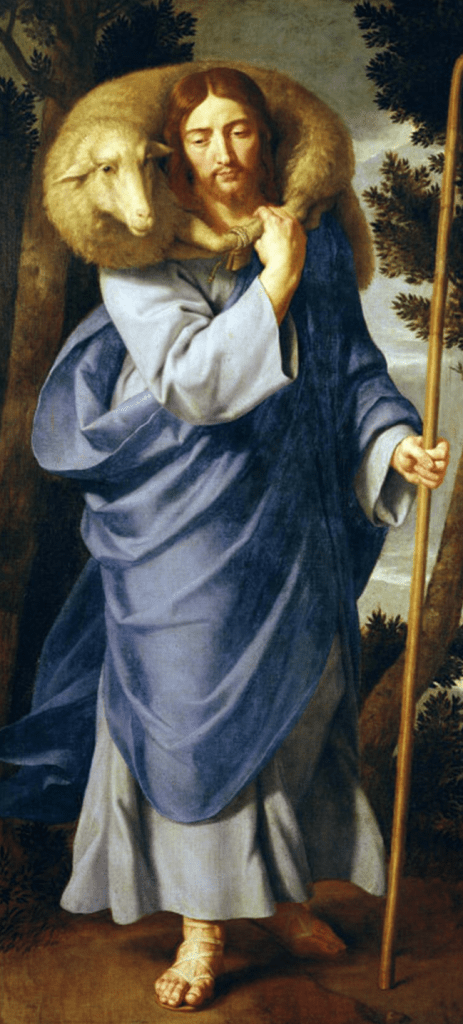
In today’s Gospel Reading, Jesus presents himself as the Good Shepherd tending his flock. He tells his confused disciples and listeners that:

I am the gate. Whoever enters by me will be saved and will come in and go out and find pasture.

John 10.9

St John tells us that ‘Jesus used this figure of speech with them, but they did not understand what he was saying to them’ (John 10.7). And, 2000 years later, we may equally find ourselves compelled to re-read and re-understand this passage. I remember in this very Cathedral hearing a priest preaching that Jesus positioned himself in direct contrast to shepherds throughout the ages who loved and tended their flock out of pure self-interest. A well-tended flock, fattened and healthy, make for the best meats that the shepherd will eventually sell or consume himself.

Jesus here is the Good Shepherd, the antithetical Shepherd, who cares for us so much that he willingly took upon himself the burden of the Cross.

Attributed to Jean Baptiste de Champaigne  (1631–1681)

The man who preached sociability and charity was instead condemned to being the centrepiece in a spectacle of public entertainment, where masses were drawn together not by love or goodwill but by the desire for cheap entertainment, obedience to the naked display of authority, and the mindless contemplation of that thing they called ‘justice’. That burden Christ took upon himself is one which countless Christians, in varying circumstances and ages, have also taken upon themselves ever since. And one which rightly should inspire us today in our struggles, and stall aggressors to check themselves in their volleys of scepticism.

Truly, Jesus was the Good Shepherd, who in his moment of truth, decided to sacrifice not his flock, but himself. He decided not to sell out or cash in, but to accept his fate, so that we may be saved. It is a decision that two millennia has perhaps dulled in our minds in the constancy of its retelling.

In this Gospel Reading, we see Jesus at pains to intervene against the odds, to disrupt the cycle of human vanities and natural instincts, and to interpose in its place a new conception of life. Jesus says to his audience words which are profound: ‘I came that they may have life and have it abundantly’ (John 10.10)

I do not see this as Jesus simply saying that he saves us from Death or at least the early grave. I see this as something which I hear every time at Evensong in this Cathedral and stirs and reinforces me personally: he is talking about: ‘that peace which the world cannot give’ (John 14.27). In talking of not just life, but a life in abundance, Jesus is talking about the way in which life itself does not solely have to be a dreary march from pillar to post, from resting point to resting point, or even, for us students, from bed to library.

He talks of life as a grander thing to be lived, if only we may halt ourselves in our tracks, and calmly contemplate. He bids us to stop up the fears and vanities, the half-truths we tell ourselves, and the arrogant presumptions we cling on to for matters of prestige and hierarchical self-assertiveness. He bids us, in short, not to live half-lives. To be, as I have long told friends, ‘our true best selves’. Indeed, that abundancy of life comes not from licence or delinquency or selfish abandon, but from the moral abundancy that we may find in the wisdom of Christ’s teachings.

This is, as I have said in a previous sermon, not just a philosophy, but a way of life. And what is this way of life? Well, we see in our first reading today, the utopian vision that Jesus inspired the early Christians with: one where meals are eaten together, and people are charitable. What a lovely vision. All are gathered together, achieving that value which has eternally escaped and passed by many generations: happiness; true, long-lasting happiness. Joy found not in having conquered the world but having conquered some part of themselves. Joy found not in extravagance, but in simplicity.

Note that the circularity of life and death, of struggle and sacrifice, or of hardship and want, has not disappeared. But their centrality to life has. God has not promised an end to all struggles. But God has promised, I think, something greater and more difficult to accept: that we do not have to face our battles alone. That we are loved, despite all our weaknesses, and failures, and frailties. And that we do not have to retreat from the world in order to prosper in it.

The Christian spirit and message do not promise us a free lunch. It asks of us something which has failed many before us, many now, and, I have little doubt, many in the future. It demands of us vigilance, perseverance. And, above all else, courage. The courage not just of bravery in the field, but of a moral courage. Today, that courage is needed. The late Queen, who as many of you know is a source of very deep inspiration to me, in 1957 said:

Today, we need a special kind of courage, not the kind needed in battle but a kind which makes us stand up for everything that we know is right…We need the kind of courage that can withstand the subtle corruption of the cynics.

Queen Elizabeth 11

We are often the makers of our own miracles, but it is the spirit and drive we are given by God, amongst others, which will drive us forward to conquer our demons, overcome our obstacles, and live fuller lives. It is a daunting challenge, but it is one that we should accept. God is not simply the dispenser of good and evil, to be embraced or rejected as the fortunes of our lives vary. Often, God is something we cannot always necessarily discern.

And life itself may very well feel like a country driver facing intermittent weather, where the satnav has died. We may feel that God is like the radio signal, coming in with great éclat, going out with a drivel of quiet, faltering noise. We may curse it. We may dance melodiously to it. But there the radio is still. On this country drive, we would never blame ourselves for the quality or our skill. But blame others. It is by far the easier thing to do. We may stress ourselves out, fearing we shall never reach the intended destination. And in the great fire of our stress and our anger, we may fail to see the beauties of the green fields and new sights that we behold. Sometimes, in the great heat of our struggle to find our way out of the morass, we may need to apply gentle pressure to the brakes. We may even need to do that thing which any competent driver may dread, for fear of looking weak or inexperienced: we may need to pull over. We may need, in fact, to recalibrate and be still. Be still. And discern God in the distances striding to our rescue. We may need that space to discern him better by actively letting go of our struggles and our anxieties, and allowing him to take over, to direct us, to steer us, to embrace us. We may then get back on with our drive. Later, we may even try and erase that memory of when we needed help, perhaps through embarrassment, but God will not judge harshly, he will not reject us like the spurned lover.

What I’m trying to say is that the Christian faith, indeed life itself, requires vigilance on our part. I know this because I too, despite outward appearances, have found God, in the end, to be the most reliable of constants in this abased world. I have learnt harshly what it means to be alone or to feel abandoned by the passing forces of this earth, and to have felt as if I alone can fix things. I have sometimes even tried to deny God by inserting myself in His place, the mover and shaker of all things. But, as my young life has stretched out before me and maturity has dawned, I have accepted what is hard to accept for any proud or just human person: that there are some things which we need help on, some others whom we must turn to. And I am so very grateful to have such great friends who have helped me to realise this and be there for me.

Like the country driver when things are going wrong, it is the very act of acceptance and confident belief that has improved and shaped me, even rescued me from others and from myself, as with so many others.

Churchill once mused about whether history only teaches us the constant of the unteachability of Man. Well, perhaps he had a point. How many times have we, have I, trusted in those things which are not stable or durable: in the fool’s gold and decomposing promises of fellow beings, of fitness quick fixes, or of moonshine mercurial manifestoes of eternal ease and minimal effort. Amidst it all, though He may at times be hard to discern, I have found myself trusting in God. It has taken time, sometimes too much time for my liking, to find out what He has in store for me. He often gave me the most unexpected of boosts, as well as of lows. But He reassured me that right would come through.

And in that process, I became imbued with that thing rarer than hope: confidence. Confidence not just in the Church or society, but even rarer, in myself. It may falter at times, but it has derived from the rock and refuge of Christ, not the shifting sands of Man or of man-made structures.

So, what was Christ, the supposed Good Shepherd, saving us from? Was it war or strife? Possibly. But I think the Good Shepherd saved us from something far worse: he saved us from ourselves. If we choose to follow the teachings of this mighty faith, we are offered the chance of ourselves reborn and resurrected.

As you may have gathered from this morning’s sermon, religion (like many other things) is not just philosophy, not just a way of life either. Religion is psychology too, I think. The questions of life: how we might better ourselves, how we might better others, how we might save ourselves from despair and cynical fatalism, how we might trust that things might turn out okay. All are met in the empty tomb of Christ resurrected.

Throughout all the challenges and changes of life, not all bad, not all good, I have come to a stage where, thanks to the confidence I have in the teachings and bolstering support of the Christian religion, I too may say in the words of Pilgrim’s Progress:

and though with great difficulty I am got hither, yet now I do not repent me of all the trouble I have been at to arrive where I am. My sword I give to him that shall succeed me in my pilgrimage and my courage and skill to him that can get it. My marks and scars I carry with me, to be a witness for me that I have fought his battles who now will be my rewarder.

John Bunyan, Pilgrim’s Progress

Now, for many of us, a term of great momentousness beckons. It shall not be easy. And at times we may feel that we are incapable or unworthy of the challenge. I pray for you all daily that you may find time, like the country driver, to accept that we are not alone, that we are not helpless, and that, though great difficulties may attend us, we shall reap fully our rewards. Things will come aright! But, to do all this, one needs constancy, vigilance, perseverance. That is not just the foundation of hope, but indeed of confidence, self-confidence, too.

I have found that trusting in God has led more and more to trusting in self. That God-given confidence I pray you may all find in your own way and in your own time. In the tranquil calm of this Cathedral, where a thousand ancient stones tell their own stories of countless peoples’ struggles and battles, I pray too that you may find truly what Christ promised: that peace which the world cannot give. Amen.  

A Mirror To Society, not a Mirror Of Society

A sermon by Darian Murray-Griffiths, 3rd year student of History and Politics, Christ Church. Given on 5th February 2023.

Isaiah 58: 1-9
1 Corinthians 2:1-12
Matthew 5: 13-20

Lord, mercifully grant that I may speak your Truth and be ever pleasing to you, in the name of the Father, the Son and the Holy Spirit.

In today’s readings, we hear of St Paul at pains to communicate that he speaks and preaches not on his own terms or of his own wishes, but on God’s power and wisdom. He asks them to elevate the considerations of their minds above the conventional wisdoms of the age, above the stereotyping, frivolities, dogmas, and petty judgements of conventional human beliefs that we sometimes quite arrogantly call ‘wisdom’.

We also hear in the Reading of Isaiah of those who, outwardly, performed the acts ordained by God, who almost buy into the ancient Greco-Roman ideal of theology, that the gods are but jealous hagglers, purely transactional in the hope that a sacrifice and a vain appeal to their memory may produce the divine favour which they feel they are owed.

Why should the Christian God be any different? Why does our conduct matter? Why should it matter when, as Isaiah says:

‘on the day of your fasting, you do as you please and exploit all your workers. Your fasting ends in quarrelling and strife’ (Isaiah 58:4-5)

Today, if the congregation would allow me, I shall be slightly more personal, in answering the broader question of what role can faith and the Church play in the life of a 21st-century young adult, in a world increasingly secular and sceptical of all received wisdoms?

I think that, amidst all the trials and tribulations, the perpetual vortex of agitation within which our modern world and society seem to dwell, it is incumbent on the Church which comprises us all, to act not as a mirror OF society, but as a mirror TO society. What’s the difference, you might ask?

Well, to be a mirror OF society, is simply to reflect whatever is going on in the world beyond the church walls, to accept with good-humoured capitulation, all the mores and fads that come and go with ease.  Instead, the Church must act as a mirror TO society, to show up the real face of humanity in the present and to provide a pathway to a more enlightened and better humanity of the future.

This is the harder path of the two, the one that may involve collisions and disputes. But the Church must be emboldened, I feel at least, to lead by example, a process harder than the words may imply.

But, amidst the swirling debates of hair-splitting, contested human wisdom, scandals, and egocentric reasonings, I fear very much that the Church has somewhat lost sight of its overall purpose: to bring the light of Christ, the enlightening wisdom of God, into this all-too-fallible, all-too-contemptible, all-too-pain-ridden world.

The Christian faith is, in some way, a noble, social mission which will require every ounce of our energies, our faith, and our commitment. This is not my modern take on Scripture, but one which has lain at the heart of it, as we heard of in the Reading of Isaiah: the ‘true fasting’ we were commanded to do was not the one of mere outward appearances but of being able ‘to loose the chains of injustice and untie the cords of the yoke’, ‘to share your food with the hungry and to provide the poor wanderer with shelter’. This simple mission is the hardest of all, that’s why it demands resilience and perseverance, not faltering apathy.

I am fully aware of my own essential flaws and frailties, as a person and as a Christian, but it is the deep faith which I have in the teachings of the Christian religion which have ever been my constant guide, the personal rampart and communal bond against the multiple attacks of the world.

I understand entirely that all are at different stages in their journey of life and faith, and I know that God can often seem an inscrutable, rather remote concept and being. One that we earnestly hope is there, one whom we cannot disprove nor prove, yet for whom we seek the little touches and signals in our day-to-day life. But, I readily admit, it was often in times of deep pain, loss, and loneliness that I found the reassurance and the strength that came from outside of myself. My beliefs have not always been without some trepidation and sometimes frustration.

I remember around the time of my Confirmation in 2018 when a friend asked me whether if I was told that God did not exist, would I still think that being a Christian was worth it? To that, I simply said: Yes. This is not just a faith but a moral framework, one that shapes and conditions my life so that, like so many others, every day I wake up not a better person all round or a better person than others, but someone who is prevented from being much worse. One that fears not whether I shall ever even awake from nightly sleeps.

Faith is a complex thing, sometimes we struggle to even explain it. But in the joint prayers and hymns of a service, or the quiet of a church when tourists, pilgrims and congregants have departed, in the times when we Cross ourselves in times of suspected difficulty, or times when we feel ourselves unequal to the measure of a given task, it is that feeling of not being alone, of being rescued by a benevolent yet inscrutable Being which gives us the stayed fortitude to move on with our lives.

The reality is that whilst great empires, all-powerful rulers, and dauntless ideologies have fallen away like flies, the Faith, sometimes weakened, sometimes faltering, has endured. And this is something St Paul was aware of as he wrote letters of encouragement to those who felt cut off, adrift, as their elementary churches were ruthlessly stamped out by the forces of Roman Caesars. St Paul, perhaps like many in today’s secular world, thought little of the wisdom of this age or ‘of the rulers of this age, who are coming to nothing’. As we heard in our Readings earlier, Paul himself pondered deeply the imponderable nature of God. What sense could we make from the stories we knew?

Often, the stories of the Christian religion have been told of so many times, that we lose sense of their magnitude, of their possibility in a world as crestfallen as ours. We think it impossible that a man would willingly take up the Cross on his bare shoulders, upon which he would be nailed for hours on end. We think it impossible that tax collectors and fishermen, at the very bottom of the contemporary socio-economic hierarchy, would risk what little prosperity and security that they had accrued in their short lifetimes, for a nomadic life of danger and persecution.

How can it be that the man whom we worship as the Son of God himself was a carpenter, born in the smelly hay of a ramshackle stable? These people were not half-mad firebrands, nor what modern parlance might call ‘clout chasers’. This is the faith which is life-giving. This is the faith of those mothers of murdered sons which inspires them to forgive, unreservedly, the killers of their children. The faith in which slaves in the weather-beaten sugar plantation fields rallied to at a time when slave masters cruelly tried to deny them salvation and liberty in this world as much as in the world after this one. Even as secular forces sought to deny what Scripture foretold of ‘not Greek or Jew… slave or free; but Christ is all, and in all’.

This is a faith which is worth defending, worth believing, worth practising.

And practising not in the style of just coming to worship in church, but of practising fully, in tending, like Christ, to the sick and the needy, the broken and the shunned, the naked and the hungry. This is the faith which I know to raise people, strangers, up, not cast them down. The faith which redeems.

I have been asked by curious friends of how godly redemption can simply be abused by those who profess faith only at the end of their life. I say to them and to all who think that: that you misunderstand this faith. In accepting Christ, in accepting Christianity, we are not merely accepting belief in his existence, or belief in his Resurrection. It is about ourselves being, as the Dean of Worcester said last Easter, the Resurrection incarnate.

We stand today delicately poised at the crossroads, on the brink of catastrophe too great to imagine and to accurately foretell, such as climate change and pandemics, and much else. We stand at the precipice, and it is incumbent upon the Church to guide the hand as society slowly retreats, if indeed society does retreat.

There are some words imparted to me by preachers at my home cathedral in Worcester and reinforced by the moral strength and candour of my own family, which have forever imprinted themselves firmly on my mind: from a visiting preacher from Magdeburg, ‘see in the face of all, the face of Christ’. And from a priest who has ever been a role model and a guide to me: ‘every day on this Earth, be the hands and feet of Christ yourself’.

Being a Christian is not easy, it often involves resigning our personal wants to the dictates of a higher Duty, a higher Calling, but the rewards are not, as some would suppose, simply a happier Afterlife, but instead to see the world in which we live transformed and resurrected. Often, it involves us accepting the terrifying reality that we are not in control, that we do not know all the facts. What separates this from the philosophical traditions of others is the profound godly insight that love of the brotherhood of man, in the world as it is rather than the world as we would wish it to be, is the sole motivating principle which demands that we foreswear or sublimate all others.

It was that great Houseman, Sir Robert Peel, who once said, timelessly, in the 1830s that ‘we should look to religion for support in tribulation, admonition in time of prosperity, and comfort in time of death’.

A short walk away from here is the Chapel of Remembrance dedicated to the fallen soldiers of past wars. Above the archway is a simple inscription that has inspired me ever since I first laid eyes upon it four years ago: ‘Fear God, Honour the King, Love the Brotherhood’.  This, along with so much more, is not just a philosophy, one might say, but more a way of life.

It is when the Church confidently, even daringly, looks outward, and seeks to be the mirror to society, not the mirror of it, that we find ourselves, as a collective, acting humbly but dutifully as a moral example to others, as much as to ourselves. Not often by braggart ways of showy self-promotion but by a quiet, unstinting example in which we ourselves fulfil the promises of Resurrected Faith through the piecemeal rebuilding of our own troubled world, contributing what we can, whenever we can, in whichever way we can. Then, like Isaiah and Paul prophesied so long ago, we may count ourselves to be fasting true to that ever-testing mission and Spirit which the God of the Holy Trinity imparted to us all.

Amen.

Glimpses of Glory from the Mountaintop

Sermon at Christ Church Cathedral, 19th February 2023
Transfiguration of Jesus
Sunday before Lent

Exodus 24. 12-end; 2 Peter 1. 16-end; Matthew 17: 1-9

“The Lord said to Moses ‘Come up to me on the mountain’”
“Jesus led Peter, James, John up a high mountain, by themselves”.

In 1950 a French climber called Maurice Herzog led the first expedition to summit and return from Annapurna, the Himalayan peak in North Central Nepal. It was one of the most dangerous expeditions ever completed and was the first 8,000 meter peaks ever successfully climbed. Herzog wrote about it in a book Annapurna in which he recounts a mystical experience at the peak of the mountain.

“I felt as though I were plunging into something new and quite abnormal. I had the strangest and most vivid impressions, such as I had never before known in the mountains. There was something unnatural in the way I saw Lachenal [his climbing partner] and everything around us. I smiled to myself at the paltriness of our efforts, for I could stand apart and watch myself making these efforts. But all sense of exertion was gone, as though there was no longer any gravity. This diaphanous landscape, this quintessence of purity–these were not the mountains I knew: they were the mountains of my dreams[1].”

Those of us who aren’t mountaineers, but who love a hill climb, will know of the wonder, awe, and sense of achievement that we get when we reach the top and the world opens out in front of us. Some of us may have had some kind of mystical experience, or sense of the divine in those occasions.

And if we have, we’re not alone in this.

It was on a mountain the Moses encountered God in the flames of the burning bush where God revealed his name and commissions him to go to Pharoah and release the captive Israelites; And it was on another mountain, in the reading we have this morning, where Moses encounters God again in the glory of the cloud and is given the tables of the covenant.

One of the words for God in Hebrew is El Shadai ‘God of the Mountain’

And so it’s not surprising that it’s on a mountain that the full glory of who Jesus is revealed to his disciples. 

Rather like Maurice Herzog’s experience on Annapurna, the transfiguration has a dream like quality to it. Jesus’ face shines like the sun, his clothes glimmer, a bright cloud overshadows them. He’s joined by Moses who represents the law, and Elijah who embodies the great prophets, and into the scene there is an audible voice from heaven.

Tranfiguration of Jesus by Carl Heinrich Bloch (1834-1890)

The disciples fall over in fear.

It’s a moment when the boundary between heaven and earth seems to open up and intermingle. The other moment like it is at the moment of Jesus’ baptism. And almost the same words are heard:

‘this is my Son, the Beloved, with him I am well pleased: listen to him’.

Matthew 17.5

It’s a moment when Jesus’ divinity is shown in all its glory. And it’s fleeting because almost as soon as they experience it, it’s gone.

It’s unlikely that many of us will be able to say we’ve had a mountaintop experience anything like as dramatic as that experienced by Peter, James and John.

But we may be able to recall times when we have experienced something of the Glory of God. Not as dramatic. But wow moments. Probably just glimpses, as St Paul says ‘as through a glass darkly’ or ‘reflected in a mirror’.

  • The sense of deep peace when at prayer or listening to a beautiful piece of music
  • A eureka moment when suddenly you hear the answer and can’t quite explain where it came from.
  • When a person pops into our head, we later find out they needed help at that moment.

We get glimpses of the glory of God in these ‘mountain-top moments’, and we are to be thankful for them as they can sustain us, especially in the dark times, in the wilderness times.

But we can’t capture them or hold onto them.

On seeing the glory of God on the mountain top Peter wanted to capture the moment, build tents, hold on to the moment; ‘it is good for us to be here’.  We know that feeling when we’re on holiday or in a wonderful place and think ‘wouldn’t it be great to stay here forever’.

But that’s not what that moment was for at all. It was good, but it couldn’t be contained in that way. Jesus brought them up so they could witness who he truly was, his divinity would be revealed and this would sustain them for what was to come.

And what was to come was the journey to Jerusalem, Jesus’ arrest and death, and each of them would be challenged in their faith.

Moses came down from his mountain to find that the Israelites had forgotten everything they’d been taught and had built golden calves. He had work to do. At the foot of the transfiguration mountain there was a man having seizures who needed healing.

The Christian life is not to be lived out on the heights but in the depths.

Rowan Williams writes that the life of the Christian is:

‘in the depths: the depths of human need, including the depths of our own selves in their need – but also in the depths of God’s love; in the depths where the Spirit is re-creating and refreshing human life as God meant it to be’. [2]

Maurice Herzog says of his experience on the mountain top:

‘Annapurna, to which we had gone empty handed, was a treasure on which we should live the rest of our days. With this realisation we turn the page: and new life begins’.

I believe that down the mountain we need people who have this treasure, who shine with God’s radiance. People who are transfigured into radical bearers of God’s inclusive love.

Who love their neighbour
Who use their gifts fully
Who are fully alive, with faces that shine with life
Who are hope filled
Who care about creation

Today is the Sunday before we enter into the season of Lent. The wilderness season of the Christian calendar. As we enter into Lent it’s good to remember the glimpses of glory we’ve been given, as these will sustain us.   

A question we might ask ourselves as we move into Lent is:

How might we model our lives so that we might pay attention to these glimpses of glory?

Because they are so easy to miss. We’re busy. We’re distracted. We have things to do.

I have two suggestions.

Firstly, by making space to notice, to listen, to pay attention. Peter in our second reading says ‘you will do well to be attentive to this as to a lamp shining in a dark place’ (2 Peter. 19) We can’t do that if every waking moment is filled with screens, work, social media updates. I’m speaking to myself here. The forty days of Lent are a good time to create a new habit or let go of one that’s destructive. Or to add in space alone with God.

Secondly,  by paying attention to where we feel most alive. Where do we think our eyes shine and our face glows? That might be really simple things. Like listening to beautiful music, painting, baking a cake, speaking up about something we care about.

This is where God is.

Not just on a mountain top. God is with us when we are filled with his Spirit and living lives that are fully alive.

Have the mountain top experiences, but be prepared to then be sent down into the planes to serve.

There’s a book on prayer which a title that I love: ‘After the Ecstasy, the Laundry’ [3]

And I will end with a quote from CS Lewis in his sermon ‘weight of Glory’  – ‘heaven beckons but meanwhile there’s Monday morning’.


[1] Annapurna: the first conquest of an 8,000 metre peak, by Maurice Herzog, Vintage Classics, 2011

[2] Rowan Williams: Being Christian, SPCK, 2014

[3] After the Ecstasy, the Laundry, by Jack Kornfield

The Groaning of Creation: lament is not despair

A sermon by Canon Graham Ward, Regius Professor of Theology, Christ Church Cathedral
12th February 2023, Second Sunday before Lent

Readings: Genesis 1. 1-2.3 and Romans 8. 18-25 and Matthew 6. 25-end

All this week I have been haunted by a scene caught on a television camera in a northern Syrian town following the earthquakes, and the voice of a desperate man standing at the edge of a vast pile of shattered concrete as darkness descended. “I hear them,” he shouts. “I hear them crying out from the rubble and no one comes. No one comes to help us.”

And the blocks he stands beside are immense and impossible to lift. It’s the stuff of a nightmare and neither that man’s voice nor the buried voices he heard will go away. It is not my personal trauma, but the images will remain with me. They have left a permanent imprint, just as scenes of the Twin Towers collapsing on the 11th of September 2001, and the people jumping from the top of them. These images will never be erased. The one a natural disaster, the other a human atrocity. And always, caught up in these events, so many ordinary people trying to scrape livings and livelihoods together.

The wars in Syria have left the people in that country on the very edge and in winter living on that edge is almost unbearable. And yet devastation overtakes them in their exposure and vulnerability. It’s hard. It’s very hard. And then I read the passage from the Book of Genesis that the lectionary prescribes for today: the story of a magnificent creation, and we part of its whole design. And God, having finished the work of creation in all its teeming, cosmic vitality, saw it was “very good”. And ‘good’, in Hebrew, is rich with the sense of all things being well, ordered, peaceful and beautiful. Then there’s the passage from Matthew’s Gospel, where Jesus tells us not to be anxious about food and clothing for God knows what we need and if we set our minds on God’s kingdom and his justice before everything else “all the rest will come to you as well.”

What can we say? Here is a human situation that amplifies Jesus’ statement that “each day has trouble enough of its own” and here is Scripture. And the tension in trying to bring one to bear upon the other is painful. But if I duck out of addressing this tension, avoid speaking about this tension, then how can the Word of God in Scripture and preaching relate at all to the Word of God received in the Eucharist? The stakes are high because if they don’t relate, then I’m just sugar-coating, and that won’t assist or be redemptive for you, for me, or for any of those suffering as a consequence of those earthquakes.  

What I can’t do is explain. Explanations can be comforting. Explanations help us to understand and understanding allows us space for reassurance. But I have none of that space for reassurance. The gospel is on the line in the face of natural disasters and the immense pain human beings experience. Dying may be a great deal easier that living on with the pain of the inexplicable. How do those traumatised by the earthquakes – the children, new born babies, adults all hauled from under the debris after days of being buried – how do they live on and make sense of what has happened to them? How do they continue to live lives that aim at some modest flourishing and well-being?

In this situation, I can only turn to the Cross. Not for an answer, but as a display of crucified love. God’s love. Our reading from Paul’s letter to the church in Rome zooms out from the cross to the fabric of the cosmos: “the whole creation has been groaning in travail…and not only creation, but we ourselves…groan inwardly as we wait for…the redemption of our bodies.” We cry out and that crying is sacrificial. And by sacrificial what I mean is: this defeats our comprehension. This is not time for comfortable words, but a time for a deeply Jewish and liturgical lamentation.

There is one portion in the eucharist that increasingly gains my attention. It comes just after the consecration of the bread and the wine and the acclamation that this is an offering in which praise and thanksgiving are sacrificial. The bread is broken and we all confess both that brokenness and our unity in the body of Christ: “Though we are many, we are one body because we all eat of the one bread.”

On Sundays, like today, the Agnus Dei that follows is sung. During in the week, it is said and, in my priestly training, the priest bends over the consecrated elements and knocks his or her clenched fist against his or her heart. It is an ancient liturgical gesture.

“Lamb of God, who takes away the sin of the world, have mercy on us. Lamb of God, who takes away the sin of the world, have mercy on us. Lamb of God, who takes away the sin of the world, grant us peace.”

As for sin, I don’t know where that begins or ends. Blaming can be a way of avoiding the truth rather than facing it. And where do you even begin the blame-game when it comes to the devastation of these earthquakes and the human suffering they have brought? No, ‘sin’ is no easy answer; and judgement lies beyond mortal comprehension. So, we’re left with the phrase written deep into liturgical lamentation: “Lord have mercy upon us.” And that is all of us. The entirety of the human race over which the crucified God rises.

Whatever racial, religious and national differences, the people of Turkey and the people of Syria (every single one of them) belong to that ‘us’. They and we are parts of the one broken body of Christ, sacrificed for our salvation, for their salvation. We stand before the cross sharing in their trauma saying to the body of Jesus hung there, “we are the ones for whom you died. Have mercy on us.” We acknowledge the groaning of all creation for the redemption of the body in our incomprehension.

Many of you know of my long friendship with the Jesuits. Yesterday morning I heard directly from Father O’Riordan who is working in Aleppo. He spoke of the fear in the people who have survived, the terror of darkness and the inability to feel safe. Nothing seems secure. The very surface on which they stand and scrape together a way to survive now seems fragile. “We pray,” he said, “for God’s Spirit to enter the trauma.”

https://www.vaticannews.va/en/church/news/2023-02/jrs-syria-aleppo-earthquake-fr-oriordan-humanitarian.html

Amen to that. While he profoundly laments with the bereaved and devastated, hope comes in the enormous efforts to help made internationally and the outpouring of compassionate support. “Where earthquakes abound,” he said, adopted a phrase in Acts, “grace superabounds.”

Lament is not despair. Incomprehension is not atheism. From the cross, redemption flows, even from the wrists and feet and side of Christ lifted high. Love will be outpoured, sacrificially.

With huge thanks to Canon Graham, my friend and colleague, for allowing me to publish this sermon here.