A Sonnet for Easter Dawn

Photo – Micah Hayns (Easter Day, Oxford, 2021)

XV Easter Dawn by Malcolm Guite

He blesses every love which weeps and grieves
And now he blesses hers who stood and wept
And would not be consoled, or leave her love’s
Last touching place, but watched as low light crept
Up from the east. A sound behind her stirs
A scatter of bright birdsong through the air.
She turns, but cannot focus through her tears,
Or recognise the Gardener standing there.
She hardly hears his gentle question ‘Why,
Why are you weeping?’, or sees the play of light
That brightens as she chokes out her reply
‘They took my love away, my day is night’
And then she hears her name, she hears Love say
The Word that turns her night, and ours, to Day.

Happy Easter

Songs of the Spirit: Magnificat

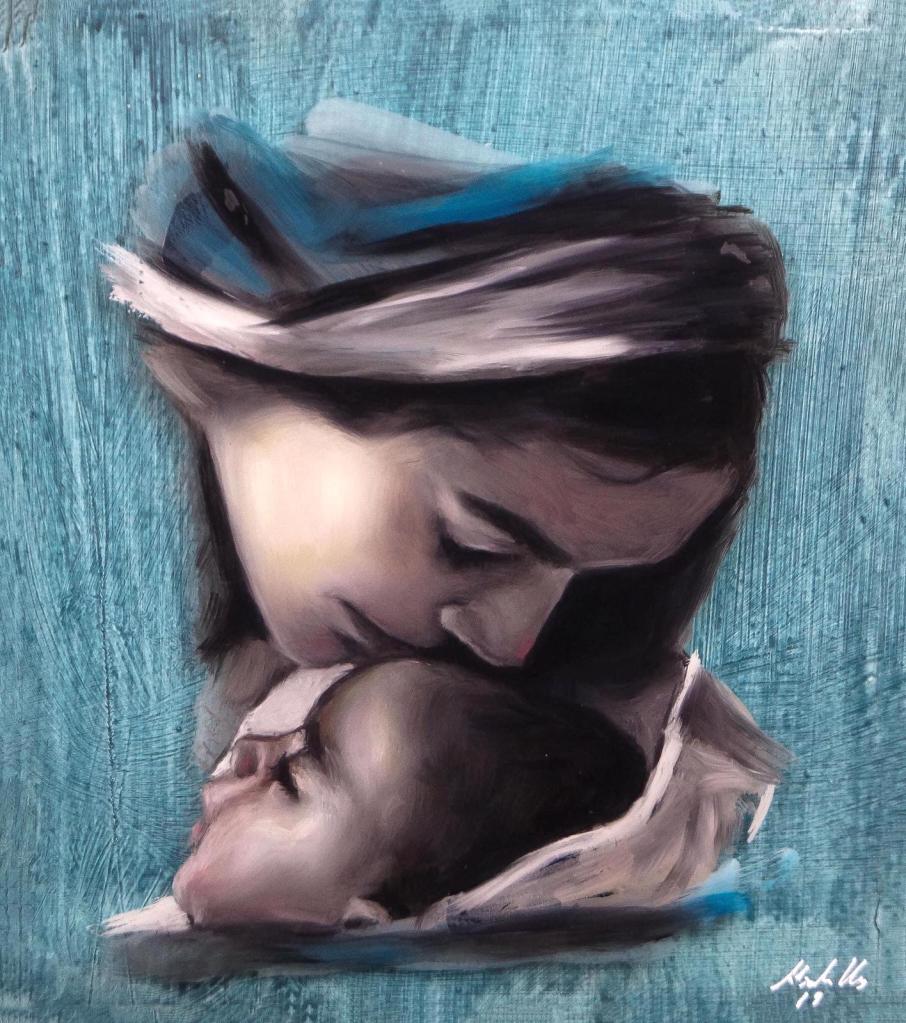
Magnificat by Micah Hayns ©

This post was written by Revd Philippa White (Precentor of Christ Church Cathedral) as part of a series for College Chapel, January 2021

For Mothering Sunday 2021

Luke 1: 39-56: The Magnificat

In a still, quiet, starlit night, a baby stirs.
He snuffles and whines and nearly cries, and his mother puts out a sleepy hand to soothe him. Very quietly, so as not to wake her husband, she starts to sing.

‘My soul magnifies the Lord, and my spirit rejoices in God my saviour; for he has looked with favour on the lowliness of his servant.’

The baby is six weeks old and his parents have taken him for the service of thanksgiving. He’s restive. His mother takes him into a corner and settles down to feed him, arranging her shawl carefully so as not to expose herself in the temple. As he sucks, she curls herself around his tiny, beloved body, and gently sings to him.

‘Surely from now on all generations will call me blessed, for the mighty one has done great things for me and holy is his name.’

He’s a toddler now. Full of energy and silliness and independence. ‘Amma, Amma, can I help? Abba, Abba, let me do it!’

But at the end of the day, with his sticky face scrubbed clean, when they settle down for bed, he listens to his Amma telling the stories of Hashem, the Holy One, calling out in fire and cloud and darkness and bringing his people out of every danger. Of Abraham and Sarah, Isaac and Rebekah, Jacob, Joseph and Moses. And then she sings him to sleep.

‘His mercy is for those who fear him, from generation to generation.’

When he’s twelve, he stays in the Temple. What else would he do, if not listen to the stories of Hashem, the promise that they are the chosen people, the treasured possession? What else would he do, if not ask the questions that bring to mind Hashem’s promises. That justice will roll down like waters and righteousness like streams; that the rich and corrupt will be swept away and those who have no power, be raised up; that light will come at last to all people. Someone had sung that to him in this temple once; his Amma had told him that. Nations will come to your light, and kings to your dawning brightness, he quotes.

When she finds him, he looks at her reproachfully. Amma, have you not realised what you’ve been teaching me since the day I was born? ‘He has shown strength with his arm; he has scattered the proud in the thoughts of their hearts;’ he sings back to her, and runs to her with a smile. In their embrace she realises for the first time that he’s nearly as tall as her. His work will soon begin.

These are her treasures when he does go. He comes back, from time to time. Sometimes he brings his friends: Peter, who hides his shyness in bluster, and Andrew, quiet and steely. James and John, whose mother she tries to like. Thomas, melancholy and utterly devoted. She welcomes them all, joins in their talk of God. He asks her to lead the prayers, sometimes.

‘He has shown strength with his arm; he has scattered the proud in the thoughts of their hearts.’

Sometimes she goes to see him. Sometimes she sits with the men, sometimes she stays with the women. Sometimes she just joins the crowd. She sees him heal. She sees him feed five thousand people. She laughs with delight when she hears him call out ‘blessed are you who are poor, for yours is the kingdom of God. Blessed are you who are hungry now, for you will be filled.’

She’s close enough for him to hear her, so she whistles her song and catches his eye, and he smiles up at her.

‘He has brought down the powerful from their thrones and lifted up the lowly. He has filled the hungry with good things and sent the rich away empty.’

And she’s there on the day he dies.
As close as she can get.
Clutching at Mary, at John, at the others as they cry.

Screaming.

Curling herself around his broken, bloody, empty body.
Dragged away at last, taken to John’s house, where she sits in the corner, hunched around herself.

And all she has to hold on to is the words she mumbles again and again:


‘He has helped his servant Israel in remembrance of his mercy, according to the promise he made to our ancestors, Abraham and his seed forever.’

You were faithful once. Why can’t you be faithful now?

Have you shut up your compassion from us? Have you utterly deserted us? Blessed are you, Lord our God, King of the Universe, whether we want to praise you or not. But make this stop.

Infinite days. Two endless nights.

At dawn on the third day John picks her up as if she weighs nothing and takes her to the room where his friends are gathering. They are kind. They are ashamed of themselves and being kind to her salves their guilt.

Until the door is flung open
and in runs Mary Magdalene
and the Light dawns.
And Mary said:


‘My soul magnifies the Lord,
   and my spirit rejoices in God my Saviour,
for he has looked with favour on the lowliness of his servant.
   Surely, from now on all generations will call me blessed;
for the Mighty One has done great things for me,
   and holy is his name.
His mercy is for those who fear him
   from generation to generation.
He has shown strength with his arm;
   he has scattered the proud in the thoughts of their hearts.
He has brought down the powerful from their thrones,
   and lifted up the lowly;
he has filled the hungry with good things,
   and sent the rich away empty.
He has helped his servant Israel,
   in remembrance of his mercy,
according to the promise he made to our ancestors,
   to Abraham and to his descendants for ever.’

Written by Revd Philippa White (Precentor of Christ Church Cathedral) as part of a series for College Chapel, January 2021


Songs of the Spirit: The Benedictus

Based on a sermon for Christ Church Chapel, February 2021

And you, child, will be called the prophet of the Most High;
    for you will go before the Lord to prepare his ways,
to give knowledge of salvation to his people
    by the forgiveness of their sins.
By the tender mercy of our God,
    the dawn from on high will break upon us,
to give light to those who sit in darkness and in the shadow of death,
    to guide our feet into the way of peace.

Luke 1. 76-79 (the full text of the Benedictus is here)

One of the best things about living at Christ Church is being able to get up early in the morning and go for a walk in the meadows before it fills up with joggers, dog walkers and people taking their daily legally sanctioned strolls. It is gloriously peaceful and if I can get up early enough to see the sun rising and I’m reminded of the promise in the Benedictus that ‘the dawn from on high will break upon us’.

The Benedictus, the Song of Zechariah, has been said or sung in early morning worship since it was introduced by Benedict of Nursia in the sixth century. It is a song of blessing (‘Benedictus’ means blessing in Latin) and hope. But it is a song that also speaks of times of hardship. It begins, ‘Blessed be the Lord the God of Israel; who has come to his people and set them free’ – we are reminded that God’s people were once enslaved, had enemies and longed to be able to worship God in freedom. 

Zechariah’s song sprung out of a time of hopelessness. The Bible tells us that he was an elderly priest who, with his wife Elizabeth, was ‘getting on in years’. They had no children. The priests would take on a week’s duty in the temple where they officiated at services: a bit like being Canon-in-Residence in our Cathedral. One day whilst in the temple Zechariah encountered an angel who promised him a son, to be called John. He was told he would have ‘joy and gladness’, that the child ‘will be great in the sight of the Lord’. (Luke 1.13)

But Zechariah didn’t believe the angel.

“How will I know that this is so?” he asked. “For I am an old man, and my wife is getting on in years.” (Luke 1.18)

From that moment he became mute, unable to speak at all. He remained silent throughout the entire pregnancy and didn’t speak until his baby was eight days old. It was only when he announced, ‘His name is John’ that his tongue was freed and he began to sing his song of blessing and hope.

One reason the Benedictus is said every morning is that in monastic times there would be a time of ‘great silence’ between Compline and Matins. Saying the Benedictus is a reminder that we, like Zachariah can break our nightly silence with praise.

Within the Benedictus there are great themes of hope and salvation.

There is hope for the salvation of the people of Israel: ‘a mighty saviour’ is on his way. There is hope for Zechariah’s son John who will prepare the way for Jesus with his father’s prophetic blessing upon him. And there is hope for all people: for each one of us.

 ‘The dawn from on high shall break upon us, to shine on those who dwell in darkness and the shadow of death, to guide our feet into the way of peace.’

Luke 1.79
Fog in Christ Church Meadows

A few days ago a dense morning fog descended on Oxford. You could hardly see a thing. Just the vague outlines of people walking in meadows. It was one of those days when you could only just make out a few steps ahead. Yet later in the day the fog lifted, clear and beautifully bright.

This seems an apt metaphor for our times. Perhaps we are deep in the fog, in the gloom, not knowing what the next steps are? Many people are struggling to keep going and to keep positive. The future seems unclear. What can we plan? When will be able to gather with our friends and family? We are still in uncertain times.

The Benedictus reminds us that we can have hope and that the dawn shall break.

The light shall shine in the darkness.

Hope is different to optimism – which is about blindly believing things will be better.

Emily Dickinson writes:

“Hope is the thing with feathers
That perches in the soul
And sings the tune without the words
And never stops at all.”

Emily Dickinson ‘

Often hope is delicate and very fragile, sometimes just a flickering candle, a clump of daffodils, a ‘thing with feathers’.

Hope is rooted in trust. Trust that God has brought God’s people out of the shadows in the past, and will do so again.  

We can trust that the fog is not the only weather: it shall lift.

The dawn from on high shall break upon us.

This is an edited extract of a sermon given by Revd Clare Hayns on February 7th 2021.


Songs of the Spirit: A New Song

A New Song

A blog for Christ Church Cathedral

Ephesians 5. 1, 18b-20

Therefore be imitators of God, as beloved children, and live in love, as Christ loved us and gave himself up for us, a fragrant offering and sacrifice to God…  be filled with the Spirit, as you sing psalms and hymns and spiritual songs among yourselves, singing and making melody to the Lord in your hearts, giving thanks to God the Father at all times and for everything in the name of our Lord Jesus Christ.

When I was a curate I used to visit a nursing home every week to take communion and lead the community in hymn singing. There was a wonderful woman called Marion, in the late stages of dementia. She had no memory. She didn’t recognise her children and no recall of recent events. Yet she had an incredible memory when it came to hymns: she was word perfect.

She knew ‘Thine be the Glory’, ‘The Lord is my Shepherd’, ‘All things Bright and Beautiful’ and ‘Great is thy Faithfulness’. All by heart.

When we sang one of those, she would stand at the front and lead the singing with great gusto.  

Singing taps into a different part of our brain than normal speech. Medics can explain this further but normal speech uses the left hemisphere of the brain and melody the right. So singing uses both sides.

You may have noticed that if you put something to a melody it becomes easier to remember. And it taps into something deep within us. Most of us will have songs that remind us of particular moments in our lives, and song that we draw on in hard times.

The Bible contains around 185 songs, and 80% of these are in the book of psalms, which is the hymn book of the Hebrew Scriptures. There are songs of lament, hope, triumph and love. There are a number of songs in scripture which are sung regularly in church, such as the Benedictus (Zachariah’s song, which we sing at Matins), The Magnificat (Mary’s song, sung at Evensong), and the Nunc Dimittus (Simeon’s song, sung at Evensong and Compline). There are also wonderful songs such as the song of Miriam and Moses, and David’s song of repentance which is psalm 51. We will look at these over the next few blog posts.

Life is difficult right now. Living through this pandemic is bleak. So much of what we love has been stripped away. One of the things I’ve missed most during this pandemic is congregational singing and I long for the time when we can gather together and raise our voices in worship.

Gathering to sing together in praise and worship has always been one of the core activities of the Judeo-Christian people. St Paul exhorts the early believers to ‘be filled with the Spirit, as you sing psalms and hymns and spiritual songs among yourselves… giving thanks to God the Father at all times’

We don’t always need to be in a group to sing. I think of St Paul singing loudly from prison in Acts.

When we sing in worship we are giving God the glory. We are putting things into perspective and remembering our place in the world. We are remembering that our current situation isn’t all there is.

When we sing we might be lifted out of our own troubles for a while, and find that God has blessed us as we worship him, and our troubles may seem a little smaller and less significant.

Ralph Waldo Emerson wrote, “Even in the mud and scum of things, something always, always sings.”

John Wesley, the founder of Methodism, who preached in our own Cathedral, left some wonderful ‘Directions for Singing’ which involved learning the words and singing ‘lustily’. At the end of them he adds: “above all, sing spiritually. Have an eye to God in every word you sing.”[1]

I love that. Sing spiritually, having an eye to God in every word.

There’s one carol that spoke to me this last Christmas. It’s ‘O Holy Night’ and the phrase that struck me particularly is “A thrill of hope. The weary world rejoices.”

We will sing because we have hope. Even though we are weary, even though we are apart, we can sing and our voices join together, with the voices of the angels, with the first Christians, with Wesley. Singing unites us across the divides of time and space.

And as we sing, out loud or in our hearts, tunefully or not, let us giving thanks to God the Father at all times and for everything in the name of our Lord Jesus Christ.

This blogpost is an edited version of a sermon given by Revd Clare Hayns in January 2021.


[1] http://meaningfulworship.blogspot.com/2018/10/wesleys-directions-for-singing.html

Leavers’ Address – June 2020

An address given to the student leavers of Christ Church, Oxford
June 17th 2020 (via video)

Philippians 1: 1-11
14th June 2020

We come to the end of this strangest of terms to a Leavers service without leavers in a cathedral without a congregation. One of my favourite books in the bible is St Paul’s letter to the Philippians. Paul is in prison and he’s writing a thank you letter to his community in Philippi, a community he’s bereft to be separated from. And so as I pondered what to say in this final address of term I thought I would write you a thank you letter in the style and manner of St Paul, using some of the text from his letter to Philippi.


Clare, servant of Christ Church and Christ Jesus,

To all the saints scattered around the country and world, together with the fellowship of Chapter and the wider community of Christ Church.

Grace and peace to you from God our Father and the Lord Jesus Christ.

I thank my God every time I remember you. I really do.

We are separated, not by chains or imprisonment, but by nature of disease, and this means we cannot be together as we wish. How I long to be able to gather together again in this holy place for Evensong, Compline and Taize. How I long to be able to dine together in Hall, host another Brain Strain tea, and even to stand outside the JCR at midnight watching Bop come to a messy end with Angels once again.

I thank God for you.

For your perseverance and endurance under immense pressure;
For the ways you have shown love, compassion and support to one another,
For how you’ve endured hardship, especially during this time of the Pandemic.

From the first day I met you in your first Michaelmas Term, until now, being confident of this, that God who began a good work in you will carry it on to completion until the day of Christ.

Now I want you to know, my sisters and brothers, that false teachers will tell you lies about yourself, and they are sometimes so loud and pervasive they are hard to ignore.

Three of these are:

I am what I do
I am what others say about me
I am what I have

‘I am what I do’ – of course my hope is that each of you will go from here into fruitful and satisfying careers where you will take all you have learned over the years here and use it for good in our world, a world that needs innovative, creative and brilliant minds like yours. I hope that you will find where you are needed, and what it is you love, and that you will do it with all the passion and skill you can. But there may be times when what you do isn’t what you hoped or longed for.
Remember: you are not what you do.

‘I am what people say about me’ – we all love it when people say good things about us, when our friends are numerous and our social media profiles are getting positive feedback. It makes us feel good, and rightly so. But how many of us remember for far longer the hurtful comments, the essay that was slammed, the criticism from someone we thought a friend. 
Remember: you are not just what other people say about you.

‘I am what I have’ – all of us have been enormously privileged to spent time in a beautiful place like Christ Church. You have the gift of an Oxford education, friendships, experiences and memories of your time here. I hope some of these will all remain with you throughout your life. But we also feel the loss of all that we didn’t have this term: dinners, the Ball, physical farewells. St Paul says he’s learned the secret of contentment whatever the circumstances. This isn’t easy but at the heart is the knowledge that what we have isn’t who we are.
Remember: you are not just what you have.

So, if we are more than what we do, what others say about us, and what we have, what is it that we are?

Just before Jesus began his ministry, just as he was stepping out into the wilderness, he was baptised, and at his baptism he heard these words coming from above:

You are my child, the beloved, with you I am well pleased

Mark 1.11

And these words are words I would like you to hear as well.

You are beloved. This is regardless of whether you consider yourself a Christian or not, whether you have worshipped regularly in this space during your time here, or whether you consider yourself to be not worthy of God’s love.  

You are beloved. You are beloved.

And once we know we are beloved then what we do, what people say about us, and what we have, becomes less important and has less hold over us.

The future is uncertain, particularly at this time in our history, and this can lead us to be fearful.

St Paul says:

Do not be anxious about anything but in everything, by prayer and petition, with thanksgiving, present your requests to God. And the peace of God which transcends all understanding will guard your hearts and minds in Christ

Philippians 4.6

So not be anxious. Do not be afraid. God is with you.

I thank God for the many gifts you have given to me over the years you’ve been here.  Gifts of laughter, joy and challenge. I have learned so much from you. Thank you.

Remember, you are more than what you do, more than what others say about you, more than what you have.

You are beloved.

To our God and Father be glory for ever and ever. Amen

Newsflash: Book Coming Soon…

We have some exciting news to share. As a result of all your encouragement and positive feedback for our Lent Blog, Micah and I put together a proposal to turn the blog into a book… and we can now announce that we have a publisher!

We are delighted that BRF (Bible Reading Fellowship) have commissioned this and we are now working hard to create a stylish book on 40 women from the Old Testament, all illustrated by Micah Hayns.

The working title is Unveiled: Women of the Old Testament and the Choices They Made.

The plan is to be completed by October 2021 – we’ll keep you posted!

Clare and Micah

Gloria by Micah Hayns

And finally…

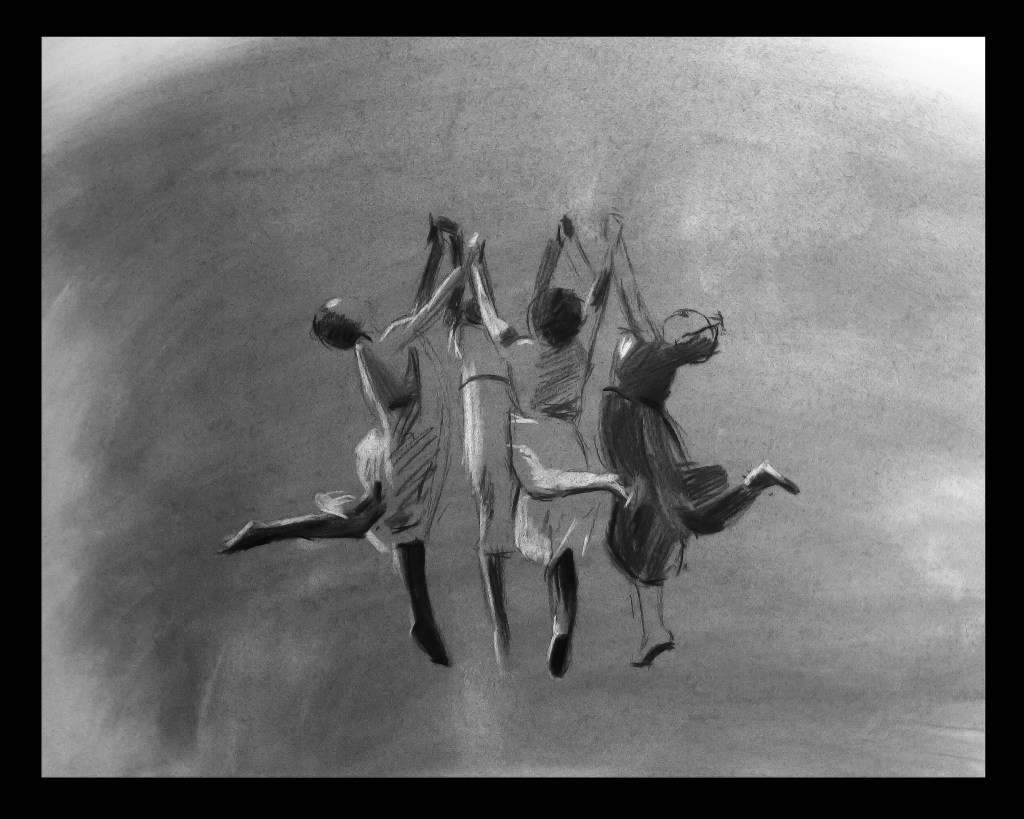
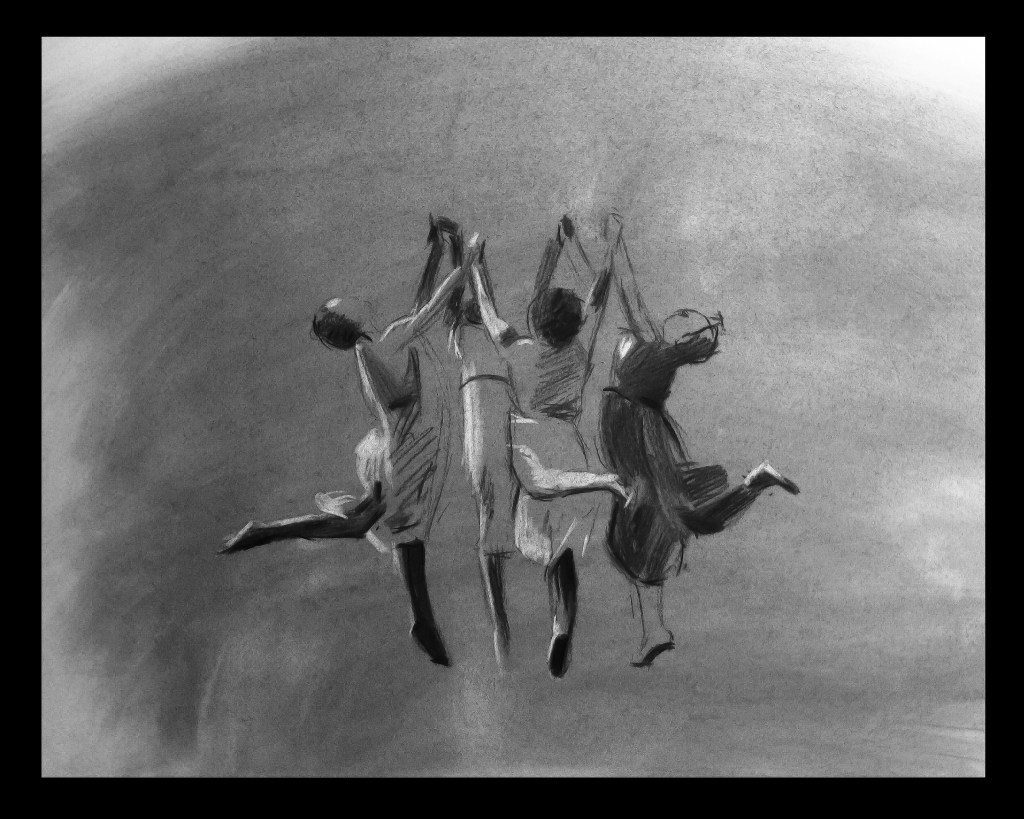
Gloria, by Micah Hayns (from the post on Miriam)

Alleluia, Christ is Risen!

Jesus said to [Mary Magdalene], “Woman, why are you weeping? Whom are you looking for?” Supposing him to be the gardener, she said to him, “Sir, if you have carried him away, tell me where you have laid him, and I will take him away.” Jesus said to her, “Mary!” She turned and said to him in Hebrew,“Rabbouni!” (which means Teacher)...’Mary Magdalene went and announced to the disciples, “I have seen the Lord”'
John 20: 15-16,18

It seems fitting to end this Lent series on Easter day remembering Mary Magdalene, the very first disciple to see the risen Jesus, and the very first to proclaim the resurrection.

As this is my final post I want to thank you for joining with me this Lent, and for all your encouragement along the way. The journey began back in February with Hagar who was pushed out into the wilderness. And goodness, what a journey this has been! None of us knew back then that the whole world would also be propelled into a strange kind of wilderness. It has felt for me that these women of old have been alongside us through these strange times, and they have taught us important truths along the way.

They have reminded us of the gifts and challenges of family life (Rachel and Leah, Rebekah), of the importance of friendships (Naomi and Ruth), of not being afraid to stand up for what is right (Shiprah and Puah, the daughters of Zelophehad), of peace making (Abigail, Esther), and of the value of a deep faith (Naaman’s servant, The widow with the oil). There have been some who were hard to like (Athaliah, Jael), and some whose stories were so painful they were hard to face (Rahab, Dinah).

And Miss Lent 2020 goes to…*

I wonder if you would like to share in the comments section which of the women you most enjoyed, either because you related to them, or because they interested or surprised you in some way. I’m sure others would enjoy reading your responses; I know I would. It’s hard for me to pick an all-round favourite as I’ve loved them all, but I think I would go with Miriam. The image of her leading the women in dancing in the wilderness really spoke to me this lent.

I would like to thank the six ‘guest bloggers’ (Megan, Milly, Emma, Alannah, Matilda and Philippa) for their thoughtful responses and for the time they put into doing this. I’d also like to thank Micah for being willing to create so many of the beautiful images, and for putting up with my demands (and one point he even declared ‘Mum, I’m not a machine!’). And whilst I’m doing an Oscars-style list I’d better even thank my husband John for his proof-reading and one-liners. He’s very much enjoyed that he gained a small fan base!!

I’m going to take a break for a while but my plan is to do something similar for Lent next year, perhaps with women from the New Testament and the early Church.

Prayer

When Hagar was in the wilderness she was met by an angel who told her that she was seen and heard by God. Centuries later Mary Magdalene was seen by the risen Jesus in the garden. I pray this Easter that you too would know what it is to be seen and heard by God, and that you too would experience the light, love and life of the risen Christ.

O Lord God, our Father. You are the light that can never be put out; and now you give us a light that shall drive away all darkness. You are love without coldness, and you have given us such warmth in our hearts that we can love all when we meet. You are the life that defies death and you have opened for us the way that leads to eternal life. None of us is a great Christian; we are all humble and ordinary. But your grace is enough of us. Arouse in us that small degree of joy and thankfulness of which we are capable, to the timid faith which we can muster, to the cautious obedience which we cannot refuse, and thus to the wholeness of life which you have prepared for all of us through the death and resurrection of your Son. Do not allow any of us to remain apathetic or indifferent to the wondrous glory of Easter, but let the light of our risen Lord reach every corner of our dull hearts. Amen
(Karl Barth, 1886-1968)

*This was of course from John!

The Shunammite Woman: a rising hope

The Shunammite Woman ©MicahHayns

2 Kings 4

We come to our final woman of the Lent 2020 series on this Good Friday and you will see why I have chosen to remember her on this day when we remember Jesus’ death on the cross.

We are now very used to our women being unnamed, but usually these are poor or seemingly unimportant. Our final woman was ‘well to do’ and actually rather wealthy, and she was a friend to the prophet Elisha, but for some reason none of the household are named.

The woman lived in a spacious house with her husband in the town of Shunem (where Abishag came from). She was a keen host and enjoyed providing food for the elderly prophet Elisha and his servant Gehazi whenever they passed through the town:

So whenever he passed that way, he would stop there for a meal.

2 Kings 4.8

After a while she decided it would be sensible if Elisha stayed overnight rather than having to travel to his home after dinner. She was clearly a woman with an eye for detail and she prepares a room for him at the top of the house:

Let us make a small roof chamber with walls, and put there for him a bed, a table, a chair, and a lamp, so that he can stay there whenever he comes to us.

2 Kings 4.10

Elisha and Gehazi want to thank her for her hospitality and so have a conversation about what they might offer her. She declines saying she has all she needs, “I have a home among my own people”

For her, that is blessing enough.

The men decide that as she is childless and ‘her husband is old’ then she can’t really be satisfied until she has a son. They tell her that by next year she would be pregnant, and she is.

The child grew and one day whilst out with his father in the fields he becomes seriously ill:

He said to his father, “My head! My head!” His father told a servant, “Carry him to his mother.” After the servant had lifted him up and carried him to his mother, the boy sat on her lap until noon, and then he died.

2 Kings 4. 19

What a tragedy for her. The woman acts quickly. She takes the child upstairs to Elisha’s room, shuts the door and then prepares the donkey to go travel to see the prophet, who is at Mount Carmel, a day’s journey away. Elisha spots her and sends Gehazi to meet her to find out what’s wrong, ‘Are you all right? Is your husband all right? Is the child all right?’.

She doesn’t want to speak to Gehazi, but to Elisha and, although the servant tries to keep her away, she pushes forward. Her reaction seems to be anger:

Did I ask you for a son my Lord? Didn’t I tell you, ‘Don’t raise my hopes?” 

2 Kings 4.28

Perhaps she felt she was worse off now than she was before she had a child. Alfred Lord Tennyson said ’Tis better to have loved and lost than never to have loved at all’, but in these early moments of grief it didn’t feel like it to her.

Elisha and Gehazi go with the woman to her home and Elisha went upstairs to see the dead boy. He prayed to the Lord. 

Then he got on the bed and lay on the boy, mouth to mouth, eyes to eyes, hands to hands. As he stretched himself out on him, the boy’s body grew warm. 

2 Kings 4.34

The boy returned to life and was given back to his mother, who fell to the ground in worship and thankfulness.

Reflection

It was now about noon, and darkness came over the whole land until three in the afternoon, for the sun stopped shining. And the curtain of the temple was torn in two. Jesus called out with a loud voice, 
“Father, into your hands I commit my spirit.” 
When he had said this, he breathed his last.
Luke 23.44-46
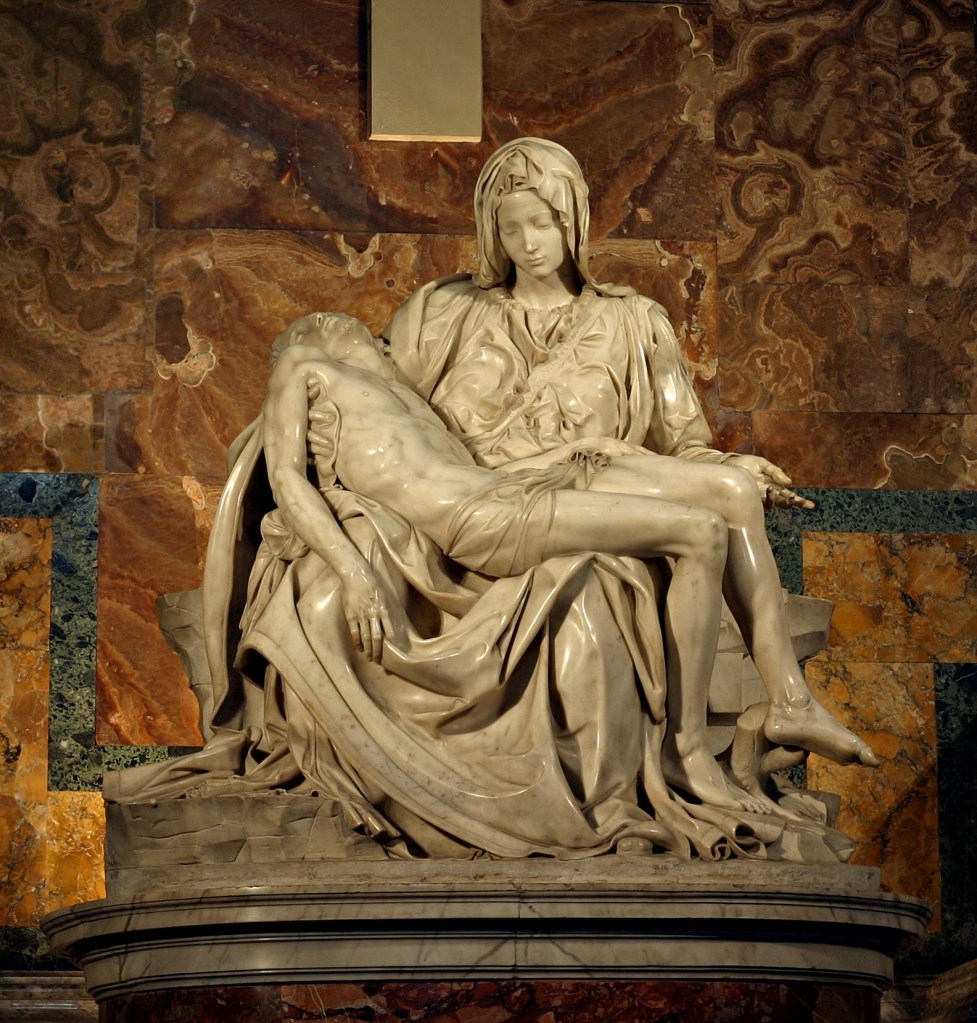
Pieta made by Michelangelo in St Peter’s Basilica in Rome

Today is Good Friday and we remember Jesus’ final hours where he was beaten, humiliated and crucified. In his death, Jesus took onto himself all the pain, suffering and sin that is in the world. We also remember Jesus’ mother Mary, who was with him until his final breath, and who held his dead, lifeless body in her arms, just as the Women of Shunem had done many years before.

Before we get to the joy of the resurrection on Easter, perhaps we could spend a bit of time today reflecting on the grief that is around us. I don’t know about you but I find it hard to stay with the pain of Good Friday and my natural inclination is to move towards the joy and hope that is to come.

But let’s stay here for a while, and let us remember all those who are grieving today. Those who’s loved ones have died, those who have been unable to hold dying relatives in their arms in their final hours, mothers who have had to witness the death of their children, all those known to us who are suffering, and who might also be wondering if the love they had was worth the pain of the grief.

Let us place all our prayers at the foot of the cross, in the hope of the resurrection and new life.

Prayer

Eternal God,
in the cross of Jesus
we see the cost of sin
and the depth of your love:
in humble hope and fear
may we place at his feet
all that we have and all that we are,
through Jesus Christ our Lord.

A Collect for Good Friday from Church of England Common Worship

The Widow and Elisha: Oil’s Well that Ends Well*

2 Kings 4.1-7

For the last two days of our Lenten journey we go back to the time of the Kings and to just before we met Naaman’s servant girl. We will reflect on two women who reach out to God through the prophet Elisha, and both of their stories are told within the same chapter of 2 Kings.

Our first woman is only known as ‘the widow with the oil’ and her husband, who had been part of a group of prophets, had recently died. She was left with the household and children to care for; she was also left with his debts. It wasn’t long before one of the creditors came for their money and, as the widow had none, demanded that the woman give him the only thing she had left: her two sons, to work for him as slaves. Alongside the tragedy of losing her sons this would also mean she would have had no hope for economic survival.

The women reached out in desperation to the prophet Elisha. He asks her what she has already:

‘Tell me, what do you have in your house’

2 Kings 4.2

She tells him that she has nothing at all, ‘except a little oil’.

Elisha tells the woman to go to her neighbours for help. She wasn’t to ask for food or money which might have been one solution. She is to ask them for empty jars. Not a few empty jars, but loads of them.

She does what is requested, gathering as many jars as she can.

‘Go inside and shut the door behind you and you sons. Pour oil into all the jars, and as each is filled, put it to one side’

2 Kings 4.4

She takes the little oil she has and, with the help of her children, she pours it into the jars: the oil flows until every single jar is full. There is abundant oil, enough to sell to pay off her debts, and to live off the remainder.

Reflection

You have loved righteousness and hated wickedness; 
therefore God, your God, has anointed you with the oil of gladness
Hebrews 1.9 

Oil was a precious commodity in those days. It was necessary for the provision of food, but it has also been used for centuries in Judeo/Christian worship to symbolise holiness and the presence of the Holy Spirit.

Moses spoke of oil mixed with spices and burned as incense ‘as a memorial on the altar, an offering made by fire, a sweet aroma to the LORD’ (Leviticus 2.2). Oil was used to make a particular place holy, and it is still used in Christian worship at baptism and at the ordination of priests.

Today is Maundy Thursday and traditionally all the clergy gather at cathedrals for a special service that includes a ‘blessing of oils’. During the service clergy remember their vows and receive oils to use in services throughout the year. This year the services will be live streamed, and we will have to remember that the Holy Spirit is not confined to bottle or to a building!

It is easy to focus on all the things we don’t have at the moment: we miss our families and friends; some of us will miss going to a Maundy Thursday service with the washing of the feet and the stripping of the altar; those on their own might yearn for physical contact; and many of us are struggling financially. Perhaps we feel exhausted and depleted like those empty jars.

Elisha encouraged the widow to look inwards to see what she already had. She had a little oil and that could be used. What do we have right here and now? There will be something to be thankful for. And perhaps we could pray for the Holy Spirit to be present with us, that we would be filled, like those empty jars, to overflowing, and that we would know God’s abundant blessing.

Prayer

This prayer is often sung during confirmation and ordination services – you can listen to a version here whilst you pray

Come, Holy Ghost, our souls inspire
and lighten with celestial fire;
thou the anointing Spirit art,
who dost thy sevenfold gifts impart.

Thy blessed unction from above
is comfort, life, and fire of love;
enable with perpetual light
the dullness of our mortal sight.

* I was asked yesterday for more of my husband’s one-liners, so he was given free rein with the subtitle today!

Shallum’s Daughters: wall builders

Shallum’s Daughters ©MicahHayns

Nehemiah 3.12

We are nearing the end of our series of women from the Hebrew bible and today’s women come at the chronological conclusion of the forty posts as the final posts will be going backwards in time to reflect on women who might be able to help us connect with the Easter story.

Today’s women share only one single verse in the bible and seem rather inconsequential compared with the women we’ve been reflecting on recently; yet they were part of something far bigger and therefore deserve a day to themselves.

Shallum son of Hallohesh, ruler of a half-district of Jerusalem, repaired the next section [of the wall] with the help of his daughters.

Nehemiah 3.12

When the Babylonians invaded Judah in c.587BCE (2 Chronicles 36.15-21), they destroyed the city of Jerusalem, including the Temple (built by Solomon) and the city walls. At this point in our story, the Jewish people had been in exile for around 70 years.

The Jews were allowed to return home to Jerusalem by King Cyrus and they were given permission to rebuild the temple (Ezra) and restore their damaged homes. The people were vulnerable to attack as the city walls were damaged and so God called Nehemiah to oversee the restoration. The book of Nehemiah is essentially a historical account of the rebuilding of the city walls:

Rebuilding the Wall of Jerusalem under Nehemiah by William Brassey Hole (1846-1917)

Jerusalem lies in ruins, and its gates have been burned with fire. Come let us rebuild the wall.  

Nehemiah 2.17

And within the book there is an entire chapter (3) which consists of a long list of names of all those who rebuilt a section of the wall. It’s not the most riveting part of scripture I have to say, but it shows that each and every person named was important and had a role to play:

And so it continues…

The men of Jericho built the adjoining section, and Zakkur son of Imri built next to them. The Fish Gate was rebuilt by the sons of Hassenaah. They laid its beams and put its doors and bolts and bars in place. 

Nehemiah 3.2

The daughters of Shallum are the only women named in the rebuilding work. I find it intriguing to wonder what their role was. How exactly did they help their father? Perhaps they financed the work, or brought food and drink to the labourers? Or did they do actual hard labour, carrying stones, placing beams, hoisting doors and shovelling rubble?

Whatever their exact role involved, they were part of the working party who finished the wall in only 52 days, enabling the Jewish families to return home (chapter 7) to live and worship in safety.

Reflection and Prayer

Jesus answered them, “Destroy this temple, and I will raise it again in three days.”They replied, “It has taken forty-six years to build this temple, and you are going to raise it in three days?” 
But the temple he had spoken of was his body. 
John 2.19-20

The daughters of Shallum helped to build the walls in Jerusalem that were still standing during Jesus’ final journey into Jerusalem. He may even have ridden through the gate they built when he arrived on the colt. Or perhaps he passed their section of the wall when he was being dragged towards the cross on his final journey.

I thought it was important to include them in this blog because it’s good to remember those who just get on with the task in hand, without fuss and ceremony, and often without being given any accolades for what they do.

During this curious time of Covid-19 it can feel that our world is crumbling around us and structures that we thought of as strong and solid turn out to be weaker that we ever imagined. When things are crumbling we can really appreciate the multitude of people performing every day tasks that keep us secure and enable us to function. Let us pray for hospital porters, cleaners, catering staff, nursing assistants and all those who keep our nursing homes and hospices running smoothy.

And let us remember that Jesus’ body (which he compared to the temple), although utterly broken and destroyed, was indeed raised in three days. And like the daughters of Shallum each one of us is called to play our own little part in the rebuilding work of God’s kingdom, a kingdom that can never be destroyed and will last forever.

Behold our lives, our faculties, our wills: we have given them all to You. We are Yours; dispose of us according to your will. We see well enough, O Lord, how little we can do. But now having drawn near to You, having ascended this watchtower from which Your truth can be seen,
and while You depart not from us, we can do all things. Amen
(A prayer of Teresa of Avila)