Ruth: faithful friendship

The Book of Ruth

As a young Christian I was transfixed by the story of Jackie Pullinger. In 1966, when she was in her early twenties, she was called by God to leave her home and family in London and she set off on a boat with a one way ticket to Hong Kong without any idea of what she would do when she got there. She then lived and worked in the infamous Kowloon walled city amongst drug users and triad gangs and developed a ministry which continues to this day. She was one of the first female role models I can remember, and what attracted me was her bravery and willingness to go where she believed God was calling her, even though that came with huge risks to her own life. In her book, ‘Chasing the Dragon’ she writes:

‘God wants us to have soft hearts and hard feet. The trouble with so many of us is that we have hard hearts and soft feet.’

I think we can be sure that Ruth had both a soft heart and hard feet. She was a non-Jewish women from Moab whose Jewish husband had died leaving her with a bitterly grieving mother-in-law, Naomi and a sister-in-law, Orpah, whose husband had also died. When her mother-in-law chose to return to her homeland, Ruth made the brave decision to move away from all she knew to go with her. She was determined and in deciding to bind herself to Naomi she also made a commitment to Naomi’s community, and to God. Her prayer of conversion is beautiful:

‘Where you go, I will go; where you lodge, I will lodge; your people shall be my people, and your God my God. Where you die, I will die – there will I be buried.

Ruth 1.16-17

What a powerful declaration of loving commitment from one person to another.

Ruth and Naomi’s journey from Moab to Bethlehem

Ruth chose to accompany Naomi and was willing to step out into the unknown, into a life that was unpredictable and precarious, to go to a foreign land where she would be vulnerable and unprotected. Her motivations for doing this are unclear. Did she stay with Naomi because of her deep love and affection for this older and in many ways bitter woman? Or did Ruth have a sense of God’s call on her life that meant that she knew deep down in her soul that she should leave Moab.

Whatever her reason, Ruth’s brave decision led her to Bethlehem where, whilst in the fields gathering food, she meets Boaz, a distant relative of Naomi’s. Boaz protects her from harm and Naomi encourages their blossoming romance and even gives her a few tips as to how to secure his affection: ‘Now wash and anoint yourself, and put on your best clothes and go down to the threshing floor’ (Ruth 3.3). Ruth and Boaz eventually marry, her future is secured, and they have a child, Obed, who will one day be the Grandfather of King David.

Ruth becomes one of the small number of  women, alongside Tamar, Rahab and Bathsheba to be named in the genealogy of Jesus.

Reflection

Not many people are called by God to leave everything they’ve ever known in the way Jackie Pullinger or Ruth were, but we may be able to identify a time when we have been asked to take a step of faith. When I first felt God was calling me to be a priest, knew that this would mean we would have to leave our comfortable home in an Oxfordshire village, a decision that was harder to make because we had three young boys at the time. It’s tempting at times to wonder what might have been if we had taken other paths in life, but Jesus’ call to his disciples is always to follow, to look forward, to put the hand to the plough and not look back. (Luke 9.62).

Loving God,
We thank you for the joy and comfort of friendships:
For those who have been there for us through the ups and downs of life;
For those who have walked beside us even when we’ve not been great company;
For those who have given us advice and guidance;
and for those friends who are no longer with us and who we long to meet again.
Amen
Rahab: harlot, heroine or both?

Joshua 2, 6

Depending on the version in the Bible you read, our next woman is described as either a harlot or a  prostitute (although some Rabbinic texts describe her as an Innkeeper). Yet despite her likely profession, and even though she wasn’t an Israelite, she is one of the few women named in the genealogy of Jesus at the beginning of Matthew’s Gospel.

Abraham was the father of Isaac….and Salmon the father of Boaz by Rahab, …and Jesse the father of King David…and Jacob the father of Joseph the husband of Mary, of whom Jesus was born, who is called the Messiah

Matthew 1

So, who was she?

Some background. Moses had died and his assistant Joshua had taken over the leadership of the Israelites, who were still in exile in the wilderness. God had promised them that they would be led into the Promised Land and they had camped in the Jordan valley opposite the City of Jericho in hope that this was indeed the land they had waited for for so long. But first they needed to check out the city and so Joshua sent some spies on a reconnaissance mission.

Rahab was a citizen of Jericho and she lived literally on the edges of the City:

..her house was on the outer side of the city wall and she resided within the wall itself.

Joshua 2.15

Joshua’s spies went to stay at Rahab’s house ‘and spent the night there’. We don’t hear whether they were doing so because she had an Inn or because of her other profession… we can only imagine! The King of Jericho found out about them and ordered that they be brought to him. Rahab was cunning though. She had heard about their God and also realised these men might be useful to her and her family. And so she hid them in her room, lied to the King’s men by sending them in the wrong direction, and then hatched a plan.

Before the men are allowed to sleep, Rahab went up to the roof to  speak to them:

I know that the Lord has given you the land…. we have heard how the Lord dried up the water of the Red Sea… The Lord your God is indeed God in heaven above and earth below.

Joshua 2.8
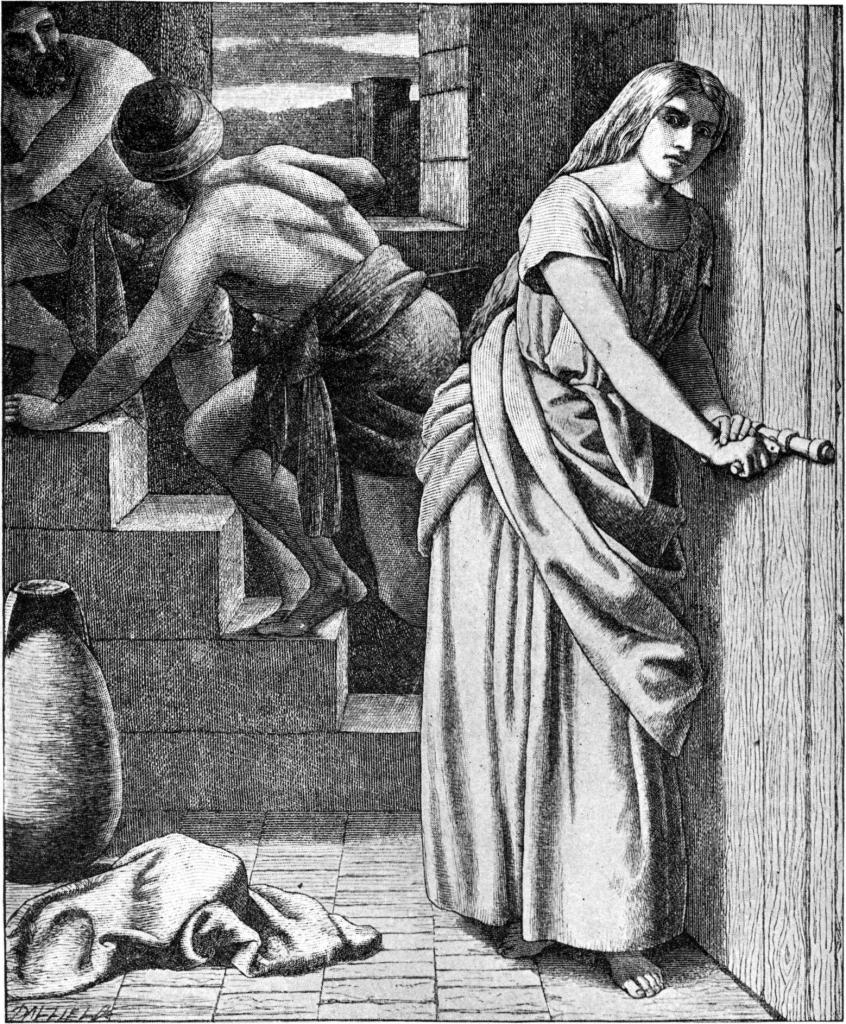
Rahab Helping the Two Israelite Spies., Frederick Richard Pickersgill, illustrator of the 1897 Bible Pictures and What They Teach Us by Charles Foster

She defied the orders of the King (rather like Shiprah and Puah, the midwives), and made a pact with the spies. She would help them escape and in return they were to ensure that all her family would be unharmed when they eventually come to take the land. The Israelites would know them because of the red cords tied on their windows. The pact is made and the spies escape.

A little while later the City of Jericho was surrounded by the Israelites who marched round the city walls for seven days blowing their trumpets and processing the Arc of the Covenant.  They eventually took the city killing all those who lived there, but Rahab and all her family were spared and they become incorporated into the Jewish people.

This blog is not the place to defend or attack the actions of the ancient people of Israel in the time of Joshua, though it’s hard imagine that the God of love and justice ever commanded the destruction of a city and its people.

Instead, let us focus on this remarkable woman who comes to be named in the New Testament as a hero of faith (Hebrews 11) and as an example of faith in action (Book of James ). She used her position, her (perhaps intimate) knowledge of people both within and outside of her culture, her home, persuasive powers, charm and wily intellect, to protect the Israelite spies and to secure the lives of her entire family, a family that would in time include Jesus of Nazareth. It is an impressive feat.

Rahab: harlot or heroine? Perhaps she was both.

Reflection and Prayer

Which of the two did the will of his father?” They said, “The first.” Jesus said to them, “Truly I tell you, the tax collectors and the prostitutes are going into the kingdom of God ahead of you.
Matthew 21.31 (from the parable of the two sons in the vineyard)

Jesus was criticised by the religious leaders for spending time with those they considered to be ‘sinners’ and ‘unclean’, the prostitutes, tax collectors and lepers. Yet they were often the first to recognise that He was the Saviour, the one who would bring healing and wholeness. Rahab’s story reminds us that we too often make judgements about people because of their lifestyle, profession or values. She also reminds us that God often chooses the most unlikely people to bring about His purposes, even women like Rabah, and you and me!

Many of us are fearful for families and friends at this time of Covid 19. Let us pray for God’s protection, especially for those who are sick, and those who care for them. Perhaps we might think about what we can do to support someone who is fearful.

Father, give to us, and to all your people,
in times of anxiety, serenity;
in times of hardship, courage;
in times of uncertainty, patience;
and at all times, a quiet trust in your wisdom, protection and love; through Jesus Christ our Lord. Amen
A Prayer from New Every Morning

The Daughters of Zelophehad: girl power

Daughters of Zelophehad ©MicahHayns

Numbers 27

One of our family treats is going to see musical theatre, and we recently enjoyed seeing Trevor Nunn’s production of Fiddler on the Roof at the Playhouse Theatre in London. It was wonderful. The story, for those who don’t know it, revolves around Jewish patriarch Tevye and his five daughters, all who need husbands and dowries, which Tevye, as much as he pleads to God (remember ‘if I were a rich man’), can’t afford.

One man, five daughters, no sons. This is a rather similar situation for Zelophehad, who who lived at time when the Israelites were in exile, wandering in the wilderness with Moses as their leader.

Now Zelophehad son of Hepher had no sons, but daughters: and the name of the daughters of Zelophehad were Mahlan, Noah, Hoglah, Milcah, and Tirzah

Numbers 26.13

Five women that you’re unlikely to have ever heard of but whose chutzpah transformed the lives of women down the centuries.

Zelophehad was the son of Hepher, son of Gilead, son of Machir, son of Manasseh, son of Joseph (another great musical!), son of Jacob, son of Isaac, son of Abraham.

Sons. It was a classic patriarchal society and every father needed a son in  order to ensure the family line continued, and land was apportioned accordingly as inheritance. Now Zelophehad had died and the tradition was that if a man had no sons then his land and possessions would be inherited by his brother, and his family name would be lost.

But these women had another idea.

The daughters of Zelophehad came forward 

Numbers 27.1

They decided that this wasn’t good enough and so, as a group, they ‘came forward’ to argue their case before Moses, Eleazar the Priest and the other elders. Their argument was forthright, concise, personal, persuasive and ends with their plea:

why should the name of our father be taken away from his clan because he had no son? Give to us a possession among our father’s brothers.

Numbers 27.4
The Daughters of Zelophehad, illustration from The Bible and Its Story Taught by One Thousand Picture Lessons. Edited by Charles F. Horne and Julius A. Bewer. 1908.

And Moses prays about it. And the Lord speaks to Moses.

The daughters of Zelophehad are right in what they are saying; you shall indeed let them possess an inheritance.

Numbers 27.4

The daughters are right. Wow. The inheritance laws are duly changed and from then on daughters could inherit if there were no sons – provided they don’t marry someone outside of their fathers’ clan.

Reflection

We cannot underestimate the importance of the actions of these brave women in changing the lives of so many others down the generations.

Gender inequality in inheritance law and land ownership rights is still a current issue and One of the Sustainable Development Goals (SDG’s) of the United Nations is Achieve Gender Equality and Empower Women and Girls and a sub-category of this is Realising Women’s Right to Land in the Law. The report makes interesting reading on why land rights for women is still vitally important: http://www.fao.org/3/I8785EN/i8785en.pd

It’s never easy to ‘come forward’ to tackle injustice and to speak up for something you believe in. Sometimes it’s easier to do this in a group that on our own isn’t it? The sisters might not have had the courage to speak to Moses on their own, and it’s unlikely they would have had a hearing. Let’s give thanks for women’s groups and support networks which have been so important over the centuries for standing up for justice for women and children. I’m involved in a wonderful clergy women’s support group, and frankly couldn’t do without it.

The Women’s Institute Prayer

The Women’s Institute Prayer. The Women’s Institute (WI) was formed in 1915 to revitalise rural communities and encourage women to become more involved in producing food during the First World War. Since then the organisation’s aims have broadened and the WI is now the largest voluntary women’s organisation in the UK. The WI celebrated its centenary in 2015 and currently has almost 220,000 members in approximately 6,300 WIs

Miriam: The Joyful Prophet

Exodus 2.4-6, Exodus 15.20-21, Numbers 12.1, Micah 6.4, Numbers 20:1

This blog series all began because of Miriam.

I was in a shop getting some pictures framed whilst wearing my clerical collar and the man at the desk said: ‘you’ll know the answer to this as you’re a Vicar’.

Church leaders may know the feeling of dread at that statement!

'So, Miriam from the Bible, who was she then?' 

I floundered. I knew she was in the Old Testament and had something to do with Moses. Nothing else. Another customer came in so I took the time to hide behind the frames to google her! I came away determined I’d find out more about Miriam, and also all the other wonderful women of scripture: hence this blog.

So, who was Miriam? She was Moses and Aaron’s sister, the daughter of Amran (one of the Israelite leaders) and Jochebed. That was the simple answer I gave the framer. But there is so much more to her. She was also the first women to be described as a prophetess, a leader of women, a musician and the very first worship leader mentioned in scripture!

Jocheved, Miriam, and Moses, an illustration from the 1897 Bible Pictures and What They Teach Us: Containing 400 Illustrations from the Old and New Testaments, by Charles Foster

We first hear of her when Moses is a baby in the bulrushes having been hidden by his mother to protect him from Pharaoh’s wicked plans to kill the male children. Jochebed (another fabulous woman) placed Moses in the river and Miriam stands at a distance to keep watch. When Pharaoh’s daughter comes and scoops Moses out of the river Miriam steps forward and suggests an ingenious plan.

Shall I go and get you a nurse from the Hebrew women to nurse the child for you?

Exodus 2.7

Miriam suggests Moses’ mother, who is then paid a wage to look after her own son!

Miriam’s Song, by John Edward Poynter (The Bible and Its Story, 1910)

We next hear of Miriam after Pharoah’s army has been defeated and the Israelites escape from Egypt across the red sea into the wilderness. She leads the defiant ‘song of the sea’, a song of triumph which is still recited in jewish daily prayers to this day.

[Miriam] took a tambourine in her hand; and all the women went out after her with tambourines and with dancing:

“Sing to the Lord, for he has triumphed gloriously; horse and rider he has thrown into the sea.”

Exodus 15.20-21

I love the fact that when Miriam and the women fled Egypt, when they didn’t even have time to wait for the bread to rise, they took with them their musical instruments. It’s as if they knew there would be a time to celebrate again one day, and they wanted to make sure they were ready.

It is likely that she was one of the community leaders whilst the Israelites were in exile, and we hear that she wasn’t afraid to confront Moses when she disapproved of a relationship of his (Numbers 12.1). Her forthright nature leads to her being accused of being jealous of Moses and she contracts leprosy (which was understood as a punishment) and is ostracised for a week.

She died at a time of drought in the wilderness of Zin and she was remembered many years later by the prophets as having been one of the three (with Moses and Aaron) who were sent by God to deliver his people from slavery (see Micah 6.4).

So, who was Miriam? A courageous sister, a leader of women, a musician, a worship leader, a dancer, and so much more!

Reflection and Prayer

There is a fantastically catchy song by Debbie Friedman which is sung at Jewish children’s camps in America (and maybe in the UK) called Miriam’s Song. I love this version as it’s rough and ready but totally joyful and the clips of Jewish kids enjoying themselves is a delight. Have a listen. https://youtu.be/1dcBTze-T4o

And Miriam the prophet took her timbrel in her hand
And all the women followed her just as she had planned
And Miriam raised her voice in song
She sang with praise and might
We’ve just lived through a miracle: We’re going to dance tonight!!

Miriam was first to lead the community in joyful praise after many years of hardship. Sometimes it’s good to remember to be thankful, whatever else is going on in our lives. Perhaps you might like to think of five things you are thankful for right now? You might like to say them out loud, boldly, remembering Miriam as you do so.

May we accept this day at your hand, O Lord
as a gift to be treasured,
a life to be enjoyed,
a trust to be kept
and a hope to be fulfilled:
and all for your glory. Amen

(A prayer of Stanley Pritchard)

Shiprah and Puah: the rebel midwives

Exodus 1

Rebel Midwives ©MicahHayns

One of my favourite TV shows to watch when my husband is out (he’s not so keen) is BBC’s Call the Midwife. I love the drama of it. The Sisters are just fabulous and they balance the stark reality of daily life with a deep faith so well. I love the way the programme focuses on the every day details of each family, and the mix of pain, struggle and endurance that leads to new life.

Sometimes it’s pretty gruesome, but birth is like that.

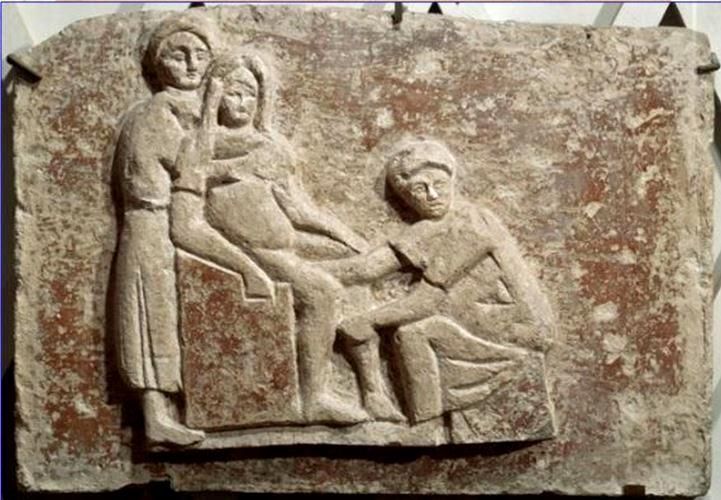
Funerary relief of a midwife, Ostia Antica (Roman Art)

I’ve always admired midwives. Having given birth three times I know it’s a messy business and these women (I know, I know, there are of course male midwives) are willing to be at the gritty end. Midwives are the kind of people you want in a crisis: unflustered, clear thinking, plain talking, patient and encouraging, even willing to be shouted and sworn at in the course of their work!

There must have been many midwives in the Bible but only two are mentioned by name: Shiprah and Puah. (Exodus 1.15).

We have come to the end of our readings from Genesis. The Israelites were now living in Egypt having settled there during the time of Joseph. A new Pharaoh had taken the throne who didn’t remember Joseph and his economic success, and he began to oppress them, forcing them into hard labour. Despite this the Israelites had grown in number and Pharoah was afraid they would rise up against him and so he brought Shiprah and Puah to him and made a terrible demand of them:

When you act as midwives to the Hebrew women, and see them on the birthstool, if it is a boy, kill him; but if it is a girl, she shall live.

Exodus 1.16

In what is no doubt the first act of civil disobedience in recorded history, the midwives refused to follow this murderous edict: [i]

But the midwives feared God; they did not do as the king of Egypt had commanded them, but they let the boys live.

Exodus 1.17

They knew that they could not openly disobey the order of their King, and so they were clever about it: they made up a racially charged explanation!

The Hebrew women are not like other women (they told the king) for they are vigorous and give birth before the midwife comes to them.

Exodus 1.19

Ingenious. It seems that Pharoah fell for this explanation, and because of the cunning bravery of these women the Israelites continued to procreate, the boy babies lived, and Moses, who would later lead them into freedom, was born.

Reflection

The two psalms below use imagery of the midwife to describe God.

“Yet it was you who took me from the womb;
you kept me safe on my mother’s breast.
On you I was cast from my birth,
and since my mother bore me
you have been my God.”
(Psalm 22:9-10)

“For you, O Lord, are my hope,
my trust, O Lord, from my youth.
Upon you I have leaned from my birth;
it was you who took me from my mother’s womb.
My praise is continually of you.”
(Psalm 71: 5-6)

How beautiful to think of the midwives, doctors, nurses and doulas who attend to women and babies at birth as being God-like in their work, bringing forth new life into the world.

Apparently 2020 has been designated ‘Year of the Nurse and the Midwife’ and Pope Francis said that “midwives carry out perhaps the noblest of the professions”.

Let us remember them today and pray for them in their work.

Mother God, as a midwife brings forth new life into the world, You long to nurture new life in us today. Help us to trust in your love and protection, knowing that we are safe in your loving arms. Amen

For more stories of incredible women see our book Unveiled: women of the Old Testament and the choices they made’ – https://www.brfonline.org.uk/products/unveiled

[i]

Francine Klagsbrun said that the refusal of Shiphrah and Puah to follow the Pharaoh’s genocidal instructions “may be the first known incident of civil disobedience in history” (Voices of WisdomISBN 0-394-40159-X).

Tamar: ruin and righteousness

Genesis 38

Written by Alannah Jeune, Doctoral student in History, University of Canterbury, New Zealand

I was ten when prostitution became legal in New Zealand, my home country. I remember the debates and news coverage surrounding the decision and the sudden increased visibility of street prostitution in my part of the city. My understanding of prostitution was very limited – largely derived from biblical passages and stories, and I think I had assumed it was something that only happened in ‘olden times’.

I can only faintly recall hearing the story of Tamar in Church, and the little I did remember was that she was characterised as a prostitute. But Tamar is far from the deceptive temptress that this label implied – her story is that of a remarkable woman who was to become one of only four women named in Jesus’s ancestral line.

Tamar’s story falls in the middle of the Genesis account of Joseph and his brothers. Chapter 38 begins with Judah and his three sons Er, Onan and Shelah. Tamar is married first to Er:

But Er, Judah’s firstborn, was wicked in the sight of the Lord, and the Lord put him to death.

Genesis 38:7

Judah then instructs his second son, Onan to marry Tamar according to levirate custom. This custom stated that any children born to the couple would be legally Er’s and inherit on his behalf. Therefore, Onan ensured that Tamar would not become pregnant, with the result that he too was put to death by the Lord.

Judah, probably a little nervous about Tamar by this point, ordered her to return to her father’s house telling her to wait there until Shelah was old enough to marry. Tamar does this and lives as a young widow in her father’s household, but Judah does not send for her once Shelah is grown.

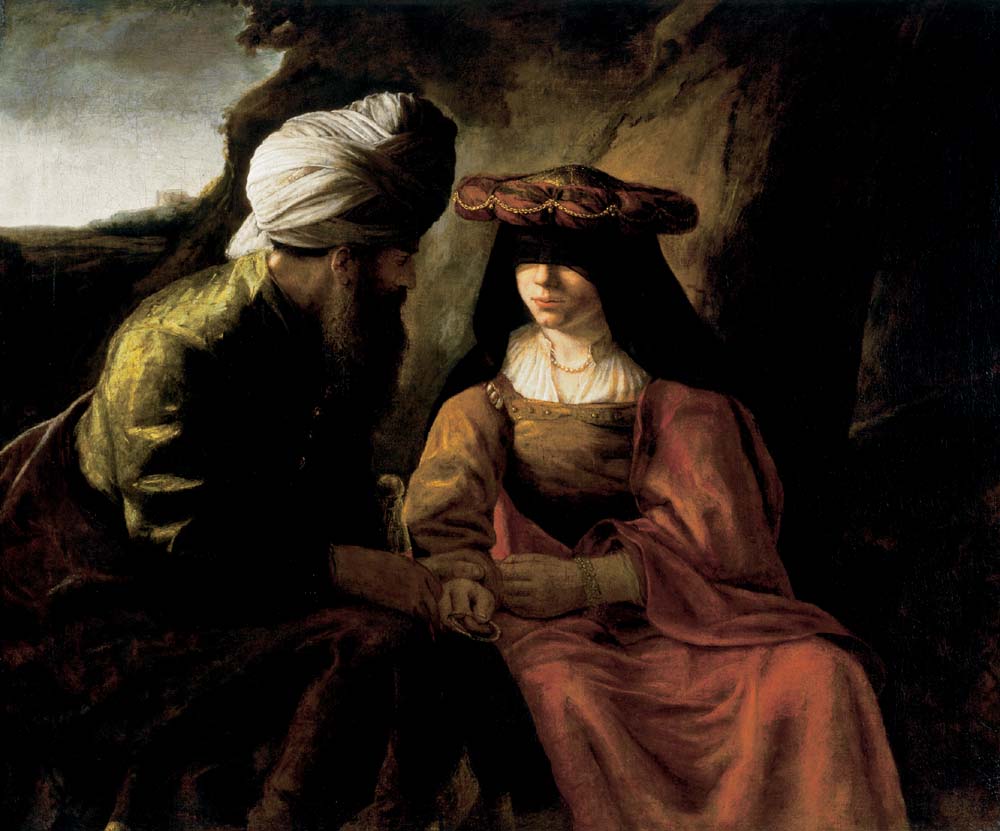
Judah and Tamar, School of Rembrandt, 1650-1660

By this point Judah’s own wife has died, and when Tamar hears he is going on a journey to Timnah, she decides to take control of the situation. She dresses herself as a prostitute and sits at the entrance of Enaim, a town on the way to Timnah. Judah propositions her, sleeps with her, and leaves his signet and staff as a pledge till he can send a young kid to her as payment. However, Judah is unable to find the prostitute when he returns to recover his identifying belongings.

Meanwhile, Tamar has become pregnant by Judah and this is soon noticed. Judah is informed and he orders that she be brought out and burned. Tamar shows Judah his own signet and staff and tells him she is pregnant by the owner of these items.

Then Judah acknowledged them and said, ‘she is more in the right than I, since I did not give her to my son Shelah.’

Genesis 38:26

The tale concludes with the birth of Tamar’s twins: Perez and Zerah.

Tamar’s story is messy. She is passed as property from one man to another, from her father via Judah to Er then to Onan, then back to her father. At no point does Tamar have any choice or control. Her future is bleak – as a childless widow she has no societal standing, nor the security of someone to care for her in her old age. Hers is a situation in which women across the generations have found themselves caught – in a patriarchal society, the worst thing to be is a woman alone.

While emotional details are scant, Tamar’s story reveals a lot about her relationships with the men who control her life. Tamar’s first husband is put to death by the Lord for wickedness… it is no stretch to assume that this was not the happiest of marriages for Tamar, and that she may have suffered at his hands. But being married to a wicked man and all the trials that comes with such a union, was preferable to no marriage at all. And her father-in-law not only cheats her out of a marriage with Shelah, but seems to have been a man of questionable morals – Tamar chose the disguise of a prostitute implying she knew that Judah would be likely to use such services.

This is not a family anyone would choose to join willingly, but Tamar has few options so takes control of her own future through the only means she has. She has nothing to barter with but her own body, and her capacity to bear children, so this is the way provides herself with some security.

And yet this dysfunctional family is one that God has chosen to bless. Matthew’s gospel recounts Jesus’ genealogy and there in verse 3 is Tamar:

and Judah the father of Perez and Zerah by Tamar, and Perez the father of Hezron, and Hezron thefather of Aram

Matthew 1:3

Tamar could not have known that through her son Perez, she would be an antecedent of Jesus. Her actions were designed only to ensure her own survival in a deeply patriarchal world – with few options open to her, she makes a difficult choice and tries to gain some control over her life. She changes her narrative  from that of a desperate victim of circumstance to a woman who is praised for her righteousness by her family.

Tamar’s story is difficult, but that is why it is powerful. The Bible does not edit out the difficult parts, just as we cannot edit out the painful, messy and difficult parts of our lives, no matter how much we might want to. Because God is there in the difficulties, in the mess. He works through imperfect and flawed people like Tamar and her family, just as he works in our lives in both the bad times as well as the good.

It is easy to feel God with us and working through us when things are going well – when we are succeeding, loving our neighbours and full of hope. But Tamar reminds us that He is also with us in the depths of our despair, in the lowest moments of our lives or those times when we feel we are falling short.

Prayer

Tamar’s story does not belong in ‘olden times’, she embodies the female experience of so many women around the world who live under oppressive political or social systems. But she also embodies that hope for us all – that even in the worst of times, God is with us and working through us.

A Prayer for International Women’s Day (which is tomorrow)

God of all, God of hope,
We pray for women and girls today.
That they will be all they can be.
Give us courage to speak and work
For equality and justice
Until the earth is filled
With righteousness and love.
Amen.

Potiphar’s Wife: the seductress

Genesis 39

Potiphar’s Wife ©MicahHayns
Potiphar was cool and so fine
But his wife would never toe the line
It's all there in chapter 39 of Genesis
She was beautiful but evil
Saw a lot of men against his will
(from Joseph the Musical)

One of the things you quickly notice when reading about the women in scripture is often they are often only allowed one characteristic (jealous sister, childless woman, whore), whilst the men are able to be complex and multi-faceted.

Take the story in Genesis about Joseph – he’s a good example. Joseph, sold by his jealous and deceitful brothers into slavery in Egypt, had been the favoured and much beloved son of Jacob and Rachel. He was a dreamer and rather vain (he loved that coat!), but was also resourceful and cunning, fearful and faithful.

Potiphar’s Wife, on the other hand, was only one thing:

A Seductress.

We don’t find out anything much about her life and we don’t even get to know her name.  We don’t know whether she had children, whether she was a kind or demanding mistress, or what Potiphar, an Officer of the King of Egypt (Pharaoh), was like as a husband.

It’s likely that she lived in luxury. They had servants and a large household, within which Joseph had worked his way up the ranks to become the overseer, like a young Mr Carson (from Downton Abbey).

Now Joseph was handsome and good-looking. And after a time his master’s wife cast her eyes on Joseph

Genesis 39.6-7

Mrs Potiphar was clearly very taken by this handsome young Hebrew man. She began to pay him ‘special attention’ and then one day propositioned him:

Lie with me

Genesis 39.7

The story is told as if this attraction was entirely one way but this may well not have been the case. It has all the hallmarks of a Downton Abbey upstairs-downstairs affair. She was certainly infatuated with Joseph and he may well have been attracted by his mistress, but he would have known that if he slept with her he risked his job, his place in the household, and even his life: adultery was punishable by death. He was also faithful to God:

How then could I do this great wickedness, and sin against God?

Genesis 39.9

So, Joseph resisted but Mrs P persisted, until one day they found themselves alone.  She made a pass at him and even got some of his clothes off, but Joseph ran out of the house leaving her holding his ‘garment’.

Joseph wanted to resist her till
One day she proved too eager
Joseph cried in vain
"Please stop, I don't believe in free love"
1910 comic caricature of Joseph and Potiphar’s wife by Joseph Kuhn-Régnier,
Notice the chilled wine bottle and glasses on the small table at the left!

She was furious. How dare he, a slave, spurn her. She turned against him, and in her fury accused him of attacking her: she had his coat as proof. Joseph was thrown into prison.

Poor, poor Joseph, what'cha gonna do?
Things look bad for you, hey, what'cha gonna do?

Once in Prison Joseph began to interpret dreams and this led to him being introduced to Pharaoh himself, and becoming the Egyptian King’s right hand man. We hear nothing more of Potiphar’s wife.

Her role as ‘the seductress’ has been fulfilled and she’s no longer necessary for the rest of the story.

Reflection and Prayer

I pray, O Lord, that I will not fall into temptation; for the spirit is willing, but the flesh is weak
Matthew 26.41 (Good News Version, adapted)

Many of the women in the Hebrew Scriptures are portrayed as innocent victims and so it’s surprising and rather refreshing to come across a woman like Potiphar’s wife, a powerful protagonist and an instigator, and who desired love rather than children. Perhaps today we can pray for all those whose love is unrequited, for those who are tempted into adultery, and for those who continue to resist.

O God our Father, hear me, who am trembling in this darkness, and stretch forth thy hand unto me; hold forth thy light before me; recall me from my wanderings; and thou be my guide, may I be restored to myself and to thee
Augustine, 354-430

Dinah: The Voiceless One

Genesis 34

We have been lost to each other for so long. My name means nothing to you. My memory is dust. This is not your fault, or mine. The chain connecting mother to daughter was broken and the word passed to the keeping of men, who had no way of knowing.

From The Red Tent by Anita Diamant, page 1

The Red Tent is a wonderful novel by Anita Diamant which imagines Dinah’s story rather differently to the text we are given in Genesis 34.

There is a problem with the story of Dinah. We hear about an horrific crime committed against her, but the difficulty is that as everything is told from the point of view of either the accused (Shechem), or the accusers (her brothers), it’s hard to know the truth of the matter. She doesn’t get to say a word.

It’s a gruesome tale and needs a trigger warning as it contains a rape.

Dinah was the only daughter of Jacob and Leah and so we know that she had six brothers and six half-brothers. The story we are told in Genesis 34 is that Dinah went to visit the local women and whilst there she encountered the son of the local ruler called Shechem.

[he] saw her, he took her and raped her

Genesis 34. 2

This is a despicable crime and we deplore any violence towards women of this kind, whether happening now or thousands of years ago in the ancient world.

Shechem then ‘falls in love’ with Dinah, ‘speaks tenderly to her’, and asks his father Hamor if he can marry her. At that time it was unheard for women from the Abrahamic tribes to intermarry with local people, and so this was a bold request.

Hamor went to speak with Jacob to ask for his daughter’s hand in marriage for his son but at this point her brothers turned up, hear what had happened and fly into a rage. 

They were filled with grief and fury, because Shechem had done a disgraceful thing in Israel by lying with Jacob’s daughter – a thing that should not be done.

Genesis 34. 7

Shechem and Hamor pleaded with Jacob and offered a dowry for Dinah’s hand in marriage. But the brothers refused. This time their refusal was because Shechem was ‘uncircumcised’ and therefore considered unclean. They claimed that the marriage would be ‘a disgrace to us’.

They hatched a plan. They tell Shechem that the marriage (and other marriages between the Israelites and the locals) can go ahead only if all the men in their community are circumcised.

And Shechem agrees to this, and in fact does so with gusto:

the young man.. lost no time in doing what they said, because he was delighted with Jacob’s daughter.

Genesis 24. 19

The circumcision of the Shechemites. Engraving by J. Muller 1571-1628. Credit: Wellcome Collection

And all the men get circumcised. Imagine what that must have been like. Imagine the groans of pain emanating from every household as all the men nurse their tender nether regions!

Three days later Simeon and Levi, two of the brothers, take matters into their own hands. Whilst all the Canaanite men were in pain they went into the town and attacked them, killing them all and looting from their homes. It’s another terrible crime.

 Shechem and Hamor are murdered, and Dinah is ‘rescued’.

What is so brilliant about Anita Diamond’s book ‘The Red Tent’ is that she imagines this story differently. She imagines that Dinah falls in love with Shechem, sleeps with him and then hopes to marry him. Dinah pleads with her father that the marriage might go ahead, and encourages Shechem and the Canaanites to be circumcised as she shares her faith. Her brothers are so blinded by their rage, pride and assumptions about their sister – she couldn’t possibly have willingly have had sex with an outsider, it therefore must have been forced – that they don’t listen to her and carry out a terrible atrocity against her will.

Was Dinah a woman who was raped and held against her will? Or was she a woman who loved someone who her family disapproved of and paid a terrible price?

We can never know for sure. Without the voice of the woman in the story being heard we are only getting half the truth, which isn’t truth at all.

It's a wonder that any mother ever called a daughter Dinah again. But some did. Maybe you guessed that there was more to me than the voiceless cipher in the text. Maybe you heard it in the music of my name: the first vowel high and clear, as when a mother calls to her child at dusk; the second sound soft, for whispering secrets on pillows. Dee-nah.
The Red Tent, Anita Diamant

Refection and Prayer

This is a difficult passage to reflect on, but sometimes we need to focus prayerfully on the darkness in our world. We remember all women (and men) who have suffered from sexual violence and rape. We also remember women who are prevented from marrying the people they love by their family members, and recall that ‘honour killings’ are sadly still going on every day in our world. And we remember all those whose voices aren’t heard and whose stories will never be told.

Let us pray for light in the darkness.

Eternal Light, shine into our hearts,
Eternal Goodness, deliver us from evil,
Eternal Power, be our support,
Eternal Wisdom, scatter the darkness of our ignorance,
Eternal Pity, have mercy upon us;
that with all our heart and mind and soul and strength
we may seek thy face and be brought by thine infinite mercy
to thy holy presence;  through Jesus Christ our Lord.  Amen

A prayer of Alciun of York, 735-804

Leah: The Other Sister

Genesis 29. 15-35, 30.1-20

In the previous post we heard about Rachel, the wife who Jacob loved the most but who never seemed to find contentment. Now we hear of her sister Leah, the wife Jacob never really loved but who was blessed with a huge number of sons.

Me and my sister, Milly (plus Layla and Koru)

Much of my childhood was spent in arguments with my sister. I was a couple of years older and was deeply jealous of her. Apparently when I was around three I used to sleep outside my parents’ bedroom door so I was first to be seen in the morning! I don’t look back on those years with much pride as I was pretty vile. I even cut her beautiful red hair and made her promise not to tell anyone! One of the greatest blessings in my life is that she forgave me and we’re now the best of friends.

This certainly wouldn’t be the case if we were married to the same man!!

Leah knew from the beginning of her marriage to Jacob that she wasn’t the one that Jacob loved most. But she did have lots of boys (something we share as Milly and I have 5 boys between us), and boys in those days were a sign of God’s blessing.

When the Lord saw that Leah was unloved, he opened her womb

Genesis 29.31

She had four sons in quick succession (Rueben, Simeon, Levi and Judah)

Surely now my husband will love me

Genesis 29. 32

But sadly for Leah this doesn’t seem to be the case and Jacob continued to prefer her sister, even though she had even more sons via her handmaid Zilpah (Gad and Asher).

Although neither Rachel nor Leah had much power over who they were to marry, it seems that they did have agency within their relationship. They were able to name their sons for example. And it seems that they were also able to control which of them Jacob slept with. Here is an example:

Illustration of Mandragora officinalis (Mandrake)
Fun Fact: In the Odyssey, the Greek enchantress Circe used Mandragora in a brew to turn Odysseus’ men into swine!
Fun Fact 2: Mandrakes are used in Harry Potter (Herbology) as a powerful restorative.

After Leah has stopped having children her eldest son Rueben finds some mandrake plants, a known ancient aphrodisiac said to possess natural stimulants. When you see the plants it’s not surprising why they became known as an ancient form of viagra!

Leah gave Rachel the plants in return for a night in Jacob’s bed.

When Jacob came in from the field in the evening Leah went out to meet him, and said, “you must come in to me; for I have hired you with my son’s mandrakes.” So Jacob lay with her that night

Genesis 30.16

The result of this led to her fifth son, Isaachar. She went on to have two more children, Zebulun and last but not least a daughter… Dinah (who we will hear about tomorrow).

Leah may not have been Jacob’s most beloved wife, but she seemed to have been more contented that her sister, and she was blessed with a quiver full of sons who then went on to be the foundation tribes of Israel.

We don’t hear if the sisters were ever fully reconciled but I like to think that their passionate jealousy and fierce rivalry ran alongside a deep love for one another. They were in an impossible situation and one that would have tested even the most dedicated siblings.

Jacob may not have favoured her in life, but in death she was honoured and buried alongside Abraham and Sarah in a place where Jacob would be eventually laid to rest.[1] United in death if not in life.  


[1] Genesis 49.31 – ‘There Abraham and his wife Sarah were buried; their Isaac and his wife Rebekah were buried; and there I buried Leah.’

Prayer

Get rid of all bitterness, rage and anger.... be kind and compassionate to one another, forgiving each other, just as in Christ God forgave you
Ephesians 4.32

As we’ve reflected over the last couple of days on the complicated sibling relationship between Rachel and Leah perhaps we might think about our own relationship with a sibling or close family member. What do we appreciate about them? What is difficult?

Perhaps we can think of three things about them that we are thankful for. We may even like to send them a message to let them know. If your relationship is complex and damaged then perhaps you might like to pray for healing and forgiveness.

Be gracious to all that are near and dear to us, and keep us all in thy fear and love. Guide us, good Lord, and govern us by the same Spirit, that we may be so united to thee here as not to be divided when thou art pleased to call us hence, but may together enter into thy glory,
through Jesus Christ. Amen

A prayer of John Wesley, 1703-91

Rachel: the sister who was loved

This post is a bit longer than usual because it’s a complex story, but I’ve tried to condense it as much as possible.

We probably all know the story of Jacob and his numerous sons, even if only from Joseph and his Amazing Technicolour Dreamcoat.

But what do we know of Joseph’s mother, and the mothers of the many other sons of Jacob, for there were at least four? Rachel and Leah, who were sisters, and Bilhah and Zilphah (their maids).

If anyone thinks the Old Testament is dull, they haven’t read the story of Rachel and Leah. It involves two women wounded by the actions of their father, mistaken identity, sisterly jealousy, fierce rivalry, and even curious aphrodisiac plants!

Dante’s Vision of Rachel and Leah 1855 Dante Gabriel Rossetti 1828-1882 (Bequeathed by Beresford Rimington Heaton 1940 http://www.tate.org.uk/art/work/N05228)

I’ll cover both women over the next two days, but first some background.  

Leah and Rachel were the daughters of Laban (Rebekah’s brother) and lived with him in Haran. Leah is the eldest and we’re told, ‘her eyes were lovely (or in some versions of the bible ‘weak’), whereas Rachel ‘was graceful and beautiful’.

Jacob, one of the sons of Isaac and Rebekah, was on the run from his twin brother Esau (as we read yesterday). He had fled to his Uncle Laban in hope that he might find a wife.

He found two!

Firstly, Rachel’s story. 

Jacob and Rachel at the Well, c. 1896-1902, by James Jacques Joseph Tissot , at the Jewish Museum, New York

Rachel was looking after her sheep when she first saw Jacob by the well. In a wonderfully romantic encounter (or maybe a rather clunky way in which a man shows off to a woman he fancies?), Jacob sees Rachel, leaps off his camel, rolls back the large stone over the well (showing off his rippling muscles?) to water her sheep.

Then Jacob kissed Rachel, and wept aloud. 

Genesis 29.9-11

Gloriously romantic, or all a bit much, depending on your perspective!

From this moment on Jacob loves Rachel, but in order to marry her he has to work for her wily father Laban for seven years:

..and they seem to him but a few days because of the love he had for her

Genesis 29.20

When the time was up there was an engagement feast and, in an action that would change the course of the sisters’ lives forever, Laban sent older sister Leah into the tent to have sex with Jacob. In that culture, that meant that they were then married. Jacob didn’t realise what had happened until the morning and was understandably horrified. I don’t imagine Rachel was particularly pleased either!

Laban allowed Jacob to marry Rachel the next week after making him pledge to work for him for another seven years. The sisters had no say in all of this of course. Having multiple wives was common in the culture of the time, but it isn’t hard to imagine how difficult it must have been for the sisters.

Jacob loved Rachel more than Leah, but Leah was able to have children. A recipe for disaster! Rachel wanted children more than anything and as time went on she envied Leah and got so low that she cried out to her husband:

give me children or I shall die!

Genesis 30.1

This didn’t go down well, Jacob got angry and Rachel, in her desperation, came up with a plan which involved sending her maid Bilhah to have sex with Jacob so that she could have a child through her as a surrogate. Her plan worked and two sons were born.

Eventually Rachel had a son of her own: Joseph.

Rachel hides the teraphim in a camel’s saddle and sits on it, Giovanni Volpato, from Wikipedia Commons

The family left Laban’s household and headed back to Canaan where Jacob was eventually reunited with his brother Esau. The journey turned out to be calamitous for Rachel. But before this there is a wonderful demonstration of her strength of character in the tale of the missing idols. Laban was enraged that someone in the fleeing party had stolen his ‘household Gods’ so he searched everywhere until he came to Rachel’s tent. She had them but managed to foil him by putting them in her camel’s saddle, sitting on it, and telling him she had her period!

Let not my Lord be angry that I cannot rise before you, for the way of the woman is on me

Genesis 31.35

I love this!

Rachel had her longed for second child whilst on the journey. It was a difficult pregnancy and she didn’t survive the birth. Her final act was to name her son Ben-oni, which means ‘son of my sorrow’, a name that revealed so much about this beautiful but deeply sad woman who never seemed to be able to find contentment in life.

Thankfully for the baby Jacob overruled the name and called him Benjamin which means ‘son of my right hand’. The tribe of Benjamin became one of the most significant tribes for the people of Israel, and it was from here that the first king of Israel (Saul) emerged.

Rachel was buried on the way to Bethlehem, and her tomb is a significant site for pilgrims to this day.

PRAYER

God, you are my God, early will I seek you, My Soul thirsts for You, my flesh longs for You,  in a barren and dry land where no water is'. 
Psalm 63

Rachel’s life wasn’t easy and she faced many challenges and sorrows along the way. I wonder if she was happiest when looking after her sheep as a child. Women in the ancient world were expected to produce offspring and their prosperity and happiness depended upon this. Let’s pray for all those who continue to be defined by their fertility, and for those who never seem to find contentment in life.

Holy and Eternal God,
give us such trust in your sure purpose,
that we measure our lives
not by what we have done or failed to do,
but by our faithfulness to you. Amen
From A New Zealand Prayer Book