Rebekah: faith and favouritism

Rebekah ©MicahHayns

Genesis 24-28, 49

Rebekah is the first of a number of women in the bible whose story involves leaving their home in order to marry a suitor they’ve not yet met. It is a story that involves camels, nose rings, a family feud and troublesome twins. I’ll try and tell it briefly.

Rebekah, beautiful, wealthy and privileged, lived with her family in the City of Nahor. The daughter of Bethuel of Arameus (Abraham’s nephew), granddaughter of Milcah and Nahor, her brother was Laban. We are told she had a nurse (Deborah) and several lady’s maids.

Abraham was an elderly patriarch and wanted to find a wife for his son Isaac from his own home country, rather than from Canaan where they now lived. He sent his estate manager, (often known as Eliezer) to Nahor (now Syria) on a quest to find someone suitable, with numerous camels carrying bags of jewels as a dowry. Eliezer promises to bring back a wife for Isaac.

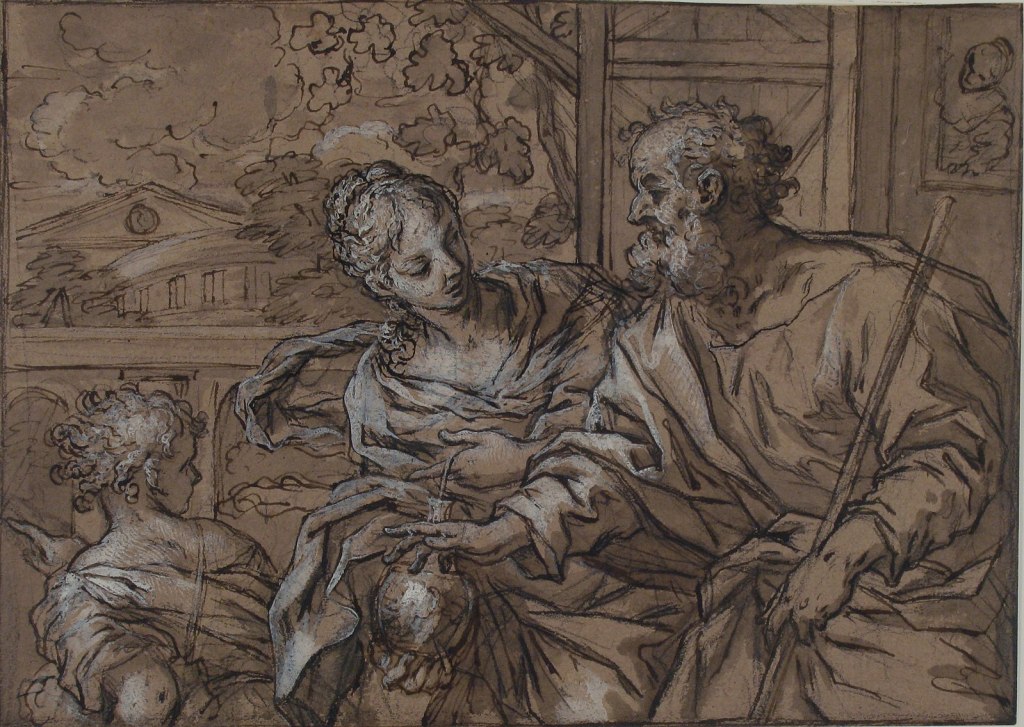
Jean-Baptiste Camille Corot, Rebecca at the Well, c. 1896-1902 (image from Wikipedia Commons)

He spots Rebekah by a well at the city gates and she offers to fetch water for him and his camels. He takes this as a sign that she’s the one and gives her a nose ring and two gold arm bracelets. She invites him back to her father’s house.

After some negotiation over plentiful hospitality and more gifts (jewels, gold and cloth), the family concluded that the Lord indeed intended for Rebekah to marry Isaac. Rebekah was asked if she was willing to go (which was nice of them!), and she gave her consent with a simple:

I will go.

Genesis 24. 58

The very next day she leaves her home, her family and all that she knows to marry a man she’s never met before.

She marries Isaac and eventually, after a difficult pregnancy (I can relate to that!) she gives birth to twin boys, Esau and Jacob. Her boys were very different to one other, Esau being a rugged hunter, Jacob being a quieter home-based type.

Families are rarely simple and straightforward and often jealousies, feuds and rivalries are formed early on. This family was no exception and perhaps it began here:

Isaac loved Esau… But Rebekah loved Jacob

Genesis 25.28

The family rift grew when she disapproved of Esau’s choice of wives (he married two Hittite women, Judith and Basemouth). She plotted to make sure that Jacob would gain his father’s blessing over and above his slightly older twin.

This plot led to Jacob tricking Isaac, a fraternal feud which lasted many years, and Jacob having to flee into exile to Rebekah’s brother Laban. The blessing however, even though brought about by rather dubious moral means, is given to Jacob and he becomes the ‘father of many nations’.

We don’t know if Rebekah lived to see her beloved son Jacob again, or if she ever saw his eventual reconciliation with his brother. The last we hear of her is that she is buried alongside Isaac, Abraham and Sarah in the cave near the Oaks of Mamre.

Prayer

Rebekah was a courageous and bold woman of God, not afraid to take risks, to speak her mind, to use the power she had to secure what she wanted for those she loved.

Her actions caused conflict within her family though and her sons’ rivalry was perhaps partly due to their parents’ favouritism. Research in the UK came out this week which reveals that 30% of people thought their parents had a favourite child (but only 10% of parents admitted it), and believed this had had a lasting impact on family relations. (1)

Parenting isn’t easy, and so let’s pray for all those who navigate this tricky path, and who get it wrong at times. And for ourselves that we wouldn’t let old wounds fester.

A prayer of Evelyn Underhill

Lord, grant us to love You with all our heart, mind and soul and our neighbour for Your sake: that the grace of charity and kindly love may dwell in us, and all envy, harshness and ill will may die in us. Fill our hearts with patience, kindness and compassion; that, constantly rejoicing in the happiness and good success of others, and putting away the spirit of criticism and envious thoughts, we may follow You, who are Yourself the true and perfect love. Amen

(from Evelyn Underhill’s Prayer Book)

(1) research conducted by a YouGov Poll of 6,242 British adults for The Times, reported on Saturday 29th February 2020

Eve

Daughter of Eve

Eve by Lucas Cranach the Elder
1526, Public Domain


by Megan Chester, Undergraduate of English, Christ Church, Oxford (written for this blog, February 2020)

To my precious, darling daughter,
My flesh, my blood, my bone,
Wherever you fall, whatever you do,
Please know you’re not alone.

I never got to be a child,
Never had that time to grow.
I didn’t have a mother telling me
All the things that I should know.

I fell with such velocity,
That the world still feels the quake.
Daughter, I found out the hard way,
So please learn from my mistake.

I know evil, daughter,
I know how he plays –
He waits until you’re vulnerable,
Invites himself in, stays.

But my love, don’t talk to strangers,
Never entertain his game;
It’s hard to win and the loser’s
Forever burdened with his blame.

Daughter, don’t dance with the devil –
Be bold in what you know is right.
He’ll trample your knowledge with what you don’t know.
Though the bait may look tempting, don’t bite.

Don’t follow in my footsteps child,
Only follow paths divine,
And I’ll be right there behind you
Until we reach the time

When I can’t go where you can tread.
There I will meet the end,
But I’ll watch you from the gate and pray
That God’s grace will extend.

Be careful of always wanting more.
Save yourself the cost.
I paid but my debt’s still great,
So, love, learn from what I lost.

Seemingly sweet is sour,
This I wish that I was told.
A lesson you figure through suffering
When as a newborn you are old.

I had more love than I could carry,
So much desire – what to do?
But in this strength the snake saw weakness.
I was naïve. The serpent knew.

I was seduced by a promise of wisdom,
Which the wise would have refused.
My heart chased what it didn’t love –
Its desire was abused.

I was lured into loving a beauty,
Which true love would have let go.
Where I was weak, my child, be strong.
I have faith you can say no.

I wish you could feel how it was before
The dawn of darkness came.
When united in flesh we loved and were loved,
When bare bodies knew no shame.

Please, if you can, forgive me child
When labour tears you limb from limb.
I wish I’d done things differently
And never let him in.

I hear his hissing every night
And I’m sorry every day
That, because I tripped and fell so far,
Your life must be this way.

Child, all this one day will change,
In flesh and blood beyond our scope,
But until then listen to your mother’s words,
My darling daughter Hope.

Perhaps you too in days to come
Will be lover, mother, wife,
Or perhaps you won’t, but Daughter of Eve
I know you will breathe life.

Precious girl, please don’t make my mistakes.
I’m sure at times you’ll make your own.
But remember, even if you do,
You’ll never fall alone.

A prayer for Lent adapted from the Book of Common Prayer
Almighty God, grant your people grace to withstand the temptations of the world, the flesh, and the devil, and with pure hearts and minds to follow you, the only God; through Jesus Christ, our Lord. Amen

Lot’s Wife: the woman who turned

Genesis 19

Lot’s Wife ©Micah Hayns

Like many of the women of the Bible we don’t know the name of our next woman, only that she was Lot’s Wife (although in some Jewish traditions she’s named Ado or Edith). We know very little about her other than she had two daughters and that she lived in Sodom, a town with a long-lasting reputation for being rather seedy.  Although we know very little about her life she’s mainly remembered for the manner of her death: being turned into a pillar of salt as punishment for turning around to look back at her burning home.

It’s a curious story.

Lot was Abraham’s nephew and he settled the land called the Plain of Jordan (better known as Sodom), whilst Abraham settled in Caanan.

The enigmatic angelic visitors who had visited Abraham and Sarah then headed towards the city of Sodom. Lot, who was sitting at the City gate, greeted them and invited them to his home and his wife provided a feast for them. However, before they’d finished eating the ‘men of the city’ surrounded the house demanding the visitors be given over to them ‘so that we may know them’ (Genesis 19.5). Lot refused to allow the men into his home and instead offered them his own virgin daughters.

Much has been written of these passages in relation to sexuality, and they have been used as justification of God’s displeasure at same-sex relationships. This is simply wrong. This is not a passage about relationships, same-sex or otherwise: it is about violence. The men of Sodom want to rape Lot’s visitors, and so he protects them by offering his own daughters instead.

The angelic visitors strike the rampaging Sodomites with blindness so they can’t find the door and then they urge the family to flee before the city is destroyed. They were told:

Flee for your life; do not look back or stop anywhere in the Plain; flee to the hills, or else you will be consumed.

Genesis 19.17

As the family flee, the cities of Sodom and neighbouring Gomorrah are both destroyed in a shower of ‘sulphur and fire from the Lord out of heaven’.

But Lot’s wife, behind him, looked back, and she became a pillar of salt

Genesis 19:26

Why did she look back? And why salt? It’s all very strange.

I’ve often heard it said the reason she looked back was that she she lacked faith, but this seems overly harsh. Perhaps she was grieving a place which held all her childhood memories; or maybe she felt closer to the people in Sodom than to her husband, a man who would offer up his own daughters to be raped in order to protect some visitors; or perhaps she was simply terrified and frozen to the spot by the horror she was seeing.

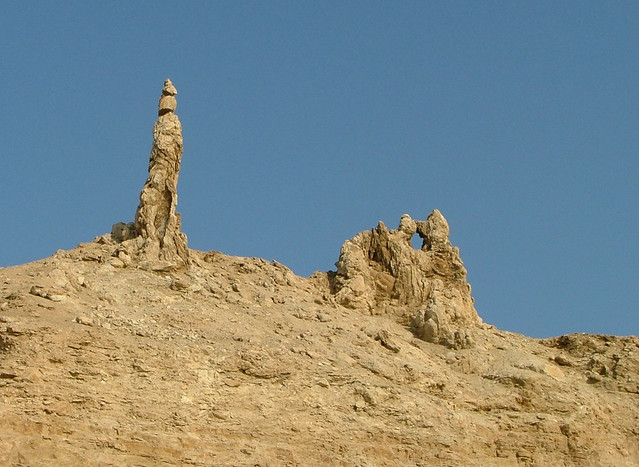
The rock formation called ‘Lot’s Wife’ is found near the Dead Sea on Mount Sodom in Israel

It is interesting to note that the ‘Pillar of Salt’ is also an ancient legend told to explain some curious salt rock formations in this region.

Also, being turned into a pillar of salt is an idiom in Eastern tradition for dying of fright.

Whatever happened to Lot’s wife, she reminds us of thousands of women forced to flee their homes each day due to violence, war and natural disaster. She reminds us of all those who look back and remember all those they’ve left behind.

But perhaps she also reminds us that in this time of Lent we are also invited to turn – to turn towards God, who receives us with open arms of love.

Prayer

The UN Refugee Agency estimates that there are 70.8 million forcibly displaced people in the world today and 37,000 people each day flee their homes due to conflict or persecution. (see here for figures at a glance: https://www.unhcr.org/ph/figures-at-a-glance)

Answer me, O Lord, for your steadfast love is good; 
according to your abundant mercy, turn to me.
Psalm 69.16

God of love, as we remember Lot’s wife who had to turn away from her home in fear, we remember all those today who are forced to leave their homes and face an uncertain future. Give them your strength and show them your love. We pray also that, in this time of lent, we might turn towards your love and know your peace in our lives. Amen

Sarai: under the oaks

Genesis 18: 1-23; 21; 23

I have always loved trees. As a child growing up in Buckinghamshire we had a vast sycamore tree in our garden which we called ‘The Big Tree’ (See image below). It was said to be one of the largest and oldest of its kind in the UK and was simply magnificent. There was a branch to the left of it that came right to the ground which was perfect for climbing up into a cavity in the middle of the tree, which was the place we went to as children to get away from everyone. My first experience of prayer was here as I spoke to God about whatever problems I was having – normally some kind of sibling rivalry or another.

The Big Tree at The Old Rectory, Adstock, Bucks painted by R Read. Sadly the tree died several years ago.

There is something permanent and comforting about old trees. I often sit under Christ Church’s ‘Jaberwocky Tree’ imagining all those who have gone before over the centuries, and somehow all the temporary concerns are put in to perspective.

Sarai’s (her name is later changed to Sarah) story features a particular tree, or group of trees, evocatively named ‘The Oaks of Mamre’.

Sarai was married to Abram (her half-brother) and much of their life was spent travelling as Abram had been called by God to leave their homeland (Haran) and go into a new land where, he was told, they would be blessed. (Genesis 12.1-3).

They were indeed blessed in many ways, with wealth, land and livestock, but they were not blessed with a child, and this was all that Sarai wanted, and was all that was expected of her as a woman.  

It is at the base of the Oaks of Mamre that two incidents occurred which changed the course of Sarai’s life. It was here that Abram first received the promise that they would have a child, and not only that, but their offspring would be so numerous they would be ‘like the dust of the earth’ (Genesis 13.16).

The Oak of Mamre believed to be around 5000 years old and which, in tradition, is said to mark the place where Abraham entertained the three angels or where Abraham and Sarai pitched their tent.

And it was also at the foot of the Oak of Mamre many years later when Sarah and Abram had another encounter with the Lord who came in the guise of three strange men, and again they were promised they would have a child.

But this time Sarah laughed at the prospect. She was now past the menopause or, as the bible delicately puts it, ‘it has ceased to be with [her] the manner of women’. Abraham was also past his prime – ‘my husband is old, shall I have pleasure?’ (Genesis 18.11-12).

But this time the promise was fulfilled. Sarah did indeed have a child,  Isaac (which means ‘he laughs’).

Sarah’s life can’t have been easy and, as Hagar’s story yesterday revealed, she struggled with rivalry and jealousy. But she was faithful and strong and is remembered in all three Abrahamic faiths as one of the few biblical matriarchs (with Rebekah and Leah).

At the end of her long life Sarah was buried in the very first description of a funeral and burial in scripture, in a place lovingly secured by her husband Abraham, and where he would later join her: in a plot overlooking her beloved Oaks of Mamre.

So the field of Ephron in Machpelah, which was to the east of Mamre, the field with the cave that was in it and all the trees that were in the field, throughout its whole area…After this, Abraham buried Sarah his wife in the cave of the field of Machpelah facing Mamre (that is, Hebron) in the land of Canaan. 

Genesis 23. 17-19

Reflection

In John’s Gospel one of the very first disciples Jesus calls to follow him is Nathanael, who is sitting under a tree at the time!

I saw you under the fig tree

John 1.48

and the very first thing Jesus says to those who follow him (in John’s Gospel) is:

What are you looking for?

John 1.38

‘I saw you’, ‘What are you looking for?’

These are good questions to begin our Lent journey. Perhaps you might like to go outside and spend some time sitting under or near a tree and reflecting on what it is you’re looking for this Lent? It might be something personal like Sarai who longed for a child, or it might be a more rewarding job, or wisdom for a particular problem, or an ability to concentrate on your studies. Or perhaps it is for a deeper relationship with God this Lent.
Whatever it is, perhaps you might like to take it God in prayer.

Prayer

Heavenly Father, thank you that you see us and hear us when we come to you in prayer. As you heard your daughter Sarai many centuries ago we pray that you would hear us today as we speak to you of all that we long for.

Amen

Hagar: the woman who is seen

Genesis 16 and 21

Note: this series of posts about women of the Old Testament were originally written for a Lent Blog in 2020. They have been updated. Many of the images are original pieces of art produced by Micah Hayns. Please only use them with permission. You can get in touch with him for originals or high res. images for promotions via http://www.micahhayns.com

We begin with Hagar.

Hagar was the very first person to dare to give God a name. She wasn’t a person of any authority or particular merit, she wasn’t a prophet or a priestess: she was an Egyptian slave-girl owned by Abram’s wife, Sarai.

Sarai hadn’t been able to have children and so had hatched the kind of plan that we might recognise from the Handmaid’s Tale: she would have a child with Abram via the means of her slave, Hagar. Abram willingly went along with the plan and Hagar, clearly having no choice in the matter, became pregnant. The two women began to hate each other but Sarai of course, had the upper hand and Abram gave his wife authority to do as she pleased. Sarai’s anger deepened as time went on and she became violent and eventually the pregnant Hagar, fearful for the safety of her unborn child, fled to into the wilderness.  

It was as she was hiding near a well that Hagar heard the voice of an angel:

Hagar, slave-girl of Sarai, where have you come from and where are you going?’

Genesis 16.7

She was promised her son would be a ‘wild donkey of a man’, and told to return.

Hagar was so overwhelmed by having been seen and heard, perhaps for the first time in her life, that she gave the Lord a name,

You are El-roi”; (God who Sees), for she said, “Have I really seen God and remained alive after seeing him?”

Genesis 16.13
The Dismissal of Hagar by Giuseppe Nicola Nasini, between 1657 and 1736, (image from Wikimedia Commons)

She bravely returns to Sarai, gives birth to Ishmael, and brings him up in Sarai’s household until Sarah (given a new name) had herself produced a child of her own, Isaac. Now with a son of her own Sarah didn’t want them around anymore and they were once again banished.

Ishmael was an adult by this time (around 15 years old). The banished pair wandered in the desert until their food and water had dried up and all hope of survival had gone. In the first description of a death ritual in scripture, Hagar put her child under a bush, sat at a distance, and waited for him to die.

Their tears were heard by the angel of God who, like the angel that appeared to Mary centuries later, said to them: ‘do not be afraid’, a well of water appeared and they survived.

Hagar became a Grandmother to many, and Ishmael’s descendants, the Ishmaelites, populated the land and grew powerful.

Hagar, enslaved, abused, and mistreated, was seen and heard by God.

THE SITUATION TODAY

Sadly slavery isn’t in the past and although it’s hard to find accurate statistics it is estimated that over 40 million people are held against their will and that 71% of overall victims of modern day slavery are believed to be women – this is nearly 30million people! https://www.antislavery.org/slavery-today/modern-slavery/

Now the Lord is the Spirit, and where the Spirit of the Lord is, 
there is freedom.
2 Corinthians 3.17

PRAYER

Loving God, who sees and hears all those who cry out in need, bring comfort and freedom to all your children, to those who are kept against their will, those who live in fear of violence, and those who are forced to run away to protect their family, in the name of El-Roi, The God Who Sees.
Amen

Welcome

Thank you for signing up to follow my Lent blog! Each day of Lent I’m going to post about a different woman from the Old Testament and on Saturdays we have some wonderful guest posts written by some fabulous women.

Firstly you might want to make sure the emails don’t go into your spam/junk folder by marking this email address as a ‘not junk’.

They should take about 5 mins to read, and each will end with a short prayer. I’ll send them at 6.30am each day. You might find it helpful to find a regular time of day that suits you to read them, perhaps in the mornings and some people like to have a particular place, such as a favourite chair.

We’ll begin tomorrow but I thought I’d start with a little introduction.

I began this blog last summer as a challenge for myself to a) form a writing habit, b) find out for myself more about the women of the bible, and c) learn how to use WordPress (which took a while!).

A bit about me. I’m ordained as a C of E Priest and currently work as College Chaplain and Welfare Coordinator at Christ Church, an Oxford College. I came to faith in my early 20’s having grown up in rural Bucks and my childhood was more ‘pony club’ than ‘church youth club’. I’ve often felt that my knowledge of the Old Testament was a bit scrappy, and so when I began this blog most of the women were a mystery to me.

There is an assumption that women are largely ignored in the biblical narrative, and that when they are written about they are marginal characters to the main story, or are only allowed to be either mother, whore or seductress. This is certainly the case for some of the women we’ll look at over Lent, and there are some tragic stories that we won’t gloss over and ignore. But there are also many, many women who are central to the narrative, complex in character, and who use the power they have for good, and sometimes for evil.

When I began the blog I intended to use New Testament women as well, but I found there were so many fantastic women in the Hebrew scriptures and so I decided to stay there, with two exceptions from the Apocrypha.

I hope you enjoy reading about these wonderful women as much as I have enjoyed writing these blogs. Also, if you enjoy them, please do pass the link on to your friends!

Every blessing,

Clare

A prayer for our journey

Let us make our way together, Lord; wherever you go I must go: and through whatever you pass, there too I will pass.
Teresa of Avila, 1515-1582

The Good Innkeeper: A sermon for the Oxford Winter Night Shelter

A sermon for the Oxford Winter Night Shelter (OWNS) Commissioning Service at St Michael’s in the Northgate, Oxford on 4th December 2019

Based on Luke 10.25-37 – the Parable of the Good Samaritan

The Innkeeper has finished for the night. She’s spent the day cleaning rooms, brushing floors, changing bedding. She’s overseen the chef and the maid as they prepared and served the food for the eight guests booked in for the night, and everything has been cleared away. The guests have all they need and she’s even made sure the one who tends to drink a bit too much hasn’t disturbed the others.

Everyone has gone to bed for the night; the place is quiet at last.

And, just as she’s having a moment to herself with a nightcap she hears a noise outside.

It’s a dark and blustery night and the wind is rattling through the trees. But she’s sure she hears sounds of an animal and a faint groaning. She peeks out of the window.

There’s a man slumped on the back of a donkey with a foreign looking chap helping him down and carrying him to the door.

She opens the latches and lets them in. She sees that one of them has been badly hurt. It looks like he’s been hit on the head by a rock.  She rushes to clear a space for them in the corner of the small room so he can lie down. She wakes up the old cook sleeping by the fire and together they fetch water, bandages and ointment. They take off the makeshift dressing the foreign-looking man had hastily put on, and they re-dress his wounds.

They then warm up some soup which they give to them both and find a space in the corner of the room for them to sleep for the rest of the night. They stay awake listening to the gentle snores of their (now) ten guests, relieved that for tonight all of them are safe and none of them are outside in the rattling wind.

And in the morning the Inn-Keeper is joined by her husband and together they prepare some breakfast for their hungry guests. The injured man isn’t well enough to leave just yet and so they are happy for him to stay a little longer in their Inn whilst the kind visitor goes on his way, generously giving them some funds so they can carry on looking after the poor man.

“Teacher, what must I do to inherit eternal life?”

the lawyer asks Jesus.

‘Love the Lord your God with all your heart, and with all your soul, and with all your strength, and with all your mind; and your neighbour as yourself’.

“And who is my neighbour?:

That ageless question. Who is my neighbour?

Surely we can’t love everyone. There are so many people in need. We only need to look up and down our City streets to see there are just too many people in ditches. It’s easier by far to rush on and focus on our lives. Our jobs. Our prayers. Our families.

So, who was a neighbour to the man in the ditch?

A familiar story. The story of the man in a ditch, all those who passed by, and the one who did something.

And within the tale we know so well there is also a character we don’t often pause to think about.

The Innkeeper.

The Innkeeper who welcomed them in. Who prepared the beds. Who made some soup. Who made breakfast the next day. Who cleaned up the mess. Who listened to the snoring in the night.

Of course there is another story that springs to mind when we think of a donkey, an innkeeper, and somebody in need being welcomed in. We will hear that story once again in a few weeks time. The Inn Keeper who made room for the Christ Child to be born in his stable.

Each one of you who volunteer your time for OWNS is like the Samaritan of course; but perhaps you are also like the Innkeeper who made room. The innkeeper who opened her doors and welcomed in the damaged, injured and hurting, and who ensures that for a few nights they are safe and secure and out of the cold.

Each one of you has committed yourselves to being part of the answer to the cry of those in need.

And just like in the parable it’s a team effort. Some have more capacity than others. Some have more energy than others. Some can give time, some can give money, some can give expertise. It is all vital and it brings with it eternal life.

Who was a neighbour to the man who fell into the hands of robbers?’ Jesus asks.

“The one who showed him mercy” the lawyer answers.

Jesus says to him.  Go, and do likewise.”

owns-logo

For the Interim Time, by John O’Donohue

A Blessing for all those going through a time of change at the moment.


When near the end of day, life has drained
Out of light, and it is too soon
For the mind of night to have darkened things,

No place looks like itself, loss of outline
Makes everything look strangely in-between,
Unsure of what has been, or what might come.

In this wan light, even trees seem groundless.
In a while it will be night, but nothing
Here seems to believe the relief of darkness.

You are in this time of the interim
Where everything seems withheld.

The path you took to get here has washed out;
The way forward is still concealed from you.

“The old is not old enough to have died away;
The new is still too young to be born.”

You cannot lay claim to anything;
In this place of dusk,
Your eyes are blurred;
And there is no mirror.

Everyone else has lost sight of your heart
And you can see nowhere to put your trust;
You know you have to make your own way through.

As far as you can, hold your confidence.
Do not allow confusion to squander
This call which is loosening
Your roots in false ground,
That you might come free
From all you have outgrown.

What is being transfigured here in your mind,
And it is difficult and slow to become new.
The more faithfully you can endure here,
The more refined your heart will become
For your arrival in the new dawn.

from: “Benedictus, A Book of Blessings” by John O’Donohue, Bantam Press, 2007

Poem: ‘Oxford’, by Keith Douglas

A Poem read at Leavers’ Evensong on June 16th 2019

Keith Douglas, 1920-1944

At home as in no other city, here
summer holds her breath in a dark street
the trees nocturnally scented, lovers like moths
go by silently on the footpaths
and spirits of the young wait,
cannot be expelled, multiply each year.
In the meadows, walks, over the walls
the sunlight, far-travelled, tired and content,
warms the recollections of old men, touching
the hand of the scholar on his book, marching
through quadrangles and arches, at last spent
it leans through the stained windows and falls.

This then is the city of young men, of beginning,
ideas, trials, pardonable follies,
the lightness, seriousness and sorrow of youth.
And the city of the old, looking for truth,
browsing for years, the mind’s seven bellies
filled, become legendary figures, seeming
stones of the city, her venerable towers;
dignified, clothed by erudition and time.
For them it is not a city but an existence;
outside which everything is a pretence:
within, the leisurely immortals dream,
venerated and spared by the ominous hours.

Used with kind permission by the Douglas Estate

Leavers’ Address – June 2019

This address was given at the Leavers’ Evensong in Christ Church Cathedral

Sunday 16th June 2019

Revd Clare Hayns, College Chaplain

Exodus 3:1-15

 It is a great honour as your College Chaplain to be able to say a few words as we come to the end of another academic year and some of you are move on to pastures new.

I would love to be like Robert F Smith.

A month ago stood Robert F Smith stood before the those graduating from Morehouse College, US and gave them his words of encouragement. He spoke about the importance of a great education and exalted them to ‘pay it forward’ and use what they had learned to support their community and make lives better for others.

He then proceeded to make his point by wiping out the student loans of all 400 students present!  That’s a jolly good way to ensure you’re listened to. Unfortunately I don’t have the resources to do this! You can hear his speech here

So, what to say to you as you move on from what I hope has been a happy time at University and, in the words of the poem we’ve just heard (Oxford by Keith Douglas), a time of:

This then is the city of young men, of beginning,
ideas, trials, pardonable follies,
the lightness, seriousness and sorrow of youth.

Ideas? Hopefully enough of them to get you through your degree course, or good enough to move you on to the next stage;

Trials? Most certainly; and I’ve had the privilege of supporting many of you through some of your trials;

Pardonable Follies? Well, if you’ve got through 3 or 4 years without any follies at all then maybe you haven’t gone out enough!

When musing on what to say to you today the word that came to me was COURAGE.

It is one of the four classic cardinal virtues – temperance, prudence, courage (fortitude), and justice.

Maya Angelou , my literary hero says:

Courage is the most important of all the virtues because without courage, you can’t practice any other virtue consistently.

Firstly, be people of inner courage.

I have spent a great deal of time with many of you here this evening and can testify that you are courageous. Just coming to Oxford University in the first place has taken courage. And throughout your time here you will have been courageous, in big and small ways.

As I’m not a tutor I don’t get to mark or grade students work but if I were to give grades they would be go to:

  • those who had the courage to seek help and support;
  • those who went to an examination even when filled with anxiety and fear;
  • those who recognised behaviour they wanted to change, and did something about it;
  • those who had the courage to work to mend a broken relationship, or to walk away when it was destructive.

Courage is of course a heart word. The root of the word is Cor – the Latin for heart. In one of its earliest forms, the word courage meant: “to speak one’s mind by telling one’s heart.” (Brene Brown)

It’s not just about heroic and brave deeds.

It takes inner strength and level of commitment to actually speak honestly and openly about who we are and about our experiences — good and bad.

It takes inner courage to do all these things I mentioned and I would like to commend you for all the small acts of courage that has got you to this point.  Continue to be people of inner courage.

Secondly, be people of moral courage.

In our first bible reading we read about Moses. Moses was called by God, firstly to worship him, and then he was sent out with a task to do. He was to lead the people out from slavery into freedom. To do this he would need to stand up to Pharaoh, a task he felt utterly ill-equipped for. He was inarticulate, afraid, and lacking in confidence.

But God told Moses that He would be with him, that he was not alone. This is the same for us.

You have been given great opportunities, a fabulous education, and a place you can always call your home in Christ Church.

Whatever it is that you go on to do, be people of moral courage by standing up for what is right; by speaking up for the oppressed; by seeking justice; by having the courage to take the ‘Road Less Travelled By’; by putting other people before yourselves.

And finally, and most importantly, and if you forget everything else, know that you are loved.

Not because you are clever, or you’ve got a degree result that you’re proud of, or even because you are morally courageous.

In our second reading from John’s Gospel we hear the wonderful Gospel line:

For God so loved the world that he gave his only Son (John 3.16)

God is love. God loves each and every one of you; even those who don’t believe in him!

You are beloved. Every one of you. Live in that love by being people of the heart, courageous people: open to love: of yourself, of one another, of God.

Amen