Naaman’s servant: faith in adversity

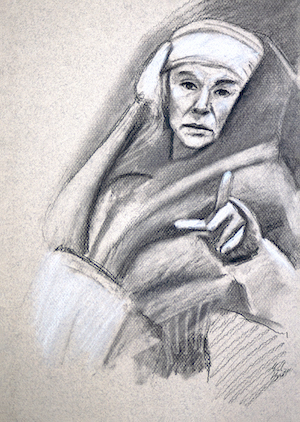
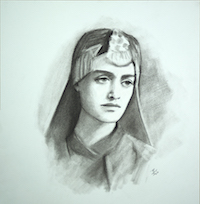
Naaman’s Servant ©MicahHayns

2 Kings 5

This next story is rather close to the bone as it involves a contagious disease. Those suffering from this illness were designated ‘unclean’ and were separated from society for the protection of others. The disease was known as leprosy, although in the bible the term actually describes a multitude of skin diseases, such as psoriasis and scabies as well as ‘Hansen’s Disease, which is what we now call leprosy. Leprosy was not a discriminating disease, it infected people across society – those living in poverty suffered alongside the wealthy and powerful.

Our next woman had no power, prestige or popularity. She was merely a servant girl and, like so many of our women, we don’t know her name, but she was an Israelite girl who had been captured during one of the many raids on Israel by their Aramean enemies to the north. She is described as ‘a young girl’ and so it is likely she was around 12 years old. She had been given as a servant to the wife of Naaman who was the commander of  King of Aram’s army and was known by all to be ‘a great man’ – he was highly respected, popular and had won battles for the King, but he suffered from this disease.

It might be useful to have a big of background to the political situation of the time. The year was around 930BC and Israel and Judah had been separate kingdoms for around 80 years. Israel had seen nine rebel kings who had turned to idolatry, worshipping golden calves, the god Baal, and other deities.

But despite this turbulent situation, there remained a ‘remnant’ within the kingdom who had continued to worship the true and living God, Yahweh (1 Kings 19.18). It is likely that our servant girl came from one of these families. She had a strong faith and perhaps it was this that enabled her to speak up when confronted with Naaman’s distress at his illness:

She said to her mistress, “If only my lord were with the prophet who is in Samaria! He would cure him of his leprosy.

1 Kings 5.3

It isn’t hard to imagine the terror of being captured in an armed raid and being taken to a foreign land to work as a slave in the household of the very person who had captured you. Perhaps she held her captors in contempt and might secretly have enjoyed watching her master suffer from his painful and debilitating skin disease. But whether she felt this way or not is immaterial because the young woman doesn’t act on this. She seeks to help him by pointing him towards someone who she knew had the power to heal: the prophet Elisha.

It is extraordinary that these few confident, faithful words from a servant girl had such power that they galvanised the whole family, and even the king, into action.

Naaman’s wife spoke to Naaman and then he went to the King of Aram who gave him permission to travel to Israel and sent him to the King of Israel with a supportive letter and gifts. The journey would have taken them several days and, although it doesn’t say this in the text, it is probable that Naaman’s wife and the servant girl would have gone along with them. What must it have been like for her to travel back to her homeland, a place where she was once free and loved, but this time with those who had captured her and killed her people?

I wonder if she witnessed Elisha the prophet who, to Naaman’s horror, sent out his servant to tell him that his healing would come if he washed himself in the river Jordan seven times:

I thought that for me he would surely come out, and stand and call on the name of the Lord his God, and would wave his hand over the spot, and cure the leprosy!

2 Kings 5.11

Naaman did not realise that his healing would be deeper than just being cured of his skin disease. He also needed to be healed of his own arrogance, pride, self-importance, and no doubt much else besides.

If the young girl had been there she may well have been worried whether those confident words said to her mistress and which sparked such a journey would be fulfilled. What if Naaman didn’t get healed by Elisha and the whole journey was in vain? What would be the consequences of this outcome for her?

If she had worried, she didn’t need to:

So [Naaman] went down and immersed himself seven times in the Jordan, according to the word of the man of God; his flesh was restored like the flesh of a young boy, and he was clean.

2 Kings 5.14

Naaman turns to God and they return to their home in peace:

 “Now I know that there is no God in all the earth except in Israel; 

2 Kings 5.15

Reflection and Prayer

Don’t let anyone look down on you because you are young, 
but set an example for the believers in speech, 
in conduct, in love, in faith and in purity. 
1 Timothy 4.12

The story of this faithful servant girl is a good reminder of the importance of having the courage to speak up about our faith at times. She could easily have believed that she was insignificant and that no-one would listen to what she had to say, and have kept quiet. Yet she shared her faith, and in doing so transformed the life of another person.

How often do we think that what we have to offer or share isn’t of much value? How often do we keep quiet about our faith in case we are ridiculed, mocked or ignored? Are there moments in your own life where you wished you had spoken up? Let us pray for the courage and faith of this young girl.

Prayer

Empower me
to be a bold participant,
rather than a timid saint in waiting,
in the difficult ordinariness of now;
to exercise the authority of honesty,
rather than to defer to power,
or deceive to get it;
to influence someone for justice,
rather than to impress anyone for gain;
and, by grace, to find treasures
of joy, friendship, healing and peace
hidden in the fields of the daily life
you have given me to plough.

The Widow of Zarephath: giving and receiving

The Widow of Zarephath ©MicahHayns

1 Kings 17. 7-24

Whenever I can I help out at the Community Emergency Foodbank in Oxford which is run by my wonderful mother. The Foodbank provides much needed sustenance to an ever growing number of families every week who struggle to provide food for themselves and their children.

Our next woman was in a similar position.

She’s known in the bible as ‘The Widow of Zarephath’ and she lived in a thriving trade centre in the province of Sidon at the time when the king of Israel was Ahab, ‘who did more evil in the eyes of the Lord than any of those before him’ (1 Kings 16.30). She had a young son to care for but as she had no husband she was vulnerable. Things were especially difficult as there was a drought in the land and she was at the point where she was down to her very last day of food, and she was close to giving up.

The prophet Elijah encountered her at the city gates where she was gathering sticks for her final meal with her son:

I am now gathering a couple of sticks, so that I may go home and prepare it [bread] for myself and my son, that we may eat it, and die.

1 Kings 17.12

Elijah had predicted the drought to King Abab and for some years had been living on the banks of a Wadi (stream) where he was said to have been fed by ravens (1 Kings 17.3). When the stream eventually dried up the Lord told Elijah to go to Zarephath, and it was here that the thirsty and hungry prophet met our widow.

He asked her for water, which she went to fetch for him, but then he asked for more that she could provide:

Bring me a morsel of bread

1 Kings 17.11

It may only have been a morsel, but even that meager amount was too much for her. Elijah told her to not be afraid, to go home and make two small cakes, one for him and then one for her and her son. He promised there would be enough, not just for that day, but until the drought ended.

She went and did as Elijah said, so that she as well as he and her household ate for many days. The jar of meal was not emptied, neither did the jug of oil fail.

1 Kings 17.15-16

There was plenty of food for them all.

The widow’s story doesn’t end there though, because even in the midst of this miracle, tragedy struck. Her beloved son became ill and died. She cried out to Elijah and in her grief looked to find someone to blame for her loss:

What have you against me, O man of God? You have come to me to bring my sin to remembrance, and to cause the death of my son!

1 Kings 17.18

Elijah had no answer for this. Instead he took hold of her son, carried him to an upper room, and cried out to God:

O Lord my God, have you brought calamity even upon the widow with whom I am staying, by killing her son?

1 Kings 17.20

In a remarkable act of faith Elijah stretched himself out on the boy and asked God for the boys’ life to return to him, which it did, ‘the life of the child came into him again, and he revived’.

Elijah Revives the Son of the Widow of Zarephath,
Julius Schnorr von Carolsfeld (1794 – 1872)

We can only imagine the joy this woman felt to see her son returned to her. Not only had the Lord provided her with enough food to sustain them through the drought, but even the death of her son was not the end of the story.

Now I know that you are a man of God, and that the word of the Lord in your mouth is truth.

1 Kings 17.24

Reflection and Prayer

Here is a boy with five small barley loaves and two small fish, 
but how far will they go among so many?...Jesus took the loaves, gave thanks, and distributed to those who were seated as much as they wanted'
John 6.9,11

There are numerous echoes from this encounter between Elijah and the Widow of Zarephath to the life of Jesus, and you can see why Jesus’ early disciples thought he was Elijah who had returned (John 1.21). Both Elijah and Jesus spent time in the wilderness before their ministry, and this particular story reminds us of the miracle of the feeding of the five thousand, where Jesus feeds a crowd with the small boy’s meagre offering of loaves and fishes. The widow was similarly generous with the little she had, and was rewarded with abundant blessings.

We are not in a time of literal drought (far from it considering the amount of rain we had this winter in the UK!), but we are in a time of wilderness and I don’t know about you, but it feels rather like a drought. In these times it is generally the poor who suffer the most. Perhaps this story is a reminder to us all to be generous with what we have, whether that is a great deal, or only the most meagre of morsels. We might also pray that God would transform what little we can give and and make it far more.

And let us support our local foodbanks at this time, remembering that just a tin or packet from each of us creates an abundance for other ‘widows’ in a time of need.

O Heavenly Father, who by thy blessed Son hast taught us to ask of thee our daily bread; have compassion on those who live in poverty and hunger; relieve their distress; make plain the way of help; and grant thy grace unto us all, that we bear each others’ burdens according to thy will; through Jesus Christ our Lord. Amen
George Appleton

The Queen of Sheba

Queen of Sheba ©MicahHayns

1 Kings 10 and 2 Chronicles 9

Our next woman is well-known, but the detail in the Bible is actually rather scant. Most of what we know about her is taken from legend, poetry, art and myth. In Ethiopian tradition she is called Makeda, and in Islamic and Yemeni tradition she is Bilquis.

The Queen of Sheba is the most exotic and enigmatic woman of this lent series and is markedly different to all the other women: she is a female ruler from a far-flung land, she is wealthy, and she seems to be totally independent of any man or of any particular social group. But what really sets her apart is that her journey is one of intellectual curiosity over and above anything else. She is a woman who loved wisdom and was willing to travel the world to seek it out.

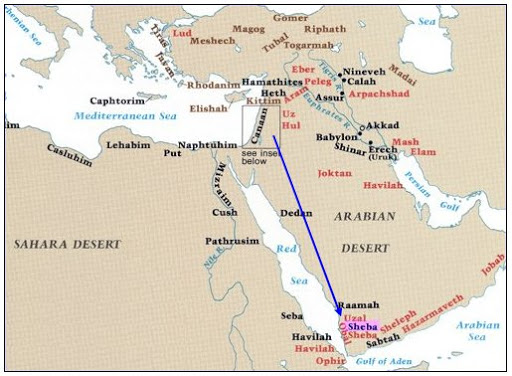
She was the queen of a land situated to the south of the Arabian desert, believed to have been the kingdom of Sheba, or Saba (which is in modern day Yemen). She had heard reports that King Solomon was the wisest man in the East and so set off on the long journey (some say it may have taken several years) to find out for herself.

When the queen of Sheba heard of the fame of Solomon, she came to Jerusalem to test him with hard questions 

2 Chronicles 9.1

She was fabulously wealthy and arrived in Jerusalem with a huge entourage that included camels, spices, precious stones, and gold. These were gifts for the king and would have been expected of a Royal visit. Her main interest does not seem to have been his wealth or huge palace, for her the audience with the King was a meeting of minds:

She came to Solomon and talked with him about all that she had on her mind. Solomon answered all her questions; nothing was too hard for the King to explain to her.

1 Kings 10.3
Piero della Francesco, Meeting between the Queen of Sheba and King Solomon, circa 1410-20

She was impressed by Solomon’s intellect, wisdom and wealth and this led her to turn to praise God at all that she saw:

Blessed be the Lord your God, who has delighted in you and set you on the throne of Israel! Because the Lord loved Israel forever, he has made you king to execute justice and righteousness.

1 Kings 10.9

Gifts of gold, spices and precious stones were handed over and then the Queen, having asked all the questions that she had on her mind, and learned all that she could from King Solomon, set off back to her home land.

Reflection and Prayer

Wisdom cries out in the street;
    in the squares she raises her voice.
21 At the busiest corner she cries out;
    at the entrance of the city gates she speaks:
22 “How long, O simple ones, will you love being simple?
Proverbs 1. 20-22

One of the many reasons I love my job as a university chaplain is being in the midst of so many people who are thirsty for knowledge and who are dedicating their lives to learning and seeking understanding. Like the Queen of Sheba they travel from around the globe in hope to find some of their questions answered.

There is difference between knowledge and wisdom though isn’t there? * Knowledge can be gained through reading, research and gathering information, but wisdom uses discernment, judgement and understanding to take this information and to use it for good. I often marvel at how the cleverest of people can make the most foolish decisions at times!

One of the great things about getting older is knowing that wisdom often come with maturity, especially if we are willing to learn from our mistakes and to change

In the Book of Proverbs ‘wisdom’ is personified as a woman,’lady wisdom’, who cries out on the streets calling men and women to the knowledge of God. Let us pray for wisdom, for ourselves and for our leaders at this time of global emergency.

Most Gracious and Holy Father,
give us wisdom to perceive you;
intelligence to understand you;
diligence to seek you,
patience to wait for you;
eyes to behold you,
a heart to meditate on you:
and a life to proclaim you,
through the power of the Holy Spirit
and the love of Jesus Christ, our Lord. Amen
Frank Topping, 1994

* John (my husband) says ‘knowledge is knowing that a tomato is a fruit; wisdom is not putting it in a fruit salad’!
 

Reclaiming Jezebel

Guest post by Matilda Hadcock, Undergraduate of History, Christ Church, Oxford

1 Kings 18-19, 21 and 2 Kings 9

Jezebel ©MicahHayns

The end of Jezebel’s life was a tragic one: she was pushed out of her window and fell to her death, then her body was eaten by dogs. Only her skull, feet and the palms of her hands remained.

This was said to have been God’s plan all along, revealed to the prophet Elijah. God had condemned the King of Israel, Ahab, including all his descendants and his wife in the curse:

Also concerning Jezebel the Lord said, ‘The dogs shall eat Jezebel within the bounds of Jezreel.’

1 Kings 21,23

Some people would argue that Jezebel deserved the end she received – as a harlot, pagan and temptress she should have expected nothing less. Others see Jezebel as a feminist icon – she lived the life she wanted and had no qualms about tarnishing her reputation; she probably would have glorified in her death. Neither interpretation leaves enough room for nuance.

The story of Jezebel is far from pleasant, and neither is it whole. Her story is told in pieces in the Bible, as is usually the way, through the men in her life. She is depicted as a wicked woman, but what else might her story tell?

There are two dictionary definitions of ‘Jezebel’. The first is in reference to her historical and biblical status as the Phoenician wife of Ahab, who pressed the cult of Baal on the Israelite kingdom and was finally killed in accordance with Elijah’s prophecy. The second is more descriptive: a jezebel is an impudent, shameless or morally unrestrained woman who gets her own way through deception. Along with sexual immorality, Jezebel is associated with vanity, worshipping false gods, and the female vice of seduction.

These common associations require some myth-busting.

Jezebel was the daughter of a Phoenician king, Ithobaal I, but she moved to Israel on her marriage to King Ahab. It was, as ever, a political marriage, the culmination of friendly relations between Israel and Phoenicia. Jezebel is blamed for introducing the nature god Baal-Melkart into Israelite society, thus confusing the Israelites about which was the true religion.

In fact, it was custom for Ahab to set up an altar for his wife to pray at, in the tradition of her home religion. The worship of Baal may well have been the only reminder of home that Jezebel had in Israel. The accusation that she prayed to false gods is only one perspective; at the time and in her mind, she must have been devout and loyal in her faith.

When Elijah orchestrated the killing of the priests of Baal, Jezebel was distraught. She threatened Elijah with death, bravely declaring:

So may the gods do to me, and more also, if I do not make your life like the life of one of them [ie. dead] by this time tomorrow.

1 Kings 19.2

Violence is common in the Old Testament, and Jezebel is not unique in her use of brutality. She stood up for what she believed in, asserting her queenly power in perhaps the only way that she knew would carry meaning.

Regarding her sexual immorality, there is no evidence in the Bible that Jezebel was unfaithful to her husband. She provided him with children, and cared for him. When Ahab got angry because he could not have the plot of land he desired, it was Jezebel who sought him out and calmed him. Ahab threw himself on the bed and turned his head away:

His wife Jezebel came to him and said, “Why are you so depressed that you will not eat?”

1 Kings 21,5

She seems to have been doing her best to be a good wife and Queen.

In the scene before her death, Jezebel appears at the window, looking down on Jehu, the new King of Israel. Jehu had been appointed by Elijah’s successor, Elisha. He had usurped and killed Joram, Ahab and Jezebel’s son, in order to remove the religion of Baal from the region.

Jezebel, in the last moments of her life, was looking down on the man who had killed her husband and her son. She is reported to have dressed up when she heard he was coming. Some interpret this to mean that she was attempting to seduce Jehu, acting indecently as ever. The alternative is that she put on her make-up and her royal garments in one last show of authority as the old Queen and mother of the rightful King. She was in a vulnerable position: she may have known she was about to die and the political situation was certainly not favourable. Rather than seeing her outfit as vanity and the work of a temptress, perhaps it should be considered as the last-ditch attempt of a grieving mother to maintain some dignity and pride.

But Jezebel was said to have been condemned by God. Why? She acted violently and hurt other people, apparently intentionally. In order to please her husband, Jezebel had the innocent commoner Naboth stoned to death. He had wanted to keep the vineyard belonging to his ancestors, but Jezebel fraudulently used Ahab’s seal to secure Naboth’s murder, pretending that he had blasphemed. This was an evil act, which her situation cannot excuse.

Prophets of Yahweh were massacred, and ultimately, Jezebel worshipped deities other than God. She was a false worshipper and did not heed His covenant. Elijah had attempted to spread God’s word amongst the Israelites and, however aggressively he had done so, she had responded in kind, threatening his life.

It is hard to know where Jezebel stands as a woman in the Judeo-Christian narrative. The understanding of Jezebel as a sexually and morally dubious character should not be believed so easily – it has been developed culturally, often for literary and cinematographic purposes. But neither should she be let off the hook. According to the Book of Kings, Jezebel really was a nasty piece of work, in league with her equally horrible and untrustworthy husband, Ahab.

In The Handmaid’s Tale, Margaret Atwood labels the seedy, misogynistic, patriarchally-run nightclub‘Jezebel’s’. Offred’s best friend, Moira, works there as a prostitute, and whilst the reader expects anti-establishment feminism, the nightclub comes to represent disappointment, weariness and loss of hope.

Perhaps this is reflective of Jezebel’s life? She lived in a time of political and religious turmoil, she was married to a seemingly wicked man, and she witnessed the murder of priests of her religion and one of her sons. Few people in the Old Testament are truly and immediately ‘good’. Whilst Jezebel cannot be considered a symbol of righteousness and virtue, not all of her actions deserve condemnation. She might not have been ‘good’, but we should be wary of reducing her to a figure of evil.

Prayer

A prayer of repentance:

If my soul has turned perversely to the dark:
If I have left a sister or brother wounded along the way;
If I have preferred my aims to thine;
If I have been impatient and could not wait;
If I have marred the pattern drawn out of my life;
If I have cost tears to those I loved;
If my heart has murmured against thy will,
O Lord, forgive.
F.B. Meyer

Abishag the Shunnamite

1 Kings 1: 1-27, 2:13-25

Abishag ©MicahHayns

The Award for the best name in the Old Testament goes to…

Abishag the Shunammite!*

She also had undoubtedly the strangest job in the entire Bible.

King David was very much past his prime. He was now an infirm old man and was so unwell that he couldn’t even keep himself warm at night. His servants tried to help by piling blankets on him, but this didn’t make any difference. They were worried for his life and so they came up with a plan.

They went out into the countryside of Israel and found a beautiful young virgin girl, probably around 12 years old. She was called Abishag and she was a Shunnamite from Isaachar.  

It was an interesting role description to say the least.

Let a young virgin be sought for my lord the king, and let her wait on the king, and be his attendant; let her lie in your bosom, so that my lord the king may be warm.

1 Kings 1.2
David and Abishag by Pedro Américo, 1879

Abishag’s role was to care for the King during the day, and at night she was to lie next to him to keep him warm! Thankfully the text clarifies one aspect:

The girl was very beautiful. She became the king’s attendant and served him, but the king did not know her sexually.

1 Kings 1.4

Like any lady-in-waiting or butler in a royal household Abishag would have seen a great deal from the sidelines without anyone paying her much attention, and she was in King David’s room to witness the drama over who would succeed the King to the throne.

King David’s eldest surviving son was Adonijah and he, having garnered support from a rogue priest (Abiathar), had announced himself as King without David’s blessing. He held a large celebration banquet with numerous royal officials and it seemed as if he would become the next king. David though had promised the throne to his younger son, Solomon, whose mother was Bathsheba.

A number of deathbed audiences ensued with both Bathsheba and Nathan pleading with the ailing King David to take control of the situation. He eventually does and Solomon was anointed by him as the next King. David died soon after and Solomon became the King of Israel. Abishag witnessed the whole thing from the edge of the room.

A little while later the ousted prince Adonijah returned to the palace and pleaded with Bathsbeba for the hand of Abishag the Shunnamite in marriage. She takes his request to Solomon who is furious:

 And why do you ask Abishag the Shunammite for Adonijah? Ask for him the kingdom as well! 

1 Kings 2.22

Why is he so angry?

It’s likely that Solomon realised that Adonijah’s proposal was a last ditch attempt to obtain the throne. It showed that Abishag was considered part of David’s harem, and therefore a marriage to her would have been politically expedient for him. It backfired badly as Solomon was so enraged he had Adonijah killed and the Priest Abiathar removed from the priesthood.

We don’t know what happened to Abishag after David’s death. It is likely that she remained part of King Solomon’s Harem, which at around 700 wives and 300 concubines was rather large!

Reflection and Prayer

Abishag the Shunammite had a memorable name and was set apart in King David’s household for a particular role (even though that role was bizarre and is uncomfortable for us to read or imagine every being acceptable), but there were countless other unnamed women who were just one of the 1000 wives and concubines of King Solomon. What must their lives have been like? It’s very hard for us to imagine isn’t it.

As we reflect on Abishag’s story let’s remember in prayer all those who care for the elderly and those at the end of their lives: particularly nurses, home carers, those who work in nursing homes, hospitals and hospices. It must be particularly difficult at the moment and especially hard when family members aren’t able to be with their loved ones in their final days. I hope those in the UK joined the nation in #clapforcarers at 8pm last night – how wonderful to see!

A prayer for Nurses:

*my husband’s Joke..
Abishag the Shunnamite… or she might not!

The Witch of Endor: going the extra mile

1 Samuel 28

Medium of Endor ©MicahHayns

One of the films I’m most looking forward to once we can go to the cinema again is Blithe Spirit, based on the play by Noel Coward and starring the great Dame Judy Dench. She will playing the role of the psychic medium Madame Acarti who summons the ghost of the late Elvira Condomine, the first wife of Charles, who then proceeds to haunt him and his current wife. You can see the trailer here

Our next woman is also a medium and she is commonly known as the Witch of Endor, although oddly the bible never actually calls her a witch. We don’t know her name but she was clearly a well-known figure in Endor and her life was likely to have been ‘underground’ and on the margins. The ancient religious tradition of the time believed that consulting the dead could reveal secret wisdom, but all witchcraft and necromancy (speaking to the dead) had been banned by Jewish law:

No one shall be found among you who makes a son or daughter pass through fire, or who practices divination, or is a soothsayer, or an augur, or a sorcerer, or one who casts spells, or who consults ghosts or spirits, or who seeks oracles from the dead. For whoever does these things is abhorrent to the Lord’

Deuteronomy 18. 10-12

Added to this King Saul had recently expelled all the mediums and ‘spiritists’ from the region (1 Samuel 28.3).

I have a confession to make here. My husband is a magician and before ordination I spent my time organising parties which included magic, fire eating and general sorcery. But we didn’t summon ghosts or consult with the dead, so hopefully that’s OK!

Considering King Saul had just banished all spiritualists it’s surprising that in his time of greatest need he turned to the Medium of Endor for answers. He was at the end of his life and the Philistine forces, with David now on their side, were preparing to fight him once again. He didn’t know what to do and so, in flagrant disregard for his own law, he disguised himself and went out late at night to visit the Medium to ask her to consult the late prophet Samuel.

She lets him in but is wary. She quickly sees through his disguise and thinks it might be a trick :

‘Why have you deceived me? You are Saul’

1 Samuel 28.12

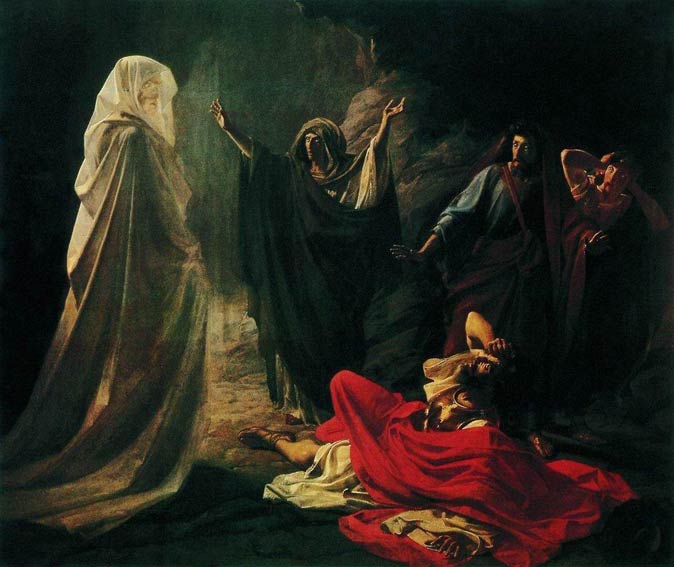
But she does what’s asked of her and summons up the spirit of the prophet Samuel. There is all the drama you would expect: Madam Acarti would have approved!

..she cried with a loud voice...I see a divine being coming up out of the ground.” He said to her, “What is his appearance?” She said, “An old man is coming up; he is wrapped in a robe.” 1 Samuel 28.13-14
Witch of Endor by Nikolai Ge, 1857.

Samuel tells Saul what he doesn’t want to hear: that Saul had angered the Lord, and by the next day he and his sons would be dead. He’s devastated by this news, understandably.

The story ends with a gesture which shows the kindness of the Medium of Endor towards the King. She saw Saul’s distress and offers him food, which he refused at first. She insisted and persuaded him to stay and even killed the fatted calf and baked some bread. He eventually ate and is restored enough to go on his way.

He does indeed die the very next day.

Reflection and Prayer

It’s hard to know what to make of this story. Do we believe the soul of Samuel was really summoned up, or was this some kind of trickery, or an apparition of a weary, hungry and desperate man? It’s been a cause of debate for centuries, with her being called a ventriloquist, a demon and a prophet. She’s been portrayed in fantasy art and even has a mention in the Star Wars franchise (the planet where the Ewok’s live is called Endor!). I don’t know the answer. I think it’s dangerous to dabble in the occult, but I’ve also been around enough magicians to know that most of it is simple sleight of hand and clever illusions.

But perhaps what we can take from this story is that she was a woman who was part of a persecuted group, who encountered the very person who had banished her people. She did what was asked of her but went the extra mile and provided much needed hospitality to her oppressor. An early Good Samaritan in fact!

But a Samaritan while traveling came near him; and when he saw him, he was moved with pity. He went to him and bandaged his wounds, having poured oil and wine on them. Then he put him on his own animal, brought him to an inn, and took care of him....Which of these three, do you think, was a neighbour to the man who fell into the hands of the robbers?”  He said, 
“The one who showed him mercy.” Jesus said to him, “Go and do likewise.”
From the parable of the Good Samaritan
Luke 10: 25-37

Support for our neighbours and for those in need is crucially important at this time isn’t it? And that support can sometimes come from the most unexpected people. Let us be thankful for all those who, like the Medium of Endor, go the extra mile.

Lord Jesus, who taught us to love our neighbour as ourselves,
we lay before you the needs and concerns of our community,
knowing that in your love for us you will hear, guide and heal
according to your wisdom;
help us in our daily living, to respond
with the same love, patience and mercy
to those who call on us.
For your names sake. Amen
Frank Topping


Abigail: the desert diplomat

1 Samuel 25: 1-44

Abigail ©MicahHayns

In 2014 Major General Kristin Lund of Norway was appointed as the first woman to serve as Force Commander in a United Nations peacekeeping operation. (1)

Our next woman, Abigail, was also a peacekeeper.

The whole story is written rather like a play within a play. The setting is in the desert at a time when the Israelites were desert tribes, Saul was still King, the prophet Samuel had just died, and David was gaining power as a tribal leader.

Abigail (meaning father’s joy) was married to Nabal (meaning fool or moron). They could not have been a more mismatched couple. Abigail was beautiful, intelligent and sensitive whereas Nabal was surly, mean and a drunkard. He had a large farm with 3000 sheep, 1000 goats and a property at the foot of Mount Carmel.

It was sheep shearing season, traditionally a time when communities would hold celebration feasts. David, whose men had protected Nabal’s farm, sent ten men to ask for some produce for the feast as payment. Nabal responded to their polite (although 10 men sounds pretty threatening) request by shouting at them and insulting the men, and David.

Who is this David? Who is this son of Jesse?

1 Samuel 25.10

David was furious when he heard this and began to prepare to go to war against them. One of Nabal’s men saw what had happened and wisely realised that there was no point talking to his master as ‘he’s so ill-natured that no-one can speak to him’. Instead he went to Abigail and explained the dangerous situation.

Abigail lost no time.

She gathered a number of gifts (including managing to rustle up 200 cakes of figs and 100 cakes of raisins, which is pretty impressive), loaded up the donkeys and headed off to meet David.

Abigail throws herself at David’s feet. Minature from Rudolf von Ems’ World Chronicle, Codex bibl. 205, fol. 136 (14th Century)

She found him and his men on their way to battle. She got off her donkey, threw herself at David’s feet and then delivered a brilliant peacekeeping speech: a speech which appealed to David’s pride and was both theologically compelling and strategically sensible. She used winning peace making strategies, many typically used by women who don’t have power and strength on their side:

  • Flattery – ‘my Lord’
  • Humility – ‘let the blame be on me alone’
  • Explanation – ‘pay no attention to that wicked man Nabal – his name is Fool and folly goes with him’
  • Gift giving – ‘let this gift.. be given to the men who follow you’
  • Appeal to the conscience – ‘let no wrong-doing be found in you as long as you live’.

Abigail’s speech changed David’s heart and he called off his men.

May you be blessed for your good judgement and for keeping me from bloodshed this day

1 Samuel 25.33

What Abigail did that day was hugely risky. David could easily have killed her, and even after her meeting with him she then had to go back home to face the wrath of her husband. Once back she found him ‘in high spirits and very drunk’ and so she wisely decided to wait until he had sobered up to tell him what she had done.

A C14th depiction of Abigail tending Nabal by John de Teye (1361-1384)
commons.wikimedia.org

He was so shocked ‘his heart failed him and became like stone’. (37)

It is likely that he had a stroke or a heart attack, and 10 days later he died.

Abigail’s story doesn’t end there as David, hearing of Nabal’s death, sends for her and she becomes his wife, and the mother of his second son (Daniel).

Reflection and Prayer

Abigail’s story is one of salvation.  She saves her household and herself from her boorish husband and from the ensuing army set to destroy them. She saved David from acting in a way that would lead to sin, and she secured peace in the region and a better life for herself and her people.

A very early role model for the female peacekeepers of the United Nations today?

As we remember Abigail let us pray for all those who are peacemakers in our communities, for those who do this on a global and national stage, but also for those who are involved in conflict mediation on a local level. Let us also remember women who are today living with partners who struggle with alcohol addiction, and who’s behaviour is unpredictable and violent. This must be particularly difficult during this difficult time.

O God, from whom all holy desires, all good counsels, and all just works do proceed: Give unto thy servants that peace which the world cannot give, that our hearts may be set to obey thy commandments,
and also that by thee, we, being defended from the fear of all enemies,
may pass our time in rest and quietness;
through the merits of Jesus Christ our Saviour. 
Amen.
The Collect for Peace from the Book of Common Prayer

(1 and 2) https://unu.edu/publications/articles/why-un-needs-more-female-peacekeepers.html

Michal: a tale of love and hate

1 Samuel 18-19; 2 Samuel 3.13-16; 6.12-23

Michal ©MicahHayns

There’s a beautiful word in Hebrew חֶסֶד that’s pronounced ‘hesed’. It’s often translated as ‘loving kindness’ and is a word that describes the sacrificial love that exists between people, and that of the love God has for humanity.

It’s interesting though that the root of the word can mean both passion for someone and also passion against someone. Love and hate are closely entwined, and the most passionate love can turn very quickly into something ugly, as anyone whose marriage or relationship hasn’t turned out as they expect will know only too well.

Michal’s story involves deep love but it’s a love that is never truly shared and it turns into profound bitterness, and ultimately to hatred.

Michal was the youngest daughter of King Saul, the first king of Israel and Judah, and she is the only woman the Bible explicitly states as loving a man:

Now Saul’s daughter Michal loved David. Saul was told, and the thing pleased him. 

1 Samuel 18.20

David was a handsome young man in the king’s household who’d gained Saul’s favour by killing off his enemy Goliath. Saul was delighted with the idea of a union between his daughter and David for the sole reason that he saw it as an opportunity to get rid of his rival, and his plan is both macabre and bizarre.

In those days it was customary for the groom to offer a gift to the father of the bride, but what Saul demanded for his daughter was:

no other price for the bride that a hundred Philistine foreskins’

1 Samuel 18.25

She was worth A HUNDRED FORESKINS! There is no doubt that Saul was hoping that David would be killed in the process of collecting this macabre gift, but in fact David hands over double this and the marriage is agreed.  

You may remember the quote by Princess Diana when speaking about her marriage to Charles:

'There were three of us in this marriage'

For Princess Michal there were rather more as Polygamy (for men) was allowed at this time in Israel’s history and David had up to seven wives. The other person to show this deep ‘hesed’ love towards David was in fact not another wife, but Michal’s brother, Jonathan:

the soul of Jonathan was bound to the soul of David, and Jonathan loved him as his own soul… Then Jonathan made a covenant with David, because he loved him as his own soul. Jonathan stripped himself of the robe that he was wearing, and gave it to David, and his armour, and even his sword and his bow and his belt. 

1 Samuel 18.2-3

It’s hard to find a more beautiful description of covenanted love in the bible than the one made between Jonathan and David.. but that’s another story!

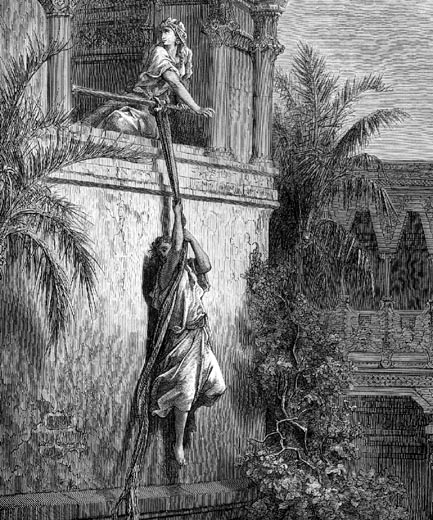
Michal lets David escape from the window. A painting by Gustave Doré, 1865. commons.wikimedia.org

Saul’s jealousy towards his son-in-law built. His rages became more violent and unpredictable and he vowed to kill him. Both Michal and Jonathan showed ‘hesed’ love by helping David escape at great personal risk. Jonathan warned David that Saul wanted to murder him and Michal let him out of the window and then duped her murderous father into thinking he was sick by putting a dummy in his bed and dressing it up. It’s was an incredibly brave act and gave David time to escape.

As David had fled Michal was given in marriage to ‘Paltiel son of Laish, who was from Gallim’, but once David became King he demanded she be brought back to him. Poor Paltiel was bereft and followed behind her weeping before being sent back home.

Any initial love that Michal had towards David was a distant memory by the end of their relationship.

David returned from war having claimed the Arc of the Covenant (the ancient symbol of God’s presence), and was so happy he danced in the streets with abandon:

David, wearing a linen ephod, danced before the Lord with all his might, whilst he and the entire house of Israel brought up the ark of the Lord

2 Samuel 6.14

Michal watched him from a window: she was not impressed. David had gone back home expecting a hero’s welcome from his wife, but instead he got the full force of her fury:

by Francesco de Rossi, 1552-1552 (Wikimedia)

When she saw King David leaping and dancing before the Lord, she despised him in her heart….How the king of Israel honoured himself today, uncovering himself today before the eyes of his servants’ maids, as any vulgar fellow might

2 Samuel 6.16, 20

The argument descended as so many marital rows do. He told her he could celebrate however he liked and warned her he could become even more undignified. She accused him of losing his clothes in front of the servants and he threw at her the fact her father lost the entire kingdom!

Hurtful words said in the heat of an argument can’t easily be taken back again.

Sadly, Michal and David’s relationship (if their union could ever have been called that) never recovers and the last we hear is:

Michal daughter of Saul had no children to the day of her death.

2 Samuel 6.23

Reflection and Prayer

Though the mountains be shaken and the hills be removed, 
yet my unfailing love (hesed) for you will not be shaken
 Isaiah 54:10

Michal is a great character isn’t she? I find it refreshing to read about a bible woman given a a full range of human emotions, from sacrificial love, to irritation, to downright hatred! She was willing to dedicate her life to David but by the end even the way he danced drove her mad with irritation.

Her story reminds us of the delicate nature of human love. It’s so easy to take one another for granted and to let the small irritations fester and grow. Let’s protect and nurture the loving relationships that we have, whether they be with a partner, friend or family member, and especially at this time of global and local anxiety. Remember that the love we have for one another is but a dim reflection of the sacrificial (hesed) love that our heavenly father has for each of us, a love that is revealed through the ultimate sacrifice of Jesus on the cross.

A blessing from the 2nd Century for us all:
O Sovereign God, bless all thy people, and all thy flock. Give thy peace, thy help, thy love unto us thy servants, the sheep of thy fold, that we may be united in the bond of peace and love, one body and one spirit, in one hope of our calling, in thy divine and boundless love. Amen

Liturgy of St Mark, 2nd Century

(1) From Jenni Williams, God Remembered Rachel, SPCK, 2014, chapter 6

Hannah: she rose

1 Samuel 1: 1-28, 2:1-11, 18-21

Here’s a quick quiz for you. How many women in the bible can you think of who were known to be infertile (at some stage)?

And how many men?

I thought so!

Hannah is one of several bible women whose story revolves around infertility and the longing for a child. She lived in Israel at the time when Eli was the High Priest. She was married to Elkanah who had a second wife called Penninah.

It’s perhaps worth giving a bit of background into the culture of the time. In the ancient world to be married and childless was a social disgrace. There wasn’t the understanding that fertility could also be a male issue, and it was believed that the woman who didn’t conceive wasn’t living up to the Creator’s command to be ‘fruitful and multiply’ (Genesis 1:28). The expectation was that women should become the mothers of sons, who would continue the family name and provide for them in their old age. It was of course a classic patriarchal society and women unable to do what was required of them were often shunned and excluded from society. And so with that background we can understand Hannah’s story better:

Peninnah had children, but Hannah had no children.

1 Samuel 1. 2

Elkanah was supportive and generous, even giving Hannah double portions of food during the annual sacrifice feast, ‘because he loved her’. But for Hannah, it was Penninah, the other woman, who seemed to cause her the most pain.

Her rival used to provoke her severely, to irritate her, because the Lord had closed her womb. So it went on year by year as often as she went up to the house of the Lord, she used to provoke her.

1 Samuel 1.6

Hannah became depressed, even getting to the stage that she couldn’t eat and spent her time in tears. Elikinah doesn’t seem to understand the depth of her sadness: of course, he already had children and so for him a child with Hannah wasn’t necessary:

Elkanah said to her, “Hannah, why do you weep? Why do you not eat? Why is your heart sad? Am I not more to you than ten sons?”

1 Samuel 1.8

Despite all of this sadness Hannah was a woman of deep faith and of hope, and the turning point in her story comes with two powerful words:

Hannah rose

Hannah rose up, went to the temple to pray day after day, even though she had to suffer Peninnah’s taunts on the way. One day she was praying so earnestly and with such passion that the priest at the temple (Eli) thought she must be drunk!

Hannah and Eli engraving by German painter Julius Schnorr von Carolsfeld

No, my lord, I am a woman deeply troubled; I have drunk neither wine nor strong drink, but I have been pouring out my soul before the Lord

(1 Samuel 1.15)

She vowed that if God gave her a child then she would repay this blessing by offering him back to God to live and work in the temple. She becomes pregnant and carried out her promise to the Lord. When her child Samuel (which means God has heard) is fully weaned (probably about 3 years old), she took him to the temple where he grew up under Eli’s guidance. She to visit him every year with clothes she had lovingly made for him, and went on to have five more children.

Samuel grew to be one of the greatest prophets in Israel.

Reflection and Prayer

For it is the God who said, “Let light shine out of darkness,” who has shone in our hearts to give the light of the knowledge of the glory of God in the face of Jesus Christ. But we have this treasure in clay jars, so that it may be made clear that this extraordinary power belongs to God and does not come from us. We are afflicted in every way, but not crushed; perplexed, but not driven to despair.
2 Corinthians 4: 6-8

There was a time in Hannah’s story when her longing was so great that ‘her heart was sad’. No amount of kind words or extra portions of food from her husband was going to make any difference to this. It must have been difficult for Elkanah to know how to support his beloved wife in her despair. What changed things in the end for Hannah was that she ‘rose up’ and somehow managed to find the strength to go the temple and pour out her heart to God. Sometimes even doing that seems impossible.

These are troubling days for so many people and so let us pray for all those whose hearts are sad at this time, for those who can’t even find the strength to eat or pray, and for those who stand beside them wondering how best to help.

O God, from whom to be turned is to fall,
to whom to be turned is to rise,
and in whom to stand is to abide for ever:
grant us in all our duties thy help,
in all our perplexities thy guidance,
in all our dangers thy protection,
and in all our sorrows thy peace;
through Jesus Christ our Lord. Amen
Augustine, 352-430

Bathsheba’s Song

Bathsheba ©MicahHayns

From 2 Samuel 11

Guest Blog by Milly Sinclair, training consultant…and my sister!

How long, how long will we sing this song
How long…

Raped Bathsheba
Given a name
But no voice
Just another
Naked beauty
Broken
A footnote in a
Famous man’s story

Boy David
Turned Goliath
Powerful man king
Snatching at flesh
That wasn’t his
To take

And Oh, oh, oh
she had no stone to fell him

The fame of
David’s name.
His lust known
His rape
His murder:
‘You are the man… yes you are the man.’
His lavish atonement
His grief
His poetry
His lineage
Writ large for perpetuity

Bathsheba
You share the blame
Of his shame
Your child taken.

How wild was David’s grief
How deep and wide David’s repentance…
‘wash me as white as snow’

Bathsheba’s cries unheard
Bathsheba’s grief unwritten
Bathsheba’s rape unredeemed
Bathsheba’s stain unwashed
Wife of a murdered husband
Mother of a stolen child
Forced to drink
Again… and again…
The bitter cup

All the women,
Yes, all the women
Whose bodies are used
As weapons of war,
All the footnotes
In powerful men’s story,
All that share the blame
Of man’s shame.
All the nameless,
The blameless
The wordless
Raped women
Line up… line up
Fill our ears with your voice.
Bathsheba’s story is your story
We hear you.

How long, how long will
We sing this song
How long….

Broken, naked woman
Broken, naked, man
Redeem us.

It is Mothering Sunday in the UK tomorrow, a day that is full of joy for some and sorrow for others. This year will be particularly difficult for all those who can’t be with their mothers. And so let us pray for women who are mothers, for our own mothers, for those who long to be a mother, and for all those who have a ‘mothering’ role in caring for children and young people.

Lord, we pray for the women of our world
the mothers of all nations.
May those who suffer violence be given strength to survive.
May those who suffer poverty and distress be given hope and aid.
May those who suffer pain and fear be given relief and courage.
May those who are homeless be given shelter and protection.
Lord guide those who have, that they may give
with love and compassion to those who have not.
A prayer from Pida Ripley, London