Tamar: ruin and righteousness

Genesis 38

Written by Alannah Jeune, Doctoral student in History, University of Canterbury, New Zealand

I was ten when prostitution became legal in New Zealand, my home country. I remember the debates and news coverage surrounding the decision and the sudden increased visibility of street prostitution in my part of the city. My understanding of prostitution was very limited – largely derived from biblical passages and stories, and I think I had assumed it was something that only happened in ‘olden times’.

I can only faintly recall hearing the story of Tamar in Church, and the little I did remember was that she was characterised as a prostitute. But Tamar is far from the deceptive temptress that this label implied – her story is that of a remarkable woman who was to become one of only four women named in Jesus’s ancestral line.

Tamar’s story falls in the middle of the Genesis account of Joseph and his brothers. Chapter 38 begins with Judah and his three sons Er, Onan and Shelah. Tamar is married first to Er:

But Er, Judah’s firstborn, was wicked in the sight of the Lord, and the Lord put him to death.

Genesis 38:7

Judah then instructs his second son, Onan to marry Tamar according to levirate custom. This custom stated that any children born to the couple would be legally Er’s and inherit on his behalf. Therefore, Onan ensured that Tamar would not become pregnant, with the result that he too was put to death by the Lord.

Judah, probably a little nervous about Tamar by this point, ordered her to return to her father’s house telling her to wait there until Shelah was old enough to marry. Tamar does this and lives as a young widow in her father’s household, but Judah does not send for her once Shelah is grown.
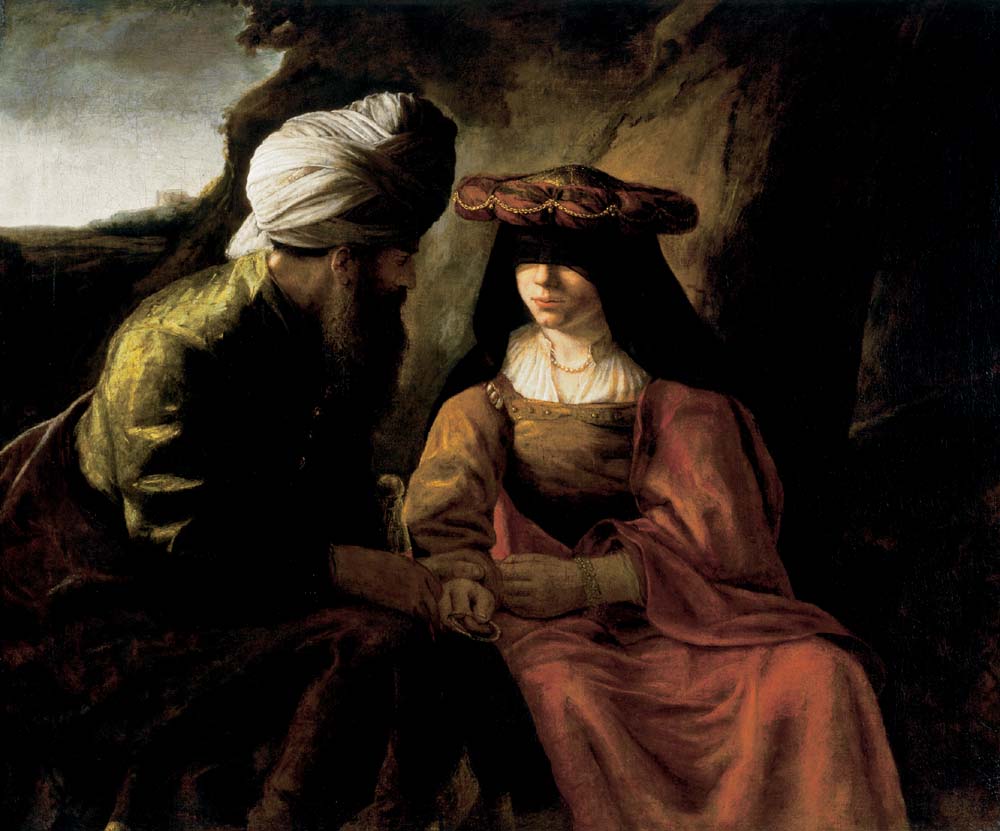
Judah and Tamar, School of Rembrandt, 1650-1660

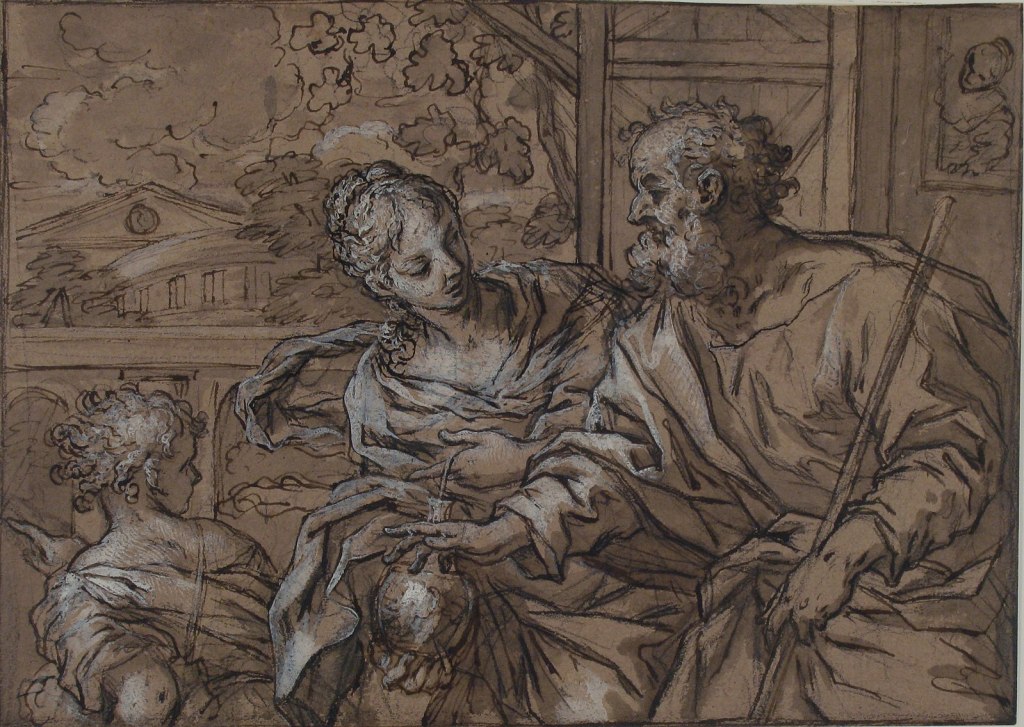
By this point Judah’s own wife has died, and when Tamar hears he is going on a journey to Timnah, she decides to take control of the situation. She dresses herself as a prostitute and sits at the entrance of Enaim, a town on the way to Timnah. Judah propositions her, sleeps with her, and leaves his signet and staff as a pledge till he can send a young kid to her as payment. However, Judah is unable to find the prostitute when he returns to recover his identifying belongings.

Meanwhile, Tamar has become pregnant by Judah and this is soon noticed. Judah is informed and he orders that she be brought out and burned. Tamar shows Judah his own signet and staff and tells him she is pregnant by the owner of these items.

Then Judah acknowledged them and said, ‘she is more in the right than I, since I did not give her to my son Shelah.’

Genesis 38:26

The tale concludes with the birth of Tamar’s twins: Perez and Zerah.

Tamar’s story is messy. She is passed as property from one man to another, from her father via Judah to Er then to Onan, then back to her father. At no point does Tamar have any choice or control. Her future is bleak – as a childless widow she has no societal standing, nor the security of someone to care for her in her old age. Hers is a situation in which women across the generations have found themselves caught – in a patriarchal society, the worst thing to be is a woman alone.

While emotional details are scant, Tamar’s story reveals a lot about her relationships with the men who control her life. Tamar’s first husband is put to death by the Lord for wickedness… it is no stretch to assume that this was not the happiest of marriages for Tamar, and that she may have suffered at his hands. But being married to a wicked man and all the trials that comes with such a union, was preferable to no marriage at all. And her father-in-law not only cheats her out of a marriage with Shelah, but seems to have been a man of questionable morals – Tamar chose the disguise of a prostitute implying she knew that Judah would be likely to use such services.

This is not a family anyone would choose to join willingly, but Tamar has few options so takes control of her own future through the only means she has. She has nothing to barter with but her own body, and her capacity to bear children, so this is the way provides herself with some security.

And yet this dysfunctional family is one that God has chosen to bless. Matthew’s gospel recounts Jesus’ genealogy and there in verse 3 is Tamar:

and Judah the father of Perez and Zerah by Tamar, and Perez the father of Hezron, and Hezron thefather of Aram

Matthew 1:3

Tamar could not have known that through her son Perez, she would be an antecedent of Jesus. Her actions were designed only to ensure her own survival in a deeply patriarchal world – with few options open to her, she makes a difficult choice and tries to gain some control over her life. She changes her narrative  from that of a desperate victim of circumstance to a woman who is praised for her righteousness by her family.

Tamar’s story is difficult, but that is why it is powerful. The Bible does not edit out the difficult parts, just as we cannot edit out the painful, messy and difficult parts of our lives, no matter how much we might want to. Because God is there in the difficulties, in the mess. He works through imperfect and flawed people like Tamar and her family, just as he works in our lives in both the bad times as well as the good.

It is easy to feel God with us and working through us when things are going well – when we are succeeding, loving our neighbours and full of hope. But Tamar reminds us that He is also with us in the depths of our despair, in the lowest moments of our lives or those times when we feel we are falling short.

Prayer

Tamar’s story does not belong in ‘olden times’, she embodies the female experience of so many women around the world who live under oppressive political or social systems. But she also embodies that hope for us all – that even in the worst of times, God is with us and working through us.

A Prayer for International Women’s Day (which is tomorrow)

God of all, God of hope,
We pray for women and girls today.
That they will be all they can be.
Give us courage to speak and work
For equality and justice
Until the earth is filled
With righteousness and love.
Amen.

Potiphar’s Wife: the seductress

Genesis 39

Potiphar’s Wife ©MicahHayns
Potiphar was cool and so fine
But his wife would never toe the line
It's all there in chapter 39 of Genesis
She was beautiful but evil
Saw a lot of men against his will
(from Joseph the Musical)

One of the things you quickly notice when reading about the women in scripture is often they are often only allowed one characteristic (jealous sister, childless woman, whore), whilst the men are able to be complex and multi-faceted.

Take the story in Genesis about Joseph – he’s a good example. Joseph, sold by his jealous and deceitful brothers into slavery in Egypt, had been the favoured and much beloved son of Jacob and Rachel. He was a dreamer and rather vain (he loved that coat!), but was also resourceful and cunning, fearful and faithful.

Potiphar’s Wife, on the other hand, was only one thing:

A Seductress.

We don’t find out anything much about her life and we don’t even get to know her name.  We don’t know whether she had children, whether she was a kind or demanding mistress, or what Potiphar, an Officer of the King of Egypt (Pharaoh), was like as a husband.

It’s likely that she lived in luxury. They had servants and a large household, within which Joseph had worked his way up the ranks to become the overseer, like a young Mr Carson (from Downton Abbey).

Now Joseph was handsome and good-looking. And after a time his master’s wife cast her eyes on Joseph

Genesis 39.6-7

Mrs Potiphar was clearly very taken by this handsome young Hebrew man. She began to pay him ‘special attention’ and then one day propositioned him:

Lie with me

Genesis 39.7

The story is told as if this attraction was entirely one way but this may well not have been the case. It has all the hallmarks of a Downton Abbey upstairs-downstairs affair. She was certainly infatuated with Joseph and he may well have been attracted by his mistress, but he would have known that if he slept with her he risked his job, his place in the household, and even his life: adultery was punishable by death. He was also faithful to God:

How then could I do this great wickedness, and sin against God?

Genesis 39.9

So, Joseph resisted but Mrs P persisted, until one day they found themselves alone.  She made a pass at him and even got some of his clothes off, but Joseph ran out of the house leaving her holding his ‘garment’.

Joseph wanted to resist her till
One day she proved too eager
Joseph cried in vain
"Please stop, I don't believe in free love"
1910 comic caricature of Joseph and Potiphar’s wife by Joseph Kuhn-Régnier,
Notice the chilled wine bottle and glasses on the small table at the left!

She was furious. How dare he, a slave, spurn her. She turned against him, and in her fury accused him of attacking her: she had his coat as proof. Joseph was thrown into prison.

Poor, poor Joseph, what'cha gonna do?
Things look bad for you, hey, what'cha gonna do?

Once in Prison Joseph began to interpret dreams and this led to him being introduced to Pharaoh himself, and becoming the Egyptian King’s right hand man. We hear nothing more of Potiphar’s wife.

Her role as ‘the seductress’ has been fulfilled and she’s no longer necessary for the rest of the story.

Reflection and Prayer

I pray, O Lord, that I will not fall into temptation; for the spirit is willing, but the flesh is weak
Matthew 26.41 (Good News Version, adapted)

Many of the women in the Hebrew Scriptures are portrayed as innocent victims and so it’s surprising and rather refreshing to come across a woman like Potiphar’s wife, a powerful protagonist and an instigator, and who desired love rather than children. Perhaps today we can pray for all those whose love is unrequited, for those who are tempted into adultery, and for those who continue to resist.

O God our Father, hear me, who am trembling in this darkness, and stretch forth thy hand unto me; hold forth thy light before me; recall me from my wanderings; and thou be my guide, may I be restored to myself and to thee
Augustine, 354-430

Dinah: The Voiceless One

Genesis 34

We have been lost to each other for so long. My name means nothing to you. My memory is dust. This is not your fault, or mine. The chain connecting mother to daughter was broken and the word passed to the keeping of men, who had no way of knowing.

From The Red Tent by Anita Diamant, page 1

The Red Tent is a wonderful novel by Anita Diamant which imagines Dinah’s story rather differently to the text we are given in Genesis 34.

There is a problem with the story of Dinah. We hear about an horrific crime committed against her, but the difficulty is that as everything is told from the point of view of either the accused (Shechem), or the accusers (her brothers), it’s hard to know the truth of the matter. She doesn’t get to say a word.

It’s a gruesome tale and needs a trigger warning as it contains a rape.

Dinah was the only daughter of Jacob and Leah and so we know that she had six brothers and six half-brothers. The story we are told in Genesis 34 is that Dinah went to visit the local women and whilst there she encountered the son of the local ruler called Shechem.

[he] saw her, he took her and raped her

Genesis 34. 2

This is a despicable crime and we deplore any violence towards women of this kind, whether happening now or thousands of years ago in the ancient world.

Shechem then ‘falls in love’ with Dinah, ‘speaks tenderly to her’, and asks his father Hamor if he can marry her. At that time it was unheard for women from the Abrahamic tribes to intermarry with local people, and so this was a bold request.

Hamor went to speak with Jacob to ask for his daughter’s hand in marriage for his son but at this point her brothers turned up, hear what had happened and fly into a rage. 

They were filled with grief and fury, because Shechem had done a disgraceful thing in Israel by lying with Jacob’s daughter – a thing that should not be done.

Genesis 34. 7

Shechem and Hamor pleaded with Jacob and offered a dowry for Dinah’s hand in marriage. But the brothers refused. This time their refusal was because Shechem was ‘uncircumcised’ and therefore considered unclean. They claimed that the marriage would be ‘a disgrace to us’.

They hatched a plan. They tell Shechem that the marriage (and other marriages between the Israelites and the locals) can go ahead only if all the men in their community are circumcised.

And Shechem agrees to this, and in fact does so with gusto:

the young man.. lost no time in doing what they said, because he was delighted with Jacob’s daughter.

Genesis 24. 19

The circumcision of the Shechemites. Engraving by J. Muller 1571-1628. Credit: Wellcome Collection

And all the men get circumcised. Imagine what that must have been like. Imagine the groans of pain emanating from every household as all the men nurse their tender nether regions!

Three days later Simeon and Levi, two of the brothers, take matters into their own hands. Whilst all the Canaanite men were in pain they went into the town and attacked them, killing them all and looting from their homes. It’s another terrible crime.

 Shechem and Hamor are murdered, and Dinah is ‘rescued’.

What is so brilliant about Anita Diamond’s book ‘The Red Tent’ is that she imagines this story differently. She imagines that Dinah falls in love with Shechem, sleeps with him and then hopes to marry him. Dinah pleads with her father that the marriage might go ahead, and encourages Shechem and the Canaanites to be circumcised as she shares her faith. Her brothers are so blinded by their rage, pride and assumptions about their sister – she couldn’t possibly have willingly have had sex with an outsider, it therefore must have been forced – that they don’t listen to her and carry out a terrible atrocity against her will.

Was Dinah a woman who was raped and held against her will? Or was she a woman who loved someone who her family disapproved of and paid a terrible price?

We can never know for sure. Without the voice of the woman in the story being heard we are only getting half the truth, which isn’t truth at all.

It's a wonder that any mother ever called a daughter Dinah again. But some did. Maybe you guessed that there was more to me than the voiceless cipher in the text. Maybe you heard it in the music of my name: the first vowel high and clear, as when a mother calls to her child at dusk; the second sound soft, for whispering secrets on pillows. Dee-nah.
The Red Tent, Anita Diamant

Refection and Prayer

This is a difficult passage to reflect on, but sometimes we need to focus prayerfully on the darkness in our world. We remember all women (and men) who have suffered from sexual violence and rape. We also remember women who are prevented from marrying the people they love by their family members, and recall that ‘honour killings’ are sadly still going on every day in our world. And we remember all those whose voices aren’t heard and whose stories will never be told.

Let us pray for light in the darkness.

Eternal Light, shine into our hearts,
Eternal Goodness, deliver us from evil,
Eternal Power, be our support,
Eternal Wisdom, scatter the darkness of our ignorance,
Eternal Pity, have mercy upon us;
that with all our heart and mind and soul and strength
we may seek thy face and be brought by thine infinite mercy
to thy holy presence;  through Jesus Christ our Lord.  Amen

A prayer of Alciun of York, 735-804

Leah: The Other Sister

Genesis 29. 15-35, 30.1-20

In the previous post we heard about Rachel, the wife who Jacob loved the most but who never seemed to find contentment. Now we hear of her sister Leah, the wife Jacob never really loved but who was blessed with a huge number of sons.

Me and my sister, Milly (plus Layla and Koru)

Much of my childhood was spent in arguments with my sister. I was a couple of years older and was deeply jealous of her. Apparently when I was around three I used to sleep outside my parents’ bedroom door so I was first to be seen in the morning! I don’t look back on those years with much pride as I was pretty vile. I even cut her beautiful red hair and made her promise not to tell anyone! One of the greatest blessings in my life is that she forgave me and we’re now the best of friends.

This certainly wouldn’t be the case if we were married to the same man!!

Leah knew from the beginning of her marriage to Jacob that she wasn’t the one that Jacob loved most. But she did have lots of boys (something we share as Milly and I have 5 boys between us), and boys in those days were a sign of God’s blessing.

When the Lord saw that Leah was unloved, he opened her womb

Genesis 29.31

She had four sons in quick succession (Rueben, Simeon, Levi and Judah)

Surely now my husband will love me

Genesis 29. 32

But sadly for Leah this doesn’t seem to be the case and Jacob continued to prefer her sister, even though she had even more sons via her handmaid Zilpah (Gad and Asher).

Although neither Rachel nor Leah had much power over who they were to marry, it seems that they did have agency within their relationship. They were able to name their sons for example. And it seems that they were also able to control which of them Jacob slept with. Here is an example:

Illustration of Mandragora officinalis (Mandrake)
Fun Fact: In the Odyssey, the Greek enchantress Circe used Mandragora in a brew to turn Odysseus’ men into swine!
Fun Fact 2: Mandrakes are used in Harry Potter (Herbology) as a powerful restorative.

After Leah has stopped having children her eldest son Rueben finds some mandrake plants, a known ancient aphrodisiac said to possess natural stimulants. When you see the plants it’s not surprising why they became known as an ancient form of viagra!

Leah gave Rachel the plants in return for a night in Jacob’s bed.

When Jacob came in from the field in the evening Leah went out to meet him, and said, “you must come in to me; for I have hired you with my son’s mandrakes.” So Jacob lay with her that night

Genesis 30.16

The result of this led to her fifth son, Isaachar. She went on to have two more children, Zebulun and last but not least a daughter… Dinah (who we will hear about tomorrow).

Leah may not have been Jacob’s most beloved wife, but she seemed to have been more contented that her sister, and she was blessed with a quiver full of sons who then went on to be the foundation tribes of Israel.

We don’t hear if the sisters were ever fully reconciled but I like to think that their passionate jealousy and fierce rivalry ran alongside a deep love for one another. They were in an impossible situation and one that would have tested even the most dedicated siblings.

Jacob may not have favoured her in life, but in death she was honoured and buried alongside Abraham and Sarah in a place where Jacob would be eventually laid to rest.[1] United in death if not in life.  


[1] Genesis 49.31 – ‘There Abraham and his wife Sarah were buried; their Isaac and his wife Rebekah were buried; and there I buried Leah.’

Prayer

Get rid of all bitterness, rage and anger.... be kind and compassionate to one another, forgiving each other, just as in Christ God forgave you
Ephesians 4.32

As we’ve reflected over the last couple of days on the complicated sibling relationship between Rachel and Leah perhaps we might think about our own relationship with a sibling or close family member. What do we appreciate about them? What is difficult?

Perhaps we can think of three things about them that we are thankful for. We may even like to send them a message to let them know. If your relationship is complex and damaged then perhaps you might like to pray for healing and forgiveness.

Be gracious to all that are near and dear to us, and keep us all in thy fear and love. Guide us, good Lord, and govern us by the same Spirit, that we may be so united to thee here as not to be divided when thou art pleased to call us hence, but may together enter into thy glory,
through Jesus Christ. Amen

A prayer of John Wesley, 1703-91

Rachel: the sister who was loved

This post is a bit longer than usual because it’s a complex story, but I’ve tried to condense it as much as possible.

We probably all know the story of Jacob and his numerous sons, even if only from Joseph and his Amazing Technicolour Dreamcoat.

But what do we know of Joseph’s mother, and the mothers of the many other sons of Jacob, for there were at least four? Rachel and Leah, who were sisters, and Bilhah and Zilphah (their maids).

If anyone thinks the Old Testament is dull, they haven’t read the story of Rachel and Leah. It involves two women wounded by the actions of their father, mistaken identity, sisterly jealousy, fierce rivalry, and even curious aphrodisiac plants!

Dante’s Vision of Rachel and Leah 1855 Dante Gabriel Rossetti 1828-1882 (Bequeathed by Beresford Rimington Heaton 1940 http://www.tate.org.uk/art/work/N05228)

I’ll cover both women over the next two days, but first some background.  

Leah and Rachel were the daughters of Laban (Rebekah’s brother) and lived with him in Haran. Leah is the eldest and we’re told, ‘her eyes were lovely (or in some versions of the bible ‘weak’), whereas Rachel ‘was graceful and beautiful’.

Jacob, one of the sons of Isaac and Rebekah, was on the run from his twin brother Esau (as we read yesterday). He had fled to his Uncle Laban in hope that he might find a wife.

He found two!

Firstly, Rachel’s story. 

Jacob and Rachel at the Well, c. 1896-1902, by James Jacques Joseph Tissot , at the Jewish Museum, New York

Rachel was looking after her sheep when she first saw Jacob by the well. In a wonderfully romantic encounter (or maybe a rather clunky way in which a man shows off to a woman he fancies?), Jacob sees Rachel, leaps off his camel, rolls back the large stone over the well (showing off his rippling muscles?) to water her sheep.

Then Jacob kissed Rachel, and wept aloud. 

Genesis 29.9-11

Gloriously romantic, or all a bit much, depending on your perspective!

From this moment on Jacob loves Rachel, but in order to marry her he has to work for her wily father Laban for seven years:

..and they seem to him but a few days because of the love he had for her

Genesis 29.20

When the time was up there was an engagement feast and, in an action that would change the course of the sisters’ lives forever, Laban sent older sister Leah into the tent to have sex with Jacob. In that culture, that meant that they were then married. Jacob didn’t realise what had happened until the morning and was understandably horrified. I don’t imagine Rachel was particularly pleased either!

Laban allowed Jacob to marry Rachel the next week after making him pledge to work for him for another seven years. The sisters had no say in all of this of course. Having multiple wives was common in the culture of the time, but it isn’t hard to imagine how difficult it must have been for the sisters.

Jacob loved Rachel more than Leah, but Leah was able to have children. A recipe for disaster! Rachel wanted children more than anything and as time went on she envied Leah and got so low that she cried out to her husband:

give me children or I shall die!

Genesis 30.1

This didn’t go down well, Jacob got angry and Rachel, in her desperation, came up with a plan which involved sending her maid Bilhah to have sex with Jacob so that she could have a child through her as a surrogate. Her plan worked and two sons were born.

Eventually Rachel had a son of her own: Joseph.

Rachel hides the teraphim in a camel’s saddle and sits on it, Giovanni Volpato, from Wikipedia Commons

The family left Laban’s household and headed back to Canaan where Jacob was eventually reunited with his brother Esau. The journey turned out to be calamitous for Rachel. But before this there is a wonderful demonstration of her strength of character in the tale of the missing idols. Laban was enraged that someone in the fleeing party had stolen his ‘household Gods’ so he searched everywhere until he came to Rachel’s tent. She had them but managed to foil him by putting them in her camel’s saddle, sitting on it, and telling him she had her period!

Let not my Lord be angry that I cannot rise before you, for the way of the woman is on me

Genesis 31.35

I love this!

Rachel had her longed for second child whilst on the journey. It was a difficult pregnancy and she didn’t survive the birth. Her final act was to name her son Ben-oni, which means ‘son of my sorrow’, a name that revealed so much about this beautiful but deeply sad woman who never seemed to be able to find contentment in life.

Thankfully for the baby Jacob overruled the name and called him Benjamin which means ‘son of my right hand’. The tribe of Benjamin became one of the most significant tribes for the people of Israel, and it was from here that the first king of Israel (Saul) emerged.

Rachel was buried on the way to Bethlehem, and her tomb is a significant site for pilgrims to this day.

PRAYER

God, you are my God, early will I seek you, My Soul thirsts for You, my flesh longs for You,  in a barren and dry land where no water is'. 
Psalm 63

Rachel’s life wasn’t easy and she faced many challenges and sorrows along the way. I wonder if she was happiest when looking after her sheep as a child. Women in the ancient world were expected to produce offspring and their prosperity and happiness depended upon this. Let’s pray for all those who continue to be defined by their fertility, and for those who never seem to find contentment in life.

Holy and Eternal God,
give us such trust in your sure purpose,
that we measure our lives
not by what we have done or failed to do,
but by our faithfulness to you. Amen
From A New Zealand Prayer Book

Rebekah: faith and favouritism

Rebekah ©MicahHayns

Genesis 24-28, 49

Rebekah is the first of a number of women in the bible whose story involves leaving their home in order to marry a suitor they’ve not yet met. It is a story that involves camels, nose rings, a family feud and troublesome twins. I’ll try and tell it briefly.

Rebekah, beautiful, wealthy and privileged, lived with her family in the City of Nahor. The daughter of Bethuel of Arameus (Abraham’s nephew), granddaughter of Milcah and Nahor, her brother was Laban. We are told she had a nurse (Deborah) and several lady’s maids.

Abraham was an elderly patriarch and wanted to find a wife for his son Isaac from his own home country, rather than from Canaan where they now lived. He sent his estate manager, (often known as Eliezer) to Nahor (now Syria) on a quest to find someone suitable, with numerous camels carrying bags of jewels as a dowry. Eliezer promises to bring back a wife for Isaac.

Jean-Baptiste Camille Corot, Rebecca at the Well, c. 1896-1902 (image from Wikipedia Commons)

He spots Rebekah by a well at the city gates and she offers to fetch water for him and his camels. He takes this as a sign that she’s the one and gives her a nose ring and two gold arm bracelets. She invites him back to her father’s house.

After some negotiation over plentiful hospitality and more gifts (jewels, gold and cloth), the family concluded that the Lord indeed intended for Rebekah to marry Isaac. Rebekah was asked if she was willing to go (which was nice of them!), and she gave her consent with a simple:

I will go.

Genesis 24. 58

The very next day she leaves her home, her family and all that she knows to marry a man she’s never met before.

She marries Isaac and eventually, after a difficult pregnancy (I can relate to that!) she gives birth to twin boys, Esau and Jacob. Her boys were very different to one other, Esau being a rugged hunter, Jacob being a quieter home-based type.

Families are rarely simple and straightforward and often jealousies, feuds and rivalries are formed early on. This family was no exception and perhaps it began here:

Isaac loved Esau… But Rebekah loved Jacob

Genesis 25.28

The family rift grew when she disapproved of Esau’s choice of wives (he married two Hittite women, Judith and Basemouth). She plotted to make sure that Jacob would gain his father’s blessing over and above his slightly older twin.

This plot led to Jacob tricking Isaac, a fraternal feud which lasted many years, and Jacob having to flee into exile to Rebekah’s brother Laban. The blessing however, even though brought about by rather dubious moral means, is given to Jacob and he becomes the ‘father of many nations’.

We don’t know if Rebekah lived to see her beloved son Jacob again, or if she ever saw his eventual reconciliation with his brother. The last we hear of her is that she is buried alongside Isaac, Abraham and Sarah in the cave near the Oaks of Mamre.

Prayer

Rebekah was a courageous and bold woman of God, not afraid to take risks, to speak her mind, to use the power she had to secure what she wanted for those she loved.

Her actions caused conflict within her family though and her sons’ rivalry was perhaps partly due to their parents’ favouritism. Research in the UK came out this week which reveals that 30% of people thought their parents had a favourite child (but only 10% of parents admitted it), and believed this had had a lasting impact on family relations. (1)

Parenting isn’t easy, and so let’s pray for all those who navigate this tricky path, and who get it wrong at times. And for ourselves that we wouldn’t let old wounds fester.

A prayer of Evelyn Underhill

Lord, grant us to love You with all our heart, mind and soul and our neighbour for Your sake: that the grace of charity and kindly love may dwell in us, and all envy, harshness and ill will may die in us. Fill our hearts with patience, kindness and compassion; that, constantly rejoicing in the happiness and good success of others, and putting away the spirit of criticism and envious thoughts, we may follow You, who are Yourself the true and perfect love. Amen

(from Evelyn Underhill’s Prayer Book)

(1) research conducted by a YouGov Poll of 6,242 British adults for The Times, reported on Saturday 29th February 2020

Eve

Daughter of Eve

Eve by Lucas Cranach the Elder
1526, Public Domain


by Megan Chester, Undergraduate of English, Christ Church, Oxford (written for this blog, February 2020)

To my precious, darling daughter,
My flesh, my blood, my bone,
Wherever you fall, whatever you do,
Please know you’re not alone.

I never got to be a child,
Never had that time to grow.
I didn’t have a mother telling me
All the things that I should know.

I fell with such velocity,
That the world still feels the quake.
Daughter, I found out the hard way,
So please learn from my mistake.

I know evil, daughter,
I know how he plays –
He waits until you’re vulnerable,
Invites himself in, stays.

But my love, don’t talk to strangers,
Never entertain his game;
It’s hard to win and the loser’s
Forever burdened with his blame.

Daughter, don’t dance with the devil –
Be bold in what you know is right.
He’ll trample your knowledge with what you don’t know.
Though the bait may look tempting, don’t bite.

Don’t follow in my footsteps child,
Only follow paths divine,
And I’ll be right there behind you
Until we reach the time

When I can’t go where you can tread.
There I will meet the end,
But I’ll watch you from the gate and pray
That God’s grace will extend.

Be careful of always wanting more.
Save yourself the cost.
I paid but my debt’s still great,
So, love, learn from what I lost.

Seemingly sweet is sour,
This I wish that I was told.
A lesson you figure through suffering
When as a newborn you are old.

I had more love than I could carry,
So much desire – what to do?
But in this strength the snake saw weakness.
I was naïve. The serpent knew.

I was seduced by a promise of wisdom,
Which the wise would have refused.
My heart chased what it didn’t love –
Its desire was abused.

I was lured into loving a beauty,
Which true love would have let go.
Where I was weak, my child, be strong.
I have faith you can say no.

I wish you could feel how it was before
The dawn of darkness came.
When united in flesh we loved and were loved,
When bare bodies knew no shame.

Please, if you can, forgive me child
When labour tears you limb from limb.
I wish I’d done things differently
And never let him in.

I hear his hissing every night
And I’m sorry every day
That, because I tripped and fell so far,
Your life must be this way.

Child, all this one day will change,
In flesh and blood beyond our scope,
But until then listen to your mother’s words,
My darling daughter Hope.

Perhaps you too in days to come
Will be lover, mother, wife,
Or perhaps you won’t, but Daughter of Eve
I know you will breathe life.

Precious girl, please don’t make my mistakes.
I’m sure at times you’ll make your own.
But remember, even if you do,
You’ll never fall alone.

A prayer for Lent adapted from the Book of Common Prayer
Almighty God, grant your people grace to withstand the temptations of the world, the flesh, and the devil, and with pure hearts and minds to follow you, the only God; through Jesus Christ, our Lord. Amen

Lot’s Wife: the woman who turned

Genesis 19

Lot’s Wife ©Micah Hayns

Like many of the women of the Bible we don’t know the name of our next woman, only that she was Lot’s Wife (although in some Jewish traditions she’s named Ado or Edith). We know very little about her other than she had two daughters and that she lived in Sodom, a town with a long-lasting reputation for being rather seedy.  Although we know very little about her life she’s mainly remembered for the manner of her death: being turned into a pillar of salt as punishment for turning around to look back at her burning home.

It’s a curious story.

Lot was Abraham’s nephew and he settled the land called the Plain of Jordan (better known as Sodom), whilst Abraham settled in Caanan.

The enigmatic angelic visitors who had visited Abraham and Sarah then headed towards the city of Sodom. Lot, who was sitting at the City gate, greeted them and invited them to his home and his wife provided a feast for them. However, before they’d finished eating the ‘men of the city’ surrounded the house demanding the visitors be given over to them ‘so that we may know them’ (Genesis 19.5). Lot refused to allow the men into his home and instead offered them his own virgin daughters.

Much has been written of these passages in relation to sexuality, and they have been used as justification of God’s displeasure at same-sex relationships. This is simply wrong. This is not a passage about relationships, same-sex or otherwise: it is about violence. The men of Sodom want to rape Lot’s visitors, and so he protects them by offering his own daughters instead.

The angelic visitors strike the rampaging Sodomites with blindness so they can’t find the door and then they urge the family to flee before the city is destroyed. They were told:

Flee for your life; do not look back or stop anywhere in the Plain; flee to the hills, or else you will be consumed.

Genesis 19.17

As the family flee, the cities of Sodom and neighbouring Gomorrah are both destroyed in a shower of ‘sulphur and fire from the Lord out of heaven’.

But Lot’s wife, behind him, looked back, and she became a pillar of salt

Genesis 19:26

Why did she look back? And why salt? It’s all very strange.

I’ve often heard it said the reason she looked back was that she she lacked faith, but this seems overly harsh. Perhaps she was grieving a place which held all her childhood memories; or maybe she felt closer to the people in Sodom than to her husband, a man who would offer up his own daughters to be raped in order to protect some visitors; or perhaps she was simply terrified and frozen to the spot by the horror she was seeing.

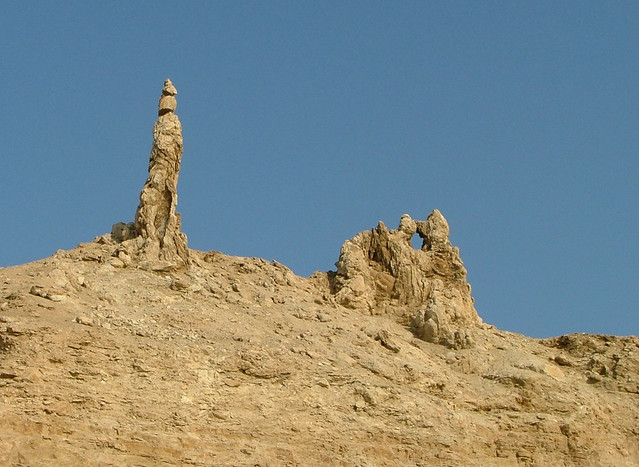
The rock formation called ‘Lot’s Wife’ is found near the Dead Sea on Mount Sodom in Israel

It is interesting to note that the ‘Pillar of Salt’ is also an ancient legend told to explain some curious salt rock formations in this region.

Also, being turned into a pillar of salt is an idiom in Eastern tradition for dying of fright.

Whatever happened to Lot’s wife, she reminds us of thousands of women forced to flee their homes each day due to violence, war and natural disaster. She reminds us of all those who look back and remember all those they’ve left behind.

But perhaps she also reminds us that in this time of Lent we are also invited to turn – to turn towards God, who receives us with open arms of love.

Prayer

The UN Refugee Agency estimates that there are 70.8 million forcibly displaced people in the world today and 37,000 people each day flee their homes due to conflict or persecution. (see here for figures at a glance: https://www.unhcr.org/ph/figures-at-a-glance)

Answer me, O Lord, for your steadfast love is good; 
according to your abundant mercy, turn to me.
Psalm 69.16

God of love, as we remember Lot’s wife who had to turn away from her home in fear, we remember all those today who are forced to leave their homes and face an uncertain future. Give them your strength and show them your love. We pray also that, in this time of lent, we might turn towards your love and know your peace in our lives. Amen

Sarai: under the oaks

Genesis 18: 1-23; 21; 23

I have always loved trees. As a child growing up in Buckinghamshire we had a vast sycamore tree in our garden which we called ‘The Big Tree’ (See image below). It was said to be one of the largest and oldest of its kind in the UK and was simply magnificent. There was a branch to the left of it that came right to the ground which was perfect for climbing up into a cavity in the middle of the tree, which was the place we went to as children to get away from everyone. My first experience of prayer was here as I spoke to God about whatever problems I was having – normally some kind of sibling rivalry or another.

The Big Tree at The Old Rectory, Adstock, Bucks painted by R Read. Sadly the tree died several years ago.

There is something permanent and comforting about old trees. I often sit under Christ Church’s ‘Jaberwocky Tree’ imagining all those who have gone before over the centuries, and somehow all the temporary concerns are put in to perspective.

Sarai’s (her name is later changed to Sarah) story features a particular tree, or group of trees, evocatively named ‘The Oaks of Mamre’.

Sarai was married to Abram (her half-brother) and much of their life was spent travelling as Abram had been called by God to leave their homeland (Haran) and go into a new land where, he was told, they would be blessed. (Genesis 12.1-3).

They were indeed blessed in many ways, with wealth, land and livestock, but they were not blessed with a child, and this was all that Sarai wanted, and was all that was expected of her as a woman.  

It is at the base of the Oaks of Mamre that two incidents occurred which changed the course of Sarai’s life. It was here that Abram first received the promise that they would have a child, and not only that, but their offspring would be so numerous they would be ‘like the dust of the earth’ (Genesis 13.16).

The Oak of Mamre believed to be around 5000 years old and which, in tradition, is said to mark the place where Abraham entertained the three angels or where Abraham and Sarai pitched their tent.

And it was also at the foot of the Oak of Mamre many years later when Sarah and Abram had another encounter with the Lord who came in the guise of three strange men, and again they were promised they would have a child.

But this time Sarah laughed at the prospect. She was now past the menopause or, as the bible delicately puts it, ‘it has ceased to be with [her] the manner of women’. Abraham was also past his prime – ‘my husband is old, shall I have pleasure?’ (Genesis 18.11-12).

But this time the promise was fulfilled. Sarah did indeed have a child,  Isaac (which means ‘he laughs’).

Sarah’s life can’t have been easy and, as Hagar’s story yesterday revealed, she struggled with rivalry and jealousy. But she was faithful and strong and is remembered in all three Abrahamic faiths as one of the few biblical matriarchs (with Rebekah and Leah).

At the end of her long life Sarah was buried in the very first description of a funeral and burial in scripture, in a place lovingly secured by her husband Abraham, and where he would later join her: in a plot overlooking her beloved Oaks of Mamre.

So the field of Ephron in Machpelah, which was to the east of Mamre, the field with the cave that was in it and all the trees that were in the field, throughout its whole area…After this, Abraham buried Sarah his wife in the cave of the field of Machpelah facing Mamre (that is, Hebron) in the land of Canaan. 

Genesis 23. 17-19

Reflection

In John’s Gospel one of the very first disciples Jesus calls to follow him is Nathanael, who is sitting under a tree at the time!

I saw you under the fig tree

John 1.48

and the very first thing Jesus says to those who follow him (in John’s Gospel) is:

What are you looking for?

John 1.38

‘I saw you’, ‘What are you looking for?’

These are good questions to begin our Lent journey. Perhaps you might like to go outside and spend some time sitting under or near a tree and reflecting on what it is you’re looking for this Lent? It might be something personal like Sarai who longed for a child, or it might be a more rewarding job, or wisdom for a particular problem, or an ability to concentrate on your studies. Or perhaps it is for a deeper relationship with God this Lent.
Whatever it is, perhaps you might like to take it God in prayer.

Prayer

Heavenly Father, thank you that you see us and hear us when we come to you in prayer. As you heard your daughter Sarai many centuries ago we pray that you would hear us today as we speak to you of all that we long for.

Amen

Hagar: the woman who is seen

Genesis 16 and 21

Note: this series of posts about women of the Old Testament were originally written for a Lent Blog in 2020. They have been updated. Many of the images are original pieces of art produced by Micah Hayns. Please only use them with permission. You can get in touch with him for originals or high res. images for promotions via http://www.micahhayns.com

We begin with Hagar.

Hagar was the very first person to dare to give God a name. She wasn’t a person of any authority or particular merit, she wasn’t a prophet or a priestess: she was an Egyptian slave-girl owned by Abram’s wife, Sarai.

Sarai hadn’t been able to have children and so had hatched the kind of plan that we might recognise from the Handmaid’s Tale: she would have a child with Abram via the means of her slave, Hagar. Abram willingly went along with the plan and Hagar, clearly having no choice in the matter, became pregnant. The two women began to hate each other but Sarai of course, had the upper hand and Abram gave his wife authority to do as she pleased. Sarai’s anger deepened as time went on and she became violent and eventually the pregnant Hagar, fearful for the safety of her unborn child, fled to into the wilderness.  

It was as she was hiding near a well that Hagar heard the voice of an angel:

Hagar, slave-girl of Sarai, where have you come from and where are you going?’

Genesis 16.7

She was promised her son would be a ‘wild donkey of a man’, and told to return.

Hagar was so overwhelmed by having been seen and heard, perhaps for the first time in her life, that she gave the Lord a name,

You are El-roi”; (God who Sees), for she said, “Have I really seen God and remained alive after seeing him?”

Genesis 16.13
The Dismissal of Hagar by Giuseppe Nicola Nasini, between 1657 and 1736, (image from Wikimedia Commons)

She bravely returns to Sarai, gives birth to Ishmael, and brings him up in Sarai’s household until Sarah (given a new name) had herself produced a child of her own, Isaac. Now with a son of her own Sarah didn’t want them around anymore and they were once again banished.

Ishmael was an adult by this time (around 15 years old). The banished pair wandered in the desert until their food and water had dried up and all hope of survival had gone. In the first description of a death ritual in scripture, Hagar put her child under a bush, sat at a distance, and waited for him to die.

Their tears were heard by the angel of God who, like the angel that appeared to Mary centuries later, said to them: ‘do not be afraid’, a well of water appeared and they survived.

Hagar became a Grandmother to many, and Ishmael’s descendants, the Ishmaelites, populated the land and grew powerful.

Hagar, enslaved, abused, and mistreated, was seen and heard by God.

THE SITUATION TODAY

Sadly slavery isn’t in the past and although it’s hard to find accurate statistics it is estimated that over 40 million people are held against their will and that 71% of overall victims of modern day slavery are believed to be women – this is nearly 30million people! https://www.antislavery.org/slavery-today/modern-slavery/

Now the Lord is the Spirit, and where the Spirit of the Lord is, 
there is freedom.
2 Corinthians 3.17

PRAYER

Loving God, who sees and hears all those who cry out in need, bring comfort and freedom to all your children, to those who are kept against their will, those who live in fear of violence, and those who are forced to run away to protect their family, in the name of El-Roi, The God Who Sees.
Amen