The Groaning of Creation: lament is not despair

A sermon by Canon Graham Ward, Regius Professor of Theology, Christ Church Cathedral
12th February 2023, Second Sunday before Lent

Readings: Genesis 1. 1-2.3 and Romans 8. 18-25 and Matthew 6. 25-end

All this week I have been haunted by a scene caught on a television camera in a northern Syrian town following the earthquakes, and the voice of a desperate man standing at the edge of a vast pile of shattered concrete as darkness descended. “I hear them,” he shouts. “I hear them crying out from the rubble and no one comes. No one comes to help us.”

And the blocks he stands beside are immense and impossible to lift. It’s the stuff of a nightmare and neither that man’s voice nor the buried voices he heard will go away. It is not my personal trauma, but the images will remain with me. They have left a permanent imprint, just as scenes of the Twin Towers collapsing on the 11th of September 2001, and the people jumping from the top of them. These images will never be erased. The one a natural disaster, the other a human atrocity. And always, caught up in these events, so many ordinary people trying to scrape livings and livelihoods together.

The wars in Syria have left the people in that country on the very edge and in winter living on that edge is almost unbearable. And yet devastation overtakes them in their exposure and vulnerability. It’s hard. It’s very hard. And then I read the passage from the Book of Genesis that the lectionary prescribes for today: the story of a magnificent creation, and we part of its whole design. And God, having finished the work of creation in all its teeming, cosmic vitality, saw it was “very good”. And ‘good’, in Hebrew, is rich with the sense of all things being well, ordered, peaceful and beautiful. Then there’s the passage from Matthew’s Gospel, where Jesus tells us not to be anxious about food and clothing for God knows what we need and if we set our minds on God’s kingdom and his justice before everything else “all the rest will come to you as well.”

What can we say? Here is a human situation that amplifies Jesus’ statement that “each day has trouble enough of its own” and here is Scripture. And the tension in trying to bring one to bear upon the other is painful. But if I duck out of addressing this tension, avoid speaking about this tension, then how can the Word of God in Scripture and preaching relate at all to the Word of God received in the Eucharist? The stakes are high because if they don’t relate, then I’m just sugar-coating, and that won’t assist or be redemptive for you, for me, or for any of those suffering as a consequence of those earthquakes.  

What I can’t do is explain. Explanations can be comforting. Explanations help us to understand and understanding allows us space for reassurance. But I have none of that space for reassurance. The gospel is on the line in the face of natural disasters and the immense pain human beings experience. Dying may be a great deal easier that living on with the pain of the inexplicable. How do those traumatised by the earthquakes – the children, new born babies, adults all hauled from under the debris after days of being buried – how do they live on and make sense of what has happened to them? How do they continue to live lives that aim at some modest flourishing and well-being?

In this situation, I can only turn to the Cross. Not for an answer, but as a display of crucified love. God’s love. Our reading from Paul’s letter to the church in Rome zooms out from the cross to the fabric of the cosmos: “the whole creation has been groaning in travail…and not only creation, but we ourselves…groan inwardly as we wait for…the redemption of our bodies.” We cry out and that crying is sacrificial. And by sacrificial what I mean is: this defeats our comprehension. This is not time for comfortable words, but a time for a deeply Jewish and liturgical lamentation.

There is one portion in the eucharist that increasingly gains my attention. It comes just after the consecration of the bread and the wine and the acclamation that this is an offering in which praise and thanksgiving are sacrificial. The bread is broken and we all confess both that brokenness and our unity in the body of Christ: “Though we are many, we are one body because we all eat of the one bread.”

On Sundays, like today, the Agnus Dei that follows is sung. During in the week, it is said and, in my priestly training, the priest bends over the consecrated elements and knocks his or her clenched fist against his or her heart. It is an ancient liturgical gesture.

“Lamb of God, who takes away the sin of the world, have mercy on us. Lamb of God, who takes away the sin of the world, have mercy on us. Lamb of God, who takes away the sin of the world, grant us peace.”

As for sin, I don’t know where that begins or ends. Blaming can be a way of avoiding the truth rather than facing it. And where do you even begin the blame-game when it comes to the devastation of these earthquakes and the human suffering they have brought? No, ‘sin’ is no easy answer; and judgement lies beyond mortal comprehension. So, we’re left with the phrase written deep into liturgical lamentation: “Lord have mercy upon us.” And that is all of us. The entirety of the human race over which the crucified God rises.

Whatever racial, religious and national differences, the people of Turkey and the people of Syria (every single one of them) belong to that ‘us’. They and we are parts of the one broken body of Christ, sacrificed for our salvation, for their salvation. We stand before the cross sharing in their trauma saying to the body of Jesus hung there, “we are the ones for whom you died. Have mercy on us.” We acknowledge the groaning of all creation for the redemption of the body in our incomprehension.

Many of you know of my long friendship with the Jesuits. Yesterday morning I heard directly from Father O’Riordan who is working in Aleppo. He spoke of the fear in the people who have survived, the terror of darkness and the inability to feel safe. Nothing seems secure. The very surface on which they stand and scrape together a way to survive now seems fragile. “We pray,” he said, “for God’s Spirit to enter the trauma.”

https://www.vaticannews.va/en/church/news/2023-02/jrs-syria-aleppo-earthquake-fr-oriordan-humanitarian.html

Amen to that. While he profoundly laments with the bereaved and devastated, hope comes in the enormous efforts to help made internationally and the outpouring of compassionate support. “Where earthquakes abound,” he said, adopted a phrase in Acts, “grace superabounds.”

Lament is not despair. Incomprehension is not atheism. From the cross, redemption flows, even from the wrists and feet and side of Christ lifted high. Love will be outpoured, sacrificially.

With huge thanks to Canon Graham, my friend and colleague, for allowing me to publish this sermon here.
The Wedding of Cana: a foretaste of feasts to come

A sermon at College Communion given by Monty Powell, an undergraduate in French and German at Christ Christ – 29th January 2023

4th Sunday of Epiphany

Readings:
1 Kings 17: 8-16
John 2: 1-11

‘Nelly, do you never dream queer dreams?’, Catherine said, suddenly.
‘Yes, now and then’, I answered.
‘So do I. I’ve dreamt in my life dreams that have stayed with me ever after, and changed my ideas; they’ve gone through and through me, like wine through water, and altered the colour of my mind.’

I always quite enjoy the little stories or anecdotes which you often find at the start of sermons. Now, I do, though, have a story about one late evening last term when a couple of friends and I here in college did actually run out of wine. Just like – I am sure – all the guests at the wedding in Cana, I was, at first, rather annoyed by this, and wished I had bought some more – but I’m not sure my story quite fits, largely because – and for reasons I probably don’t need to go into with you today – it probably turned out to be for the best that we didn’t have any more…

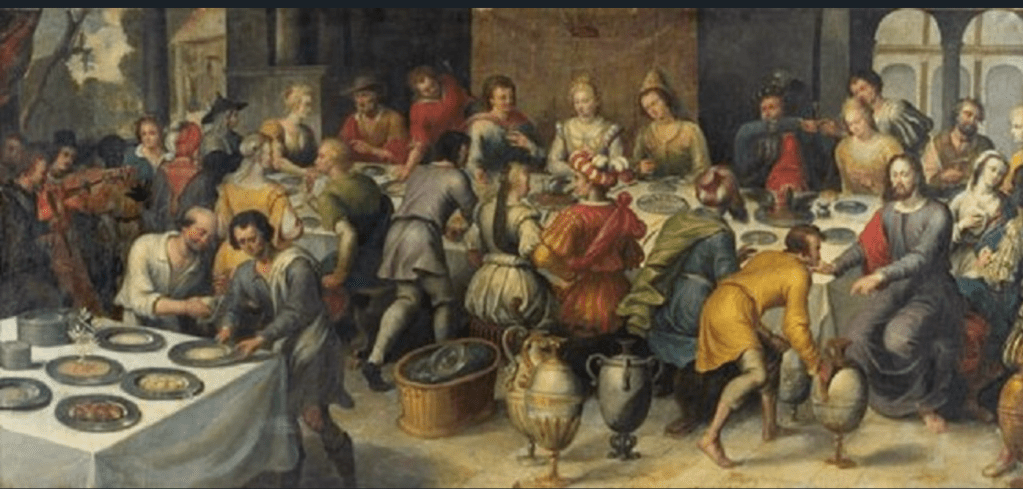
The Marriage of Cana, Adam Van Noort, between 1587 and 1641

In today’s Gospel, Jesus, on the other hand, seems at first to take the opposite view. When his mother says to him: ‘they have no wine’, Jesus replies that this has nothing to do with him or her; that his hour is not yet come.


I find it quite puzzling that Mary takes absolutely no notice of Jesus’ response at all. Instead, straight away she orders the servants to do whatsoever he tells them. It seems, then, that Mary is convinced that Jesus will help her; sure in her expectation that Jesus as the Son of God will just magic up a few more barrels of wine for her so as to avoid disappointing the guests. But this isn’t quite what happens.

When Rowan Atkinson parodied this story in a rather funny sketch, he makes Jesus out to have been some sort of entertainer – playing to a crowd which goes wild after they witness his supernatural powers of turning the water into wine. Perhaps something like this is what Mary expected of Jesus too.

And yet, the Gospel gives us something rather different. You’ll have noticed that John never describes the moment at which the change from water into wine happens; and neither the servants nor Mary nor even Jesus himself ever acknowledge it.

According to John, Jesus carried out seven signs on Earth. Whilst turning the water into wine is the first of these seven, in the final sign, Jesus raises Lazarus from the dead in front of a great crowd. That is the story in which we are confronted by what the late Pope Benedict XVI termed Christ’s ‘absolute power over life and death’.

Here, though, there is no great crowd, no great revelation of Christ’s divinity in front of all and sundry. Instead, the Ruler of the Feast ‘knew not whence the wine came’; and, as far as we know, he never did find out. He believes, erroneously, that it was the bridegroom who saved the best wine until last.

It seems to me that this quietly reveals something about the way God works in the world.

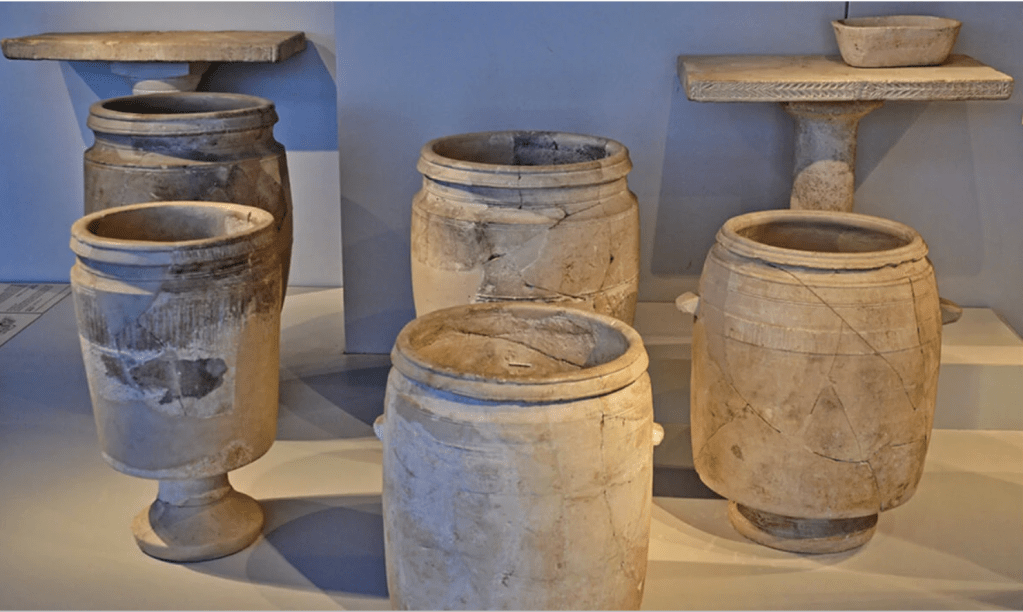
One commentator writes that the real miracle here isn’t that Jesus turns the water into wine, but that the servants listen to his orders. After filling up these great stone pots with a hundred gallons of water or more, they bring them up to the steward of the feast. I think that the servants show a surprisingly great deal of trust in Jesus by doing this. Not only do they carry out quite an arduous task, but also run the rather mortifying risk of telling the ruler of the feast that that which was and should still be – from a material, objective perspective – water, is now wine.

I think this tells us about the way God works on earth because – just like the ruler of the feast, who knows not whence the wine came – we rarely notice him, all too distracted by work and stress and technology for us to perceive, never mind be grateful for, his presence. We might call out to God – like Mary does to Jesus here – when we think we need Him, as I certainly have done, but that doesn’t mean a response will come straight away or in the form we expect. It is, instead, the servants who are attentive to and place great trust in Jesus’ words who make this miracle possible.

I began with a quote from Emily Brontë’s novel Wuthering Heights. If you’ve read it, you might think this a somewhat strange choice – it certainly isn’t the most ‘Christian’ novel around – but I really like this image in particular.

The Gospel verse just before the story of the wedding tells that we shall see Heaven open, and the angels of God ascending and descending (John 1.51). As Tom Wright puts it, in the wine which Christ has transformed, heaven and earth intersect.

Like the wine which pours out of Catherine’s dreams into the watery materiality of her existence, so the wine which Jesus brings to the feast, is a sign of God’s presence in a world that is all too often tasteless and insipid, if not downright bitter. This presence might be secluded and hidden from us when we are not attentive to it, as I know I rarely am, but it is ready to be felt when we are; just as the servants were.

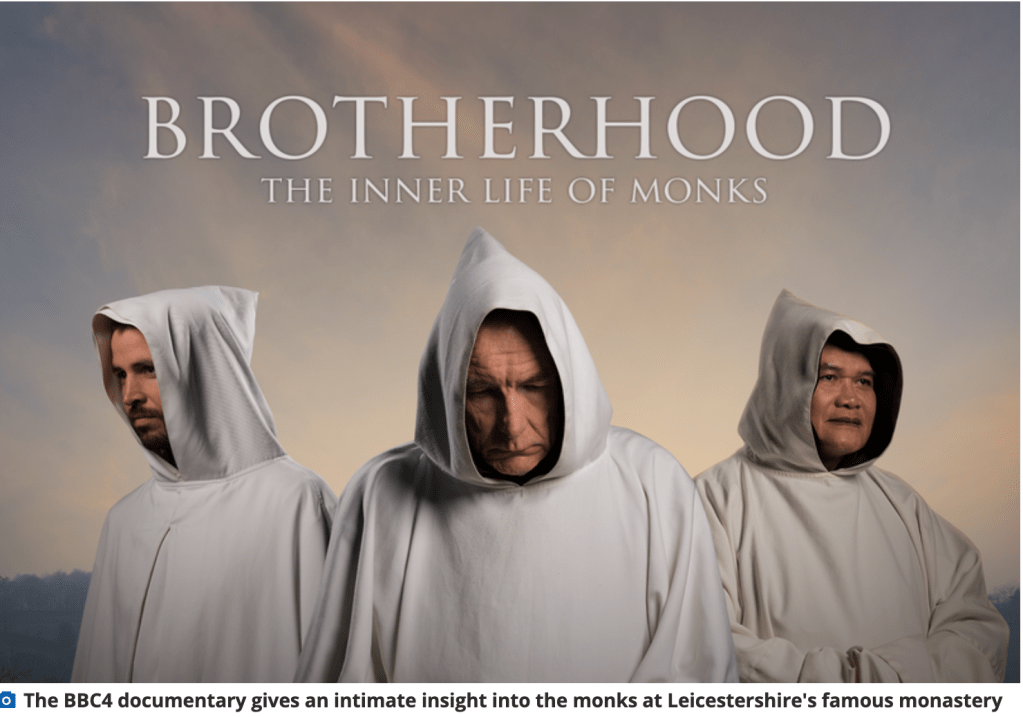
We’re increasingly living in a world where giving this attention to God can seem almost impossible, as technology fills our every waking moment and more and more of our nights with the flickers and sounds of distraction – and that’s if we even want to do so. A couple of years ago, there was a documentary on TV about a trappist monastery near Loughborough (Brotherhood: the inner life of monks). Something which has stayed with me ever since are the words of one of the older monks: that, when we strip away all of the racing thoughts and distractions of daily life and are left with nothing but silence; that’s where God is. Perhaps, that’s where the wine is.

And why Wine? In a few moments we will all be invited to partake in Holy Communion, a foretaste of wine of that other life which Christ, as he raises Lazarus from the dead, promises to us.

It’s a promise of fullness and wonder, and one in which we should rejoice. As one commentator put it: ‘Jesus did not multiply vinegar at a funeral’.

Martha and Mary: Attentive Hospitality

Revd Clare Hayns
Trinity 5C
A sermon for Christ Church Cathedral, Oxford on 16th July 2022

Genesis 18.1-10
Luke 10. 38-end

Diego VelázquezChrist in the House of Martha and Mary   (I love how grumpy Martha looks here!)

‘It’s not fair’

Last night I went to a milestone birthday party for my sister who’s 2 1/2 years younger than me. We are now the best of friends but our childhood consisted of almost constant arguments. I was the oldest of four and considered myself to be the one who was always expected to be helpful, to lay the table, to help my mother in the kitchen, to be responsible (I’m not sure I was particularly, but that was my perception!). My sister had a gift of always being absent when the table needed laying or a job needed to be done. Particularly if there was hosting to be done and just as people were arriving. She was normally to be found hiding away and reading a book, often in the bath where no one could find her, or sitting under a tree writing a poem about her feelings. It drove me mad.

‘it’s not fair’ was my regular refrain. I would often go to my parents and say a similar plea to that of Martha to Jesus:

Do you not care that my sister has left me to do all the work by myself? Tell her to help me.

Luke 10:40

There’s a lot of hosting going on in both readings from Genesis and Luke. In Genesis three angelic visitors turn up at the tent of Abraham and Sarah. They are on their way to Sodom and Gomorrah and have an important message to impart on their way.

And in Luke’s gospel, Jesus and his no doubt large group of disciples turn up at the home of Martha of Bethany and her sister Mary.

And the hosts spring into action to provide hospitality. Abraham rushes around, he runs to his guests, he runs to the herd, and he ‘hastens’ to give Sarah instructions.

And there’s Martha. Similarly rushing around to provide food for her guests. I love Martha. In my view she’s one of the best female bible characters in the New Testament. She’s feisty and not afraid to speak her mind.  In John’s gospel, it’s Martha who runs to Jesus after her brother Lazarus dies and she rebukes him ‘Lord, if you’d have been here my brother wouldn’t have died’ (John 11.21) She is loved by Jesus, clearly loves him, and feels comfortable with him.

And so when Jesus turns up with all his friends and she’s left alone to do everything because her sister has abandoned her, she doesn’t hesitate to speak her mind.

And can we blame her? We’ve probably all been there at some time or other.

It’s important to remember a couple of things of context here.

What Martha was doing was providing hospitality and welcome, and this was vitally important in the culture of the time. In first-century Palestine, hospitality was (and still is) about allowing the guest to share the sacredness of the family space. The women’s role was (and still is in many households) to do the cooking and food preparation. Martha was doing just what was expected of her.

What was unexpected was what Mary was doing.

It was very unusual for Jewish Palestinian women to join male guests before they are done with all the food preparation. And even more unusual for a woman to be sitting amongst the men in the posture of a disciple.

And can we blame Mary for taking this opportunity to sit with the male disciples and listen to Jesus? It was an unexpected and surprising gift.

But it is this that infuriates her sister the most.

It’s not fair.

And Jesus’ response? He points out her frustration. (rather a brave thing for him to do!)

Martha, Martha, you are worried and distracted by many things; there is need of only one thing. Mary has chosen the better part, which will not be taken away from her.

Luke 10.42

It seems as if Jesus is rebuking Martha for doing what was expected of her. The comment ‘the better part’ seems as if Jesus is creating a hierarchy where sitting and listening is ‘better’ than active service.

This has often been how we’ve read this passage. Where the contemplative life is seen as better than the activist life; where the call to a life of prayer as a nun or monk or priest is seen as being more spiritual than the call to being a parent or medic or homemaker.

Is this what Jesus meant by this? I think not.

The word for the ‘many things’, or in other versions ‘many tasks’ that Martha is distracted by is ‘diakonia’: service/ministry. It is where we get the word ‘deacon’ from.  It can mean all sorts of different aspects of ministry, from preparing food to looking after the poor.

Elsewhere in Luke’s gospel those who provide service (Diakonia) are commended. Last week we read of the Good Samaritan who was commended for his active service and the disciples surely had Jesus’ words ‘go and do likewise’ ringing in their ears as they went to Martha’s house. (Luke 10.37) Also, Jesus describes himself as ‘one who serves’.

So it can’t be right that Jesus is criticising Martha for also being one who serves. Or for doing what is essentially ministry.

So what is he saying?

We are told in John’s Gospel that: ‘Jesus Loved Martha’ (John 11.5). And in the context of love that he points out to her the truth.

Martha’s attention was in the wrong place, even if what she was doing was the right thing. Jesus is gently pointing out that her service, her ‘diakonia’, was being done with distraction, worry, and irritation. Her attention was on herself and on Mary not doing what Martha thought Mary should be doing.  

In her distraction, Martha was missing what was important right then.

Jesus was pointing out that what Mary was doing was, at that particular moment in time, was exactly what Mary should have been doing. She was paying attention to Jesus, to the Son of God who was right there in her home.

How often have we been in a conversation when we know we aren’t really focused on it. My kids always know when I’m pretending to listen to them but really my mind is on something else. When I’m talking to them and just saying ‘hm, hm’ – they can tell. They now call me out on it. 

Simone Weil, who was both political activist and contemplative, said that: ‘Attention is the rarest and purest form of generosity’. [1]

Can you remember when someone last sat and listened to you, giving you their full attention, and how that felt?

Paying attention to someone is an act of service, of generosity. It shows that they are of value to you.

Paying attention to God though is even more important. It can literally change our lives.

Sarah (Genesis) was paying attention whilst Abraham rushed about and she heard the angelic visitors telling her she was to have a child. We don’t know what Mary was hearing as she sat listening, but Jesus says it was ‘the better part’ and that ‘it wouldn’t be taken from her’.

I think Sarah and Mary were providing hospitality to their visitors by paying attention to them. What they were doing could be described as attentive hospitality. What Martha was doing was distracted hospitality.

What might attentive hospitality look like in our own lives and in the lives of our churches?

Do we pay attention? To one another, to Jesus.

Or are we so busy doing stuff or being distracted that we don’t notice that Jesus is in our midst, wanting to bless us?

Are we so anxious about what others are doing or not doing, so worried about fairness, that we forget to realise what we are being invited to?

And what are we being invited to?

A loving relationship with Jesus who, like Mary and Martha wants to spend time with us. Who knows and loves us even when we’re distracted and gently draws us back into relationship with him.

Perhaps that’s what we are being invited to, in this time as we head into the holiday season.

What might it be like to give Jesus attentive hospitality?

To put aside all our worries and distractions for a little while.

To respond to the invitation:

 ‘there is need (right now) of only one thing’.  

[1] https://lithub.com/simone-weils-radical-conception-of-attention/

A Heart of Peace: Lessons from Abigail

From a sermon given at Led by the Spirit, High Wycombe, Bucks – 22nd May 2022

1 Samuel 25
John 14. 23-29

Abigail, by ©MicahHayns

Peace be to you, and peace be to your house, and peace be to all that you have

1 Samuel 25.6

Said David, the outcast future King of Israel to Nabal, the owner of the land David had been protecting.

Peace I leave with you; my peace I give you

John 14.27

Said Jesus to his disciples just before he was to be taken away to be tried and crucified.

Peace be with you. We say it to one another just before communion as we nod in an Anglican kind of way: certainly no hand shaking or hugging anymore!

Peace.

What is it?

Is it the absence of something? An ending of conflict. The cessation of war?

Or is it a feeling? That feeling you get when you’re on holiday or having a massage?

But we all know that after a war ‘ends’, conflicts can continue to simmer within communities for years.

And I don’t know about you but when I’m meant to FEEL peaceful (on holiday or having a massage) I find I’m anything but. My mind fills with worries. I start chuntering about a problem or annoyance.

So, what does Jesus mean when he says ‘my peace I give to you’?

What does having Jesus’ peace mean when we find ourselves, for whatever reason, in the midst of conflict?

Because conflict is part of human existence isn’t it.

Think for a moment of the conflicts that impact you in some way.

  • Global – Ukraine is on all our minds
  • Communities or work situations
  • Home life/family life

None of us are immune. As soon as one finishes something else begins!

When I was a child, my mother counted the seconds in the morning to see how quickly I would say something mean to my sister that would cause her to cry or shout. Never much more than ten!

Both our readings begin with ‘peace be with you’ – but then both lead pretty quickly into conflict. We know what happened to Jesus soon after this. But the story in 1 Samuel is less well known. As is the main peacemaker – Abigail.

Abigail found herself in the middle of two warring men.

She was married to Nabal, a drunken,  boorish man whose name literally means ‘fool’. He was the landowner of the region that David had been protecting with his men.

Nabal threw David’s ‘peace be with you’ back at him by pretending he had no idea who he was (1 Samuel 25.10). David, thin-skinned and easily offended reacted immediately:

‘Every man strap on his sword!’…David also strapped on his sword

1 Samuel 25.13

And they head off to murder Nabal and all his household.

Before we judge too harshly let’s pause to reflect on ourselves here.

We may not have an actual sword or an army of men with swords like David. But let’s be honest, we can all strap on our metaphorical swords when we find ourselves in a conflict. Our weapons may be a caustic tweet, a winning takedown in an argument, an angry gesture in a car, a passive-aggressive ‘ghosting’. We all have our weapons of choice, don’t we?

Abigail is alerted to the conflict by one of Nabal’s men. He knew she was the more sensible one to speak to. And her immediate response isn’t to ‘strap on her sword’ and gather the troops.

Her response was one of peace-making. Her response was considered, thoughtful, and prepared.

The first thing she did?

She baked! OK, she may not have baked it all herself but she knew food was required. I know this may be rather gendered but….a clever woman’s tactic! She prepared fig cakes, loaves, wine and put them all on a donkey, and sent them ahead of her.

Street Pastors

She perhaps knew what the modern-day Street Pastors know. They go to nightclubs armed with lollies as they know it’s hard to fight whilst sucking a lolly!

When Abigail reached David (who was chuntering in his anger), she threw herself at his feet and used every peace-making tactic in her repertoire.

She flattered him – ‘my Lord, my Lord’; she told him Nabal wasn’t worth it – ‘fool by name and fool by nature’; and she handed over her gifts.

But the thing that made all the difference in the end?

She raised David’s eyes and reminded him of God. And she reminded him of who he was in the eyes of God.

The Lord has appointed you prince over Israel…. you are fighting the Lord’s battles…..my lord shall have no pangs of conscience’

1 Samuel 25.27-31

Abigail reminds David who he truly was and who he would one day become. And David changes his mind, and puts down his weapons.

Blessed be the Lord who sent you to meet me today…blessed be your good sense.

1 Samuel 25.32

The end of the story is that family is saved. Abigail waits for her husband to sober up before telling him what she’d done, and Nabal is so shocked he had a heart attack and died… and she ends up marrying David (which by all accounts isn’t necessarily a happy ending!)

So what might we learn from Abigail when it comes to peace-making?

That peace is not an absence of conflict or a feeling, but can also be an action. An action that can involve heading into conflict and not hiding away from it.

One of the books I found helpful this past year has been ‘The Anatomy of Peace’ by the Arbinger Institute.

The authors speak of the choice between having a ‘heart of war’ and a ‘heart of peace’ in the midst of conflict. Having a ‘heart of war’ involves seeing people as objects, often using language in a way that dehumanises: this always makes things worse and leads to further conflict.

The alternative is to enter conflict with a ‘heart of peace’: seeing others as people, human beings beloved of God.

It’s been something I keep going back to. I certainly don’t always get it right. If I find I have a ‘heart of war’ I need to seek out Abigail’s to help me look up and remind me who I am.

And this perhaps is what Jesus means when he speaks about the peace he leaves with us. He gives us a heart of peace.

The Hebrew word for peace is Shalom.

It is not the absence of something at all. Shalom means fullness, rightness, contentment, wholeness. Shalom is all things made well.

So, if you are in the midst of a conflict situation right now – Shalom
If you are concerned about a situation involving others – Shalom
If you are stuck in the middle of warring parties like Abigail – Shalom
If you are struggling to find a heart of peace – Shalom

Jesus’ peace isn’t like the world’s peace. It’s the ‘peace that passes all understanding’. It’s Shalom. And he offers this to you, to me today.

Amen

Prayer

God of peace and love,
We thank you that you offer us a peace that passes all understanding. We pray for that peace, that Shalom, today. For ourselves, our world, and for those we love, and especially for those we are in any kind of conflict with. Amen

Wall Building with All the Saints

Nehemiah 3. 6-12
Revelation 21.

Daughters of Shallum @MicahHayns

From a sermon preached at College Communion at Christ Church
All Saints Sunday 2021

‘Shallum, son of Hallohesh, ruler of a half district of Jerusalem, repaired the next section with the help of his daughters’

Nehemiah 3.12

All Saint’s Day is an opportunity to think about the Church in all eternity. Where all time is one and all time is God’s time, so we are part of one Church which is here and everywhere, a Church that stretches back to include all people, a body of Christ that stretches back into the past and on into the future. It’s a mind-bending concept.

So let’s focus right back to into Old Testament, to two stories of two different groups of sisters, one from the book of Numbers and the other from one brief mention in the book of Nehemiah. Stories over 1000 years apart and over 1000 years from where we are now.

There are several reasons to focus on their stories:
Firstly, I’ve been emersed in stories of Old Testament women for the last few years as I’ve been working on a book on women from the OT and have been so inspired that if I get a chance to share their stories I want to take it; and secondly, because I think they have something to teach us and their stories can inspire us.

The first group of sisters (Numbers 27) are Mahlan, Noah, Hoglah, Milcan and Tirzan: the five daughters of Zelophehad, an Israelite from the tribe of Manasseh. The period was when the Israelites tribes were being led by Moses in the desert and had been in the wilderness for many years and they were about to enter the ‘promised land’ and claim their land.

Zelphehad had died. He only had sons, no daughters. The custom was that in that case the land of the deceased would pass over to another clan and Zelphehad’s name would die with him.

His daughters thought differently. They ‘came forward’ and bravely went to the tent of Moses and the gathered elders to argue their case. Their reasoning was forthright, concise, personal, and persuasive and ended with the plea:


‘why should the name of our father be taken away from his clan because he has no son?’.

Numbers 27.4

Moses didn’t know how to answer them so he prayed about it and heard from God.

‘the daughters of Zelophehad are right in what they are saying’.

Numbers 27.7

The daughters were right! The law was changed and from then on daughters could inherit at the death of their father. They were also allowed to choose their own husbands as long as they were from the same clan. This move transformed their lives (they eventually inherited the land as detailed in Joshua), but also transformed the lives of women down the centuries.

The other story of a group of sisters is just mentioned in one line in the book of Nehemiah, chapter 3.11 We don’t know their names, they are simply ‘Shallum’s daughters’.

The time period is many centuries later. Judah had been invaded by the Babylonians and the city of Jerusalem, including its palaces, the Holy Temple, and the grand City walls had all been destroyed. The Jewish people had been exiled for nearly a hundred years and had been given permission to return by King Cyrus of Persia.

Everything had been destroyed and so there was a huge amount of building work to do to restore the house of God, restore the holiness of their people and restore the city walls. Nehemiah 3 is a long list of all the people who helped in this restoration. The whole community gathered together to build sections. It was hard labour.

And in amongst the long list of fathers and sons are Shallum’s daughters working alongside them all to rebuild the wall.

What strikes me about these two stories is they both speak of the power of working together to bring about transformation and change. The Daughters of Zelophehad wouldn’t have been listened to on their own. They needed to go as a group to Moses’ tent. The wall builders each had their section to complete; they had to work together and focus on their little section of the whole.

The reading from Revelation 21 also speaks of a rebuilt city – the vision of a new heaven and a new earth, the holy city, the new Jerusalem, a city where:

‘Death will be no more;
mourning and crying and pain will be no more,

Revelation 21.4a

The old city of Jerusalem was destroyed with its temple. Jesus, likened himself to the temple that would be destroyed but rebuilt in three days. And we, with all the saints past and present, are called to be his temple, his resurrected body, in the world and to be part of the building project of this new kingdom.

There is much rebuilding to be done, the problem is often where to start. There are so many issues today in our church and society – it can become overwhelming to know what to focus on.

Gender equality is still an issue today – land rights for women are a UN sustainability goal; there is environmental work to be done, we think of Cop 26 this week; there is homelessness, food poverty.. the list goes on.

We each have a section of wall to rebuild. This is different for each of us. Each of us will have the thing that stirs us to go the tent to speak out. What might that be?

So often church people waste time critiquing other saints’ wall building methods, or comparing their own section with either pride or dissatisfaction. We don’t need to do that.

On this All Saint’s Day we join with the body of all believers, past and present. May we be like the daughters of Zelophehad as we link arms and speak up against injustice where we see it. May we be like the daughters of Shallum as we pick up our tools and focus on rebuilding our little area of wall.

So often it can feel as if our hard labour isn’t achieving anything much at all. But it is. It is part of something bigger. Sometimes we are just building foundations that other saints build on; at other times it’s making small repairs to peoples’ lives which are hardly noticeable. But it all matters.

We don’t do any of this on our own of course. We do this in community, and through the power of the Holy Spirit, and in the company of all the Saints.

Amen

.

Songs of the Spirit: The Benedictus

Based on a sermon for Christ Church Chapel, February 2021

And you, child, will be called the prophet of the Most High;
    for you will go before the Lord to prepare his ways,
to give knowledge of salvation to his people
    by the forgiveness of their sins.
By the tender mercy of our God,
    the dawn from on high will break upon us,
to give light to those who sit in darkness and in the shadow of death,
    to guide our feet into the way of peace.

Luke 1. 76-79 (the full text of the Benedictus is here)

One of the best things about living at Christ Church is being able to get up early in the morning and go for a walk in the meadows before it fills up with joggers, dog walkers and people taking their daily legally sanctioned strolls. It is gloriously peaceful and if I can get up early enough to see the sun rising and I’m reminded of the promise in the Benedictus that ‘the dawn from on high will break upon us’.

The Benedictus, the Song of Zechariah, has been said or sung in early morning worship since it was introduced by Benedict of Nursia in the sixth century. It is a song of blessing (‘Benedictus’ means blessing in Latin) and hope. But it is a song that also speaks of times of hardship. It begins, ‘Blessed be the Lord the God of Israel; who has come to his people and set them free’ – we are reminded that God’s people were once enslaved, had enemies and longed to be able to worship God in freedom. 

Zechariah’s song sprung out of a time of hopelessness. The Bible tells us that he was an elderly priest who, with his wife Elizabeth, was ‘getting on in years’. They had no children. The priests would take on a week’s duty in the temple where they officiated at services: a bit like being Canon-in-Residence in our Cathedral. One day whilst in the temple Zechariah encountered an angel who promised him a son, to be called John. He was told he would have ‘joy and gladness’, that the child ‘will be great in the sight of the Lord’. (Luke 1.13)

But Zechariah didn’t believe the angel.

“How will I know that this is so?” he asked. “For I am an old man, and my wife is getting on in years.” (Luke 1.18)

From that moment he became mute, unable to speak at all. He remained silent throughout the entire pregnancy and didn’t speak until his baby was eight days old. It was only when he announced, ‘His name is John’ that his tongue was freed and he began to sing his song of blessing and hope.

One reason the Benedictus is said every morning is that in monastic times there would be a time of ‘great silence’ between Compline and Matins. Saying the Benedictus is a reminder that we, like Zachariah can break our nightly silence with praise.

Within the Benedictus there are great themes of hope and salvation.

There is hope for the salvation of the people of Israel: ‘a mighty saviour’ is on his way. There is hope for Zechariah’s son John who will prepare the way for Jesus with his father’s prophetic blessing upon him. And there is hope for all people: for each one of us.

 ‘The dawn from on high shall break upon us, to shine on those who dwell in darkness and the shadow of death, to guide our feet into the way of peace.’

Luke 1.79
Fog in Christ Church Meadows

A few days ago a dense morning fog descended on Oxford. You could hardly see a thing. Just the vague outlines of people walking in meadows. It was one of those days when you could only just make out a few steps ahead. Yet later in the day the fog lifted, clear and beautifully bright.

This seems an apt metaphor for our times. Perhaps we are deep in the fog, in the gloom, not knowing what the next steps are? Many people are struggling to keep going and to keep positive. The future seems unclear. What can we plan? When will be able to gather with our friends and family? We are still in uncertain times.

The Benedictus reminds us that we can have hope and that the dawn shall break.

The light shall shine in the darkness.

Hope is different to optimism – which is about blindly believing things will be better.

Emily Dickinson writes:

“Hope is the thing with feathers
That perches in the soul
And sings the tune without the words
And never stops at all.”

Emily Dickinson ‘

Often hope is delicate and very fragile, sometimes just a flickering candle, a clump of daffodils, a ‘thing with feathers’.

Hope is rooted in trust. Trust that God has brought God’s people out of the shadows in the past, and will do so again.  

We can trust that the fog is not the only weather: it shall lift.

The dawn from on high shall break upon us.

This is an edited extract of a sermon given by Revd Clare Hayns on February 7th 2021.


Songs of the Spirit: A New Song

A New Song

A blog for Christ Church Cathedral

Ephesians 5. 1, 18b-20

Therefore be imitators of God, as beloved children, and live in love, as Christ loved us and gave himself up for us, a fragrant offering and sacrifice to God…  be filled with the Spirit, as you sing psalms and hymns and spiritual songs among yourselves, singing and making melody to the Lord in your hearts, giving thanks to God the Father at all times and for everything in the name of our Lord Jesus Christ.

When I was a curate I used to visit a nursing home every week to take communion and lead the community in hymn singing. There was a wonderful woman called Marion, in the late stages of dementia. She had no memory. She didn’t recognise her children and no recall of recent events. Yet she had an incredible memory when it came to hymns: she was word perfect.

She knew ‘Thine be the Glory’, ‘The Lord is my Shepherd’, ‘All things Bright and Beautiful’ and ‘Great is thy Faithfulness’. All by heart.

When we sang one of those, she would stand at the front and lead the singing with great gusto.  

Singing taps into a different part of our brain than normal speech. Medics can explain this further but normal speech uses the left hemisphere of the brain and melody the right. So singing uses both sides.

You may have noticed that if you put something to a melody it becomes easier to remember. And it taps into something deep within us. Most of us will have songs that remind us of particular moments in our lives, and song that we draw on in hard times.

The Bible contains around 185 songs, and 80% of these are in the book of psalms, which is the hymn book of the Hebrew Scriptures. There are songs of lament, hope, triumph and love. There are a number of songs in scripture which are sung regularly in church, such as the Benedictus (Zachariah’s song, which we sing at Matins), The Magnificat (Mary’s song, sung at Evensong), and the Nunc Dimittus (Simeon’s song, sung at Evensong and Compline). There are also wonderful songs such as the song of Miriam and Moses, and David’s song of repentance which is psalm 51. We will look at these over the next few blog posts.

Life is difficult right now. Living through this pandemic is bleak. So much of what we love has been stripped away. One of the things I’ve missed most during this pandemic is congregational singing and I long for the time when we can gather together and raise our voices in worship.

Gathering to sing together in praise and worship has always been one of the core activities of the Judeo-Christian people. St Paul exhorts the early believers to ‘be filled with the Spirit, as you sing psalms and hymns and spiritual songs among yourselves… giving thanks to God the Father at all times’

We don’t always need to be in a group to sing. I think of St Paul singing loudly from prison in Acts.

When we sing in worship we are giving God the glory. We are putting things into perspective and remembering our place in the world. We are remembering that our current situation isn’t all there is.

When we sing we might be lifted out of our own troubles for a while, and find that God has blessed us as we worship him, and our troubles may seem a little smaller and less significant.

Ralph Waldo Emerson wrote, “Even in the mud and scum of things, something always, always sings.”

John Wesley, the founder of Methodism, who preached in our own Cathedral, left some wonderful ‘Directions for Singing’ which involved learning the words and singing ‘lustily’. At the end of them he adds: “above all, sing spiritually. Have an eye to God in every word you sing.”[1]

I love that. Sing spiritually, having an eye to God in every word.

There’s one carol that spoke to me this last Christmas. It’s ‘O Holy Night’ and the phrase that struck me particularly is “A thrill of hope. The weary world rejoices.”

We will sing because we have hope. Even though we are weary, even though we are apart, we can sing and our voices join together, with the voices of the angels, with the first Christians, with Wesley. Singing unites us across the divides of time and space.

And as we sing, out loud or in our hearts, tunefully or not, let us giving thanks to God the Father at all times and for everything in the name of our Lord Jesus Christ.

This blogpost is an edited version of a sermon given by Revd Clare Hayns in January 2021.


[1] http://meaningfulworship.blogspot.com/2018/10/wesleys-directions-for-singing.html

Leavers’ Address – June 2020

An address given to the student leavers of Christ Church, Oxford
June 17th 2020 (via video)

Philippians 1: 1-11
14th June 2020

We come to the end of this strangest of terms to a Leavers service without leavers in a cathedral without a congregation. One of my favourite books in the bible is St Paul’s letter to the Philippians. Paul is in prison and he’s writing a thank you letter to his community in Philippi, a community he’s bereft to be separated from. And so as I pondered what to say in this final address of term I thought I would write you a thank you letter in the style and manner of St Paul, using some of the text from his letter to Philippi.


Clare, servant of Christ Church and Christ Jesus,

To all the saints scattered around the country and world, together with the fellowship of Chapter and the wider community of Christ Church.

Grace and peace to you from God our Father and the Lord Jesus Christ.

I thank my God every time I remember you. I really do.

We are separated, not by chains or imprisonment, but by nature of disease, and this means we cannot be together as we wish. How I long to be able to gather together again in this holy place for Evensong, Compline and Taize. How I long to be able to dine together in Hall, host another Brain Strain tea, and even to stand outside the JCR at midnight watching Bop come to a messy end with Angels once again.

I thank God for you.

For your perseverance and endurance under immense pressure;
For the ways you have shown love, compassion and support to one another,
For how you’ve endured hardship, especially during this time of the Pandemic.

From the first day I met you in your first Michaelmas Term, until now, being confident of this, that God who began a good work in you will carry it on to completion until the day of Christ.

Now I want you to know, my sisters and brothers, that false teachers will tell you lies about yourself, and they are sometimes so loud and pervasive they are hard to ignore.

Three of these are:

I am what I do
I am what others say about me
I am what I have

‘I am what I do’ – of course my hope is that each of you will go from here into fruitful and satisfying careers where you will take all you have learned over the years here and use it for good in our world, a world that needs innovative, creative and brilliant minds like yours. I hope that you will find where you are needed, and what it is you love, and that you will do it with all the passion and skill you can. But there may be times when what you do isn’t what you hoped or longed for.
Remember: you are not what you do.

‘I am what people say about me’ – we all love it when people say good things about us, when our friends are numerous and our social media profiles are getting positive feedback. It makes us feel good, and rightly so. But how many of us remember for far longer the hurtful comments, the essay that was slammed, the criticism from someone we thought a friend. 
Remember: you are not just what other people say about you.

‘I am what I have’ – all of us have been enormously privileged to spent time in a beautiful place like Christ Church. You have the gift of an Oxford education, friendships, experiences and memories of your time here. I hope some of these will all remain with you throughout your life. But we also feel the loss of all that we didn’t have this term: dinners, the Ball, physical farewells. St Paul says he’s learned the secret of contentment whatever the circumstances. This isn’t easy but at the heart is the knowledge that what we have isn’t who we are.
Remember: you are not just what you have.

So, if we are more than what we do, what others say about us, and what we have, what is it that we are?

Just before Jesus began his ministry, just as he was stepping out into the wilderness, he was baptised, and at his baptism he heard these words coming from above:

You are my child, the beloved, with you I am well pleased

Mark 1.11

And these words are words I would like you to hear as well.

You are beloved. This is regardless of whether you consider yourself a Christian or not, whether you have worshipped regularly in this space during your time here, or whether you consider yourself to be not worthy of God’s love.  

You are beloved. You are beloved.

And once we know we are beloved then what we do, what people say about us, and what we have, becomes less important and has less hold over us.

The future is uncertain, particularly at this time in our history, and this can lead us to be fearful.

St Paul says:

Do not be anxious about anything but in everything, by prayer and petition, with thanksgiving, present your requests to God. And the peace of God which transcends all understanding will guard your hearts and minds in Christ

Philippians 4.6

So not be anxious. Do not be afraid. God is with you.

I thank God for the many gifts you have given to me over the years you’ve been here.  Gifts of laughter, joy and challenge. I have learned so much from you. Thank you.

Remember, you are more than what you do, more than what others say about you, more than what you have.

You are beloved.

To our God and Father be glory for ever and ever. Amen

The Good Innkeeper: A sermon for the Oxford Winter Night Shelter

A sermon for the Oxford Winter Night Shelter (OWNS) Commissioning Service at St Michael’s in the Northgate, Oxford on 4th December 2019

Based on Luke 10.25-37 – the Parable of the Good Samaritan

The Innkeeper has finished for the night. She’s spent the day cleaning rooms, brushing floors, changing bedding. She’s overseen the chef and the maid as they prepared and served the food for the eight guests booked in for the night, and everything has been cleared away. The guests have all they need and she’s even made sure the one who tends to drink a bit too much hasn’t disturbed the others.

Everyone has gone to bed for the night; the place is quiet at last.

And, just as she’s having a moment to herself with a nightcap she hears a noise outside.

It’s a dark and blustery night and the wind is rattling through the trees. But she’s sure she hears sounds of an animal and a faint groaning. She peeks out of the window.

There’s a man slumped on the back of a donkey with a foreign looking chap helping him down and carrying him to the door.

She opens the latches and lets them in. She sees that one of them has been badly hurt. It looks like he’s been hit on the head by a rock.  She rushes to clear a space for them in the corner of the small room so he can lie down. She wakes up the old cook sleeping by the fire and together they fetch water, bandages and ointment. They take off the makeshift dressing the foreign-looking man had hastily put on, and they re-dress his wounds.

They then warm up some soup which they give to them both and find a space in the corner of the room for them to sleep for the rest of the night. They stay awake listening to the gentle snores of their (now) ten guests, relieved that for tonight all of them are safe and none of them are outside in the rattling wind.

And in the morning the Inn-Keeper is joined by her husband and together they prepare some breakfast for their hungry guests. The injured man isn’t well enough to leave just yet and so they are happy for him to stay a little longer in their Inn whilst the kind visitor goes on his way, generously giving them some funds so they can carry on looking after the poor man.

“Teacher, what must I do to inherit eternal life?”

the lawyer asks Jesus.

‘Love the Lord your God with all your heart, and with all your soul, and with all your strength, and with all your mind; and your neighbour as yourself’.

“And who is my neighbour?:

That ageless question. Who is my neighbour?

Surely we can’t love everyone. There are so many people in need. We only need to look up and down our City streets to see there are just too many people in ditches. It’s easier by far to rush on and focus on our lives. Our jobs. Our prayers. Our families.

So, who was a neighbour to the man in the ditch?

A familiar story. The story of the man in a ditch, all those who passed by, and the one who did something.

And within the tale we know so well there is also a character we don’t often pause to think about.

The Innkeeper.

The Innkeeper who welcomed them in. Who prepared the beds. Who made some soup. Who made breakfast the next day. Who cleaned up the mess. Who listened to the snoring in the night.

Of course there is another story that springs to mind when we think of a donkey, an innkeeper, and somebody in need being welcomed in. We will hear that story once again in a few weeks time. The Inn Keeper who made room for the Christ Child to be born in his stable.

Each one of you who volunteer your time for OWNS is like the Samaritan of course; but perhaps you are also like the Innkeeper who made room. The innkeeper who opened her doors and welcomed in the damaged, injured and hurting, and who ensures that for a few nights they are safe and secure and out of the cold.

Each one of you has committed yourselves to being part of the answer to the cry of those in need.

And just like in the parable it’s a team effort. Some have more capacity than others. Some have more energy than others. Some can give time, some can give money, some can give expertise. It is all vital and it brings with it eternal life.

Who was a neighbour to the man who fell into the hands of robbers?’ Jesus asks.

“The one who showed him mercy” the lawyer answers.

Jesus says to him.  Go, and do likewise.”

owns-logo

Leavers’ Address – June 2019

This address was given at the Leavers’ Evensong in Christ Church Cathedral

Sunday 16th June 2019

Revd Clare Hayns, College Chaplain

Exodus 3:1-15

 It is a great honour as your College Chaplain to be able to say a few words as we come to the end of another academic year and some of you are move on to pastures new.

I would love to be like Robert F Smith.

A month ago stood Robert F Smith stood before the those graduating from Morehouse College, US and gave them his words of encouragement. He spoke about the importance of a great education and exalted them to ‘pay it forward’ and use what they had learned to support their community and make lives better for others.

He then proceeded to make his point by wiping out the student loans of all 400 students present!  That’s a jolly good way to ensure you’re listened to. Unfortunately I don’t have the resources to do this! You can hear his speech here

So, what to say to you as you move on from what I hope has been a happy time at University and, in the words of the poem we’ve just heard (Oxford by Keith Douglas), a time of:

This then is the city of young men, of beginning,
ideas, trials, pardonable follies,
the lightness, seriousness and sorrow of youth.

Ideas? Hopefully enough of them to get you through your degree course, or good enough to move you on to the next stage;

Trials? Most certainly; and I’ve had the privilege of supporting many of you through some of your trials;

Pardonable Follies? Well, if you’ve got through 3 or 4 years without any follies at all then maybe you haven’t gone out enough!

When musing on what to say to you today the word that came to me was COURAGE.

It is one of the four classic cardinal virtues – temperance, prudence, courage (fortitude), and justice.

Maya Angelou , my literary hero says:

Courage is the most important of all the virtues because without courage, you can’t practice any other virtue consistently.

Firstly, be people of inner courage.

I have spent a great deal of time with many of you here this evening and can testify that you are courageous. Just coming to Oxford University in the first place has taken courage. And throughout your time here you will have been courageous, in big and small ways.

As I’m not a tutor I don’t get to mark or grade students work but if I were to give grades they would be go to:

  • those who had the courage to seek help and support;
  • those who went to an examination even when filled with anxiety and fear;
  • those who recognised behaviour they wanted to change, and did something about it;
  • those who had the courage to work to mend a broken relationship, or to walk away when it was destructive.

Courage is of course a heart word. The root of the word is Cor – the Latin for heart. In one of its earliest forms, the word courage meant: “to speak one’s mind by telling one’s heart.” (Brene Brown)

It’s not just about heroic and brave deeds.

It takes inner strength and level of commitment to actually speak honestly and openly about who we are and about our experiences — good and bad.

It takes inner courage to do all these things I mentioned and I would like to commend you for all the small acts of courage that has got you to this point.  Continue to be people of inner courage.

Secondly, be people of moral courage.

In our first bible reading we read about Moses. Moses was called by God, firstly to worship him, and then he was sent out with a task to do. He was to lead the people out from slavery into freedom. To do this he would need to stand up to Pharaoh, a task he felt utterly ill-equipped for. He was inarticulate, afraid, and lacking in confidence.

But God told Moses that He would be with him, that he was not alone. This is the same for us.

You have been given great opportunities, a fabulous education, and a place you can always call your home in Christ Church.

Whatever it is that you go on to do, be people of moral courage by standing up for what is right; by speaking up for the oppressed; by seeking justice; by having the courage to take the ‘Road Less Travelled By’; by putting other people before yourselves.

And finally, and most importantly, and if you forget everything else, know that you are loved.

Not because you are clever, or you’ve got a degree result that you’re proud of, or even because you are morally courageous.

In our second reading from John’s Gospel we hear the wonderful Gospel line:

For God so loved the world that he gave his only Son (John 3.16)

God is love. God loves each and every one of you; even those who don’t believe in him!

You are beloved. Every one of you. Live in that love by being people of the heart, courageous people: open to love: of yourself, of one another, of God.

Amen