Micah and I are looking forward to being at the St Andrew’s Literature Festival next weekend.
We will be speaking about our book on the Psalms – ‘Garden Song’ (on Friday and Saturday), and Micah will be leading charcoal drawing workshop and exhibiting his art work.
It’s been ages since I posted a sermon as I tend to now put them on the church website but I thought I’d post this one.
A sermon given at St Mary’s Church on 2nd February 2025 Luke 2. 22-40
I’ve been fascinated by Rembrandt’s art for years and if you’ve been to my study you’ll see his image of the Prodigal Son, which may be well known to you.
Like most European artists in the 17th Century the main focus of his work was religious, and Rembrandt mined the scripture for dramatic imagery. The image he came back most often in his life was this one we’ve just read from Luke’s Gospel.
The Presentation in the Temple.
The Presentation of Jesus in the Temple oil on panel, 1631 (since 1816 in the Mauritshuis in The Hague)
Simeon’s Song of Praise, c1669 Nationalmuseum, Stockholm
Here are two paintings by Rembrandt of this scene at the temple, painted at different times in his life. The first is The Presentation of Jesus in the Temple painted in around 1630 when Rembrandt was around 25 years old, full of hopes and dreams for his future. It’s a lavish image, opulent, full of people, the light shines out from the infant Jesus at the centred.
The second one, Simeon’s Song of Praise was painted nearly 40 years later and was probably the last painting he ever painted – it was left unfinished on his canvas when he died. It’s a close up of the scene, Simeon is an old man here, almost blind, wearied by life which is all behind him.
Rembrandt was a master at the use of light and darkness to draw us into the picture and so let’s use that to look closer at the characters in this scene.
Imagine a stage on a theatre which is in total darkness. And then a spotlight shines onto various sections on the stage illuminating the characters one by one.
Imagine I have four spotlights.
Spotlight One – Mary and Joseph
Here we see a young couple doing what is best for their new son – all the male children in a Jewish household are circumcised at eight days old, as was Jesus, and 33 days after giving birth to a male child, the birth mother is expected to participate in the rite of purification.
So, Mary and Joseph take Jesus to the Temple to present him to YHWH. They are poor – we know that because they can only afford to bring doves as an offering; the wealthy parents brought lambs. Mary and Joseph knew they had been given a great gift in this son of theirs, they had been given hints by the angels who visited them of course, but they can’t yet have known what was in store for them. Like all parents they would have longed for the best for their child.
But the prophesies they hear from Simeon are sobering – first they hear that he will be a light to the gentiles and glory to Israel. But then they hear that he will be opposed, and that this will cause them great suffering and pain – ‘a sword will pierce your own soul too’.
Imagine hearing this.
Spotlight Two – Simeon and Anna
These wise elders represent Israel (Simeon) and the temple (Anna). We learn that Simeon was devout and righteous and ‘the holy spirit was on him’. He had been waiting for a saviour for Israel all his life and the spirit led him to the temple on that day.
Rembrandt’s image of Simeon is beautiful in that it shows the blind old man at the end of his life who sees in this baby the light they had been looking for. Simeon takes the child in his arms, and prays a prayer of blessing– a prayer we know as the Nunc Dimitus:
‘My eyes have seen your salvation which you have prepared in the presence of all people’ (Luke 2.30)
Simeon’s song is both Christmas and Good Friday – it encapsulates both joy and great sorrow.
We learn that Anna was 84, had been the daughter of a prominent man but widowed after only 7 years of marriage, without children, and literally lived day and night in the temple – she never left – she prayed and fasted night and day. She was the very first person to tell people about Jesus: ‘she came up at that moment and gave thanks to God, and spoke about Jesus to everyone who was waiting’. (Luke 2.38)
These prayerful elders recognised something that no-one else around them did. That all they’d been searching for and praying for was to be found in this vulnerable child. How did they recognise him?
Spotlight Three – Jesus
It’s unlikely that as Mary and Joseph brought their child into the temple that he had a ready break glow round him, or a shaft of light emanating from him as in a Dutch master painting!
No, Jesus was a proper human baby. He was vulnerable, he needed to learn from his parents. We hear: ‘the child grew and became strong, filled with wisdom’. Some of that wisdom would have been taught to him by his parents.
How did they recognise him?
Simeon, ‘filled with the spirit’ was led to the temple: Anna – though years of prayer and fasting – this is how they knew who Jesus was. Because they were so deeply rooted in prayer, and had been for so many years, that they recognised the light and salvation of the Christ child when it was there amongst them.
Spotlight Four – each of us
In the first few chapters of his Gospel Luke, rather like a Rembrandt painting, invites us to enter into the stories, to identify with the characters.
We have older parents amazed to conceive (Elizabeth and Zachariah), a young woman preparing to have a child (Mary), a man working out how to support his family (Joseph), two elders who are nearing the end of their lives (Simeon and Anna), and next passage we hear of Jesus as a young adolescent working out his independence from his parents. Different people at different life stages all encountering Christ.
So where are we in this story? The spotlight is on us now.
Maybe we identify with these young parents bringing up their children in hope and love; or with the elderly Anna waiting in hope and prayer; or with Simeon, nearing the end of his life marvelling at what has been. Or maybe we can’t see ourselves in this family scene at all because that’s not our experience of life. Perhaps we identify more with the outsiders on the edges looking in, wondering if this child has anything to do with us.
I wonder if perhaps we could then just gaze at the focus of this scene, at the infant. Because in this infant all the hopes and dreams of Simeon and Anna, Mary and Joseph have been fulfilled.
Simeon sings: ‘my eyes have seen your salvation’. And what does salvation look like?
Like a vulnerable baby.
This story is both Christmas and Easter. Joy and suffering. Death and resurrection. The great mystery is that God is made fully known to us by entering into humanity in human form and so from this moment on there isn’t any separation between God and humanity.
That’s what Simeon and Anna noticed. That their salvation was right there in their midst and no-one else had even noticed. God entered into the mess of humanity through Christ and continues to do enter into the world through the spirit which lives in US, you and me.
Simeon and Anna didn’t miss him. Let’s not miss him. So, this is our story, and we are invited to enter into it. As we go from here God won’t be revealed to us by a spotlight shining to show us the way – here, here, here. Instead, we see God working when we spend time rooted in prayer, when we spent time with the people Jesus spent time with, when we make decisions to love one another and when we live our lives remembering that we have God within us.
Now, this is the news that Simeon and Anna were so excited about. And Anna’s response to this?
‘At that moment she came, and began to praise God and to speak about the child to all who were looking’. (Luke 2. 38)
We want to share the good news that our new book ‘Garden Song: exploring the psalms through paintings, reflections and prayers’ is now available in shops.
It’s a similar style to our previous book ‘Unveiled’, but this time we look at 30 psalms through Micah’s beautiful artwork, some short reflections, and prayers.
“Micah and Clare have created a beautiful, multisensorial entry point into the psalms. In this lovely book they give us an accessible way into these ancient songs, inviting connection with the created world, with our deepest longings, with our everyday, often prosaic lives and with the one who loves us. Dwell, ponder, enjoy!”
It’s been a long time since I last posted on here. Part of the reason for this has been due to my changing role and moving from chaplaincy back into parish ministry. I am now Vicar of St Mary’s Church (Iffley, Rose Hill and Donnington) in Oxford, a beautiful place full of interesting and delightful people. We couldn’t be happier with the move.
The other reason is Micah and I have been working hard on a NEW BOOK called Garden Song: exploring the psalms through paintings, reflections and prayers.
Before moving for my curacy in 2011 we lived in Horspath, just beyond the ring road behind the Mini factory. The village had two central buildings on either side of the road. On one side was the Church of St Giles and on the other side was the village shop and Post Office run by Vipin and Jayshree Patel.
As I was moving I heard rumours that the post office had been closed because Mr Patel, formerly a pillar of the community, had been accused of putting his hands in the till.
I confess I didn’t do anything about this. It seemed odd and unlikely, but we were moving away, and who knew what was true.
I now know the truth, as do we all. I also now know that although many in the village were kind to Mr and Mrs Patel, others bullied and vilified them. They even had a cross placed outside their shop and home, with a wreath on it and RIP Vipin Patel. They were prosecuted and acquitted in 2021 but, like so many others, have still not received a penny and so can’t retire despite being elderly and unwell.
We’ve been hearing stories like theirs all week, particularly since ITV aired the brilliant Mr Bates v. the Post Office. If you haven’t seen it I commend it to you. If you’ve been living under a rock this week, over 900 sub-postmasters were charged with false accounting, fraud and theft, and many lost their livelihoods, their standing in the community, and some even their lives.
For years these poor people have been trying to make themselves heard but no-one seemed to be listening. Not the Horizon helpline they called endlessly. Not the Post Office corporation who pursued them through the courts. Not the politicians they appealed to.
And it took a drama to finally wake us all up to what’s been happening. And we’ve woken up to a huge injustice, probably the worst corporate scandal of our era. And it’s caused national outrage. It’s been a national epiphany in a way. I think of an epiphany as a lightbulb, or ‘aha’, moment.
We are in the church season of Epiphany, where we consider the manifestation of God in the person of Jesus. We hear how, in numerous ‘aha’ moments in the bible, ordinary people have their lives transformed and changed by encountering Jesus.
And our Bible readings today look at three aha moments. Three people who have an epiphany, an awakening moment of one kind or other.
In our OT reading we have Eli and Samuel; and in the Gospel we have Nathaniel.
The story of Eli and Samuel might be a familiar one to you.
Samuel was the longed for son of Hannah, the woman who went to the temple every day to cry out to God for a child. She cried so hard the priest Eli thought she was drunk (you can read Hannah’s story here) .
Eli teaching Samuel depicted in a window at Christ Church Cathedral, by Edward Burne-Jones
A child eventually came (Samuel), and when he was a young boy he was given to the Lord as promised by his mother, and lived under Eli’s protection to work in the temple. His job seemed to be to guard the holiest space ‘the ark of the Lord’ as this is where he was sleeping in our reading.
Samuel was literally asleep when he was woken up by word of God. Not once but four times!
The first three he didn’t understand who was speaking. He assumes it’s Eli. Perhaps he was the only person to ever spoke to the boy. Perhaps Eli regularly called out for help in the night – he was elderly and so maybe he did. Samuel certainly doesn’t think it’s God, and frankly why should he, he’s never heard God before.
It’s a great story.
Samuel gets up and runs to Eli’s room ‘here I am’, and each time he’s sent away. This happens three times and on the last time Eli works it out.
Eli tells him to go back and say to God:
Speak Lord, your servant is listening
1 Samuel 19
There’s a difference between hearing and listening isn’t there.
Samuel heard a voice, but he wasn’t actually listening.
I’m often blamed by my sons for not listening. I’m distracted by many things, and they talk a lot. Often I’m hearing words and do the hmm hmm thing, where I can then zone in when a question is asked. If challenged I can usually parrot the last thing they said, but if honest haven’t really been listening, and they can tell!
Listening is hard, but we know what it’s like to be heard, and what it’s like not to be heard.
The producer of the ITV programme on the PO said she thought it had hit such a nerve with people as it ‘stands for all the ways everybody feels unheard’.
Samuel hadn’t yet learned to listen to God.
Samuel did not yet know the Lord, and the word of the Lord had not yet been revealed to him.
1 Samuel 3.7
Listening is something we learn to do, it’s not easy. It takes practice. And the same applies when we listen to others, and to God. True listening is a skill and it takes practice and we often need guidance. Taken me years and still not always very good at it.
Many use contemplative exercises to learn to listen. We need to guild up slowly, and can often benefit from the wisdom of our elders for this.
One thing is true though. It is impossible to truly listen whilst doing something else at the same time. Maybe this is why God speaks to Samuel whilst he’s lying in bed at night.
The old man Eli also needed an epiphany, an awakening, and this came through the prophetic words of his young prodigy Samuel.
Eli spent all his days in the temple taking care of the life and work of the sacred space. But despite this it seems that this didn’t bring him close to God.
The word of the Lord was rare in those days; visions were not widespread
1 Samuel 3.1
This seems rather an understatement as in the passage beforehand it seems that Eli’s sons had been doing just the thing our poor Sub Post-Masters had been wrongly accused of.
They were ‘scoundrels’ and thieves. They had been waiting for people to offer meat for sacrifice and then they would steal the meat for themselves. And they did this in full knowledge of their father who made a feeble effort to bring them into line but wasn’t able to stop them. (1 Samuel 2.25)
The message that Samuel was given in the night was a difficult one for Eli to hear.
I am about to punish the house of Eli, from beginning to end… because his sons were blaspheming God and he did not restrain them.
1 Samuel 3.13
It was a hard message, and all credit to Eli that he enabled Samuel to speak up with this message, telling him not to hide anything from him.
Prophetic truth-tellers are not often popular, but they are doing the work of God.
Perhaps Alan Bates is a prophetic voice in this recent Post Office situation. He spoke the simple truth even though that was unpopular, and he brought an injustice into the light. That’s surely the work of God.
Prophets wake us up. And if we’re honest, sometimes we’d prefer to stay asleep. I confess there are many issues I can’t quite wake up to.
In our Gospel reading we see another character who experiences an awakening to the truth. Nathaniel.
Jesus is gathering his disciples and he’s already recruited Andrew, Peter and Philip, and Philip goes to tell Nathaniel what they’ve experienced.
But Nathaniel’s first reactions reveal how he’s kept from seeing truth, even when it’s right there, in the person of Jesus.
Can anything good come from Nazareth?
John 1.46
Nathaniel can’t believe the messiah could come from a backwater, small town place so far from the centre of things. His prejudice almost keeps him from seeing Jesus. Nathaniel might have been prevented from seeing Jesus, but Jesus saw Nathaniel:
I saw you under the fig tree before Philip called you
John 1.48
Despite all these very human failings, God comes close to Samuel, Eli and Nathaniel and reveals himself to each one of them, in different ways. Each of them is called to serve. Each of them has an awakening.
Jesus sees and hears us, and each one of us is called in some way. Perhaps we are all invited to wake up in some way. The challenge is that sometimes we might prefer to stay asleep, as once we wake up we often then have to do something, change in some way, love people we find it hard to love, confront an injustice we might prefer to ignore.
I wonder who we relate to most in these characters from scripture, or who we are most challenged by?
Is it Samuel who is physically and spiritually woken up as he learns how to listen to God and, despite being young, begins his prophetic ministry? Do we feel we are asleep to God? Perhaps we feel we wouldn’t have a clue what God sounded like if he called our name? Might God be gently challenging us to wake up to hear his voice lovingly calling us into his service. Perhaps he has something unique for us to do or say if only we’d listen.
Or perhaps we feel more akin to Eli, tired in faith and going through the motions. Perhaps God is waking us to the fact we have something to offer that we can share with others. Perhaps, like Eli, we could be guides to those young in faith. Or perhaps we can see God speaking in the lives of others even if we’re not sure we can hear him ourselves in our own lives.
Or, like Eli, do we need to wake up to a particular injustice that’s happening under our very noses and in our own neighbourhoods.
I wish I had done more in Horspath, gone round to speak to the Patels, and asked more questions.
Or might we be like Nathaniel, not noticing Jesus right there with us because we think he couldn’t possibly be in somewhere as backwater as with us in our little lives.
Because that’s exactly where Jesus is. With each one of us, calling us by name, into a life that’s awake. Awake to God, to others, to ourselves.
It’s a challenging life, but one that is far better than being asleep. And it begins with us saying these simple words:
‘Whoever welcomes you welcomes me, and whoever welcomes me welcomes the one who sent me’
Matthew 10:40
I hope that each and every one of you arrived today to a warm welcome from our lovely stewards team.
Over the past few days Christ Church has welcomed a LOT of people. On Wednesday and Thursday we had our College Open Days where we welcomed around 6,000 people – young prospective students and their parents. Each was welcomed by one of our undergraduates, and given a pen and a branded goodie bag (anything to show a warmer welcome than our rival colleges!). One young welcomer told me her face ached after two days of smiling so much.
Welcome/ Willcomen. The root of both the English and the German word is the Proto-Germanic word ‘wiljacumo’, which literally means ‘wished-for comer’ – someone whose coming you desire. To welcome is to invite another to cross the boundaries of your space, be it your college, home, church, meal table. It goes beyond obligation or toleration. It is to invite in the ‘wished for comer’.
We heard the word ‘welcome’ several times in today’s gospel; 6 times in just 2 small verses, to be exact.
This little passage comes at the end of a section of teaching where Jesus sends his twelve disciples out as missionaries into the community around them. They are sent out with a job to do – to heal the sick, proclaim the good news, cast out demons – but they are sent without everything they need as they are to rely on the kindness of strangers and to have faith in God’s provision.
And they’re warned that this wouldn’t always be easy – “I am sending you out like sheep amongst wolves” (Matthew 10:16) – they wouldn’t always be welcomed.
If anyone will not welcome you or listen to you shake off the dust from your feet as you leave the house or town.
Matthew 10:14
I’m sure we all know what it is to be not welcomed. It’s painful, particularly when that involves a church or religious community.
Siobhan Garrigan, Professor of Theology at Trinity College, Dublin, wrote a book called ‘the Real Peace Process’[1] which documents Ireland around the time of the Good Friday Agreement. She writes about how the Irish peace process worked out in the reality of peoples’ homes and churches.
She tells a story that once she arrived for worship at a Presbyterian Church in Northern Ireland. She was greeted by two (seemingly) nice women at the door who began a conversation with her. They were welcomers of some sort. They asked her name and the first names of any other approaching strangers who came to morning worship. She then figured out what was happening. Their job was to question new-comers as they arrived. Those with protestant sounding names, such as Billy and Elizabeth, were shown to their seats; those with apparently Catholic names, the Mary’s, Patricks and Siobhan’s, were told they were surely in the wrong place and shown to the Roman Catholic church round the corner! This was not the dim and distant past – this was 1990s Northern Ireland.
But before we get too judgmental and think this could never happen here, we should remind ourselves of all the subtle and not so subtle ways in which we include and exclude people.
I remember turning up to a village Church not far from here with young child to be told by the welcomer that, ‘the family service is next week’. She was a well-meaning and kindly woman, but she gave me the impression that I didn’t belong.
And we (all of us – I include myself here) exclude in all sort of unconscious ways, be it due to not prioritising disability accessibility, assuming a level of academic ability or tutting if a child cries.
I’d like to pause to say that if any of you here have ever felt unwelcome here, then on behalf of the clergy team – sorry.
Jesus’ teaching reminds us that each person is made in the image of God, and when we welcome another, we welcome the person in whose image they are made. Jesus’ followers probably were quite uncomfortable hearing him talk about this kind of welcome.
In order to understand that, we have to take a step back into the Judea of the 1st century. In this context everyone was defined and identified by the groups they belonged to: family, tribe, religion, region, social status, profession. So people were usually identified by their family ties – think of James and John, the sons of Zebedee – or by their place of origin, like Mary of Bethany.
And in Jewish society of the time, who you welcomed in your home/synagogue mattered. Clear religious and cultural boundaries delineated who belonged, who was ritually clean, and who was part of the community.
One of the main criticisms levelled at Jesus was that he kept breaking these rules. He kept welcoming, and allowing himself to be welcomed by, all sorts of unsuitable, unclean, unsavoury people.
He received a cup of water from the hands of a five times-married Samaritan woman by the side of a well in Samaria; – John 4: 7-15 He stayed at the home of the hated chief tax collector Zacchaeus – Luke 19: 1-10 He allowed his feet to be anointed by a ‘sinful’ woman – Luke 7:36-50
It’s no wonder the Pharisees and the scribes were grumbling and saying:
This fellow welcomes sinners and eats with them.
Luke 15:2
Jesus was constantly extending and expanding his welcome to bring in more and more people. What would it be like if our church community was a place which also extended welcome in this way?
There is a church notice board in Scotland which inspired me (which I’ve adapted slightly).
“WELCOME: We extend a special welcome to those who are single, married, in a partnership, divorced, widowed, gay, confused, filthy rich, comfortable, or dirt poor. We extend a special welcome to wailing weans and excited toddlers. We welcome you whether you can sing like Pavarotti or just growl quietly to yourself. You’re welcome here if ‘you’re just browsing,’ just woken up or just got out of prison. We don’t care if you’re more Christian than the Archbishop of Canterbury or haven’t been to church since Christmas twenty years ago. We extend a special welcome to those who are over 60 but not grown up yet and teenagers who are growing up too fast. We welcome those who are in recovery or still addicted. We welcome you if you’re having problems, are down in the dumps or don’t like ‘organised religion.’ We offer a welcome to those who think the earth is flat, work too hard, don’t work, can’t spell or are here because you are at a loose end. We welcome those who are inked, pierced, both or neither. We offer a special welcome to those who could use a prayer right now, had religion shoved down their throat as children or got lost and wound up here by mistake. We welcome pilgrims, tourists, seekers, doubters . . . and you!You are very welcome.”
Could we welcome others in this way? What might that look like? How might we begin to offer others this kind of radical welcome?
Because when we welcome others, we don’t just welcome them, we welcome those communities they belong to, and we welcome Christ in whose image they are made.
It’s not enough to just say ‘welcome’ if we then don’t act in a way that makes a person know that it is real. We can offer more than just a smile and a cup of cold water. And the reward will be great, in fact the reward will be eternal life. We could make a start.
But our human welcome will always be far inferior to the welcome that we receive from Jesus. Remember the story of the Prodigal Son, when the father runs out with open arms to invite his son back home? That’s the welcome we receive from the father.
The Return of the Prodigal Son, Rembrandt Harmensz van Rijn
Shortly we are about to be invited to the Eucharistic table. It’s a meal where everyone is invited and welcomed.
I will end with some words by John Chrysostom preached on Easter Day in the 4th Century, which speak of the feast wherein we can all participate and experience this welcome, where Jesus offers himself to us.
Wherefore, enter you all into the joy of your Lord; and receive your reward, both the first, and likewise the second. You rich and poor together, hold high festival. You sober and you heedless, honour the day. Rejoice today, both you who have fasted and you who have disregarded the fast. The table is full-laden; feast ye all sumptuously. The calf is fatted; let no one go hungry away.[2]
Lord, hear me and inspire me, that I may be ever faithful to your service. In the name of the Father, the Son, and the Holy Spirit.Amen
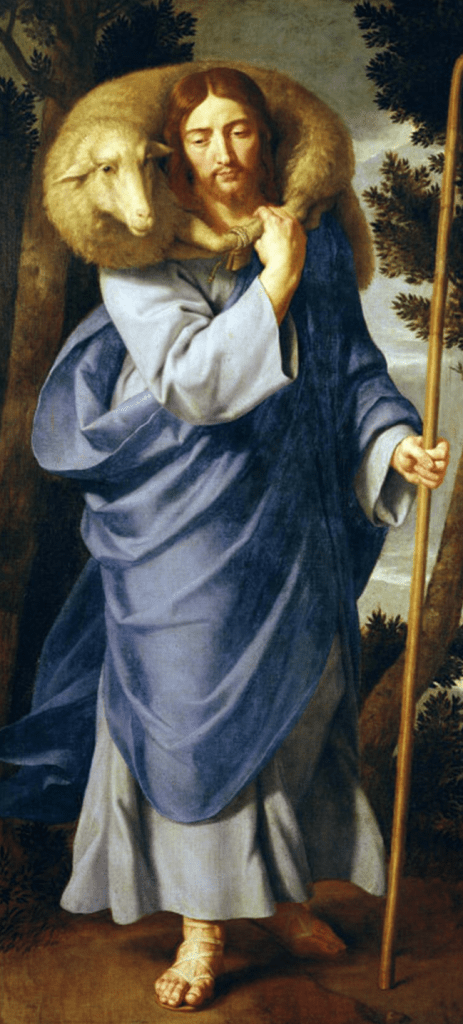
In today’s Gospel Reading, Jesus presents himself as the Good Shepherd tending his flock. He tells his confused disciples and listeners that:
I am the gate. Whoever enters by me will be saved and will come in and go out and find pasture.
John 10.9
St John tells us that ‘Jesus used this figure of speech with them, but they did not understand what he was saying to them’ (John 10.7). And, 2000 years later, we may equally find ourselves compelled to re-read and re-understand this passage. I remember in this very Cathedral hearing a priest preaching that Jesus positioned himself in direct contrast to shepherds throughout the ages who loved and tended their flock out of pure self-interest. A well-tended flock, fattened and healthy, make for the best meats that the shepherd will eventually sell or consume himself.
Jesus here is the Good Shepherd, the antithetical Shepherd, who cares for us so much that he willingly took upon himself the burden of the Cross.
The man who preached sociability and charity was instead condemned to being the centrepiece in a spectacle of public entertainment, where masses were drawn together not by love or goodwill but by the desire for cheap entertainment, obedience to the naked display of authority, and the mindless contemplation of that thing they called ‘justice’. That burden Christ took upon himself is one which countless Christians, in varying circumstances and ages, have also taken upon themselves ever since. And one which rightly should inspire us today in our struggles, and stall aggressors to check themselves in their volleys of scepticism.
Truly, Jesus was the Good Shepherd, who in his moment of truth, decided to sacrifice not his flock, but himself. He decided not to sell out or cash in, but to accept his fate, so that we may be saved. It is a decision that two millennia has perhaps dulled in our minds in the constancy of its retelling.
In this Gospel Reading, we see Jesus at pains to intervene against the odds, to disrupt the cycle of human vanities and natural instincts, and to interpose in its place a new conception of life. Jesus says to his audience words which are profound: ‘I came that they may have life and have it abundantly’ (John 10.10)
I do not see this as Jesus simply saying that he saves us from Death or at least the early grave. I see this as something which I hear every time at Evensong in this Cathedral and stirs and reinforces me personally: he is talking about: ‘that peace which the world cannot give’ (John 14.27). In talking of not just life, but a life in abundance, Jesus is talking about the way in which life itself does not solely have to be a dreary march from pillar to post, from resting point to resting point, or even, for us students, from bed to library.
He talks of life as a grander thing to be lived, if only we may halt ourselves in our tracks, and calmly contemplate. He bids us to stop up the fears and vanities, the half-truths we tell ourselves, and the arrogant presumptions we cling on to for matters of prestige and hierarchical self-assertiveness. He bids us, in short, not to live half-lives. To be, as I have long told friends, ‘our true best selves’. Indeed, that abundancy of life comes not from licence or delinquency or selfish abandon, but from the moral abundancy that we may find in the wisdom of Christ’s teachings.
This is, as I have said in a previous sermon, not just a philosophy, but a way of life. And what is this way of life? Well, we see in our first reading today, the utopian vision that Jesus inspired the early Christians with: one where meals are eaten together, and people are charitable. What a lovely vision. All are gathered together, achieving that value which has eternally escaped and passed by many generations: happiness; true, long-lasting happiness. Joy found not in having conquered the world but having conquered some part of themselves. Joy found not in extravagance, but in simplicity.
Note that the circularity of life and death, of struggle and sacrifice, or of hardship and want, has not disappeared. But their centrality to life has. God has not promised an end to all struggles. But God has promised, I think, something greater and more difficult to accept: that we do not have to face our battles alone. That we are loved, despite all our weaknesses, and failures, and frailties. And that we do not have to retreat from the world in order to prosper in it.
The Christian spirit and message do not promise us a free lunch. It asks of us something which has failed many before us, many now, and, I have little doubt, many in the future. It demands of us vigilance, perseverance. And, above all else, courage. The courage not just of bravery in the field, but of a moral courage. Today, that courage is needed. The late Queen, who as many of you know is a source of very deep inspiration to me, in 1957 said:
Today, we need a special kind of courage, not the kind needed in battle but a kind which makes us stand up for everything that we know is right…We need the kind of courage that can withstand the subtle corruption of the cynics.
Queen Elizabeth 11
We are often the makers of our own miracles, but it is the spirit and drive we are given by God, amongst others, which will drive us forward to conquer our demons, overcome our obstacles, and live fuller lives. It is a daunting challenge, but it is one that we should accept. God is not simply the dispenser of good and evil, to be embraced or rejected as the fortunes of our lives vary. Often, God is something we cannot always necessarily discern.
And life itself may very well feel like a country driver facing intermittent weather, where the satnav has died. We may feel that God is like the radio signal, coming in with great éclat, going out with a drivel of quiet, faltering noise. We may curse it. We may dance melodiously to it. But there the radio is still. On this country drive, we would never blame ourselves for the quality or our skill. But blame others. It is by far the easier thing to do. We may stress ourselves out, fearing we shall never reach the intended destination. And in the great fire of our stress and our anger, we may fail to see the beauties of the green fields and new sights that we behold. Sometimes, in the great heat of our struggle to find our way out of the morass, we may need to apply gentle pressure to the brakes. We may even need to do that thing which any competent driver may dread, for fear of looking weak or inexperienced: we may need to pull over. We may need, in fact, to recalibrate and be still. Be still. And discern God in the distances striding to our rescue. We may need that space to discern him better by actively letting go of our struggles and our anxieties, and allowing him to take over, to direct us, to steer us, to embrace us. We may then get back on with our drive. Later, we may even try and erase that memory of when we needed help, perhaps through embarrassment, but God will not judge harshly, he will not reject us like the spurned lover.
What I’m trying to say is that the Christian faith, indeed life itself, requires vigilance on our part. I know this because I too, despite outward appearances, have found God, in the end, to be the most reliable of constants in this abased world. I have learnt harshly what it means to be alone or to feel abandoned by the passing forces of this earth, and to have felt as if I alone can fix things. I have sometimes even tried to deny God by inserting myself in His place, the mover and shaker of all things. But, as my young life has stretched out before me and maturity has dawned, I have accepted what is hard to accept for any proud or just human person: that there are some things which we need help on, some others whom we must turn to. And I am so very grateful to have such great friends who have helped me to realise this and be there for me.
Like the country driver when things are going wrong, it is the very act of acceptance and confident belief that has improved and shaped me, even rescued me from others and from myself, as with so many others.
Churchill once mused about whether history only teaches us the constant of the unteachability of Man. Well, perhaps he had a point. How many times have we, have I, trusted in those things which are not stable or durable: in the fool’s gold and decomposing promises of fellow beings, of fitness quick fixes, or of moonshine mercurial manifestoes of eternal ease and minimal effort. Amidst it all, though He may at times be hard to discern, I have found myself trusting in God. It has taken time, sometimes too much time for my liking, to find out what He has in store for me. He often gave me the most unexpected of boosts, as well as of lows. But He reassured me that right would come through.
And in that process, I became imbued with that thing rarer than hope: confidence. Confidence not just in the Church or society, but even rarer, in myself. It may falter at times, but it has derived from the rock and refuge of Christ, not the shifting sands of Man or of man-made structures.
So, what was Christ, the supposed Good Shepherd, saving us from? Was it war or strife? Possibly. But I think the Good Shepherd saved us from something far worse: he saved us from ourselves. If we choose to follow the teachings of this mighty faith, we are offered the chance of ourselves reborn and resurrected.
As you may have gathered from this morning’s sermon, religion (like many other things) is not just philosophy, not just a way of life either. Religion is psychology too, I think. The questions of life: how we might better ourselves, how we might better others, how we might save ourselves from despair and cynical fatalism, how we might trust that things might turn out okay. All are met in the empty tomb of Christ resurrected.
Throughout all the challenges and changes of life, not all bad, not all good, I have come to a stage where, thanks to the confidence I have in the teachings and bolstering support of the Christian religion, I too may say in the words of Pilgrim’s Progress:
and though with great difficulty I am got hither, yet now I do not repent me of all the trouble I have been at to arrive where I am. My sword I give to him that shall succeed me in my pilgrimage and my courage and skill to him that can get it. My marks and scars I carry with me, to be a witness for me that I have fought his battles who now will be my rewarder.
John Bunyan, Pilgrim’s Progress
Now, for many of us, a term of great momentousness beckons. It shall not be easy. And at times we may feel that we are incapable or unworthy of the challenge. I pray for you all daily that you may find time, like the country driver, to accept that we are not alone, that we are not helpless, and that, though great difficulties may attend us, we shall reap fully our rewards. Things will come aright! But, to do all this, one needs constancy, vigilance, perseverance. That is not just the foundation of hope, but indeed of confidence, self-confidence, too.
I have found that trusting in God has led more and more to trusting in self. That God-given confidence I pray you may all find in your own way and in your own time. In the tranquil calm of this Cathedral, where a thousand ancient stones tell their own stories of countless peoples’ struggles and battles, I pray too that you may find truly what Christ promised: that peace which the world cannot give. Amen.
Lord, mercifully grant that I may speak your Truth and be ever pleasing to you, in the name of the Father, the Son and the Holy Spirit.
In today’s readings, we hear of St Paul at pains to communicate that he speaks and preaches not on his own terms or of his own wishes, but on God’s power and wisdom. He asks them to elevate the considerations of their minds above the conventional wisdoms of the age, above the stereotyping, frivolities, dogmas, and petty judgements of conventional human beliefs that we sometimes quite arrogantly call ‘wisdom’.
We also hear in the Reading of Isaiah of those who, outwardly, performed the acts ordained by God, who almost buy into the ancient Greco-Roman ideal of theology, that the gods are but jealous hagglers, purely transactional in the hope that a sacrifice and a vain appeal to their memory may produce the divine favour which they feel they are owed.
Why should the Christian God be any different? Why does our conduct matter? Why should it matter when, as Isaiah says:
‘on the day of your fasting, you do as you please and exploit all your workers. Your fasting ends in quarrelling and strife’ (Isaiah 58:4-5)
Today, if the congregation would allow me, I shall be slightly more personal, in answering the broader question of what role can faith and the Church play in the life of a 21st-century young adult, in a world increasingly secular and sceptical of all received wisdoms?
I think that, amidst all the trials and tribulations, the perpetual vortex of agitation within which our modern world and society seem to dwell, it is incumbent on the Church which comprises us all, to act not as a mirror OF society, but as a mirror TO society. What’s the difference, you might ask?
Well, to be a mirror OF society, is simply to reflect whatever is going on in the world beyond the church walls, to accept with good-humoured capitulation, all the mores and fads that come and go with ease. Instead, the Church must act as a mirror TO society, to show up the real face of humanity in the present and to provide a pathway to a more enlightened and better humanity of the future.
This is the harder path of the two, the one that may involve collisions and disputes. But the Church must be emboldened, I feel at least, to lead by example, a process harder than the words may imply.
But, amidst the swirling debates of hair-splitting, contested human wisdom, scandals, and egocentric reasonings, I fear very much that the Church has somewhat lost sight of its overall purpose: to bring the light of Christ, the enlightening wisdom of God, into this all-too-fallible, all-too-contemptible, all-too-pain-ridden world.
The Christian faith is, in some way, a noble, social mission which will require every ounce of our energies, our faith, and our commitment. This is not my modern take on Scripture, but one which has lain at the heart of it, as we heard of in the Reading of Isaiah: the ‘true fasting’ we were commanded to do was not the one of mere outward appearances but of being able ‘to loose the chains of injustice and untie the cords of the yoke’, ‘to share your food with the hungry and to provide the poor wanderer with shelter’. This simple mission is the hardest of all, that’s why it demands resilience and perseverance, not faltering apathy.
I am fully aware of my own essential flaws and frailties, as a person and as a Christian, but it is the deep faith which I have in the teachings of the Christian religion which have ever been my constant guide, the personal rampart and communal bond against the multiple attacks of the world.
I understand entirely that all are at different stages in their journey of life and faith, and I know that God can often seem an inscrutable, rather remote concept and being. One that we earnestly hope is there, one whom we cannot disprove nor prove, yet for whom we seek the little touches and signals in our day-to-day life. But, I readily admit, it was often in times of deep pain, loss, and loneliness that I found the reassurance and the strength that came from outside of myself. My beliefs have not always been without some trepidation and sometimes frustration.
I remember around the time of my Confirmation in 2018 when a friend asked me whether if I was told that God did not exist, would I still think that being a Christian was worth it? To that, I simply said: Yes. This is not just a faith but a moral framework, one that shapes and conditions my life so that, like so many others, every day I wake up not a better person all round or a better person than others, but someone who is prevented from being much worse. One that fears not whether I shall ever even awake from nightly sleeps.
Faith is a complex thing, sometimes we struggle to even explain it. But in the joint prayers and hymns of a service, or the quiet of a church when tourists, pilgrims and congregants have departed, in the times when we Cross ourselves in times of suspected difficulty, or times when we feel ourselves unequal to the measure of a given task, it is that feeling of not being alone, of being rescued by a benevolent yet inscrutable Being which gives us the stayed fortitude to move on with our lives.
The reality is that whilst great empires, all-powerful rulers, and dauntless ideologies have fallen away like flies, the Faith, sometimes weakened, sometimes faltering, has endured. And this is something St Paul was aware of as he wrote letters of encouragement to those who felt cut off, adrift, as their elementary churches were ruthlessly stamped out by the forces of Roman Caesars. St Paul, perhaps like many in today’s secular world, thought little of the wisdom of this age or ‘of the rulers of this age, who are coming to nothing’. As we heard in our Readings earlier, Paul himself pondered deeply the imponderable nature of God. What sense could we make from the stories we knew?
Often, the stories of the Christian religion have been told of so many times, that we lose sense of their magnitude, of their possibility in a world as crestfallen as ours. We think it impossible that a man would willingly take up the Cross on his bare shoulders, upon which he would be nailed for hours on end. We think it impossible that tax collectors and fishermen, at the very bottom of the contemporary socio-economic hierarchy, would risk what little prosperity and security that they had accrued in their short lifetimes, for a nomadic life of danger and persecution.
How can it be that the man whom we worship as the Son of God himself was a carpenter, born in the smelly hay of a ramshackle stable? These people were not half-mad firebrands, nor what modern parlance might call ‘clout chasers’. This is the faith which is life-giving. This is the faith of those mothers of murdered sons which inspires them to forgive, unreservedly, the killers of their children. The faith in which slaves in the weather-beaten sugar plantation fields rallied to at a time when slave masters cruelly tried to deny them salvation and liberty in this world as much as in the world after this one. Even as secular forces sought to deny what Scripture foretold of ‘not Greek or Jew… slave or free; but Christ is all, and in all’.
This is a faith which is worth defending, worth believing, worth practising.
And practising not in the style of just coming to worship in church, but of practising fully, in tending, like Christ, to the sick and the needy, the broken and the shunned, the naked and the hungry. This is the faith which I know to raise people, strangers, up, not cast them down. The faith which redeems.
I have been asked by curious friends of how godly redemption can simply be abused by those who profess faith only at the end of their life. I say to them and to all who think that: that you misunderstand this faith. In accepting Christ, in accepting Christianity, we are not merely accepting belief in his existence, or belief in his Resurrection. It is about ourselves being, as the Dean of Worcester said last Easter, the Resurrection incarnate.
We stand today delicately poised at the crossroads, on the brink of catastrophe too great to imagine and to accurately foretell, such as climate change and pandemics, and much else. We stand at the precipice, and it is incumbent upon the Church to guide the hand as society slowly retreats, if indeed society does retreat.
There are some words imparted to me by preachers at my home cathedral in Worcester and reinforced by the moral strength and candour of my own family, which have forever imprinted themselves firmly on my mind: from a visiting preacher from Magdeburg, ‘see in the face of all, the face of Christ’. And from a priest who has ever been a role model and a guide to me: ‘every day on this Earth, be the hands and feet of Christ yourself’.
Being a Christian is not easy, it often involves resigning our personal wants to the dictates of a higher Duty, a higher Calling, but the rewards are not, as some would suppose, simply a happier Afterlife, but instead to see the world in which we live transformed and resurrected. Often, it involves us accepting the terrifying reality that we are not in control, that we do not know all the facts. What separates this from the philosophical traditions of others is the profound godly insight that love of the brotherhood of man, in the world as it is rather than the world as we would wish it to be, is the sole motivating principle which demands that we foreswear or sublimate all others.
It was that great Houseman, Sir Robert Peel, who once said, timelessly, in the 1830s that ‘we should look to religion for support in tribulation, admonition in time of prosperity, and comfort in time of death’.
A short walk away from here is the Chapel of Remembrance dedicated to the fallen soldiers of past wars. Above the archway is a simple inscription that has inspired me ever since I first laid eyes upon it four years ago: ‘Fear God, Honour the King, Love the Brotherhood’. This, along with so much more, is not just a philosophy, one might say, but more a way of life.
It is when the Church confidently, even daringly, looks outward, and seeks to be the mirror to society, not the mirror of it, that we find ourselves, as a collective, acting humbly but dutifully as a moral example to others, as much as to ourselves. Not often by braggart ways of showy self-promotion but by a quiet, unstinting example in which we ourselves fulfil the promises of Resurrected Faith through the piecemeal rebuilding of our own troubled world, contributing what we can, whenever we can, in whichever way we can. Then, like Isaiah and Paul prophesied so long ago, we may count ourselves to be fasting true to that ever-testing mission and Spirit which the God of the Holy Trinity imparted to us all.




 Consider the Lilies - Clare Hayns