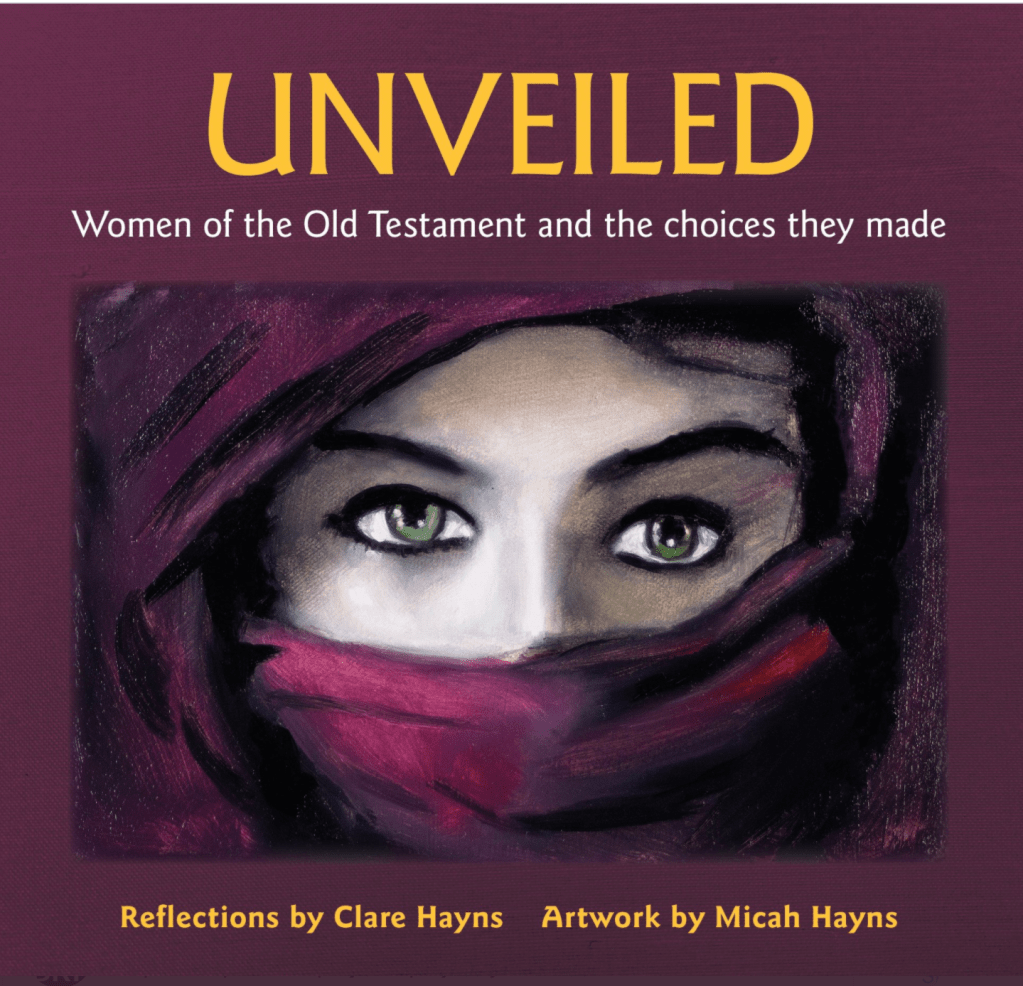
We are delighted to share the cover of ‘Unveiled’, published by BRF, which will be available to buy in October 2021
Consider the Lilies – Clare Hayns
Blog with sermons, poems and musings plus reflections on more than 40 women from the Old Testament,

We are delighted to share the cover of ‘Unveiled’, published by BRF, which will be available to buy in October 2021
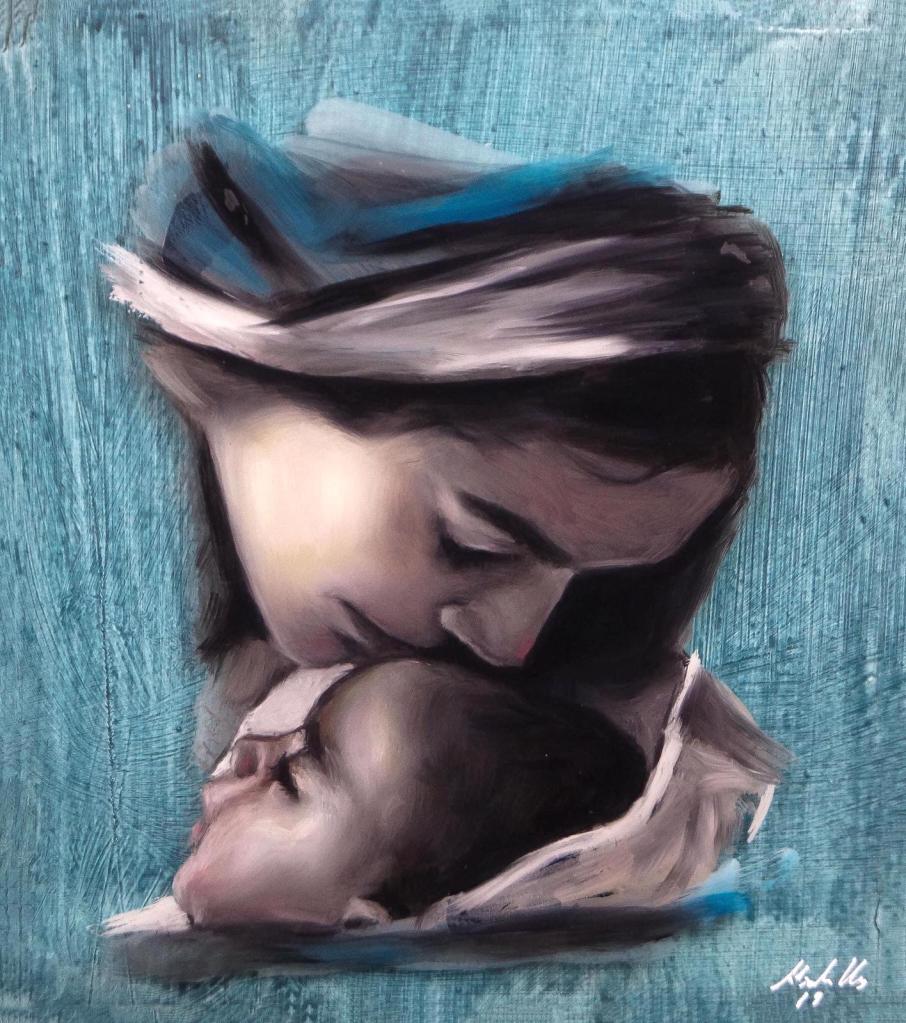
This post was written by Revd Philippa White (Precentor of Christ Church Cathedral) as part of a series for College Chapel, January 2021
For Mothering Sunday 2021
In a still, quiet, starlit night, a baby stirs.
He snuffles and whines and nearly cries, and his mother puts out a sleepy hand to soothe him. Very quietly, so as not to wake her husband, she starts to sing.
‘My soul magnifies the Lord, and my spirit rejoices in God my saviour; for he has looked with favour on the lowliness of his servant.’
The baby is six weeks old and his parents have taken him for the service of thanksgiving. He’s restive. His mother takes him into a corner and settles down to feed him, arranging her shawl carefully so as not to expose herself in the temple. As he sucks, she curls herself around his tiny, beloved body, and gently sings to him.
‘Surely from now on all generations will call me blessed, for the mighty one has done great things for me and holy is his name.’
He’s a toddler now. Full of energy and silliness and independence. ‘Amma, Amma, can I help? Abba, Abba, let me do it!’
But at the end of the day, with his sticky face scrubbed clean, when they settle down for bed, he listens to his Amma telling the stories of Hashem, the Holy One, calling out in fire and cloud and darkness and bringing his people out of every danger. Of Abraham and Sarah, Isaac and Rebekah, Jacob, Joseph and Moses. And then she sings him to sleep.
‘His mercy is for those who fear him, from generation to generation.’
When he’s twelve, he stays in the Temple. What else would he do, if not listen to the stories of Hashem, the promise that they are the chosen people, the treasured possession? What else would he do, if not ask the questions that bring to mind Hashem’s promises. That justice will roll down like waters and righteousness like streams; that the rich and corrupt will be swept away and those who have no power, be raised up; that light will come at last to all people. Someone had sung that to him in this temple once; his Amma had told him that. Nations will come to your light, and kings to your dawning brightness, he quotes.
When she finds him, he looks at her reproachfully. Amma, have you not realised what you’ve been teaching me since the day I was born? ‘He has shown strength with his arm; he has scattered the proud in the thoughts of their hearts;’ he sings back to her, and runs to her with a smile. In their embrace she realises for the first time that he’s nearly as tall as her. His work will soon begin.
These are her treasures when he does go. He comes back, from time to time. Sometimes he brings his friends: Peter, who hides his shyness in bluster, and Andrew, quiet and steely. James and John, whose mother she tries to like. Thomas, melancholy and utterly devoted. She welcomes them all, joins in their talk of God. He asks her to lead the prayers, sometimes.
‘He has shown strength with his arm; he has scattered the proud in the thoughts of their hearts.’
Sometimes she goes to see him. Sometimes she sits with the men, sometimes she stays with the women. Sometimes she just joins the crowd. She sees him heal. She sees him feed five thousand people. She laughs with delight when she hears him call out ‘blessed are you who are poor, for yours is the kingdom of God. Blessed are you who are hungry now, for you will be filled.’
She’s close enough for him to hear her, so she whistles her song and catches his eye, and he smiles up at her.
‘He has brought down the powerful from their thrones and lifted up the lowly. He has filled the hungry with good things and sent the rich away empty.’
And she’s there on the day he dies.
As close as she can get.
Clutching at Mary, at John, at the others as they cry.
Screaming.
Curling herself around his broken, bloody, empty body.
Dragged away at last, taken to John’s house, where she sits in the corner, hunched around herself.
And all she has to hold on to is the words she mumbles again and again:
‘He has helped his servant Israel in remembrance of his mercy, according to the promise he made to our ancestors, Abraham and his seed forever.’
You were faithful once. Why can’t you be faithful now?
Have you shut up your compassion from us? Have you utterly deserted us? Blessed are you, Lord our God, King of the Universe, whether we want to praise you or not. But make this stop.
Infinite days. Two endless nights.
At dawn on the third day John picks her up as if she weighs nothing and takes her to the room where his friends are gathering. They are kind. They are ashamed of themselves and being kind to her salves their guilt.
Until the door is flung open
and in runs Mary Magdalene
and the Light dawns.
And Mary said:
‘My soul magnifies the Lord,
and my spirit rejoices in God my Saviour,
for he has looked with favour on the lowliness of his servant.
Surely, from now on all generations will call me blessed;
for the Mighty One has done great things for me,
and holy is his name.
His mercy is for those who fear him
from generation to generation.
He has shown strength with his arm;
he has scattered the proud in the thoughts of their hearts.
He has brought down the powerful from their thrones,
and lifted up the lowly;
he has filled the hungry with good things,
and sent the rich away empty.
He has helped his servant Israel,
in remembrance of his mercy,
according to the promise he made to our ancestors,
to Abraham and to his descendants for ever.’
Written by Revd Philippa White (Precentor of Christ Church Cathedral) as part of a series for College Chapel, January 2021
We have some exciting news to share. As a result of all your encouragement and positive feedback for our Lent Blog, Micah and I put together a proposal to turn the blog into a book… and we can now announce that we have a publisher!
We are delighted that BRF (Bible Reading Fellowship) have commissioned this and we are now working hard to create a stylish book on 40 women from the Old Testament, all illustrated by Micah Hayns.
The working title is Unveiled: Women of the Old Testament and the Choices They Made.
The plan is to be completed by October 2021 – we’ll keep you posted!
Clare and Micah

Yesterday’s post ended with the deposition of Queen Vashti for her disobedience to the King Ahasureus’ demands. This opened the way for one of the great heroines of the Hebrew Scriptures and a story that is told each year during the festival of Purim. It is the story of Esther, the woman who saved her people from extermination.
Esther was very different to the aristocratic Vashti. She was an orphan and so had been brought up by her uncle Mordecai, and she was Jewish. This was at a time when the Jews were still in exile but they were able to live in relative peace under the authority of the Persian rulers.
The king had sent out his servants to find a suitable replacement wife and so beautiful young women from around the land were taken to the palace to join the harem under the watchful eye of Hegai, the king’s eunuch. Esther, being ‘fair and beautiful’ was one of them. She quickly became one of the favoured women.
Those of us who enjoy the odd beauty treatment might like to pause to reflect at the description of the process whereby these women were prepared for their ‘audience’ with the king:
Their cosmetic treatment [was] six months with oil of myrrh and six months with perfumes and cosmetics for women.
Esther 2.12
A whole year of beauty treatments!
Esther pleased the king and he ‘loved her more than all the other women’ and so he ‘set the royal crown on her head and made her queen instead of Vashti’. There was a banquet and national holiday in her honour, and the king distributed gifts around his kingdom in celebration.
She had a secret however: she didn’t tell anyone that she was Jewish. She continued to keep in touch with her uncle Mordecai, who spent his time sitting at the king’s gate, perhaps so he could hear news of his adoptive daughter. One day Mordecai foiled a plot against the king by overhearing rumours of rebellion: he informed Esther who told the king and the rebels were hanged.
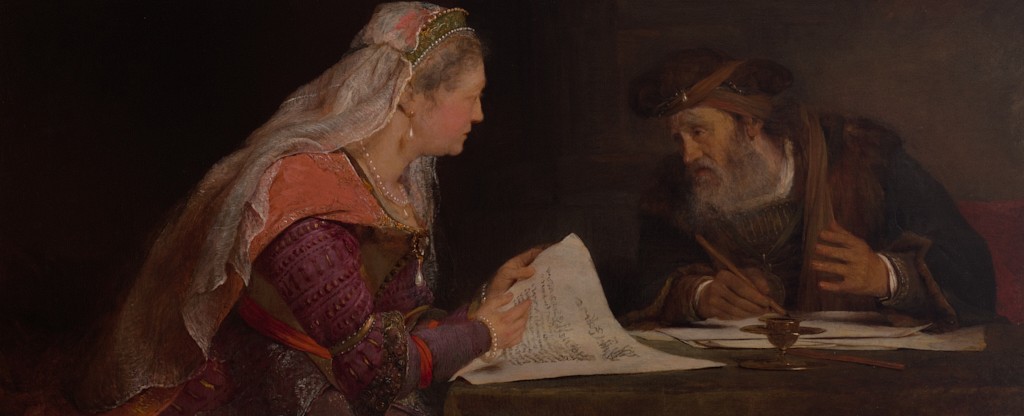
If this was a fairy tale and Queen Esther was the beautiful princess, then the evil villain now comes on the scene: Haman. He was promoted by the king to be his ‘first official’ and is given authority over all other public servants. A vain and arrogant man, Haman demanded everyone pay him homage on bended knee. Mordecai refused to bow. Haman is furious and used this slight as an excuse for his anti-Semitism and he determined to ‘destroy all the Jews, the people of Mordecai, throughout the whole kingdom’. (Esther 3.6).
Haman erects a vast gallows to carry out his murderous plan, the king passively agrees to his proposal, and the city is ‘thrown into confusion’ as edicts to kill the Jewish people are sent out.
Queen Esther is deeply distressed. Mordecai asks her to intercede with the king for their salvation and tells her that she has been put into the palace ‘at such a time as this’ for the purpose of helping her people.
But Esther realised it wasn’t going to be simple. She would have remembered what happened to Vashti. She would need to tread carefully.
She takes control of the situation, first asking all Jews to fast (and, we assume, pray) for three days. She then goes to the king and asks him if she can host a banquet for him and Haman. The king is delighted and offers her anything she desires, but she holds back and hosts a second party the next day. At the second banquet Esther makes her request, and by this stage the king is fully on her side, particularly as during the night he had had a dream where he remembered the loyalty of Mordecai who had warned him of the assassination threat.
Esther’s request is bold. She discloses her background and tells the king of the ensuing massacre:
let my life be given me… and the lives of my people, that is my request. For we have been sold, I and my people, to be destroyed, to be killed
Esther 7.3-4
The king’s eyes are opened to what is being done is his name, and the wicked Haman is killed on his own gallows, and the Jewish people are saved. In a final twist to the tale, Mordecai is given Haman’s position in the palace and Esther and her uncle are given his house and household.
for the Jews there was light and gladness, joy and honour…a festival and a holiday
Esther 8.17
The festival of Purim was instituted and every year Queen Esther continues to be remembered for her part in the salvation of the Jewish people.
Jesus went to the Mount of Olives..he knelt down and prayed,
'Father, if you are willing, remove this cup from me;
yet, not my will but yours be done'
Luke 22.42
Before taking any action Esther’s first instinct was to insist all her people spent three days in prayer and fasting. This week is Holy Week and today we remember Jesus in Gethsemane before his arrest where he spent time in prayer grappling with his Father as to whether this journey was really his to take.
There is a wonderful line in Esther’s story where Mordecai tells her that perhaps she had been placed in the palace at that particular time for a particular purpose that only she could fulfil. ‘Who Knows?’, he says, ‘perhaps you have come to royal dignity for such a time as this’.
For such a time as this
I wonder if Jesus thought of Esther as he pleaded with his Father in Gethsemane? I wonder if he recalled her courage to face the king when he was being dragged in front of Pilate? I wonder if he found himself realising that he too had been chosen ‘for such a time as this’.
O Lord, who when thine hour was near, didst go without fear among those who sought thy life; give us such boldness to confess thee before others, and such readiness to bear thy cross, that hereafter thou mayest confess us before thy Father which is in heaven. Amen
A prayer of Joseph Oldham, 1874-1969
A Blessing for all those going through a time of change at the moment.
When near the end of day, life has drained
Out of light, and it is too soon
For the mind of night to have darkened things,
No place looks like itself, loss of outline
Makes everything look strangely in-between,
Unsure of what has been, or what might come.
In this wan light, even trees seem groundless.
In a while it will be night, but nothing
Here seems to believe the relief of darkness.
You are in this time of the interim
Where everything seems withheld.
The path you took to get here has washed out;
The way forward is still concealed from you.
“The old is not old enough to have died away;
The new is still too young to be born.”
You cannot lay claim to anything;
In this place of dusk,
Your eyes are blurred;
And there is no mirror.
Everyone else has lost sight of your heart
And you can see nowhere to put your trust;
You know you have to make your own way through.
As far as you can, hold your confidence.
Do not allow confusion to squander
This call which is loosening
Your roots in false ground,
That you might come free
From all you have outgrown.
What is being transfigured here in your mind,
And it is difficult and slow to become new.
The more faithfully you can endure here,
The more refined your heart will become
For your arrival in the new dawn.
from: “Benedictus, A Book of Blessings” by John O’Donohue, Bantam Press, 2007
A Poem read at Leavers’ Evensong on June 16th 2019
Keith Douglas, 1920-1944
At home as in no other city, here
summer holds her breath in a dark street
the trees nocturnally scented, lovers like moths
go by silently on the footpaths
and spirits of the young wait,
cannot be expelled, multiply each year.
In the meadows, walks, over the walls
the sunlight, far-travelled, tired and content,
warms the recollections of old men, touching
the hand of the scholar on his book, marching
through quadrangles and arches, at last spent
it leans through the stained windows and falls.
This then is the city of young men, of beginning,
ideas, trials, pardonable follies,
the lightness, seriousness and sorrow of youth.
And the city of the old, looking for truth,
browsing for years, the mind’s seven bellies
filled, become legendary figures, seeming
stones of the city, her venerable towers;
dignified, clothed by erudition and time.
For them it is not a city but an existence;
outside which everything is a pretence:
within, the leisurely immortals dream,
venerated and spared by the ominous hours.
Used with kind permission by the Douglas Estate
 Consider the Lilies - Clare Hayns