Unveiled #Me Too: courage in the face of violence and threat

Helen Paynter, author, Baptist minister, and the director of the Centre for the Study of Bible and Violence at Bristol Baptist College. 

This article was written by Helen Paynter as part of a series based on our book Unveiled and commissioned by BRF. This was first published by BRF and is reproduced here by kind permission from Helen and BRF.

TW: Domestic Violence/sexual abuse

Standing up to a powerful man comes at considerable cost. 

Unveiled, p. 177

In 2017, the #MeToo tag went viral, becoming a global phenomenon within a matter of weeks, and emboldening millions of women – and also men – to name their experience of sexual harassment and abuse. What had, in many places, been a shadowy secret was brought into the light. The scale of the pandemic of abuse became clearer to many. Systems and structures that collude to silence women were brought under scrutiny. Serial abusers who had concealed their crimes with threats, non-disclosure agreements and the ‘old boys’ network’ were exposed and brought to justice.

What few people might imagine is that the women who shouted ‘Me too!’ had sisters who had gone before them and had left their traces in the pages of the Old Testament.

The Old Testament has a surprising collection of stories about women who stood up to powerful men, some of whom feature in the beautiful book Unveiled by Clare and Micah Hayns. Not all were speaking up about sexual abuse per se, but they share other common features: boldness, courage and truth-telling in the face of violence or threat.

Old Testament sisters

We might think of the two different Old Testament women named Tamar. The first Tamar’s story is told in Genesis and features in Unveiled. The second Tamar’s shocking story is recounted in the book of Samuel. The daughter of King David, she appeals to her lecherous half-brother with remarkable courage and wisdom. ‘No, my brother, do not force me… do not do anything so vile… you would be as one of the scoundrels in Israel’ (2 Samuel 13:12–13). Tragically, Tamar’s entreaty is over-ridden by her rapist, but when she is thrust out from his room afterwards, she raises the outcry, which is the traditional appeal for justice. ‘Tamar put ashes on her head, and tore the long robe that she was wearing; she put her hand on her head, and went away, crying aloud as she went’ (v. 19).

“Rizpah daughter of Aiah took sackcloth and spread it out for herself on a rock. From the beginning of the harvest till the rain poured down from the heavens on the bodies, she did not let the birds touch them by day or the wild animals by night.” 2 Samuel 21:10 – Image by ©MicahHayns

Or we might turn the pages to read of Rizpah, whose two sons were brutally murdered, on King David’s orders, in retribution for a crime their father Saul had committed. To compound this villainy, David allowed their bodies to remain exposed on the hillside for months, a dreadful act in the ancient world. In the face of such injustice, Rizpah, like Tamar, protested vigorously, making a public nuisance of herself as she guarded her sons’ bodies and grieved for them (2 Samuel 21:10). Such actions were dangerous under despotic kings who could easily have their thugs knife you (as one example among many, see 2 Samuel 20:8–10).

Or we could thumb further through our Bibles to read of another despotic king. In the book of Esther we read the story of Vashti, who boldly refused to be objectified by her husband at his debauched party.

Each of these women creatively and boldly called out the violence of a powerful man. They were noisy, stubborn and caused a public nuisance.

But not everyone was able to do that – then, as today. In Judges 19 we read of the horrific gang rape and murder of a secondary wife, thrust into the hands of a mob to protect her husband. She has no voice, her protest is stifled and she does not survive to raise the outcry. And though the act precipitates civil war in Israel, many more women were raped as a direct consequence of that military action, suggesting that the chief motivation was wounded male pride rather than outrage about a woman’s violation.

And so it falls to her sisters to take up her cause. To name the abuse, to call out the abuser, to cry for justice and safety.

In modern times many women have taken up the story of that nameless woman: Bekah Legg of the domestic abuse charity Restored, and biblical scholars Phyllis TribleIsabelle Hamley and myself (Helen Paynter), to name just four. I am reminded of what took place after the murder of Sarah Everard: the protests on Clapham Common and the Reclaim These Streets movement, which employed public grief to make a wider claim for justice.

Sadly, I can’t think of any good examples in the Old Testament narrative where a man takes up a woman’s cause or speaks effectively on her behalf (Clare’s note: perhaps the story of Suzanna and Daniel in the Apochrapah comes close). But if we keep turning the pages, we will eventually encounter a man who does, and repeatedly. A man who publicly defends a woman whose ‘great sin’ (probably sexual) has been forgiven, and whose gratitude leads her to weep over his feet and anoint them with oil (Luke 7:36-50). We can just imagine the sniggering and lewd remarks that were probably rippling through the onlookers as she did so. Jesus sternly rebukes them.

This is the same man who refuses to join the crowd in baying for the blood of a woman caught in the act of adultery, the crowd that was desperate to vilify the woman while curiously indifferent to the man she was with. Jesus shames the crowd into leaving, and then sends her home with gentle words.

Brothers, be more like Jesus

Because I (Helen) have written about domestic abuse, I find myself invited to speak on the subject from time to time. When the audience is free to choose whether to attend (unlike, for example, when I speak to trainee ministers or priests), it is always predominantly women who attend, usually outnumbering men by around seven to one. Why are men not more interested in this matter? (There are, of course honourable exceptions, such as this.)

Brothers, be more like Jesus, I implore you. Speak out against injustice. Actively stand against abuse. There is so much hatred and harm out there that it requires more than just passive non-complicity.

But the fact that these stories are present in our Bibles should encourage us. The accounts of these ancient women and the things they suffered have not disappeared in the patriarchal sands of time. These women mattered to God, and so he ensured that their stories were preserved in his word. And so they should matter to us, too – they and those who suffer like them in our own day

These stories should encourage contemporary sufferers of abuse to believe that God cares, and maybe to embolden them to speak out.

It is much harder for abuse to thrive when it is brought out of the shadows into the light; when it can no longer hide behind threats, non-disclosure agreements and the old boys’ network.

But, rest assured, in the end all will be revealed:

Nothing is covered up that will not be uncovered, and nothing secret that will not become known. Therefore whatever you have said in the dark will be heard in the light, and what you have whispered behind closed doors will be proclaimed from the housetops

Luke 12:2–3

Because, as the psalmist reminds us:

He who planted the ear, does he not hear?
He who formed the eye, does he not see?

Psalm 94:9

Following a career in medicine, Helen Paynter is now a Baptist minister and the director of the Centre for the Study of Bible and Violence at Bristol Baptist College. She is the author of two BRF books – God of Violence Yesterday, God of Love Today? and The Bible Doesn’t Tell Me So: why you don’t have to submit to domestic abuse and coercive control

A Heart of Peace: Lessons from Abigail

From a sermon given at Led by the Spirit, High Wycombe, Bucks – 22nd May 2022

1 Samuel 25
John 14. 23-29

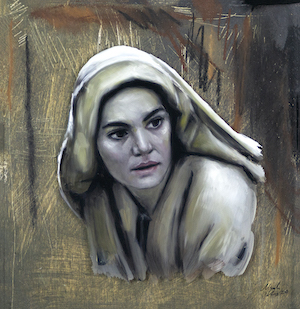
Abigail, by ©MicahHayns

Peace be to you, and peace be to your house, and peace be to all that you have

1 Samuel 25.6

Said David, the outcast future King of Israel to Nabal, the owner of the land David had been protecting.

Peace I leave with you; my peace I give you

John 14.27

Said Jesus to his disciples just before he was to be taken away to be tried and crucified.

Peace be with you. We say it to one another just before communion as we nod in an Anglican kind of way: certainly no hand shaking or hugging anymore!

Peace.

What is it?

Is it the absence of something? An ending of conflict. The cessation of war?

Or is it a feeling? That feeling you get when you’re on holiday or having a massage?

But we all know that after a war ‘ends’, conflicts can continue to simmer within communities for years.

And I don’t know about you but when I’m meant to FEEL peaceful (on holiday or having a massage) I find I’m anything but. My mind fills with worries. I start chuntering about a problem or annoyance.

So, what does Jesus mean when he says ‘my peace I give to you’?

What does having Jesus’ peace mean when we find ourselves, for whatever reason, in the midst of conflict?

Because conflict is part of human existence isn’t it.

Think for a moment of the conflicts that impact you in some way.

  • Global – Ukraine is on all our minds
  • Communities or work situations
  • Home life/family life

None of us are immune. As soon as one finishes something else begins!

When I was a child, my mother counted the seconds in the morning to see how quickly I would say something mean to my sister that would cause her to cry or shout. Never much more than ten!

Both our readings begin with ‘peace be with you’ – but then both lead pretty quickly into conflict. We know what happened to Jesus soon after this. But the story in 1 Samuel is less well known. As is the main peacemaker – Abigail.

Abigail found herself in the middle of two warring men.

She was married to Nabal, a drunken,  boorish man whose name literally means ‘fool’. He was the landowner of the region that David had been protecting with his men.

Nabal threw David’s ‘peace be with you’ back at him by pretending he had no idea who he was (1 Samuel 25.10). David, thin-skinned and easily offended reacted immediately:

‘Every man strap on his sword!’…David also strapped on his sword

1 Samuel 25.13

And they head off to murder Nabal and all his household.

Before we judge too harshly let’s pause to reflect on ourselves here.

We may not have an actual sword or an army of men with swords like David. But let’s be honest, we can all strap on our metaphorical swords when we find ourselves in a conflict. Our weapons may be a caustic tweet, a winning takedown in an argument, an angry gesture in a car, a passive-aggressive ‘ghosting’. We all have our weapons of choice, don’t we?

Abigail is alerted to the conflict by one of Nabal’s men. He knew she was the more sensible one to speak to. And her immediate response isn’t to ‘strap on her sword’ and gather the troops.

Her response was one of peace-making. Her response was considered, thoughtful, and prepared.

The first thing she did?

She baked! OK, she may not have baked it all herself but she knew food was required. I know this may be rather gendered but….a clever woman’s tactic! She prepared fig cakes, loaves, wine and put them all on a donkey, and sent them ahead of her.

Street Pastors

She perhaps knew what the modern-day Street Pastors know. They go to nightclubs armed with lollies as they know it’s hard to fight whilst sucking a lolly!

When Abigail reached David (who was chuntering in his anger), she threw herself at his feet and used every peace-making tactic in her repertoire.

She flattered him – ‘my Lord, my Lord’; she told him Nabal wasn’t worth it – ‘fool by name and fool by nature’; and she handed over her gifts.

But the thing that made all the difference in the end?

She raised David’s eyes and reminded him of God. And she reminded him of who he was in the eyes of God.

The Lord has appointed you prince over Israel…. you are fighting the Lord’s battles…..my lord shall have no pangs of conscience’

1 Samuel 25.27-31

Abigail reminds David who he truly was and who he would one day become. And David changes his mind, and puts down his weapons.

Blessed be the Lord who sent you to meet me today…blessed be your good sense.

1 Samuel 25.32

The end of the story is that family is saved. Abigail waits for her husband to sober up before telling him what she’d done, and Nabal is so shocked he had a heart attack and died… and she ends up marrying David (which by all accounts isn’t necessarily a happy ending!)

So what might we learn from Abigail when it comes to peace-making?

That peace is not an absence of conflict or a feeling, but can also be an action. An action that can involve heading into conflict and not hiding away from it.

One of the books I found helpful this past year has been ‘The Anatomy of Peace’ by the Arbinger Institute.

The authors speak of the choice between having a ‘heart of war’ and a ‘heart of peace’ in the midst of conflict. Having a ‘heart of war’ involves seeing people as objects, often using language in a way that dehumanises: this always makes things worse and leads to further conflict.

The alternative is to enter conflict with a ‘heart of peace’: seeing others as people, human beings beloved of God.

It’s been something I keep going back to. I certainly don’t always get it right. If I find I have a ‘heart of war’ I need to seek out Abigail’s to help me look up and remind me who I am.

And this perhaps is what Jesus means when he speaks about the peace he leaves with us. He gives us a heart of peace.

The Hebrew word for peace is Shalom.

It is not the absence of something at all. Shalom means fullness, rightness, contentment, wholeness. Shalom is all things made well.

So, if you are in the midst of a conflict situation right now – Shalom
If you are concerned about a situation involving others – Shalom
If you are stuck in the middle of warring parties like Abigail – Shalom
If you are struggling to find a heart of peace – Shalom

Jesus’ peace isn’t like the world’s peace. It’s the ‘peace that passes all understanding’. It’s Shalom. And he offers this to you, to me today.

Amen

Prayer

God of peace and love,
We thank you that you offer us a peace that passes all understanding. We pray for that peace, that Shalom, today. For ourselves, our world, and for those we love, and especially for those we are in any kind of conflict with. Amen

Presentation and Art Workshop for Church/Community Groups

Women of the Old Testament

Clare speaking at an event in Hazlemere, Bucks

How many women from the Old Testament can you name? Did you know the first worship leader in the Bible was a woman (Miriam), that Shiprah and Puah were the brave midwives who stood up to Pharoah, that Abigail was a peacemaker who stopped a war, and that five plucky sisters transformed land rights for women down the centuries?

Clare and Micah Hayns are a mother and son team and together created the book Unveiled: women of the Old Testament and the Choices they made which is published by Bible Reading Fellowship. The book tells the story of over forty women with each chapter written by Clare and illustrated by beautiful and original artwork by Micah.

They would love to come to your church/women’s group/community to speak about the wonderful women of the Old Testament that feature in the book. Their talk brings these stories to life in an engaging and lively way which is illustrated with Micah’s images and can be accompanied by a short art workshop and table discussion questions. It’s suitable for those with no prior knowledge of the Bible/Old Testament as well as those who have been in church for years.

About Clare and Micah

Micah and Clare Hayns

Revd Clare Hayns is College Chaplain & Welfare Coordinator at Christ Church, Oxford. She grew up in rural Bucks, her childhood more Pony Club than church youth group. Pre-ordination she was a Social Worker specialising in substance misuse. She is married to John, an entertainer, and has three creative sons

Born in 1997, Micah Hayns is a contemporary classical painter from Oxford. He takes the classical techniques and tradition of the old masters, whom he studied at the Florence Academy of Art, and infuses them with a contemporary aesthetic, inspired by street art, abstract expressionism, and collage. He has a gallery and studio in Oxford and teaches drawing to children and young people.

Testimonials

Clare and Micah visited one of our regular Ladies’ nights and what a super evening we had! We learned about some awesome women of the Old Testament and Clare had a wonderfully warm way of bringing the stories alive and connecting with both our teenagers and those wise in years. Micah is an outstanding artist and with his gentle direction and encouragement enabled us to create our own masterpieces within 45 minutes! A fabulous evening celebrating awesome woman – then and now – and we felt truly blessed by them both. Thank you for a memorable evening!

Revd Trudie Wigley, Rector of the Dorcan Group, Swindon (March 2022)

Clare and Micah did a fantastic joint presentation for us as part of our Pause for Thought in Marston. Clare bringing to our consciousness the women who’s voices are seldom heard in the old Testament and Micah giving them substance and colour through art and form. The evening was a highlight this year and as one of our parishioners said it was one of the best evenings they have had in a very long time! The fact that Mothering Sunday was close by and we were in Lent made unveiling the Old Testament women even more special. 

Revd Skye Denno, Vicar of Old Marston and Elsfield, Oxford

Costs and details

The costs are:
Talk with Q&A – £100 plus travel expenses
Talk with Q&A plus art workshop and table discussion questions – £150 (includes materials) plus travel expenses

The talk lasts approximately 45 mins which includes Q and A
The art workshop/table discussion lasts up to 45 mins
We can also bring along books and prints/original art to sell

Art Workshop using charcoals led by Micah (lasts approx 45 mins) – image is Tamar’s eyes
Three generations of women enjoying an art workshop with Micah

How To Book

To enquire about booking, please contact Clare on haynsclare@gmail.com

Artwork Display

We can also bring along original paintings by Micah Hayns for sale and/or display

Original artwork by Micah on display

Jochebed: a tale for Mothering Sunday

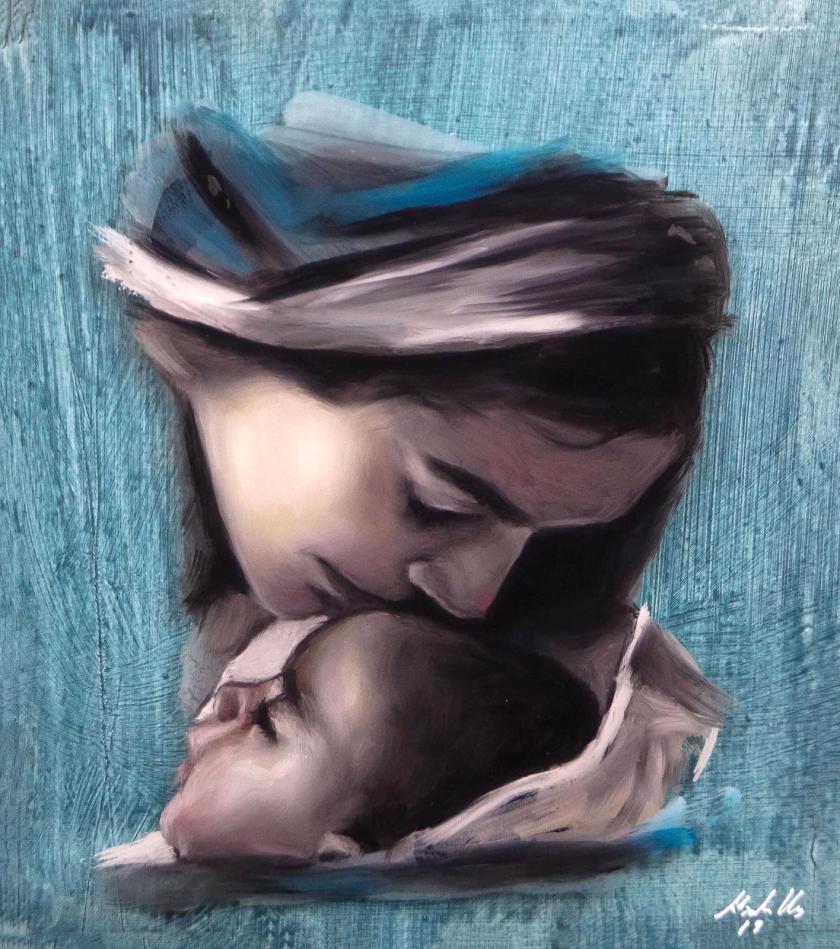
Magnificat by ©micahhayns

Exodus 2

Moses is no doubt the most important prophet in Judaism, and one of the most significant for Christianity and Islam. He led the Israelites out of Egyptian captivity, was given the Ten Commandments thereby establishing Jewish law, and he is believed to have been the author of the Torah, the first five books of the bible. However, without the bravery of several women, he may never have made it beyond the first few months of life. There was the bravery of the midwives (Shiprah and Puah) who prevented infanticide, and now we learn of how his mother (Jochebed), sister (Miriam) and an Egyptian princess came together in an extraordinary way to protect his life.

Having a baby at the time of war or persecution must be a terrifying ordeal, one that millions of women encounter every year – we have all seen with horror the images of pregnant women fleeing bombing in Ukraine. The situation for Jochebed and her child was dire. The Pharaoh had issued an edict to murder all the Hebrew baby boys by throwing them into the River Nile and Jochebed had given birth to ‘a fine baby’ at this dangerous time.

Jochebed was one of Levi’s daughters, therefore was one of Jacob’s grandchildren.  She was married to Amran and had two older children, Aaron and Miriam. She had successfully hidden her new-born baby for three months but this was becoming impossible and so she needed another plan. She created a basket out of reeds, waterproofed it with a plant resin and took the ‘moses basket’ and hid it near to the place the wealthy women bathed in river. Her daughter Miriam was stationed to watch over the baby, and I imagine both mother and daughter prayed earnestly to God for his protection. They could not have imagined in their wildest dreams that his salvation would come from the very place that also posed the greatest risk to his life.

Pharaoh’s daughter Bithia was bathing in the river alongside her entourage and she spotted the baby in the reeds. If she had followed her father’s rules she would have been obliged to hand him over to the authorities. What she did was far more risky. Realising he was a Hebrew baby she took pity on him and decided to adopt him. He was still breastfeeding and, in an extraordinary twist and an answer to Jochebad’s prayers, Miriam, who had been watching all this unfold, stepped forward and offered to find a ‘wet-nurse’ for the baby. So Moses’ own mother was paid to look after her child until adulthood, presumably from the safety of the royal palace or its surroundings.

Reflection

We can imagine Jochebed’s joy at the return of her beautiful son and the delight that they could now live in safety without fear. It’s Mothering Sunday in the UK and this story reminds us of the sacrifices made by mothers through the ages. Many of these acts are unremarkable and go unnoticed, such as those who take two jobs or who put their careers on hold for a time. Sometimes the sacrifice is costly. I remember meeting a woman whilst working for a homeless charity who offered up her child for adoption as she knew she wouldn’t be able to have looked after him. Her decision was painful and was clearly made out of a deep love for her little boy. This story also reminds us that the care of children is so often done by a community working together, and so we think of all the foster parents, respite carers, nannies, and siblings who so often take on these caring roles to help children thrive.

Prayer

God of Miriam and Jochebed,
you care for those the world forgets
and you never forget the needs of your people.
Be present with all who make agonising decisions;
protect children who have nobody to protect them;
bless those who foster, adopt and take care of children;
and may all teh members of your family
live for one another in self-giving love. Amen


International Women’s Day – Tuesday 8th March

Daughters of Zelophehad by ©MicahHayns

On this day where we celebrate International Women’s Day, I’d like to remember the wonderful women of the Old Testament who have accompanied me over the past few years as I worked on our book ‘Unveiled’. Seeing them listed in this way reminds me that God has been working through wonderful women for centuries, and continues to do so.

These women remind us:

Eve, that we all stuff up, but God has a plan;
Hagar, that outsiders are seen and heard by God;
Sarah, that dreams can come true even when we feel past it.
Lot’s Wife, that women are fleeing from their homes because of war right now.
Rebekah, that parenting is difficult and it’s OK if we get it wrong;
Rachel, that even being loved by a man is sometimes not enough;
Leah, that it’s really tough when we feel marginalised and unnoticed.
Dinah, that women aren’t defined by the worst thing a man did to them.
Potiphar’s Wife, that God can work through sexy women;
Tamar, that sometimes it’s best to push forward and demand to be noticed;
Shiprah and Puah, that civil disobedience can sometimes save lives;
Jochebed, that we should never give up hope;
Miriam, that there is always time to dance and sing with joy.
Mahlan, Noah, Hoglah, Milcah and Tirzah (the daughters of Zelophehad), that sometimes when you speak up against injustice, change happens.
Rahab, that the genealogy of Jesus names a prostitute and so no one is ‘not good enough’;
Ruth, that at times friendship is the most precious thing in life;
Naomi, that even the most bitter and bereaved can be restored to wholeness.
Deborah, that at times we need to listen to the wise women in our community;
Jael, that some women have to take up arms and fight for freedom;
The First Mrs Samson, that marriage really isn’t the best option for some women;
Delilah, that power isn’t always about being strong.
Jephthah’s Daughter, that sometimes the people we love the most can hurt and harm us;
Bathsheba, that women are too often shamed and blamed for men’s actions;
Hannah, that our prayers from the heart are heard.
Michal, that love isn’t static and can change over time;
Abigail, that many women today are keeping the peace between feuding men;
Rizpah, that warfare leads to too many grieving mothers;
The Medium of Endor, that just because you can do something doesn’t mean you should;
Queen Vashti, that saying ‘no’ to powerful men is costly;
Esther, that sometimes we’re in just the right place at the right time.
Abishag, that even the most lowly of jobs can be important;
Jezebel, that our reputations don’t define us;
Huldah, that at times telling the truth means giving ‘bad news’;
Suzannah, that some women aren’t believed when they tell the truth;
Queen of Sheba, that seeking knowledge is a good thing.
The widow of Zarephath, that being generous with little can lead to abundant blessing;
Naaman’s maidservant, that the courage of the smallest can have profound consequences;
Athalia, that not all women have redeeming qualities, and that’s OK;
The Shunamite Woman, that at times we have to be feisty to fight for those we love;
And finally, Shallum’s daughters, that women are always part of the story, even if they’re not named or remembered by our history books.

Happy International Women’s Day!


Esther: for such a time as this

The Book of Esther

Queen Esther ©MicahHayns

Yesterday’s post ended with the deposition of Queen Vashti for her disobedience to the King Ahasureus’ demands. This opened the way for one of the great heroines of the Hebrew Scriptures and a story that is told each year during the festival of Purim. It is the story of Esther, the woman who saved her people from extermination.

Esther was very different to the aristocratic Vashti. She was an orphan and so had been brought up by her uncle Mordecai, and she was Jewish. This was at a time when the Jews were still in exile but they were able to live in relative peace under the authority of the Persian rulers.

The king had sent out his servants to find a suitable replacement wife and so beautiful young women from around the land were taken to the palace to join the harem under the watchful eye of Hegai, the king’s eunuch. Esther, being ‘fair and beautiful’ was one of them. She quickly became one of the favoured women.

Those of us who enjoy the odd beauty treatment might like to pause to reflect at the description of the process whereby these women were prepared for their ‘audience’ with the king:

Their cosmetic treatment [was] six months with oil of myrrh and six months with perfumes and cosmetics for women.

Esther 2.12

A whole year of beauty treatments!

Esther pleased the king and he ‘loved her more than all the other women’ and so he ‘set the royal crown on her head and made her queen instead of Vashti’. There was a banquet and national holiday in her honour, and the king distributed gifts around his kingdom in celebration.

She had a secret however: she didn’t tell anyone that she was Jewish. She continued to keep in touch with her uncle Mordecai, who spent his time sitting at the king’s gate, perhaps so he could hear news of his adoptive daughter. One day Mordecai foiled a plot against the king by overhearing rumours of rebellion: he informed Esther who told the king and the rebels were hanged.

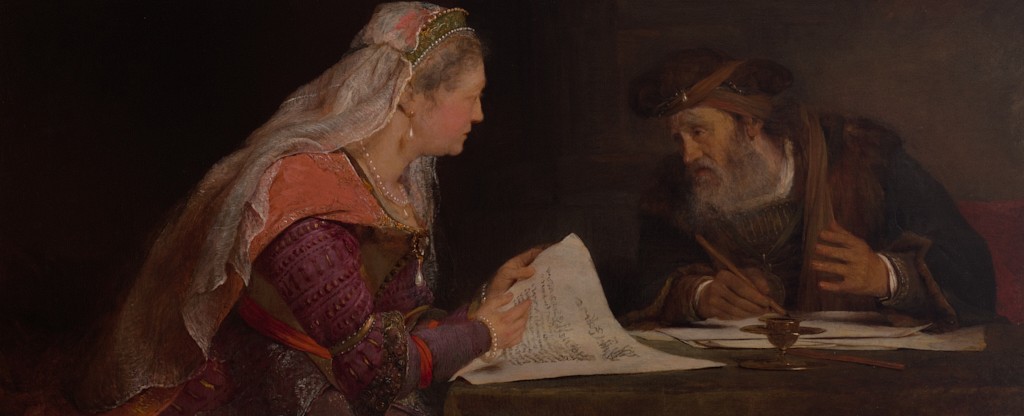
Esther and Mordecai by Arent de Gelder, circa 1685

If this was a fairy tale and Queen Esther was the beautiful princess, then the evil villain now comes on the scene: Haman. He was promoted by the king to be his ‘first official’ and is given authority over all other public servants. A vain and arrogant man, Haman demanded everyone pay him homage on bended knee. Mordecai refused to bow. Haman is furious and used this slight as an excuse for his anti-Semitism and he determined to ‘destroy all the Jews, the people of Mordecai, throughout the whole kingdom’. (Esther 3.6).

Haman erects a vast gallows to carry out his murderous plan, the king passively agrees to his proposal, and the city is ‘thrown into confusion’ as edicts to kill the Jewish people are sent out.

Queen Esther is deeply distressed. Mordecai asks her to intercede with the king for their salvation and tells her that she has been put into the palace ‘at such a time as this’ for the purpose of helping her people.

But Esther realised it wasn’t going to be simple. She would have remembered what happened to Vashti. She would need to tread carefully.

She takes control of the situation, first asking all Jews to fast (and, we assume, pray) for three days. She then goes to the king and asks him if she can host a banquet for him and Haman. The king is delighted and offers her anything she desires, but she holds back and hosts a second party the next day. At the second banquet Esther makes her request, and by this stage the king is fully on her side, particularly as during the night he had had a dream where he remembered the loyalty of Mordecai who had warned him of the assassination threat.

Esther’s request is bold. She discloses her background and tells the king of the ensuing massacre:

let my life be given me… and the lives of my people, that is my request. For we have been sold, I and my people, to be destroyed, to be killed 

Esther 7.3-4

The king’s eyes are opened to what is being done is his name, and the wicked Haman is killed on his own gallows, and the Jewish people are saved. In a final twist to the tale, Mordecai is given Haman’s position in the palace and Esther and her uncle are given his house and household.

for the Jews there was light and gladness, joy and honour…a festival and a holiday

Esther 8.17

The festival of Purim was instituted and every year Queen Esther continues to be remembered for her part in the salvation of the Jewish people.

Reflection and Prayer

Jesus went to the Mount of Olives..he knelt down and prayed, 
'Father, if you are willing, remove this cup from me; 
yet, not my will but yours be done'
Luke 22.42 

Before taking any action Esther’s first instinct was to insist all her people spent three days in prayer and fasting. This week is Holy Week and today we remember Jesus in Gethsemane before his arrest where he spent time in prayer grappling with his Father as to whether this journey was really his to take.

There is a wonderful line in Esther’s story where Mordecai tells her that perhaps she had been placed in the palace at that particular time for a particular purpose that only she could fulfil. ‘Who Knows?’, he says, ‘perhaps you have come to royal dignity for such a time as this’.

For such a time as this

I wonder if Jesus thought of Esther as he pleaded with his Father in Gethsemane? I wonder if he recalled her courage to face the king when he was being dragged in front of Pilate? I wonder if he found himself realising that he too had been chosen ‘for such a time as this’.

O Lord, who when thine hour was near, didst go without fear among those who sought thy life; give us such boldness to confess thee before others, and such readiness to bear thy cross, that hereafter thou mayest confess us before thy Father which is in heaven. Amen
A prayer of Joseph Oldham, 1874-1969