
From a sermon given at Led by the Spirit, High Wycombe, Bucks – 22nd May 2022

Peace be to you, and peace be to your house, and peace be to all that you have
1 Samuel 25.6
Said David, the outcast future King of Israel to Nabal, the owner of the land David had been protecting.
Peace I leave with you; my peace I give you
John 14.27
Said Jesus to his disciples just before he was to be taken away to be tried and crucified.
Peace be with you. We say it to one another just before communion as we nod in an Anglican kind of way: certainly no hand shaking or hugging anymore!
Peace.
What is it?
Is it the absence of something? An ending of conflict. The cessation of war?

Or is it a feeling? That feeling you get when you’re on holiday or having a massage?
But we all know that after a war ‘ends’, conflicts can continue to simmer within communities for years.
And I don’t know about you but when I’m meant to FEEL peaceful (on holiday or having a massage) I find I’m anything but. My mind fills with worries. I start chuntering about a problem or annoyance.
So, what does Jesus mean when he says ‘my peace I give to you’?
What does having Jesus’ peace mean when we find ourselves, for whatever reason, in the midst of conflict?
Because conflict is part of human existence isn’t it.
Think for a moment of the conflicts that impact you in some way.
- Global – Ukraine is on all our minds
- Communities or work situations
- Home life/family life
None of us are immune. As soon as one finishes something else begins!
When I was a child, my mother counted the seconds in the morning to see how quickly I would say something mean to my sister that would cause her to cry or shout. Never much more than ten!
Both our readings begin with ‘peace be with you’ – but then both lead pretty quickly into conflict. We know what happened to Jesus soon after this. But the story in 1 Samuel is less well known. As is the main peacemaker – Abigail.
Abigail found herself in the middle of two warring men.
She was married to Nabal, a drunken, boorish man whose name literally means ‘fool’. He was the landowner of the region that David had been protecting with his men.
Nabal threw David’s ‘peace be with you’ back at him by pretending he had no idea who he was (1 Samuel 25.10). David, thin-skinned and easily offended reacted immediately:
‘Every man strap on his sword!’…David also strapped on his sword
1 Samuel 25.13
And they head off to murder Nabal and all his household.
Before we judge too harshly let’s pause to reflect on ourselves here.
We may not have an actual sword or an army of men with swords like David. But let’s be honest, we can all strap on our metaphorical swords when we find ourselves in a conflict. Our weapons may be a caustic tweet, a winning takedown in an argument, an angry gesture in a car, a passive-aggressive ‘ghosting’. We all have our weapons of choice, don’t we?
Abigail is alerted to the conflict by one of Nabal’s men. He knew she was the more sensible one to speak to. And her immediate response isn’t to ‘strap on her sword’ and gather the troops.
Her response was one of peace-making. Her response was considered, thoughtful, and prepared.
The first thing she did?
She baked! OK, she may not have baked it all herself but she knew food was required. I know this may be rather gendered but….a clever woman’s tactic! She prepared fig cakes, loaves, wine and put them all on a donkey, and sent them ahead of her.

She perhaps knew what the modern-day Street Pastors know. They go to nightclubs armed with lollies as they know it’s hard to fight whilst sucking a lolly!
When Abigail reached David (who was chuntering in his anger), she threw herself at his feet and used every peace-making tactic in her repertoire.
She flattered him – ‘my Lord, my Lord’; she told him Nabal wasn’t worth it – ‘fool by name and fool by nature’; and she handed over her gifts.
But the thing that made all the difference in the end?
She raised David’s eyes and reminded him of God. And she reminded him of who he was in the eyes of God.
The Lord has appointed you prince over Israel…. you are fighting the Lord’s battles…..my lord shall have no pangs of conscience’
1 Samuel 25.27-31
Abigail reminds David who he truly was and who he would one day become. And David changes his mind, and puts down his weapons.
Blessed be the Lord who sent you to meet me today…blessed be your good sense.
1 Samuel 25.32
The end of the story is that family is saved. Abigail waits for her husband to sober up before telling him what she’d done, and Nabal is so shocked he had a heart attack and died… and she ends up marrying David (which by all accounts isn’t necessarily a happy ending!)
So what might we learn from Abigail when it comes to peace-making?
That peace is not an absence of conflict or a feeling, but can also be an action. An action that can involve heading into conflict and not hiding away from it.
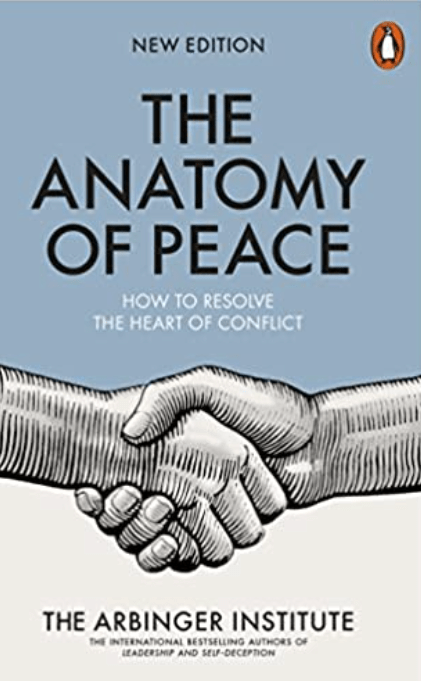
One of the books I found helpful this past year has been ‘The Anatomy of Peace’ by the Arbinger Institute.
The authors speak of the choice between having a ‘heart of war’ and a ‘heart of peace’ in the midst of conflict. Having a ‘heart of war’ involves seeing people as objects, often using language in a way that dehumanises: this always makes things worse and leads to further conflict.
The alternative is to enter conflict with a ‘heart of peace’: seeing others as people, human beings beloved of God.
It’s been something I keep going back to. I certainly don’t always get it right. If I find I have a ‘heart of war’ I need to seek out Abigail’s to help me look up and remind me who I am.
And this perhaps is what Jesus means when he speaks about the peace he leaves with us. He gives us a heart of peace.
The Hebrew word for peace is Shalom.
It is not the absence of something at all. Shalom means fullness, rightness, contentment, wholeness. Shalom is all things made well.
So, if you are in the midst of a conflict situation right now – Shalom
If you are concerned about a situation involving others – Shalom
If you are stuck in the middle of warring parties like Abigail – Shalom
If you are struggling to find a heart of peace – Shalom
Jesus’ peace isn’t like the world’s peace. It’s the ‘peace that passes all understanding’. It’s Shalom. And he offers this to you, to me today.
Amen
Prayer
God of peace and love,
We thank you that you offer us a peace that passes all understanding. We pray for that peace, that Shalom, today. For ourselves, our world, and for those we love, and especially for those we are in any kind of conflict with. Amen


 Consider the Lilies - Clare Hayns