

This post is part of a series on forty women from the Old Testament originally written for Lent 2020. It is now published by BRF as Unveiled: Women of the Old Testament and the choices they made.
The Book of Ruth
The ‘Bechdel Test’ is a measure of the representation of women in fiction and film and asks these three questions: does this feature at least two women; do the women have a conversation with each other; is that conversation about something or someone other than a man? It’s remarkable how many fail this simple test! The Book of Ruth passes the Bechdel Test. It is one of only two books of the bible named after a woman (the other being Esther), and it is a story that tells of the power of a deep, sacrificial relationship between two grieving women, Naomi and Ruth, and of their journey of friendship, faith and healing.
Naomi and her husband Elimelech lived in Bethlehem in Judah with their two sons, Mahlon and Chilion, at a time when Israel was ruled by the Judges (probably Gideon.). When a famine hit the region, Elimelech decided to move his family to Moab, a land on the other side of the Jordan with a non-Jewish population. He died soon after arriving and the sons took Moabite wives and settled. Tragedy struck again and both sons died leaving Naomi’s world devastated. It is akin to the tragic blows faced by Job, but Naomi’s situation is further exacerbated because she is a woman without the protection of a single male family member, and she is in a foreign land far from her extended family.
It isn’t surprising then that Naomi decides to return home to Bethlehem, particularly as she had heard the famine was over. Her two widowed daughters-in-law, Ruth and Orpah, both began the fifty mile journey with her, but at some point along the way Naomi realised that taking these women far away from their own people would be the wrong thing to do. As they were still young there was still some hope for them and their future. She encouraged them to return to their families, to find new husbands, and rebuild their lives. Naomi had no such hope for herself. She believed God had turned against her and her pain was so deep rooted she even asked for her name to be changed from Naomi (which means delight) to ‘Mara’ (‘bitterness’).
After a great deal of persuasion Orpah tearfully turns back to join her family, but Ruth refuses to leave Naomi and ‘clung to her’. (Ruth 1.14) Naomi eventually relented and the two widows make their way together back to Bethlehem, where they arrived in time for the harvest. Ruth went to work in the fields gleaning, harvesting the wheat reserved in the Torah for widows, and the pair began the slow work of healing. This takes time for Naomi, but the dual balm of steadfast commitment alongside the practical support offered her by her daughter (as she now saw her) began to bring signs of hope that the bitterness was melting. One of these signs was the energetic support Naomi gives Ruth in securing a husband, Boaz, a match that would ensure the land lost by Elimelech’s death would be restored to the family.
This wasn’t all that was restored to Naomi. By the end of the book she had a secure home, a daughter who loved her, and a grandchild. She also had the respect and blessing of her community, and above all this, her faith in God.
Reflection
What is so lovely about Naomi and Ruth’s relationship is that their friendship seems to be without the rivalry and jealousy that we’ve seen in some of the other female relationships so far. There is a mutual reciprocity at the heart of it – Naomi relies on Ruth’s youthful energy to provide food for them, Ruth relies on Naomi’s wisdom and contacts in a strange land, and they walk together in their grief.
Friendships like this are a gift aren’t they? Let’s give thanks for them.
Prayer
Loving God, we thank you for the joy and comfort of friendships:
for those who have been their through the ups and downs of life;
for those who have walked beside us even when we’ve not
been great company; and for those friends who are no longer with us and who we long to meet again. Amen
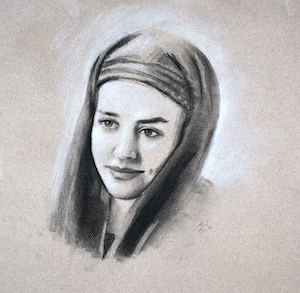

 Consider the Lilies - Clare Hayns