Sermon: Candlemas Spotlights

It’s been ages since I posted a sermon as I tend to now put them on the church website but I thought I’d post this one.

A sermon given at St Mary’s Church on 2nd February 2025
Luke 2. 22-40

I’ve been fascinated by Rembrandt’s art for years and if you’ve been to my study you’ll see his image of the Prodigal Son, which may be well known to you.

Like most European artists in the 17th Century the main focus of his work was religious, and Rembrandt mined the scripture for dramatic imagery. The image he came back most often in his life was this one we’ve just read from Luke’s Gospel.

The Presentation in the Temple.

The Presentation of Jesus in the Temple
oil on panel, 1631 (since 1816 in the Mauritshuis in The Hague)
Simeon’s Song of Praise, c1669
Nationalmuseum, Stockholm

Here are two paintings by Rembrandt of this scene at the temple, painted at different times in his life. The first is The Presentation of Jesus in the Temple painted in around 1630 when Rembrandt was around 25 years old, full of hopes and dreams for his future. It’s a lavish image, opulent, full of people, the light shines out from the infant Jesus at the centred.

The second one, Simeon’s Song of Praise was painted nearly 40 years later and was probably the last painting he ever painted –  it was left unfinished on his canvas when he died. It’s a close up of the scene, Simeon is an old man here, almost blind, wearied by life which is all behind him.

Rembrandt was a master at the use of light and darkness to draw us into the picture and so let’s use that to look closer at the characters in this scene.

Imagine a stage on a theatre which is in total darkness. And then a spotlight shines onto various sections on the stage illuminating the characters one by one.

Imagine I have four spotlights.

Spotlight One – Mary and Joseph

Here we see a young couple doing what is best for their new son – all the male children in a Jewish household are circumcised at eight days old, as was Jesus, and 33 days after giving birth to a male child, the birth mother is expected to participate in the rite of purification.

So, Mary and Joseph take Jesus to the Temple to present him to YHWH. They are poor – we know that because they can only afford to bring doves as an offering; the wealthy parents brought lambs. Mary and Joseph knew they had been given a great gift in this son of theirs, they had been given hints by the angels who visited them of course, but they can’t yet have known what was in store for them. Like all parents they would have longed for the best for their child.

But the prophesies they hear from Simeon are sobering – first they hear that he will be a light to the gentiles and glory to Israel. But then they hear that he will be opposed, and that this will cause them great suffering and pain – ‘a sword will pierce your own soul too’.

Imagine hearing this.

Spotlight Two – Simeon and Anna

These wise elders represent Israel (Simeon) and the temple (Anna). We learn that Simeon was devout and righteous and ‘the holy spirit was on him’. He had been waiting for a saviour for Israel all his life and the spirit led him to the temple on that day.

Rembrandt’s image of Simeon is beautiful in that it shows the blind old man at the end of his life who sees in this baby the light they had been looking for. Simeon takes the child in his arms, and prays a prayer of blessing– a prayer we know as the Nunc Dimitus:

‘My eyes have seen your salvation which you have prepared in the presence of all people’ (Luke 2.30)

Simeon’s song is both Christmas and Good Friday – it encapsulates both joy and great sorrow.

We learn that Anna was 84, had been the daughter of a prominent man but widowed after only 7 years of marriage, without children, and literally lived day and night in the temple – she never left – she prayed and fasted night and day. She was the very first person to tell people about Jesus: ‘she came up at that moment and gave thanks to God, and spoke about Jesus to everyone who was waiting’. (Luke 2.38)

These prayerful elders recognised something that no-one else around them did. That all they’d been searching for and praying for was to be found in this vulnerable child. How did they recognise him?

Spotlight Three – Jesus

It’s unlikely that as Mary and Joseph brought their child into the temple that he had a ready break glow round him, or a shaft of light emanating from him as in a Dutch master painting!

No, Jesus was a proper human baby. He was vulnerable, he needed to learn from his parents. We hear: ‘the child grew and became strong, filled with wisdom’. Some of that wisdom would have been taught to him by his parents.

How did they recognise him?

Simeon, ‘filled with the spirit’ was led to the temple: Anna – though years of prayer and fasting – this is how they knew who Jesus was. Because they were so deeply rooted in prayer, and had been for so many years, that they recognised the light and salvation of the Christ child when it was there amongst them.

Spotlight Four – each of us

In the first few chapters of his Gospel Luke, rather like a Rembrandt painting, invites us to enter into the stories, to identify with the characters.

We have older parents amazed to conceive (Elizabeth and Zachariah), a young woman preparing to have a child (Mary), a man working out how to support his family (Joseph), two elders who are nearing the end of their lives (Simeon and Anna), and next passage we hear of Jesus as a young adolescent working out his independence from his parents. Different people at different life stages all encountering Christ.

So where are we in this story? The spotlight is on us now.

Maybe we identify with these young parents bringing up their children in hope and love; or with the elderly Anna waiting in hope and prayer; or with Simeon, nearing the end of his life marvelling at what has been. Or maybe we can’t see ourselves in this family scene at all because that’s not our experience of life. Perhaps we identify more with the outsiders on the edges looking in, wondering if this child has anything to do with us.

I wonder if perhaps we could then just gaze at the focus of this scene, at the infant. Because in this infant all the hopes and dreams of Simeon and Anna, Mary and Joseph have been fulfilled.

Simeon sings: ‘my eyes have seen your salvation’. And what does salvation look like?

Like a vulnerable baby.

This story is both Christmas and Easter. Joy and suffering. Death and resurrection. The great mystery is that God is made fully known to us by entering into humanity in human form and so from this moment on there isn’t any separation between God and humanity.

That’s what Simeon and Anna noticed. That their salvation was right there in their midst and no-one else had even noticed. God entered into the mess of humanity through Christ and continues to do enter into the world through the spirit which lives in US, you and me.

Simeon and Anna didn’t miss him.  Let’s not miss him. So, this is our story, and we are invited to enter into it. As we go from here God won’t be revealed to us by a spotlight shining to show us the way – here, here, here. Instead, we see God working when we spend time rooted in prayer, when we spent time with the people Jesus spent time with, when we make decisions to love one another and when we live our lives remembering that we have God within us.

Now, this is the news that Simeon and Anna were so excited about. And Anna’s response to this?

‘At that moment she came, and began to praise God and to speak about the child
to all who were looking’. (Luke 2. 38)
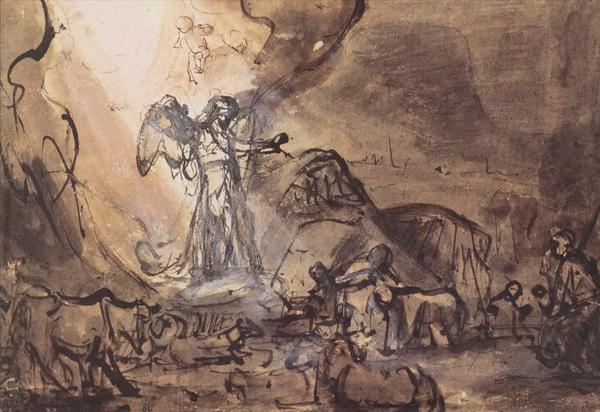
God’s Daring Plan

Image source: The adoration of the shepherds, Rembrandt

Adaption of a sermon by Barbara Brown Taylor

I came across this narrative sermon by Barbara Brown Taylor and loved it so much I thought I’d share it with you on this Christmas morning.


Once upon a time—or before time, actually, before there were clocks or calendars or Christmas trees—God was all there was.  No one knows anything about that time because no one was there to know it, but somewhere in the middle of that time before time, God decided to make a world.  Maybe God was bored or maybe God was lonely or maybe God just liked to make things and thought it was time to try something big.

Whatever the reason, God made a world—this world—and filled it with the most astonishing things: with humpback whales that sing and white-striped skunks that stink and birds with more colours on them than a box of Crayola crayons.  The list is way too long to go into here, but suffice it to say that at the end when God stood back and looked at it all, God was pleased.  Only something was missing.  God could not think what it was at first, but slowly God became aware of what it was.


Everything God had made was interesting and gorgeous and it all fit together really well, only there was nothing in the world that looked like God, exactly.  It was as if God had painted this huge masterpiece and then forgotten to sign it, so then got busy making a signature piece, something made in God’s own image, so that anyone who looked at it would know who the artist was.

God had one single thing in mind at first, but as God worked, realized that one thing all by itself was not the kind of statement that God wanted to make.  God knew what it was like to be alone, and now that God had made a world, knew what it was like to have company, and company was definitely better.  So God decided to make two things instead of one, which were alike but different, and both were reflections of God—partners who could keep God and each other company.

Flesh was what God made them out of—flesh and blood—a wonderful medium, extremely flexible and warm to the touch.  Since God, strictly speaking, was not made of anything at all, but was pure mind, pure spirit, God was very taken with flesh and blood.  Watching these two creatures stretch and yawn, laugh and run, God found with surprise feelings of envy.  God had made them, it was true, and knew how fragile they were, but their very vulnerability made them more touching, somehow.  It was not long before God was found falling in love with them.  God liked being with them better than any of the other creatures God had made, and God especially liked walking with them in the garden in the cool of the evening.

It almost broke God’s heart when they got together behind God’s back, and did the one thing they had been asked not to do, and then they hid— Hid from God!—Hid while God searched the garden until way past dark, calling their names over and over again.

Things were different after that.  God still loved the human creatures best of all, but the attraction was not mutual.  Birds were crazy about God, especially ruby-throated hummingbirds.  Dolphins and rabbits could not get enough of God, but human beings had other things on their minds.  They were busy learning how to make things, grow things, buy things, sell things, and the more they learned to do for themselves, the less they depended on God.  Night after night God threw pebbles at their windows, inviting them to go for a walk, but they said they were sorry, they were busy.

It was not long before most human beings forgot all about God.  They called themselves “self-made” men and women, as if that were a plus and not a minus.  They honestly believed they had created themselves, and they liked the result so much that the divided themselves into groups of people who looked, thought, and talked alike.  Those who still believed in God drew pictures of God that looked just like them, and that made it easier for them to turn away from the people who were different.  You would not believe the trouble this got them into: everything from armed warfare to cities split right down the middle, with one kind of people living on that side of the line and another kind on the other.

God would have put a stop to it all right there, except for one thing.  When God had made human beings, they were made free.  That was built into them just like their hearts and brains were, and even God could not take it back without killing them.  So God left them free, and it almost killed God to see what they were doing to each other.

God shouted to them from the sidelines, using every means available, including floods, famines, messengers, and manna.  God got inside people’s dreams, and if that did not work, woke them up in the middle of the night with whispering.  No matter what God tried however, God came up against the barriers of flesh and blood.  They were made of it and God was not, which made translation difficult.  God would say, “Please stop before you destroy yourselves!” but all they could hear was thunder.  God would say, “I love you as much now as the day I made you,” but all they could hear was a loon calling across the water.

Babies were the exception to this sad state of affairs.  While their parents were all but deaf to God’s messages, babies did not have any trouble hearing God at all.  They were all the time laughing at God’s jokes or crying with God when God cried, which went right over their parent’s heads.  “Colic” the grown-ups would say, or “Isn’t she cute? She’s laughing at the dust mites in the sunlight.”   Only she wasn’t, of course.  She was laughing because God had just told her it was cleaning day in heaven, and that what she saw were the fallen stars the angels were shaking from their feather dusters.

Babies did not go to war.  They never made hate speeches or littered or refused to play with each other because they belonged to different political parties.  They depended on other people for everything necessary to their lives and a phrase like “self-made babies” would have made then laugh until their bellies hurt.  While no one asked their opinions about anything that mattered (which would have been the smart thing to do), almost everyone seemed to love them, and that gave God an idea.

Why not create God’s self  as one of these delightful creatures?  God tried the idea out on the cabinet of archangels and at first they were very quiet.  Finally the senior archangel stepped forward to speak for all of them.  He told God how much they would worry, if God did that.  God would be at the mercy of God’s creatures, the angel said.  People would be able to do anything they wanted.  And if God seriously meant to become one of them there would be no escape if things turned sour.  Could God at least become like them as a magical baby with special powers?  It would not take much—just the power to become invisible, maybe, or the power to hurl bolts of lightning if the need arose.  The baby idea was a stroke of genius, the angel said, it really was, but it lacked the adequate safety features.

God thanked the archangels for their concern but said no, thought it best just to be a regular baby.  How else could God gain the trust of creation?  How else could they be persuaded that God knew their lives inside out, unless God lived one like theirs?  There was a risk.  God knew that.  Okay, there was a high risk, but that was part of what God wanted them to know: that God was willing to risk everything to get close to them, in hopes that they might love their creator again.

It was a daring plan, but once the angels saw that God was dead set on it, they broke into applause—not the uproarious kind but the steady kind that goes on and on when you have witnessed something you know you will never see again.

While they were still clapping, God turned around and left the cabinet chamber, shedding robes on the way.  The angels watched as the midnight blue mantle fell to the floor, so that all the stars on it collapsed in a heap.  Then a strange thing happened.  Where the robes had fallen, the floor melted and opened up to reveal a scrubby brown pasture.  Speckled with sheep—and right in the middle of them—a bunch of shepherds sitting around a camp-fire drinking wine out of a skin.  It was hard to say who was more startled the shepherds or the angels, but as the shepherds looked up at them, the angels pushed their senior member to the edge of the hole.  Looking down at the human beings who were all trying to hide behind each other (poor things, no wings), the angel said in as gentle a voice as he could muster,

“Do not be afraid; for see—I am bringing you good news of great joy for all the people: to you is born this day in the city of David a saviour, who is the Messiah, the Lord.”

And away up the hill, from the direction of town, came the sound of a newborn baby’s cry.

From Bread of Angels, Barbara Brown Taylor, Canterbury Press