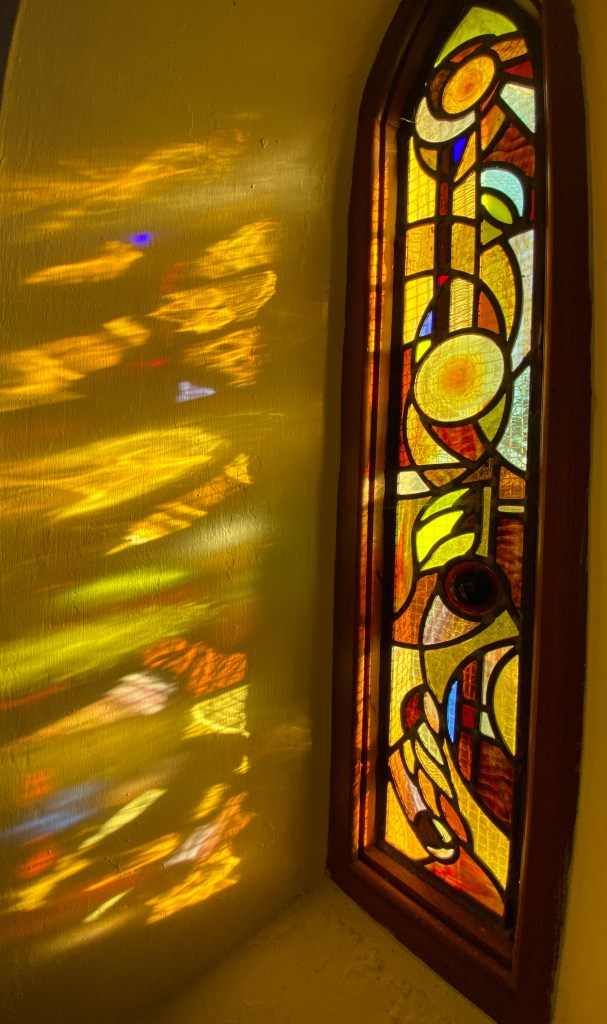
Sermon: Attitude of Gratitude

Given on 12th October 2025 at St Mary’s Church (Iffley, Rose Hill, Donnington)
Luke 17. 11-19

One of the games I remember playing as a child, that we played when our children were little was Happy Families (we still play it sometimes!).

The traditional Woodland version (unquestionably the best version) has families of animals – moles, mice, hedgehogs, shrews and they are they are shuffled and mixed up and you have to bring the families together by asking each other if they have Mr, Mrs, Miss or Master shrew, hedgehog etc.

The twist to our family games is that if when you are given the card you didn’t say thank you, you had to hand it back again. This meant that your competitor knew what cards you had and so you then invariably lost the game.

Woodland Happy Families

It was a very clever way of teaching us a lesson in manners and in learning the importance of saying thank you.

Thank you.

The first phrase most of us were taught as children. We have been drilled into us the importance of saying our p’s and q’s – (please and thank you’s) – I bet every single one of you said thank you when given an order of service when you arrived. It’s an automatic response and so we don’t often think about it very much.  

In our Gospel reading we heard the story of the thankful leper. It could be read as a moral tale about the politeness of one leper over and above the other nine, seemingly rude lepers who don’t bother to say thank you to Jesus who had brought about their healing.

“Were not ten made clean? But the other nine, where are they?“

We could read it as Jesus being rather like the grandparent being a bit affronted that they haven’t received a thank you letter three weeks after Christmas.

But this is not a story about the polite leper. It is not a moral tale about the importance of being a good citizen.

Let’s look at the passage.

The Cleansing of the Ten Lepers, c. 1035-1040, Codex Aureus Epternacensis (Wikipedia Commons)

Jesus is on a journey towards Jerusalem and as he goes on his way he is confronted by ten people with a skin disease. The bible gives them the generic term ‘leprosy’, but this wasn’t what we understand that to be now ‘Hansen’s disease’ – it was a term that covered a whole range of skin diseases.

These conditions were considered impure by Jewish law and so these people were outcasts from society, separated from family, unable to go to the temple to worship.

These 10 lepers kept themselves apart (as was lawful) and so when they saw Jesus they cried out to him from a distance.

“Jesus, Master, have mercy on us”

We often read this and think that the lepers here were asking for Jesus to heal them. They weren’t. They would have had no expectation that they would ever be cured from the disease. In the New Testament Lepers are not healed, but made clean. It is an important distinction. There was no understanding of healing for leprosy. You either had it, or you didn’t. If you had it, then you lived as if you were dead. It’s why lepers often lived in the tombs or in the uninhabited parts of cities. If you didn’t have it, then only Priest could declare you clean and you could enter back to society.

The lepers who cried out to Jesus weren’t asking him to heal them. They were asking for mercy. For kindness. They saw in Jesus someone who might be kind to them, even though they were outcast, feared, sick, alone.

And Jesus sees them, and tells them to go back to their community, to go and show themselves to the priests. (Note: did they feel dismissed by Jesus at this point I wonder?).

And as they do as Jesus says, they are made clean. They are restored from living as if they were dead, to being fully human again – with family, community, companionship.

We don’t get to know what happened to the nine lepers. They do just as Jesus asks of them.

But one leper seems to be aware of the magnitude of the kindness he had experienced that he turns back to Jesus – “He prostrated himself at Jesus’feet and thanked him”.

“And he was a Samaritan”. Samaritans were the outsiders and so this man was the outside of the outsiders. Perhaps this is why he was so thankful – because he knew so deeply what Jesus had done for him.

And in turning back to Jesus in thanks he is told that:

 ‘your faith has made you well’.

‘Made well’ in Greek is – σῴζω (pronounced sod-zo) – it can be translated as “made well,” in the sense of being healed. But it can also be translated as “saved,” in the sense of being brought through mortal danger. And it can be translated as “made whole,” in the sense of being completed and made to be what you were meant to be all along.

The Samaritan is ‘sodzo’. He’s blessed by being made clean and then when he turns to Jesus to give thanks he’s blessed again: he has been physically healed, but more than that – he has been made whole, he’s come back from the dead, he’s fully alive again. And he can’t help but respond in thanks.

Thanksgiving is such an integral part of the Christian life. Not just politeness, but recognising all we have is gift. Not just in the good times. The psalms are full of prayers of thanksgiving in the midst of troubles and difficulties.

I’d like to tell you the story of a Lutheran pastor named Martin Rinkart

Rinkart served in the German city of Eilenburg during the horrors of the Thirty Years’ War — a time of violence, famine, and plague. In 1637, when the plague swept through the city, he was the only surviving pastor left. That year alone, he conducted over 4,000 funerals, sometimes fifty a day — including the burial of his own wife.

Martin Rinkart (1586–1649)

And yet, in the midst of such sorrow, he wrote the hymn “Nun danket alle Gott” (Now thank we all our God) that we still sing today:

Now thank we all our God,
With heart and hands and voices,
Who wondrous things hath done,
In whom His world rejoices;
Who from our mother’s arms
Hath blessed us on our way
With countless gifts of love,
And still is ours today.

Rinkart’s thanksgiving was not naïve. It was defiant faith.
Like the healed leper, he turned back in gratitude — not because life was easy, but because God was still good.

We are not, I hope, going through anything like as grim as the plague in C17th Germany but we do go through times of struggle and hardship. Can we develop lives that have thankfulness at it’s core – an ‘attitude of gratitude’?

Not just because this is known to be good for us, but because it helps to make us more whole.

Social researcher Brene Brown found in her study of people who lived what she calls ‘whole hearted lives’ that:

“without exception, every person I interviewed who described living a joyful life or described themselves as joyful actively practiced gratitude and thanksgiving”[1]
She goes on to say:

“It’s not joy that makes us grateful; it’s gratitude that makes us joyful”.

So let’s embed gratitude into our lives.

Imagine you hare having a meal given by a great friend. Everyone enjoying each others’ company, when there is a pause and someone decides to toast the person who provided the meal and thanks them for all they’ve done to support them over the year. It changes everything doesn’t it. It makes that other person feel seen and valued.

Let’s do this this week. Not just being polite, but really thankful. Find someone we are really grateful for and let them know. Tell them, write them a card, call them on the phone. I assure you it will bring you, and them, joy.

And let us be thankful to God for all the blessings we have in our lives. 

We are about to come to the Eucharist meal in just a moment. Eucharist means thanksgiving. When we come to this table we are not just saying ‘thank you’, we are living it.

The Eucharist reorients our lives towards Jesus again. As we share in this thanksgiving meal we, like the thankful leper, are turning towards healing, wholeness and sodza.

End with the words of the hymn:

Now thank we all our God,
With heart and hands and voices,
Who wondrous things hath done,
In whom His world rejoices;

Amen


[1] Brene Brown, Gifts of Imperfection

Sermon: Guiding Light

A reflection at Eventide – February 2025
Revd Clare Hayns

John 1. 1-7
The Bright Field by RS Thomas

I’d like to tell a little story as we think about the light in the darkness.

When my son Simeon was 15 years old my sister took him and his younger cousins on a challenge. They set out to walk the three peaks of the British Isles within 24 hours. Ben Nevis (Scotland), Scarfell Pike (Lakes), Snowdon (Wales). In order to do this in the time, one mountain – Scarfell Pike – has to be scaled at night-time. They set off but at some point got disorientated. They were near the top on a section with small hills on top of which were piles of stones (cairns). But to the side was a steep drop, so they needed to follow the course of the hills and the stones.

But it was really dark, and they couldn’t make out their steps to stop tripping or going off course. So, they came up with a plan. Simeon offered to go on ahead of them to the top of the next hill. And he stood by the cairn and shone his torch back towards the rest of the group, and they all then made their way safely (they also made it with 15mins to spare!)

I remembered this because we’ve been thinking about light and darkness throughout this Eventide season. Last month we turned off all the lights in church and reflected on what was dark and difficult, confusing and disorientating.

Much of life can seem like stumbling along a hillside in the dark wondering what on earth it’s all about, and not quite sure of the way ahead, or why we’re here, or where we’re heading.

 John’s gospel begins in a way which mirrors the creation story of Genesis.  Which begins with darkness, formlessness, and void:

In the beginning God created the heavens and the earth. Now the earth was formless and empty, darkness was over the surface of the deep, and the Spirit of God was hovering over the waters. And God said, “Let there be light,” and there was light. Genesis 1. 1-3

And John’s gospel begins:

In the beginning was the Word, and the Word was with God, and the Word was God. He was with God in the beginning. Through him all things were made; without him nothing was made that has been made. In him was life, and that life was the light of all mankind. The light shines in the darkness, and the darkness has not overcome it. John 1. 1-5

This is a profound theological statement. That Christ was there right at the beginning of all things, when light was created out of darkness. And that this light was now to be seen in the person of Jesus who was born as a child in Bethlehem, and that through his spirit, each of us is given that same light.

You may have read Richard Rohr, if not, I encourage you to. I heard him speak at Greenbelt once and he told us that Christ is not Jesus’ last name, not his surname! It is a description who he is. Which is why in John’s gospel we get these ‘I am’ statements, which seem almost boastful.

Jesus says, ‘I am the Light of the world’. Remember, light is not so much what you directly see as that by which you see everything else.

Simeon’s light enabled the hikers to see everything clearly. One of the challenges of the Christian life is to learn to see as God sees. In other words, we have faith in Christ so we can have the faith of Christ. That is the goal.

So often what we first see as disaster can turn out to be an opportunity.
What once seems darkness, turns out to have a crack of light as Leonard Cohen sings in Anthem (“there’s a crack in everything, that’s how the light gets in”)
What seems to be death, turns out to be life.

Contemplation is one of the ways we can align ourselves more closely with Jesus so that we can learn to see.

Richard Rohr says: “Most people do not see things as they are because they see things as they are, which is not to see at all”. And he says: “We need to look at Jesus until we can look out at the world with his kind of eyes”[1]

I will end with the words of the beautiful poem The Bright Field by RS Thomas  which invites us to stop hurrying, to turn aside, to look towards the light which will stop us from stumbling in the darkness. This light is revealed to us most gloriously through Jesus, the light of the world:

Life is not hurrying
on to a receding future, nor hankering after
an imagined past. It is the turning
aside like Moses to the miracle
of the lit bush, to a brightness
that seemed as transitory as your youth
once, but is the eternity that awaits you.
RS Thomas, A Bright Field

Sermon: Candlemas Spotlights

It’s been ages since I posted a sermon as I tend to now put them on the church website but I thought I’d post this one.

A sermon given at St Mary’s Church on 2nd February 2025
Luke 2. 22-40

I’ve been fascinated by Rembrandt’s art for years and if you’ve been to my study you’ll see his image of the Prodigal Son, which may be well known to you.

Like most European artists in the 17th Century the main focus of his work was religious, and Rembrandt mined the scripture for dramatic imagery. The image he came back most often in his life was this one we’ve just read from Luke’s Gospel.

The Presentation in the Temple.

The Presentation of Jesus in the Temple
oil on panel, 1631 (since 1816 in the Mauritshuis in The Hague)
Simeon’s Song of Praise, c1669
Nationalmuseum, Stockholm

Here are two paintings by Rembrandt of this scene at the temple, painted at different times in his life. The first is The Presentation of Jesus in the Temple painted in around 1630 when Rembrandt was around 25 years old, full of hopes and dreams for his future. It’s a lavish image, opulent, full of people, the light shines out from the infant Jesus at the centred.

The second one, Simeon’s Song of Praise was painted nearly 40 years later and was probably the last painting he ever painted –  it was left unfinished on his canvas when he died. It’s a close up of the scene, Simeon is an old man here, almost blind, wearied by life which is all behind him.

Rembrandt was a master at the use of light and darkness to draw us into the picture and so let’s use that to look closer at the characters in this scene.

Imagine a stage on a theatre which is in total darkness. And then a spotlight shines onto various sections on the stage illuminating the characters one by one.

Imagine I have four spotlights.

Spotlight One – Mary and Joseph

Here we see a young couple doing what is best for their new son – all the male children in a Jewish household are circumcised at eight days old, as was Jesus, and 33 days after giving birth to a male child, the birth mother is expected to participate in the rite of purification.

So, Mary and Joseph take Jesus to the Temple to present him to YHWH. They are poor – we know that because they can only afford to bring doves as an offering; the wealthy parents brought lambs. Mary and Joseph knew they had been given a great gift in this son of theirs, they had been given hints by the angels who visited them of course, but they can’t yet have known what was in store for them. Like all parents they would have longed for the best for their child.

But the prophesies they hear from Simeon are sobering – first they hear that he will be a light to the gentiles and glory to Israel. But then they hear that he will be opposed, and that this will cause them great suffering and pain – ‘a sword will pierce your own soul too’.

Imagine hearing this.

Spotlight Two – Simeon and Anna

These wise elders represent Israel (Simeon) and the temple (Anna). We learn that Simeon was devout and righteous and ‘the holy spirit was on him’. He had been waiting for a saviour for Israel all his life and the spirit led him to the temple on that day.

Rembrandt’s image of Simeon is beautiful in that it shows the blind old man at the end of his life who sees in this baby the light they had been looking for. Simeon takes the child in his arms, and prays a prayer of blessing– a prayer we know as the Nunc Dimitus:

‘My eyes have seen your salvation which you have prepared in the presence of all people’ (Luke 2.30)

Simeon’s song is both Christmas and Good Friday – it encapsulates both joy and great sorrow.

We learn that Anna was 84, had been the daughter of a prominent man but widowed after only 7 years of marriage, without children, and literally lived day and night in the temple – she never left – she prayed and fasted night and day. She was the very first person to tell people about Jesus: ‘she came up at that moment and gave thanks to God, and spoke about Jesus to everyone who was waiting’. (Luke 2.38)

These prayerful elders recognised something that no-one else around them did. That all they’d been searching for and praying for was to be found in this vulnerable child. How did they recognise him?

Spotlight Three – Jesus

It’s unlikely that as Mary and Joseph brought their child into the temple that he had a ready break glow round him, or a shaft of light emanating from him as in a Dutch master painting!

No, Jesus was a proper human baby. He was vulnerable, he needed to learn from his parents. We hear: ‘the child grew and became strong, filled with wisdom’. Some of that wisdom would have been taught to him by his parents.

How did they recognise him?

Simeon, ‘filled with the spirit’ was led to the temple: Anna – though years of prayer and fasting – this is how they knew who Jesus was. Because they were so deeply rooted in prayer, and had been for so many years, that they recognised the light and salvation of the Christ child when it was there amongst them.

Spotlight Four – each of us

In the first few chapters of his Gospel Luke, rather like a Rembrandt painting, invites us to enter into the stories, to identify with the characters.

We have older parents amazed to conceive (Elizabeth and Zachariah), a young woman preparing to have a child (Mary), a man working out how to support his family (Joseph), two elders who are nearing the end of their lives (Simeon and Anna), and next passage we hear of Jesus as a young adolescent working out his independence from his parents. Different people at different life stages all encountering Christ.

So where are we in this story? The spotlight is on us now.

Maybe we identify with these young parents bringing up their children in hope and love; or with the elderly Anna waiting in hope and prayer; or with Simeon, nearing the end of his life marvelling at what has been. Or maybe we can’t see ourselves in this family scene at all because that’s not our experience of life. Perhaps we identify more with the outsiders on the edges looking in, wondering if this child has anything to do with us.

I wonder if perhaps we could then just gaze at the focus of this scene, at the infant. Because in this infant all the hopes and dreams of Simeon and Anna, Mary and Joseph have been fulfilled.

Simeon sings: ‘my eyes have seen your salvation’. And what does salvation look like?

Like a vulnerable baby.

This story is both Christmas and Easter. Joy and suffering. Death and resurrection. The great mystery is that God is made fully known to us by entering into humanity in human form and so from this moment on there isn’t any separation between God and humanity.

That’s what Simeon and Anna noticed. That their salvation was right there in their midst and no-one else had even noticed. God entered into the mess of humanity through Christ and continues to do enter into the world through the spirit which lives in US, you and me.

Simeon and Anna didn’t miss him.  Let’s not miss him. So, this is our story, and we are invited to enter into it. As we go from here God won’t be revealed to us by a spotlight shining to show us the way – here, here, here. Instead, we see God working when we spend time rooted in prayer, when we spent time with the people Jesus spent time with, when we make decisions to love one another and when we live our lives remembering that we have God within us.

Now, this is the news that Simeon and Anna were so excited about. And Anna’s response to this?

‘At that moment she came, and began to praise God and to speak about the child
to all who were looking’. (Luke 2. 38)

Epiphany Awakenings

Sermon for Epiphany 2B
preaced at College Communion (Christ Church) and Wesley Memorial Church (Oxford)
January 14th 2024

Readings: 1 Samuel 3: 1-10 and John 1. 43-end

Before moving for my curacy in 2011 we lived in Horspath, just beyond the ring road behind the Mini factory. The village had two central buildings on either side of the road. On one side was the Church of St Giles and on the other side was the village shop and Post Office run by Vipin and Jayshree Patel.

As I was moving I heard rumours that the post office had been closed because Mr Patel, formerly a pillar of the community, had been accused of putting his hands in the till.

I confess I didn’t do anything about this. It seemed odd and unlikely, but we were moving away, and who knew what was true.

I now know the truth, as do we all. I also now know that although many in the village were kind to Mr and Mrs Patel, others bullied and vilified them. They even had a cross placed outside their shop and home, with a wreath on it and RIP Vipin Patel. They were prosecuted and acquitted in 2021 but, like so many others, have still not received a penny and so can’t retire despite being elderly and unwell.

Vipin and Jayshree Patel were cleared in 2021 but have still not received compensation. You can read more here. Their son, Varchas Patel spoke eloquently on behalf of his father on BBC Breakfast.

We’ve been hearing stories like theirs all week, particularly since ITV aired the brilliant Mr Bates v. the Post Office. If you haven’t seen it I commend it to you. If you’ve been living under a rock this week, over 900 sub-postmasters were charged with false accounting, fraud and theft, and many lost their livelihoods, their standing in the community, and some even their lives.

For years these poor people have been trying to make themselves heard but no-one seemed to be listening. Not the Horizon helpline they called endlessly. Not the Post Office corporation who pursued them through the courts. Not the politicians they appealed to.

And it took a drama to finally wake us all up to what’s been happening. And we’ve woken up to a huge injustice, probably the worst corporate scandal of our era. And it’s caused national outrage. It’s been a national epiphany in a way. I think of an epiphany as a lightbulb, or ‘aha’, moment.

We are in the church season of Epiphany, where we consider the manifestation of God in the person of Jesus. We hear how, in numerous ‘aha’ moments in the bible, ordinary people have their lives transformed and changed by encountering Jesus.  

And our Bible readings today look at three aha moments. Three people who have an epiphany, an awakening moment of one kind or other.

In our OT reading we have Eli and Samuel; and in the Gospel we have Nathaniel.

The story of Eli and Samuel might be a familiar one to you.

Samuel was the longed for son of Hannah, the woman who went to the temple every day to cry out to God for a child. She cried so hard the priest Eli thought she was drunk (you can read Hannah’s story here) .

Eli teaching Samuel depicted in a window at Christ Church Cathedral, by Edward Burne-Jones

A child eventually came (Samuel), and when he was a young boy he was given to the Lord as promised by his mother, and lived under  Eli’s protection to work in the temple. His job seemed to be to guard the holiest space ‘the ark of the Lord’ as this is where he was sleeping in our reading.

Samuel was literally asleep when he was woken up by word of God. Not once but four times!

The first three he didn’t understand who was speaking. He assumes it’s Eli. Perhaps he was the only person to ever spoke to the boy. Perhaps Eli regularly called out for help in the night – he was elderly and so maybe he did. Samuel certainly doesn’t think it’s God, and frankly why should he, he’s never heard God before.

It’s a great story. 

Samuel gets up and runs to Eli’s room ‘here I am’, and each time he’s sent away. This happens three times and on the last time Eli works it out.

Eli tells him to go back and say to God:

Speak Lord, your servant is listening

1 Samuel 19

There’s a difference between hearing and listening isn’t there.

Samuel heard a voice, but he wasn’t actually listening.

I’m often blamed by my sons for not listening. I’m distracted by many things, and they talk a lot. Often I’m hearing words and do the hmm hmm thing, where I can then zone in when a question is asked. If challenged I can usually parrot the last thing they said, but if honest haven’t really been listening, and they can tell!

Listening is hard, but we know what it’s like to be heard, and what it’s like not to be heard. 

The producer of the ITV programme on the PO said she thought it had hit such a nerve with people as it ‘stands for all the ways everybody feels unheard’.

Samuel hadn’t yet learned to listen to God.

Samuel did not yet know the Lord, and the word of the Lord had not yet been revealed to him.

1 Samuel 3.7

Listening is something we learn to do, it’s not easy. It takes practice. And the same applies when we listen to others, and to God. True listening is a skill and it takes practice and we often need guidance. Taken me years and still not always very good at it.

Many use contemplative exercises to learn to listen. We need to guild up slowly, and can often benefit from the wisdom of our elders for this.

One thing is true though. It is impossible to truly listen whilst doing something else at the same time. Maybe this is why God speaks to Samuel whilst he’s lying in bed at night.

The old man Eli also needed an epiphany, an awakening, and this came through the prophetic words of his young prodigy Samuel.

Eli spent all his days in the temple taking care of the life and work of the sacred space. But despite this it seems that this didn’t bring him close to God.

The word of the Lord was rare in those days; visions were not widespread

1 Samuel 3.1

This seems rather an understatement as in the passage beforehand it seems that Eli’s sons had been doing just the thing our poor Sub Post-Masters had been wrongly accused of.

They were ‘scoundrels’ and thieves. They had been waiting for people to offer meat for sacrifice and then they would steal the meat for themselves. And they did this in full knowledge of their father who made a feeble effort to bring them into line but wasn’t able to stop them. (1 Samuel 2.25)

The message that Samuel was given in the night was a difficult one for Eli to hear.

I am about to punish the house of Eli, from beginning to end… because his sons were blaspheming God and he did not restrain them.

1 Samuel 3.13

It was a hard message, and all credit to Eli that he enabled Samuel to speak up with this message, telling him not to hide anything from him.

Prophetic truth-tellers are not often popular, but they are doing the work of God.

Perhaps Alan Bates is a prophetic voice in this recent Post Office situation. He spoke the simple truth even though that was unpopular, and he brought an injustice into the light. That’s surely the work of God.

Prophets wake us up. And if we’re honest, sometimes we’d prefer to stay asleep. I confess there are many issues I can’t quite wake up to.

In our Gospel reading we see another character who experiences an awakening to the truth. Nathaniel.

Jesus is gathering his disciples and he’s already recruited Andrew, Peter and Philip, and Philip goes to tell Nathaniel what they’ve experienced.

But Nathaniel’s first reactions reveal how he’s kept from seeing truth, even when it’s right there, in the person of Jesus.

Can anything good come from Nazareth?

John 1.46

Nathaniel can’t believe the messiah could come from a backwater, small town place so far from the centre of things. His prejudice almost keeps him from seeing Jesus. Nathaniel might have been prevented from seeing Jesus, but Jesus saw Nathaniel:

I saw you under the fig tree before Philip called you

John 1.48

Despite all these very human failings, God comes close to Samuel, Eli and Nathaniel and reveals himself to each one of them, in different ways. Each of them is called to serve. Each of them has an awakening.

Jesus sees and hears us, and each one of us is called in some way. Perhaps we are all invited to wake up in some way. The challenge is that sometimes we might prefer to stay asleep, as once we wake up we often then have to do something, change in some way, love people we find it hard to love, confront an injustice we might prefer to ignore.

I wonder who we relate to most in these characters from scripture, or who we are most challenged by?

Is it Samuel who is physically and spiritually woken up as he learns how to listen to God and, despite being young, begins his prophetic ministry? Do we feel we are asleep to God? Perhaps we feel we wouldn’t have a clue what God sounded like if he called our name? Might God be gently challenging us to wake up to hear his voice lovingly calling us into his service. Perhaps he has something unique for us to do or say if only we’d listen.

Or perhaps we feel more akin to Eli, tired in faith and going through the motions. Perhaps God is waking us to the fact we have something to offer that we can share with others. Perhaps, like Eli, we could be guides to those young in faith. Or perhaps we can see God speaking in the lives of others even if we’re not sure we can hear him ourselves in our own lives.

Or, like Eli, do we need to wake up to a particular injustice that’s happening under our very noses and in our own neighbourhoods.

I wish I had done more in Horspath, gone round to speak to the Patels, and asked more questions.

Or might we be like Nathaniel, not noticing Jesus right there with us because we think he couldn’t possibly be in somewhere as backwater as with us in our little lives.

Because that’s exactly where Jesus is. With each one of us, calling us by name, into a life that’s awake. Awake to God, to others, to ourselves.

It’s a challenging life, but one that is far better than being asleep. And it begins with us saying these simple words:

speak Lord, your servant is listening

1 Samuel 3.19

Amen

This Precarious Faith

Last week I was able to go on a retreat to St Bueno’s, a wonderful Jesuit retreat house in North Wales. In the main chapel, there is an altar that rests on large boulders. It inspired me to write this poem.

The altar at St Bueno’s, St Asaphs, North Wales

This precarious faith
Teetering
Balancing on the boulders
of fears, doubts and wanderings.

One strong push and it’s scattered
The table toppled
and all that was stable
broken. In pieces.

Wondering if we should pick up
the rocks and throw,
hurl and shatter.
It feels so weak.

This precarious faith
Balancing
Resting on the boulders
of the one who gathers, mends, and makes whole.

©Clare Hayns, January 2022


Window in the Rock Chapel, St Buenos by Claire Mullholland