Rachel: the sister who was loved

This post is a bit longer than usual because it’s a complex story, but I’ve tried to condense it as much as possible.

We probably all know the story of Jacob and his numerous sons, even if only from Joseph and his Amazing Technicolour Dreamcoat.

But what do we know of Joseph’s mother, and the mothers of the many other sons of Jacob, for there were at least four? Rachel and Leah, who were sisters, and Bilhah and Zilphah (their maids).

If anyone thinks the Old Testament is dull, they haven’t read the story of Rachel and Leah. It involves two women wounded by the actions of their father, mistaken identity, sisterly jealousy, fierce rivalry, and even curious aphrodisiac plants!

Dante’s Vision of Rachel and Leah 1855 Dante Gabriel Rossetti 1828-1882 (Bequeathed by Beresford Rimington Heaton 1940 http://www.tate.org.uk/art/work/N05228)

I’ll cover both women over the next two days, but first some background.  

Leah and Rachel were the daughters of Laban (Rebekah’s brother) and lived with him in Haran. Leah is the eldest and we’re told, ‘her eyes were lovely (or in some versions of the bible ‘weak’), whereas Rachel ‘was graceful and beautiful’.

Jacob, one of the sons of Isaac and Rebekah, was on the run from his twin brother Esau (as we read yesterday). He had fled to his Uncle Laban in hope that he might find a wife.

He found two!

Firstly, Rachel’s story. 

Jacob and Rachel at the Well, c. 1896-1902, by James Jacques Joseph Tissot , at the Jewish Museum, New York

Rachel was looking after her sheep when she first saw Jacob by the well. In a wonderfully romantic encounter (or maybe a rather clunky way in which a man shows off to a woman he fancies?), Jacob sees Rachel, leaps off his camel, rolls back the large stone over the well (showing off his rippling muscles?) to water her sheep.

Then Jacob kissed Rachel, and wept aloud. 

Genesis 29.9-11

Gloriously romantic, or all a bit much, depending on your perspective!

From this moment on Jacob loves Rachel, but in order to marry her he has to work for her wily father Laban for seven years:

..and they seem to him but a few days because of the love he had for her

Genesis 29.20

When the time was up there was an engagement feast and, in an action that would change the course of the sisters’ lives forever, Laban sent older sister Leah into the tent to have sex with Jacob. In that culture, that meant that they were then married. Jacob didn’t realise what had happened until the morning and was understandably horrified. I don’t imagine Rachel was particularly pleased either!

Laban allowed Jacob to marry Rachel the next week after making him pledge to work for him for another seven years. The sisters had no say in all of this of course. Having multiple wives was common in the culture of the time, but it isn’t hard to imagine how difficult it must have been for the sisters.

Jacob loved Rachel more than Leah, but Leah was able to have children. A recipe for disaster! Rachel wanted children more than anything and as time went on she envied Leah and got so low that she cried out to her husband:

give me children or I shall die!

Genesis 30.1

This didn’t go down well, Jacob got angry and Rachel, in her desperation, came up with a plan which involved sending her maid Bilhah to have sex with Jacob so that she could have a child through her as a surrogate. Her plan worked and two sons were born.

Eventually Rachel had a son of her own: Joseph.

Rachel hides the teraphim in a camel’s saddle and sits on it, Giovanni Volpato, from Wikipedia Commons

The family left Laban’s household and headed back to Canaan where Jacob was eventually reunited with his brother Esau. The journey turned out to be calamitous for Rachel. But before this there is a wonderful demonstration of her strength of character in the tale of the missing idols. Laban was enraged that someone in the fleeing party had stolen his ‘household Gods’ so he searched everywhere until he came to Rachel’s tent. She had them but managed to foil him by putting them in her camel’s saddle, sitting on it, and telling him she had her period!

Let not my Lord be angry that I cannot rise before you, for the way of the woman is on me

Genesis 31.35

I love this!

Rachel had her longed for second child whilst on the journey. It was a difficult pregnancy and she didn’t survive the birth. Her final act was to name her son Ben-oni, which means ‘son of my sorrow’, a name that revealed so much about this beautiful but deeply sad woman who never seemed to be able to find contentment in life.

Thankfully for the baby Jacob overruled the name and called him Benjamin which means ‘son of my right hand’. The tribe of Benjamin became one of the most significant tribes for the people of Israel, and it was from here that the first king of Israel (Saul) emerged.

Rachel was buried on the way to Bethlehem, and her tomb is a significant site for pilgrims to this day.

PRAYER

God, you are my God, early will I seek you, My Soul thirsts for You, my flesh longs for You,  in a barren and dry land where no water is'. 
Psalm 63

Rachel’s life wasn’t easy and she faced many challenges and sorrows along the way. I wonder if she was happiest when looking after her sheep as a child. Women in the ancient world were expected to produce offspring and their prosperity and happiness depended upon this. Let’s pray for all those who continue to be defined by their fertility, and for those who never seem to find contentment in life.

Holy and Eternal God,
give us such trust in your sure purpose,
that we measure our lives
not by what we have done or failed to do,
but by our faithfulness to you. Amen
From A New Zealand Prayer Book

Eve

Daughter of Eve

Eve by Lucas Cranach the Elder
1526, Public Domain


by Megan Chester, Undergraduate of English, Christ Church, Oxford (written for this blog, February 2020)

To my precious, darling daughter,
My flesh, my blood, my bone,
Wherever you fall, whatever you do,
Please know you’re not alone.

I never got to be a child,
Never had that time to grow.
I didn’t have a mother telling me
All the things that I should know.

I fell with such velocity,
That the world still feels the quake.
Daughter, I found out the hard way,
So please learn from my mistake.

I know evil, daughter,
I know how he plays –
He waits until you’re vulnerable,
Invites himself in, stays.

But my love, don’t talk to strangers,
Never entertain his game;
It’s hard to win and the loser’s
Forever burdened with his blame.

Daughter, don’t dance with the devil –
Be bold in what you know is right.
He’ll trample your knowledge with what you don’t know.
Though the bait may look tempting, don’t bite.

Don’t follow in my footsteps child,
Only follow paths divine,
And I’ll be right there behind you
Until we reach the time

When I can’t go where you can tread.
There I will meet the end,
But I’ll watch you from the gate and pray
That God’s grace will extend.

Be careful of always wanting more.
Save yourself the cost.
I paid but my debt’s still great,
So, love, learn from what I lost.

Seemingly sweet is sour,
This I wish that I was told.
A lesson you figure through suffering
When as a newborn you are old.

I had more love than I could carry,
So much desire – what to do?
But in this strength the snake saw weakness.
I was naïve. The serpent knew.

I was seduced by a promise of wisdom,
Which the wise would have refused.
My heart chased what it didn’t love –
Its desire was abused.

I was lured into loving a beauty,
Which true love would have let go.
Where I was weak, my child, be strong.
I have faith you can say no.

I wish you could feel how it was before
The dawn of darkness came.
When united in flesh we loved and were loved,
When bare bodies knew no shame.

Please, if you can, forgive me child
When labour tears you limb from limb.
I wish I’d done things differently
And never let him in.

I hear his hissing every night
And I’m sorry every day
That, because I tripped and fell so far,
Your life must be this way.

Child, all this one day will change,
In flesh and blood beyond our scope,
But until then listen to your mother’s words,
My darling daughter Hope.

Perhaps you too in days to come
Will be lover, mother, wife,
Or perhaps you won’t, but Daughter of Eve
I know you will breathe life.

Precious girl, please don’t make my mistakes.
I’m sure at times you’ll make your own.
But remember, even if you do,
You’ll never fall alone.

A prayer for Lent adapted from the Book of Common Prayer
Almighty God, grant your people grace to withstand the temptations of the world, the flesh, and the devil, and with pure hearts and minds to follow you, the only God; through Jesus Christ, our Lord. Amen

Lot’s Wife: the woman who turned

Genesis 19

Lot’s Wife ©Micah Hayns

Like many of the women of the Bible we don’t know the name of our next woman, only that she was Lot’s Wife (although in some Jewish traditions she’s named Ado or Edith). We know very little about her other than she had two daughters and that she lived in Sodom, a town with a long-lasting reputation for being rather seedy.  Although we know very little about her life she’s mainly remembered for the manner of her death: being turned into a pillar of salt as punishment for turning around to look back at her burning home.

It’s a curious story.

Lot was Abraham’s nephew and he settled the land called the Plain of Jordan (better known as Sodom), whilst Abraham settled in Caanan.

The enigmatic angelic visitors who had visited Abraham and Sarah then headed towards the city of Sodom. Lot, who was sitting at the City gate, greeted them and invited them to his home and his wife provided a feast for them. However, before they’d finished eating the ‘men of the city’ surrounded the house demanding the visitors be given over to them ‘so that we may know them’ (Genesis 19.5). Lot refused to allow the men into his home and instead offered them his own virgin daughters.

Much has been written of these passages in relation to sexuality, and they have been used as justification of God’s displeasure at same-sex relationships. This is simply wrong. This is not a passage about relationships, same-sex or otherwise: it is about violence. The men of Sodom want to rape Lot’s visitors, and so he protects them by offering his own daughters instead.

The angelic visitors strike the rampaging Sodomites with blindness so they can’t find the door and then they urge the family to flee before the city is destroyed. They were told:

Flee for your life; do not look back or stop anywhere in the Plain; flee to the hills, or else you will be consumed.

Genesis 19.17

As the family flee, the cities of Sodom and neighbouring Gomorrah are both destroyed in a shower of ‘sulphur and fire from the Lord out of heaven’.

But Lot’s wife, behind him, looked back, and she became a pillar of salt

Genesis 19:26

Why did she look back? And why salt? It’s all very strange.

I’ve often heard it said the reason she looked back was that she she lacked faith, but this seems overly harsh. Perhaps she was grieving a place which held all her childhood memories; or maybe she felt closer to the people in Sodom than to her husband, a man who would offer up his own daughters to be raped in order to protect some visitors; or perhaps she was simply terrified and frozen to the spot by the horror she was seeing.

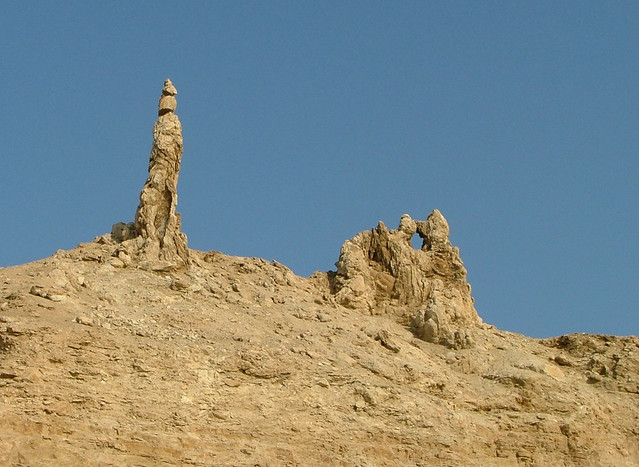
The rock formation called ‘Lot’s Wife’ is found near the Dead Sea on Mount Sodom in Israel

It is interesting to note that the ‘Pillar of Salt’ is also an ancient legend told to explain some curious salt rock formations in this region.

Also, being turned into a pillar of salt is an idiom in Eastern tradition for dying of fright.

Whatever happened to Lot’s wife, she reminds us of thousands of women forced to flee their homes each day due to violence, war and natural disaster. She reminds us of all those who look back and remember all those they’ve left behind.

But perhaps she also reminds us that in this time of Lent we are also invited to turn – to turn towards God, who receives us with open arms of love.

Prayer

The UN Refugee Agency estimates that there are 70.8 million forcibly displaced people in the world today and 37,000 people each day flee their homes due to conflict or persecution. (see here for figures at a glance: https://www.unhcr.org/ph/figures-at-a-glance)

Answer me, O Lord, for your steadfast love is good; 
according to your abundant mercy, turn to me.
Psalm 69.16

God of love, as we remember Lot’s wife who had to turn away from her home in fear, we remember all those today who are forced to leave their homes and face an uncertain future. Give them your strength and show them your love. We pray also that, in this time of lent, we might turn towards your love and know your peace in our lives. Amen

Sarai: under the oaks

Genesis 18: 1-23; 21; 23

I have always loved trees. As a child growing up in Buckinghamshire we had a vast sycamore tree in our garden which we called ‘The Big Tree’ (See image below). It was said to be one of the largest and oldest of its kind in the UK and was simply magnificent. There was a branch to the left of it that came right to the ground which was perfect for climbing up into a cavity in the middle of the tree, which was the place we went to as children to get away from everyone. My first experience of prayer was here as I spoke to God about whatever problems I was having – normally some kind of sibling rivalry or another.

The Big Tree at The Old Rectory, Adstock, Bucks painted by R Read. Sadly the tree died several years ago.

There is something permanent and comforting about old trees. I often sit under Christ Church’s ‘Jaberwocky Tree’ imagining all those who have gone before over the centuries, and somehow all the temporary concerns are put in to perspective.

Sarai’s (her name is later changed to Sarah) story features a particular tree, or group of trees, evocatively named ‘The Oaks of Mamre’.

Sarai was married to Abram (her half-brother) and much of their life was spent travelling as Abram had been called by God to leave their homeland (Haran) and go into a new land where, he was told, they would be blessed. (Genesis 12.1-3).

They were indeed blessed in many ways, with wealth, land and livestock, but they were not blessed with a child, and this was all that Sarai wanted, and was all that was expected of her as a woman.  

It is at the base of the Oaks of Mamre that two incidents occurred which changed the course of Sarai’s life. It was here that Abram first received the promise that they would have a child, and not only that, but their offspring would be so numerous they would be ‘like the dust of the earth’ (Genesis 13.16).

The Oak of Mamre believed to be around 5000 years old and which, in tradition, is said to mark the place where Abraham entertained the three angels or where Abraham and Sarai pitched their tent.

And it was also at the foot of the Oak of Mamre many years later when Sarah and Abram had another encounter with the Lord who came in the guise of three strange men, and again they were promised they would have a child.

But this time Sarah laughed at the prospect. She was now past the menopause or, as the bible delicately puts it, ‘it has ceased to be with [her] the manner of women’. Abraham was also past his prime – ‘my husband is old, shall I have pleasure?’ (Genesis 18.11-12).

But this time the promise was fulfilled. Sarah did indeed have a child,  Isaac (which means ‘he laughs’).

Sarah’s life can’t have been easy and, as Hagar’s story yesterday revealed, she struggled with rivalry and jealousy. But she was faithful and strong and is remembered in all three Abrahamic faiths as one of the few biblical matriarchs (with Rebekah and Leah).

At the end of her long life Sarah was buried in the very first description of a funeral and burial in scripture, in a place lovingly secured by her husband Abraham, and where he would later join her: in a plot overlooking her beloved Oaks of Mamre.

So the field of Ephron in Machpelah, which was to the east of Mamre, the field with the cave that was in it and all the trees that were in the field, throughout its whole area…After this, Abraham buried Sarah his wife in the cave of the field of Machpelah facing Mamre (that is, Hebron) in the land of Canaan. 

Genesis 23. 17-19

Reflection

In John’s Gospel one of the very first disciples Jesus calls to follow him is Nathanael, who is sitting under a tree at the time!

I saw you under the fig tree

John 1.48

and the very first thing Jesus says to those who follow him (in John’s Gospel) is:

What are you looking for?

John 1.38

‘I saw you’, ‘What are you looking for?’

These are good questions to begin our Lent journey. Perhaps you might like to go outside and spend some time sitting under or near a tree and reflecting on what it is you’re looking for this Lent? It might be something personal like Sarai who longed for a child, or it might be a more rewarding job, or wisdom for a particular problem, or an ability to concentrate on your studies. Or perhaps it is for a deeper relationship with God this Lent.
Whatever it is, perhaps you might like to take it God in prayer.

Prayer

Heavenly Father, thank you that you see us and hear us when we come to you in prayer. As you heard your daughter Sarai many centuries ago we pray that you would hear us today as we speak to you of all that we long for.

Amen

Hagar: the woman who is seen

Genesis 16 and 21

Note: this series of posts about women of the Old Testament were originally written for a Lent Blog in 2020. They have been updated. Many of the images are original pieces of art produced by Micah Hayns. Please only use them with permission. You can get in touch with him for originals or high res. images for promotions via http://www.micahhayns.com

We begin with Hagar.

Hagar was the very first person to dare to give God a name. She wasn’t a person of any authority or particular merit, she wasn’t a prophet or a priestess: she was an Egyptian slave-girl owned by Abram’s wife, Sarai.

Sarai hadn’t been able to have children and so had hatched the kind of plan that we might recognise from the Handmaid’s Tale: she would have a child with Abram via the means of her slave, Hagar. Abram willingly went along with the plan and Hagar, clearly having no choice in the matter, became pregnant. The two women began to hate each other but Sarai of course, had the upper hand and Abram gave his wife authority to do as she pleased. Sarai’s anger deepened as time went on and she became violent and eventually the pregnant Hagar, fearful for the safety of her unborn child, fled to into the wilderness.  

It was as she was hiding near a well that Hagar heard the voice of an angel:

Hagar, slave-girl of Sarai, where have you come from and where are you going?’

Genesis 16.7

She was promised her son would be a ‘wild donkey of a man’, and told to return.

Hagar was so overwhelmed by having been seen and heard, perhaps for the first time in her life, that she gave the Lord a name,

You are El-roi”; (God who Sees), for she said, “Have I really seen God and remained alive after seeing him?”

Genesis 16.13
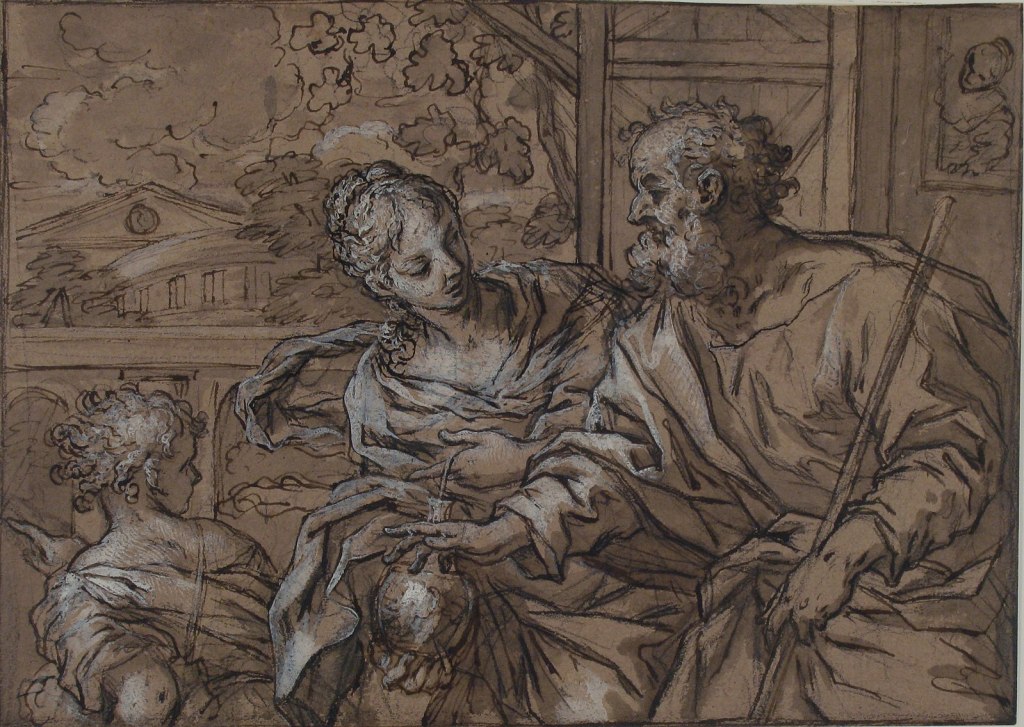
The Dismissal of Hagar by Giuseppe Nicola Nasini, between 1657 and 1736, (image from Wikimedia Commons)

She bravely returns to Sarai, gives birth to Ishmael, and brings him up in Sarai’s household until Sarah (given a new name) had herself produced a child of her own, Isaac. Now with a son of her own Sarah didn’t want them around anymore and they were once again banished.

Ishmael was an adult by this time (around 15 years old). The banished pair wandered in the desert until their food and water had dried up and all hope of survival had gone. In the first description of a death ritual in scripture, Hagar put her child under a bush, sat at a distance, and waited for him to die.

Their tears were heard by the angel of God who, like the angel that appeared to Mary centuries later, said to them: ‘do not be afraid’, a well of water appeared and they survived.

Hagar became a Grandmother to many, and Ishmael’s descendants, the Ishmaelites, populated the land and grew powerful.

Hagar, enslaved, abused, and mistreated, was seen and heard by God.

THE SITUATION TODAY

Sadly slavery isn’t in the past and although it’s hard to find accurate statistics it is estimated that over 40 million people are held against their will and that 71% of overall victims of modern day slavery are believed to be women – this is nearly 30million people! https://www.antislavery.org/slavery-today/modern-slavery/

Now the Lord is the Spirit, and where the Spirit of the Lord is, 
there is freedom.
2 Corinthians 3.17

PRAYER

Loving God, who sees and hears all those who cry out in need, bring comfort and freedom to all your children, to those who are kept against their will, those who live in fear of violence, and those who are forced to run away to protect their family, in the name of El-Roi, The God Who Sees.
Amen

Welcome

Thank you for signing up to follow my Lent blog! Each day of Lent I’m going to post about a different woman from the Old Testament and on Saturdays we have some wonderful guest posts written by some fabulous women.

Firstly you might want to make sure the emails don’t go into your spam/junk folder by marking this email address as a ‘not junk’.

They should take about 5 mins to read, and each will end with a short prayer. I’ll send them at 6.30am each day. You might find it helpful to find a regular time of day that suits you to read them, perhaps in the mornings and some people like to have a particular place, such as a favourite chair.

We’ll begin tomorrow but I thought I’d start with a little introduction.

I began this blog last summer as a challenge for myself to a) form a writing habit, b) find out for myself more about the women of the bible, and c) learn how to use WordPress (which took a while!).

A bit about me. I’m ordained as a C of E Priest and currently work as College Chaplain and Welfare Coordinator at Christ Church, an Oxford College. I came to faith in my early 20’s having grown up in rural Bucks and my childhood was more ‘pony club’ than ‘church youth club’. I’ve often felt that my knowledge of the Old Testament was a bit scrappy, and so when I began this blog most of the women were a mystery to me.

There is an assumption that women are largely ignored in the biblical narrative, and that when they are written about they are marginal characters to the main story, or are only allowed to be either mother, whore or seductress. This is certainly the case for some of the women we’ll look at over Lent, and there are some tragic stories that we won’t gloss over and ignore. But there are also many, many women who are central to the narrative, complex in character, and who use the power they have for good, and sometimes for evil.

When I began the blog I intended to use New Testament women as well, but I found there were so many fantastic women in the Hebrew scriptures and so I decided to stay there, with two exceptions from the Apocrypha.

I hope you enjoy reading about these wonderful women as much as I have enjoyed writing these blogs. Also, if you enjoy them, please do pass the link on to your friends!

Every blessing,

Clare

A prayer for our journey

Let us make our way together, Lord; wherever you go I must go: and through whatever you pass, there too I will pass.
Teresa of Avila, 1515-1582