And finally…

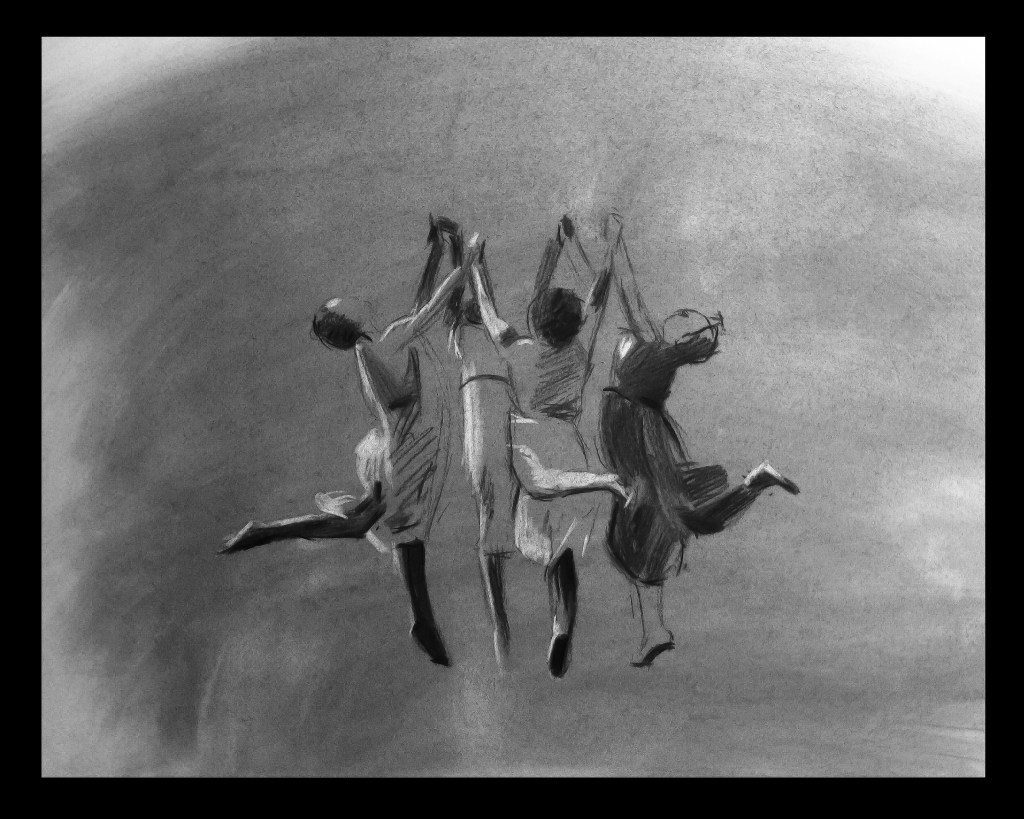
Gloria, by Micah Hayns (from the post on Miriam)

Alleluia, Christ is Risen!

Jesus said to [Mary Magdalene], “Woman, why are you weeping? Whom are you looking for?” Supposing him to be the gardener, she said to him, “Sir, if you have carried him away, tell me where you have laid him, and I will take him away.” Jesus said to her, “Mary!” She turned and said to him in Hebrew,“Rabbouni!” (which means Teacher)...’Mary Magdalene went and announced to the disciples, “I have seen the Lord”'
John 20: 15-16,18

It seems fitting to end this Lent series on Easter day remembering Mary Magdalene, the very first disciple to see the risen Jesus, and the very first to proclaim the resurrection.

As this is my final post I want to thank you for joining with me this Lent, and for all your encouragement along the way. The journey began back in February with Hagar who was pushed out into the wilderness. And goodness, what a journey this has been! None of us knew back then that the whole world would also be propelled into a strange kind of wilderness. It has felt for me that these women of old have been alongside us through these strange times, and they have taught us important truths along the way.

They have reminded us of the gifts and challenges of family life (Rachel and Leah, Rebekah), of the importance of friendships (Naomi and Ruth), of not being afraid to stand up for what is right (Shiprah and Puah, the daughters of Zelophehad), of peace making (Abigail, Esther), and of the value of a deep faith (Naaman’s servant, The widow with the oil). There have been some who were hard to like (Athaliah, Jael), and some whose stories were so painful they were hard to face (Rahab, Dinah).

And Miss Lent 2020 goes to…*

I wonder if you would like to share in the comments section which of the women you most enjoyed, either because you related to them, or because they interested or surprised you in some way. I’m sure others would enjoy reading your responses; I know I would. It’s hard for me to pick an all-round favourite as I’ve loved them all, but I think I would go with Miriam. The image of her leading the women in dancing in the wilderness really spoke to me this lent.

I would like to thank the six ‘guest bloggers’ (Megan, Milly, Emma, Alannah, Matilda and Philippa) for their thoughtful responses and for the time they put into doing this. I’d also like to thank Micah for being willing to create so many of the beautiful images, and for putting up with my demands (and one point he even declared ‘Mum, I’m not a machine!’). And whilst I’m doing an Oscars-style list I’d better even thank my husband John for his proof-reading and one-liners. He’s very much enjoyed that he gained a small fan base!!

I’m going to take a break for a while but my plan is to do something similar for Lent next year, perhaps with women from the New Testament and the early Church.

Prayer

When Hagar was in the wilderness she was met by an angel who told her that she was seen and heard by God. Centuries later Mary Magdalene was seen by the risen Jesus in the garden. I pray this Easter that you too would know what it is to be seen and heard by God, and that you too would experience the light, love and life of the risen Christ.

O Lord God, our Father. You are the light that can never be put out; and now you give us a light that shall drive away all darkness. You are love without coldness, and you have given us such warmth in our hearts that we can love all when we meet. You are the life that defies death and you have opened for us the way that leads to eternal life. None of us is a great Christian; we are all humble and ordinary. But your grace is enough of us. Arouse in us that small degree of joy and thankfulness of which we are capable, to the timid faith which we can muster, to the cautious obedience which we cannot refuse, and thus to the wholeness of life which you have prepared for all of us through the death and resurrection of your Son. Do not allow any of us to remain apathetic or indifferent to the wondrous glory of Easter, but let the light of our risen Lord reach every corner of our dull hearts. Amen
(Karl Barth, 1886-1968)

*This was of course from John!
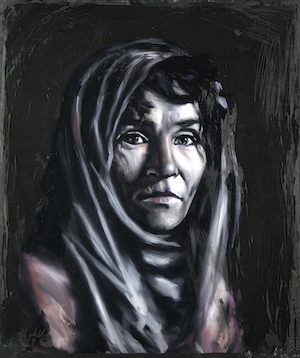
The Shunammite Woman: a rising hope

The Shunammite Woman ©MicahHayns

2 Kings 4

We come to our final woman of the Lent 2020 series on this Good Friday and you will see why I have chosen to remember her on this day when we remember Jesus’ death on the cross.

We are now very used to our women being unnamed, but usually these are poor or seemingly unimportant. Our final woman was ‘well to do’ and actually rather wealthy, and she was a friend to the prophet Elisha, but for some reason none of the household are named.

The woman lived in a spacious house with her husband in the town of Shunem (where Abishag came from). She was a keen host and enjoyed providing food for the elderly prophet Elisha and his servant Gehazi whenever they passed through the town:

So whenever he passed that way, he would stop there for a meal.

2 Kings 4.8

After a while she decided it would be sensible if Elisha stayed overnight rather than having to travel to his home after dinner. She was clearly a woman with an eye for detail and she prepares a room for him at the top of the house:

Let us make a small roof chamber with walls, and put there for him a bed, a table, a chair, and a lamp, so that he can stay there whenever he comes to us.

2 Kings 4.10

Elisha and Gehazi want to thank her for her hospitality and so have a conversation about what they might offer her. She declines saying she has all she needs, “I have a home among my own people”

For her, that is blessing enough.

The men decide that as she is childless and ‘her husband is old’ then she can’t really be satisfied until she has a son. They tell her that by next year she would be pregnant, and she is.

The child grew and one day whilst out with his father in the fields he becomes seriously ill:

He said to his father, “My head! My head!” His father told a servant, “Carry him to his mother.” After the servant had lifted him up and carried him to his mother, the boy sat on her lap until noon, and then he died.

2 Kings 4. 19

What a tragedy for her. The woman acts quickly. She takes the child upstairs to Elisha’s room, shuts the door and then prepares the donkey to go travel to see the prophet, who is at Mount Carmel, a day’s journey away. Elisha spots her and sends Gehazi to meet her to find out what’s wrong, ‘Are you all right? Is your husband all right? Is the child all right?’.

She doesn’t want to speak to Gehazi, but to Elisha and, although the servant tries to keep her away, she pushes forward. Her reaction seems to be anger:

Did I ask you for a son my Lord? Didn’t I tell you, ‘Don’t raise my hopes?” 

2 Kings 4.28

Perhaps she felt she was worse off now than she was before she had a child. Alfred Lord Tennyson said ’Tis better to have loved and lost than never to have loved at all’, but in these early moments of grief it didn’t feel like it to her.

Elisha and Gehazi go with the woman to her home and Elisha went upstairs to see the dead boy. He prayed to the Lord. 

Then he got on the bed and lay on the boy, mouth to mouth, eyes to eyes, hands to hands. As he stretched himself out on him, the boy’s body grew warm. 

2 Kings 4.34

The boy returned to life and was given back to his mother, who fell to the ground in worship and thankfulness.

Reflection

It was now about noon, and darkness came over the whole land until three in the afternoon, for the sun stopped shining. And the curtain of the temple was torn in two. Jesus called out with a loud voice, 
“Father, into your hands I commit my spirit.” 
When he had said this, he breathed his last.
Luke 23.44-46
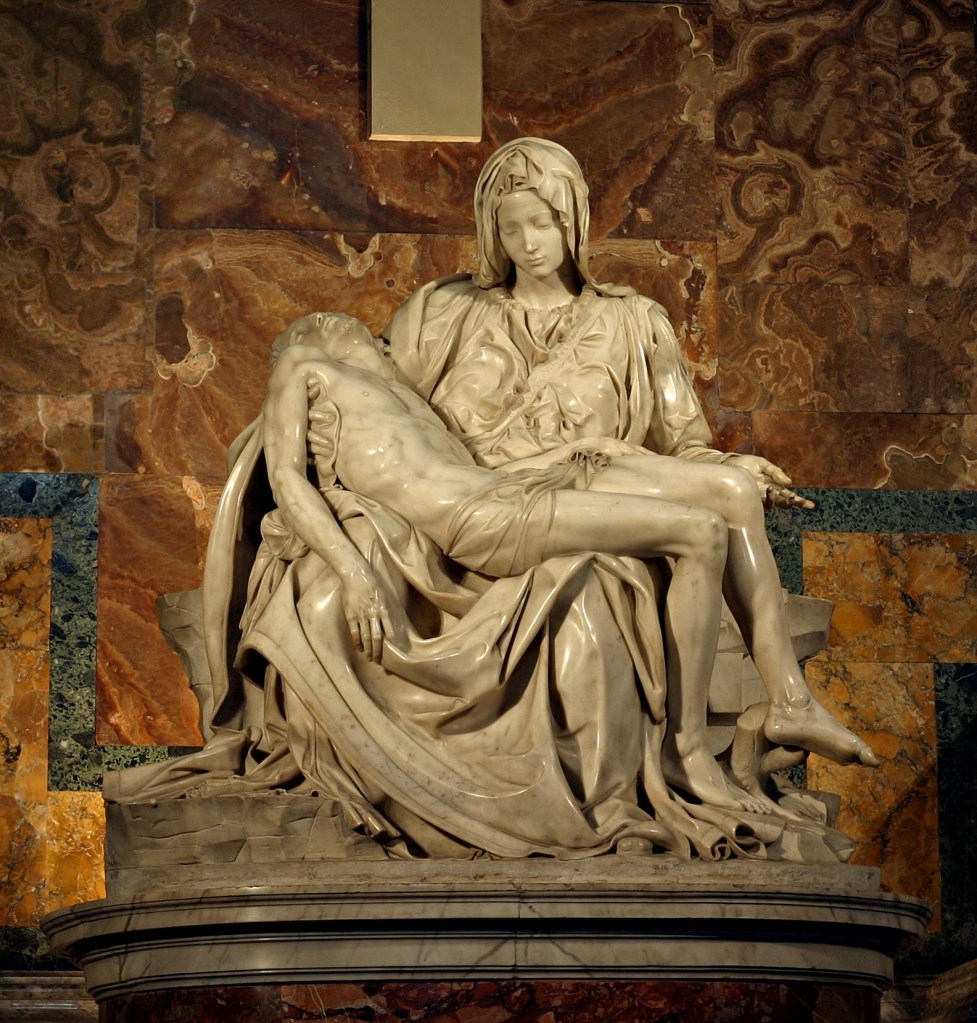
Pieta made by Michelangelo in St Peter’s Basilica in Rome

Today is Good Friday and we remember Jesus’ final hours where he was beaten, humiliated and crucified. In his death, Jesus took onto himself all the pain, suffering and sin that is in the world. We also remember Jesus’ mother Mary, who was with him until his final breath, and who held his dead, lifeless body in her arms, just as the Women of Shunem had done many years before.

Before we get to the joy of the resurrection on Easter, perhaps we could spend a bit of time today reflecting on the grief that is around us. I don’t know about you but I find it hard to stay with the pain of Good Friday and my natural inclination is to move towards the joy and hope that is to come.

But let’s stay here for a while, and let us remember all those who are grieving today. Those who’s loved ones have died, those who have been unable to hold dying relatives in their arms in their final hours, mothers who have had to witness the death of their children, all those known to us who are suffering, and who might also be wondering if the love they had was worth the pain of the grief.

Let us place all our prayers at the foot of the cross, in the hope of the resurrection and new life.

Prayer

Eternal God,
in the cross of Jesus
we see the cost of sin
and the depth of your love:
in humble hope and fear
may we place at his feet
all that we have and all that we are,
through Jesus Christ our Lord.

A Collect for Good Friday from Church of England Common Worship

Shallum’s Daughters: wall builders

Shallum’s Daughters ©MicahHayns

Nehemiah 3.12

We are nearing the end of our series of women from the Hebrew bible and today’s women come at the chronological conclusion of the forty posts as the final posts will be going backwards in time to reflect on women who might be able to help us connect with the Easter story.

Today’s women share only one single verse in the bible and seem rather inconsequential compared with the women we’ve been reflecting on recently; yet they were part of something far bigger and therefore deserve a day to themselves.

Shallum son of Hallohesh, ruler of a half-district of Jerusalem, repaired the next section [of the wall] with the help of his daughters.

Nehemiah 3.12

When the Babylonians invaded Judah in c.587BCE (2 Chronicles 36.15-21), they destroyed the city of Jerusalem, including the Temple (built by Solomon) and the city walls. At this point in our story, the Jewish people had been in exile for around 70 years.

The Jews were allowed to return home to Jerusalem by King Cyrus and they were given permission to rebuild the temple (Ezra) and restore their damaged homes. The people were vulnerable to attack as the city walls were damaged and so God called Nehemiah to oversee the restoration. The book of Nehemiah is essentially a historical account of the rebuilding of the city walls:

Rebuilding the Wall of Jerusalem under Nehemiah by William Brassey Hole (1846-1917)

Jerusalem lies in ruins, and its gates have been burned with fire. Come let us rebuild the wall.  

Nehemiah 2.17

And within the book there is an entire chapter (3) which consists of a long list of names of all those who rebuilt a section of the wall. It’s not the most riveting part of scripture I have to say, but it shows that each and every person named was important and had a role to play:

And so it continues…

The men of Jericho built the adjoining section, and Zakkur son of Imri built next to them. The Fish Gate was rebuilt by the sons of Hassenaah. They laid its beams and put its doors and bolts and bars in place. 

Nehemiah 3.2

The daughters of Shallum are the only women named in the rebuilding work. I find it intriguing to wonder what their role was. How exactly did they help their father? Perhaps they financed the work, or brought food and drink to the labourers? Or did they do actual hard labour, carrying stones, placing beams, hoisting doors and shovelling rubble?

Whatever their exact role involved, they were part of the working party who finished the wall in only 52 days, enabling the Jewish families to return home (chapter 7) to live and worship in safety.

Reflection and Prayer

Jesus answered them, “Destroy this temple, and I will raise it again in three days.”They replied, “It has taken forty-six years to build this temple, and you are going to raise it in three days?” 
But the temple he had spoken of was his body. 
John 2.19-20

The daughters of Shallum helped to build the walls in Jerusalem that were still standing during Jesus’ final journey into Jerusalem. He may even have ridden through the gate they built when he arrived on the colt. Or perhaps he passed their section of the wall when he was being dragged towards the cross on his final journey.

I thought it was important to include them in this blog because it’s good to remember those who just get on with the task in hand, without fuss and ceremony, and often without being given any accolades for what they do.

During this curious time of Covid-19 it can feel that our world is crumbling around us and structures that we thought of as strong and solid turn out to be weaker that we ever imagined. When things are crumbling we can really appreciate the multitude of people performing every day tasks that keep us secure and enable us to function. Let us pray for hospital porters, cleaners, catering staff, nursing assistants and all those who keep our nursing homes and hospices running smoothy.

And let us remember that Jesus’ body (which he compared to the temple), although utterly broken and destroyed, was indeed raised in three days. And like the daughters of Shallum each one of us is called to play our own little part in the rebuilding work of God’s kingdom, a kingdom that can never be destroyed and will last forever.

Behold our lives, our faculties, our wills: we have given them all to You. We are Yours; dispose of us according to your will. We see well enough, O Lord, how little we can do. But now having drawn near to You, having ascended this watchtower from which Your truth can be seen,
and while You depart not from us, we can do all things. Amen
(A prayer of Teresa of Avila)

Queen Vashti: #MeToo

Queen Vashti ©MicahHayns

Esther 1

In October 2017 American actress Alyssa Milano posted on Twitter: “If all the women who have been sexually harassed or assaulted wrote #MeToo as a status, we might give people a sense of the magnitude of the problem”. This was in response to allegations relating to renowned film producer Harvey Weinstein, who was recently sentenced to 23 years in prison. The #MeToo became a global movement in a matter of days opening up an important conversation about women’s experiences, particularly in industries such as film and theatre.

The story of Queen Vashti is perhaps one of the earliest accounts of a woman standing up to a powerful man.

Vashti was the Queen of Persia, the first wife of powerful King Ahasuerus (Xerxes 1), and her story is told within the Book of Esther (which is named after another fabulous woman who we will look at tomorrow), during the days of Jewish captivity in Babylon.

For the Persian rulers it was a time of peace and prosperity which meant that there was plenty of time for the king to display the glory of his kingdom. King Ahasuerus was certainly a dedicated host. One of his parties, which gathered together officials, nobles and governors from across the kingdom, lasted nearly six months!

Vashti’s story begins with one such banquet, one that is so lavish that there were couches made from gold and silver, drinks were served in golden goblets, and the wine was so plentiful that:

by the king’s command each guest was allowed to drink with no restrictions, for the king instructed all the wine stewards to serve each man what he wished.

Esther 1.8

It was a party that Weinstein and his Hollywood crowd would have approved of!

At that time the men and women of the royal palace lived largely separate lives, and Queen Vashti had her own quarters. Whilst the king celebrated she hosted her own banquet for the women of the kingdom.

After seven days of revelry, and when the king was ‘in high spirits from wine’ he sent his seven eunuchs to bring Queen Vashti to the men’s banquet. He demanded she be brought to their party and displayed:

wearing the royal crown, in order to show the peoples and the officials her beauty.

Esther 1.11

Some theologians argue that this meant the king demanded she should wear nothing at all but her crown! It’s not clear if this is the case, but Queen Vashti was clearly distressed by the command.

She says no!

Queen Vashti refused to come at the king’s command.

Esther 1.12

What a risk to take! The king was furious and ‘anger burned within him’. He had wanted to impress his party by showing how beautiful his wife was; and instead she had humiliated him publicly.

Vashti Deposed by Ernest Normand, 1859

He wanted revenge. And so, like Henry VIII, Weinstein and countless other despots since, he worked out a way to bring her down. He consulted his sages and lawyers and they found a by-law which said he could depose her as Queen because she has been disobedient to the king.

The nobles wanted to punish her to ensure the obedience of all their wives:

For this deed of the queen will be made known to all women, causing them to look with contempt on their husbands…. there will be no end of contempt and wrath.

Esther 1.17,18

The Queen was deposed and a letter was sent throughout the whole land to every province, in every local language, with the decree that:

every man should be master in his own house.

Esther 1.22

We hear no more of Vashti and she is replaced by a young Jewish woman, Esther, who we will hear about tomorrow.

Reflection and Prayer

One of the things I’ve enjoyed about this series is discovering how the stories of the women from Old Testament are at the same time ancient but also very modern and relevant to us today.

Queen Vashti said ‘no’ to the king at considerable cost to own life. We don’t get to hear why she did this. Some have argued that it was because of modesty (Midrash), others that she was unhappy with her appearance that day (Babylonian Talmud), and still others that she was a proto-feminist fighting for her integrity. Harriet Beecher Stowe (1878) says that her action was the ‘first stand for women’s rights’ (1).

Whatever the reason, she was certainly bold and you might be interested to hear that there is even an #IamVashti campaign which was started by feminist Jewish theologian Meredith Jacobs – you can read her excellent article here.

The Book of Esther is curious because it is the only book of the bible which doesn’t mention God, an odd choice perhaps as we begin Holy Week!

Let us pray for all those who continue to be exploited by the powerful, for all those who have the courage to stand up to power, and for ourselves, that we would use our own power well.

Lord Jesus, who hears the voices of the powerless,
and gives strength to those who speak up:
create safety for stories to emerge,
embolden our community to examine itself,
shine your light on abusive power, and
help us commit to holiness in every relationship,
In the name of Jesus Christ. Amen

  1. https://time.com/4269357/queen-vashti-feminist-history/

Huldah: prophetess of doom

2 Kings 22 and 2 Chronicles 34

Huldah ©MicahHayns

I confess I had never heard of Huldah before and yet she is one of the seven female prophets in Jewish tradition.*

Huldah had the ear of kings and rulers and interpreted the Jewish Law with authority, and yet unlike most other biblical prophets we hear nothing about her family history, journey of faith, or personality. The frustrating thing is we get to learn more about her husband’s genealogy than hers, and he does nothing of any consequence.

Huldah, (her name means weasel which is unfortunate!) was a prophetess from Judah at the time when King Josiah was on the throne. She lived in Jerusalem with her husband Shallum, who had the enigmatic job title, ‘keeper of the wardrobe’.**

You will remember from yesterday’s post about Queen Athaliah that this period of history was one of a seemingly endless cycle of corrupt and cruel rulers of the divided nations of Israel and Judah. During this period (around sixty years) the temple in Jerusalem had been allowed to fall into ruin, the people turned to idolatry, and the laws and statutes given to Moses had been largely forgotten.

King Josiah was one of the few kings who ‘did what was right in the eyes of the Lord’. (2 Kings 22.2). He became king when he was only eight year old and he ruled with justice and equity, ensuring those who worked on the restoration of the temple were being paid and that all the temple funds were accounted for properly.

Whilst the building work to restore the temple was taking place one of the workers found an old copy of ‘the Book of the Law’ in the rubble. This would have been a collection of rolls of parchment containing sections of the Torah. This was read aloud to the king who was convicted by what he heard realising with horror how far they had moved from the Lord’s will:

When the king heard the words of the Book of the Law, he tore his robes

2 Kings 22.11

He wanted to understand what he was hearing and so he sent his high priest (Hilkiah) and scribe (Shaphan) to ask Huldah the Prophetess for guidance. She interprets the text with authority, clarity and boldness, and speaks to them of God’s judgment towards the people:

Because they have forsaken me and burned incense to other gods and provoked me to anger by all the idols they have made, my anger will burn against this place and will not be quenched.

2 Kings 22.17

She then tells them that God had seen and heard Josiah’s repentance on receiving the Law:

Because your heart was responsive and you humbled yourself before the Lord…because you tore your robes and wept in my presence, I have heard you.

2 Kings 22.18

God used Huldah’s prophetic voice to promise King Josiah protection and peace. The king responded by restoring God’s word to temple worship, renewing their vows to obey God’s law, and bringing back long forgotten Jewish festivals such as Passover. Alongside this he destroyed all the idols and shrines, sacked all the pagan priests and mediums, and pulled down the altars to Baal.

Neither before or after Josiah was there a king like him who turned to the Lord as he did – with all his heart and with all his soul and with all his strength, in accordance with the Law of Moses. 

2 Kings 23.25

And this remarkable transformation came about through the words of a female prophet who very few have ever heard of… Huldah.

* the others are Sarah, Miriam, Deborah, Hannah, Abigail and Esther
** the job probably involved looking after the robes of the priests, rather like a verger would in our churches today.

Reflection and Prayer

The gifts he gave were that some would be apostles, some prophets, some evangelists, some pastors and teachers, to equip the saints for the work of ministry, for building up the body of Christ, until all of us come to the unity of the faith and of the knowledge of the Son of God, to maturity,
 to the measure of the full stature of Christ. 
Ephesians 4.11-13

What is remarkable about this story is that King Josiah clearly had other learned temple priests and scribes he could call upon, and yet none of them were able to interpret scripture and explain the Book of the Law in the way that Huldah could. Is this the first example of biblical interpretation in scripture? I think it may be.

As we learn of Huldah’s gifts for prophetic teaching perhaps we can give thanks for all those women and men who have opened up scripture to us and have taught us something of God’s word.

Lord Jesus, merciful and patient, grant us grace
ever to teach in a teachable spirit;
learning along with those we teach,
and learning from them when it pleases you.
Word of God, speak to us, speak by us, what you will.
Wisdom of truth, instruct us, instruct by us, if and whom you will.
Eternal truth, reveal yourself to us, reveal yourself by us,
in whatsoever measure you will;
that we and they may all be taught of God. Amen

A prayer for teachers by Christina Rossetti (1830-94)

Athaliah: the vengeful queen

Athalia ©MicahHayns

2 Kings 11

I tried reading Anna Karenina by Dostoyevky once but remember getting utterly confused by the similarity of so many of the names, with the added complexity that at times characters were called by their middle names. Our next woman, Queen Athaliah appears in a similarly confounding section of the Bible where the characters have names that sound the same and most seemed to begin with the letter J (or A).

We have Joram, Jehoram, Jehosophat, Jehosheba, Jehoash, Jehoida and they live in Jezreel. It is further confused by the fact it is a time when the kingdom is split into the Kingdoms of Judah and Israel, and at one stage the kings of both nations had the same name (Jehoram, but sometimes called Joram, in the same passage)!

Athaliah from Guillaume Rouillé’s Promptuarii Iconum Insigniorum, 1553

Athaliah was the daughter of King Ahab and Queen Jezebel of Israel and lived in around c. 841 – 835 BC. She was married to King Jehoram of Judah and it is likely that the marriage was intended to be a union to unite the two rival kingdoms: it doesn’t work out that way. Her husband was a brutal man who had killed his six brothers in order to obtain the throne. Her brother is the other Jehoram, the one that was King of Israel at the time (you can see it’s confusing!).

Athaliah and Jehoram have children but tragedy struck when a rival faction of rebels seeking independence raided their palace and captured her entire family, leaving only her youngest son, Ahaziah, who eventually succeeded his father to the throne. Ahaziah’s rule only lasted a year as he was assassinated during a state visit to Israel by Jehu (King of Israel) who not only orders the killing of Athaliah’s son but also her entire extended family. In a gruesome additional detail we are told that the heads of the 70 murdered royal princes were placed in a basket and sent as a grizzly package to King Jehu.

On hearing what had happened to her family Athaliah doesn’t seem to grieve their demise: she is more concerned for power. She proclaims herself Queen of Judah and executed all those who had any royal claim, even killing the women and children: it is a truly horrific period of Israel’s history.

Her sister Jehosheba managed to rescue one of Athaliah’s grandchildren (Joash) from her purge, and he is brought up in secret by a priest named Jehoiada. The priest instigated a rebellion and proclaimed the child King when he was only seven years’ old.

Queen Athaliah was furious when she saw what had happened.  

…all the people of the land were rejoicing and blowing trumpets. Then Athaliah tore her robes and called out, “Treason! Treason!’.

2 Kings 11.14

Her cries were useless. She was taken out and summarily executed at the gates of the palace.

‘..and the City was quiet, because Athaliah had been slain’.

2 Kings 11.20

Reflection

Two other men, both criminals, were also led out with him to be executed. When they came to the place called the Skull, 
they crucified him there, along with the criminals—one on his right,
 the other on his left. Jesus said,
 “Father, forgive them, for they do not know what they are doing.”
Luke 23.32-34

Athaliah is the only women in this lent series about whom I’ve struggled to find a single thing that is commendable or likeable. She was brutal, power hungry, and attempted to wipe out the entire line of Judah. Her sister even had to hide one of her own grandchildren from her for fear that she would commit murder. The only defence is that Athaliah was born into a violent world where both parents were brutally killed and her husband was similarly violent. Perhaps this might give us some context for her actions, but it is important to remember that women can be thoroughly evil and that some terrible crimes have been committed by women not just against them.

On reflecting on her I realise that I find it easier to consider women who are abused, victimised and enslaved than those who are powerful, vengeful and cruel. I wonder why that is?

Next week we will be heading into Holy Week where we will reflect again on Jesus’ final journey into Jerusalem, a journey which leads to his violent death on the cross. Whilst on the cross Jesus took all the pain, violence and suffering of the world onto himself and, surrounded by criminals, cried out, “Father, forgive them, for they do not know what they are doing”.

Perhaps that is all we can do when faced with cruelty and violence in our world. We can pray for forgiveness. We can remember that Jesus died for the criminal and cruel as well as for those who nurture and care. And we can recognise that each one of us has the capacity to be cruel and violent as well, even if we aren’t quite as evil as Queen Athaliah!

Prayer

This beautiful prayer was found in the clothing of a dead child at Ravensbruck concentration camp

Lord, remember not only the men and women of good will, but also those of ill will. But do not remember all of the suffering they have inflicted upon us: instead remember the fruits we have borne because of this suffering – our fellowship, our loyalty to one another, our humility, our courage, our generosity, the greatness of heart that has grown from this trouble. When our persecutors come to be judged by you, let these fruits that we have bourne be their forgiveness. Amen

The Queen of Sheba

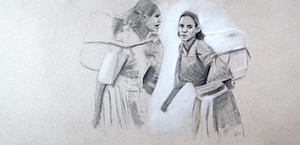
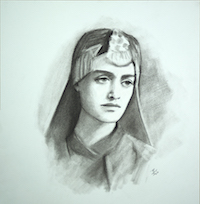
Queen of Sheba ©MicahHayns

1 Kings 10 and 2 Chronicles 9

Our next woman is well-known, but the detail in the Bible is actually rather scant. Most of what we know about her is taken from legend, poetry, art and myth. In Ethiopian tradition she is called Makeda, and in Islamic and Yemeni tradition she is Bilquis.

The Queen of Sheba is the most exotic and enigmatic woman of this lent series and is markedly different to all the other women: she is a female ruler from a far-flung land, she is wealthy, and she seems to be totally independent of any man or of any particular social group. But what really sets her apart is that her journey is one of intellectual curiosity over and above anything else. She is a woman who loved wisdom and was willing to travel the world to seek it out.

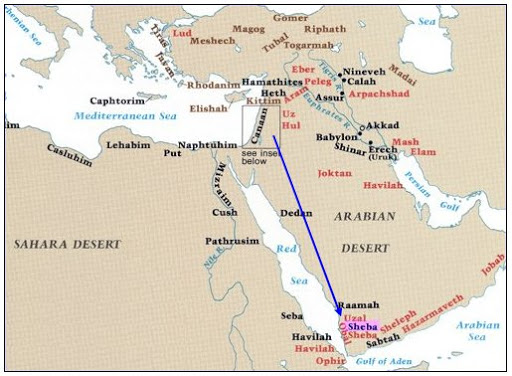
She was the queen of a land situated to the south of the Arabian desert, believed to have been the kingdom of Sheba, or Saba (which is in modern day Yemen). She had heard reports that King Solomon was the wisest man in the East and so set off on the long journey (some say it may have taken several years) to find out for herself.

When the queen of Sheba heard of the fame of Solomon, she came to Jerusalem to test him with hard questions 

2 Chronicles 9.1

She was fabulously wealthy and arrived in Jerusalem with a huge entourage that included camels, spices, precious stones, and gold. These were gifts for the king and would have been expected of a Royal visit. Her main interest does not seem to have been his wealth or huge palace, for her the audience with the King was a meeting of minds:

She came to Solomon and talked with him about all that she had on her mind. Solomon answered all her questions; nothing was too hard for the King to explain to her.

1 Kings 10.3
Piero della Francesco, Meeting between the Queen of Sheba and King Solomon, circa 1410-20

She was impressed by Solomon’s intellect, wisdom and wealth and this led her to turn to praise God at all that she saw:

Blessed be the Lord your God, who has delighted in you and set you on the throne of Israel! Because the Lord loved Israel forever, he has made you king to execute justice and righteousness.

1 Kings 10.9

Gifts of gold, spices and precious stones were handed over and then the Queen, having asked all the questions that she had on her mind, and learned all that she could from King Solomon, set off back to her home land.

Reflection and Prayer

Wisdom cries out in the street;
    in the squares she raises her voice.
21 At the busiest corner she cries out;
    at the entrance of the city gates she speaks:
22 “How long, O simple ones, will you love being simple?
Proverbs 1. 20-22

One of the many reasons I love my job as a university chaplain is being in the midst of so many people who are thirsty for knowledge and who are dedicating their lives to learning and seeking understanding. Like the Queen of Sheba they travel from around the globe in hope to find some of their questions answered.

There is difference between knowledge and wisdom though isn’t there? * Knowledge can be gained through reading, research and gathering information, but wisdom uses discernment, judgement and understanding to take this information and to use it for good. I often marvel at how the cleverest of people can make the most foolish decisions at times!

One of the great things about getting older is knowing that wisdom often come with maturity, especially if we are willing to learn from our mistakes and to change

In the Book of Proverbs ‘wisdom’ is personified as a woman,’lady wisdom’, who cries out on the streets calling men and women to the knowledge of God. Let us pray for wisdom, for ourselves and for our leaders at this time of global emergency.

Most Gracious and Holy Father,
give us wisdom to perceive you;
intelligence to understand you;
diligence to seek you,
patience to wait for you;
eyes to behold you,
a heart to meditate on you:
and a life to proclaim you,
through the power of the Holy Spirit
and the love of Jesus Christ, our Lord. Amen
Frank Topping, 1994

* John (my husband) says ‘knowledge is knowing that a tomato is a fruit; wisdom is not putting it in a fruit salad’!
 

Reclaiming Jezebel

Guest post by Matilda Hadcock, Undergraduate of History, Christ Church, Oxford

1 Kings 18-19, 21 and 2 Kings 9

Jezebel ©MicahHayns

The end of Jezebel’s life was a tragic one: she was pushed out of her window and fell to her death, then her body was eaten by dogs. Only her skull, feet and the palms of her hands remained.

This was said to have been God’s plan all along, revealed to the prophet Elijah. God had condemned the King of Israel, Ahab, including all his descendants and his wife in the curse:

Also concerning Jezebel the Lord said, ‘The dogs shall eat Jezebel within the bounds of Jezreel.’

1 Kings 21,23

Some people would argue that Jezebel deserved the end she received – as a harlot, pagan and temptress she should have expected nothing less. Others see Jezebel as a feminist icon – she lived the life she wanted and had no qualms about tarnishing her reputation; she probably would have glorified in her death. Neither interpretation leaves enough room for nuance.

The story of Jezebel is far from pleasant, and neither is it whole. Her story is told in pieces in the Bible, as is usually the way, through the men in her life. She is depicted as a wicked woman, but what else might her story tell?

There are two dictionary definitions of ‘Jezebel’. The first is in reference to her historical and biblical status as the Phoenician wife of Ahab, who pressed the cult of Baal on the Israelite kingdom and was finally killed in accordance with Elijah’s prophecy. The second is more descriptive: a jezebel is an impudent, shameless or morally unrestrained woman who gets her own way through deception. Along with sexual immorality, Jezebel is associated with vanity, worshipping false gods, and the female vice of seduction.

These common associations require some myth-busting.

Jezebel was the daughter of a Phoenician king, Ithobaal I, but she moved to Israel on her marriage to King Ahab. It was, as ever, a political marriage, the culmination of friendly relations between Israel and Phoenicia. Jezebel is blamed for introducing the nature god Baal-Melkart into Israelite society, thus confusing the Israelites about which was the true religion.

In fact, it was custom for Ahab to set up an altar for his wife to pray at, in the tradition of her home religion. The worship of Baal may well have been the only reminder of home that Jezebel had in Israel. The accusation that she prayed to false gods is only one perspective; at the time and in her mind, she must have been devout and loyal in her faith.

When Elijah orchestrated the killing of the priests of Baal, Jezebel was distraught. She threatened Elijah with death, bravely declaring:

So may the gods do to me, and more also, if I do not make your life like the life of one of them [ie. dead] by this time tomorrow.

1 Kings 19.2

Violence is common in the Old Testament, and Jezebel is not unique in her use of brutality. She stood up for what she believed in, asserting her queenly power in perhaps the only way that she knew would carry meaning.

Regarding her sexual immorality, there is no evidence in the Bible that Jezebel was unfaithful to her husband. She provided him with children, and cared for him. When Ahab got angry because he could not have the plot of land he desired, it was Jezebel who sought him out and calmed him. Ahab threw himself on the bed and turned his head away:

His wife Jezebel came to him and said, “Why are you so depressed that you will not eat?”

1 Kings 21,5

She seems to have been doing her best to be a good wife and Queen.

In the scene before her death, Jezebel appears at the window, looking down on Jehu, the new King of Israel. Jehu had been appointed by Elijah’s successor, Elisha. He had usurped and killed Joram, Ahab and Jezebel’s son, in order to remove the religion of Baal from the region.

Jezebel, in the last moments of her life, was looking down on the man who had killed her husband and her son. She is reported to have dressed up when she heard he was coming. Some interpret this to mean that she was attempting to seduce Jehu, acting indecently as ever. The alternative is that she put on her make-up and her royal garments in one last show of authority as the old Queen and mother of the rightful King. She was in a vulnerable position: she may have known she was about to die and the political situation was certainly not favourable. Rather than seeing her outfit as vanity and the work of a temptress, perhaps it should be considered as the last-ditch attempt of a grieving mother to maintain some dignity and pride.

But Jezebel was said to have been condemned by God. Why? She acted violently and hurt other people, apparently intentionally. In order to please her husband, Jezebel had the innocent commoner Naboth stoned to death. He had wanted to keep the vineyard belonging to his ancestors, but Jezebel fraudulently used Ahab’s seal to secure Naboth’s murder, pretending that he had blasphemed. This was an evil act, which her situation cannot excuse.

Prophets of Yahweh were massacred, and ultimately, Jezebel worshipped deities other than God. She was a false worshipper and did not heed His covenant. Elijah had attempted to spread God’s word amongst the Israelites and, however aggressively he had done so, she had responded in kind, threatening his life.

It is hard to know where Jezebel stands as a woman in the Judeo-Christian narrative. The understanding of Jezebel as a sexually and morally dubious character should not be believed so easily – it has been developed culturally, often for literary and cinematographic purposes. But neither should she be let off the hook. According to the Book of Kings, Jezebel really was a nasty piece of work, in league with her equally horrible and untrustworthy husband, Ahab.

In The Handmaid’s Tale, Margaret Atwood labels the seedy, misogynistic, patriarchally-run nightclub‘Jezebel’s’. Offred’s best friend, Moira, works there as a prostitute, and whilst the reader expects anti-establishment feminism, the nightclub comes to represent disappointment, weariness and loss of hope.

Perhaps this is reflective of Jezebel’s life? She lived in a time of political and religious turmoil, she was married to a seemingly wicked man, and she witnessed the murder of priests of her religion and one of her sons. Few people in the Old Testament are truly and immediately ‘good’. Whilst Jezebel cannot be considered a symbol of righteousness and virtue, not all of her actions deserve condemnation. She might not have been ‘good’, but we should be wary of reducing her to a figure of evil.

Prayer

A prayer of repentance:

If my soul has turned perversely to the dark:
If I have left a sister or brother wounded along the way;
If I have preferred my aims to thine;
If I have been impatient and could not wait;
If I have marred the pattern drawn out of my life;
If I have cost tears to those I loved;
If my heart has murmured against thy will,
O Lord, forgive.
F.B. Meyer

Abigail: the desert diplomat

1 Samuel 25: 1-44

Abigail ©MicahHayns

In 2014 Major General Kristin Lund of Norway was appointed as the first woman to serve as Force Commander in a United Nations peacekeeping operation. (1)

Our next woman, Abigail, was also a peacekeeper.

The whole story is written rather like a play within a play. The setting is in the desert at a time when the Israelites were desert tribes, Saul was still King, the prophet Samuel had just died, and David was gaining power as a tribal leader.

Abigail (meaning father’s joy) was married to Nabal (meaning fool or moron). They could not have been a more mismatched couple. Abigail was beautiful, intelligent and sensitive whereas Nabal was surly, mean and a drunkard. He had a large farm with 3000 sheep, 1000 goats and a property at the foot of Mount Carmel.

It was sheep shearing season, traditionally a time when communities would hold celebration feasts. David, whose men had protected Nabal’s farm, sent ten men to ask for some produce for the feast as payment. Nabal responded to their polite (although 10 men sounds pretty threatening) request by shouting at them and insulting the men, and David.

Who is this David? Who is this son of Jesse?

1 Samuel 25.10

David was furious when he heard this and began to prepare to go to war against them. One of Nabal’s men saw what had happened and wisely realised that there was no point talking to his master as ‘he’s so ill-natured that no-one can speak to him’. Instead he went to Abigail and explained the dangerous situation.

Abigail lost no time.

She gathered a number of gifts (including managing to rustle up 200 cakes of figs and 100 cakes of raisins, which is pretty impressive), loaded up the donkeys and headed off to meet David.

Abigail throws herself at David’s feet. Minature from Rudolf von Ems’ World Chronicle, Codex bibl. 205, fol. 136 (14th Century)

She found him and his men on their way to battle. She got off her donkey, threw herself at David’s feet and then delivered a brilliant peacekeeping speech: a speech which appealed to David’s pride and was both theologically compelling and strategically sensible. She used winning peace making strategies, many typically used by women who don’t have power and strength on their side:

  • Flattery – ‘my Lord’
  • Humility – ‘let the blame be on me alone’
  • Explanation – ‘pay no attention to that wicked man Nabal – his name is Fool and folly goes with him’
  • Gift giving – ‘let this gift.. be given to the men who follow you’
  • Appeal to the conscience – ‘let no wrong-doing be found in you as long as you live’.

Abigail’s speech changed David’s heart and he called off his men.

May you be blessed for your good judgement and for keeping me from bloodshed this day

1 Samuel 25.33

What Abigail did that day was hugely risky. David could easily have killed her, and even after her meeting with him she then had to go back home to face the wrath of her husband. Once back she found him ‘in high spirits and very drunk’ and so she wisely decided to wait until he had sobered up to tell him what she had done.

A C14th depiction of Abigail tending Nabal by John de Teye (1361-1384)
commons.wikimedia.org

He was so shocked ‘his heart failed him and became like stone’. (37)

It is likely that he had a stroke or a heart attack, and 10 days later he died.

Abigail’s story doesn’t end there as David, hearing of Nabal’s death, sends for her and she becomes his wife, and the mother of his second son (Daniel).

Reflection and Prayer

Abigail’s story is one of salvation.  She saves her household and herself from her boorish husband and from the ensuing army set to destroy them. She saved David from acting in a way that would lead to sin, and she secured peace in the region and a better life for herself and her people.

A very early role model for the female peacekeepers of the United Nations today?

As we remember Abigail let us pray for all those who are peacemakers in our communities, for those who do this on a global and national stage, but also for those who are involved in conflict mediation on a local level. Let us also remember women who are today living with partners who struggle with alcohol addiction, and who’s behaviour is unpredictable and violent. This must be particularly difficult during this difficult time.

O God, from whom all holy desires, all good counsels, and all just works do proceed: Give unto thy servants that peace which the world cannot give, that our hearts may be set to obey thy commandments,
and also that by thee, we, being defended from the fear of all enemies,
may pass our time in rest and quietness;
through the merits of Jesus Christ our Saviour. 
Amen.
The Collect for Peace from the Book of Common Prayer

(1 and 2) https://unu.edu/publications/articles/why-un-needs-more-female-peacekeepers.html

Michal: a tale of love and hate

1 Samuel 18-19; 2 Samuel 3.13-16; 6.12-23

Michal ©MicahHayns

There’s a beautiful word in Hebrew חֶסֶד that’s pronounced ‘hesed’. It’s often translated as ‘loving kindness’ and is a word that describes the sacrificial love that exists between people, and that of the love God has for humanity.

It’s interesting though that the root of the word can mean both passion for someone and also passion against someone. Love and hate are closely entwined, and the most passionate love can turn very quickly into something ugly, as anyone whose marriage or relationship hasn’t turned out as they expect will know only too well.

Michal’s story involves deep love but it’s a love that is never truly shared and it turns into profound bitterness, and ultimately to hatred.

Michal was the youngest daughter of King Saul, the first king of Israel and Judah, and she is the only woman the Bible explicitly states as loving a man:

Now Saul’s daughter Michal loved David. Saul was told, and the thing pleased him. 

1 Samuel 18.20

David was a handsome young man in the king’s household who’d gained Saul’s favour by killing off his enemy Goliath. Saul was delighted with the idea of a union between his daughter and David for the sole reason that he saw it as an opportunity to get rid of his rival, and his plan is both macabre and bizarre.

In those days it was customary for the groom to offer a gift to the father of the bride, but what Saul demanded for his daughter was:

no other price for the bride that a hundred Philistine foreskins’

1 Samuel 18.25

She was worth A HUNDRED FORESKINS! There is no doubt that Saul was hoping that David would be killed in the process of collecting this macabre gift, but in fact David hands over double this and the marriage is agreed.  

You may remember the quote by Princess Diana when speaking about her marriage to Charles:

'There were three of us in this marriage'

For Princess Michal there were rather more as Polygamy (for men) was allowed at this time in Israel’s history and David had up to seven wives. The other person to show this deep ‘hesed’ love towards David was in fact not another wife, but Michal’s brother, Jonathan:

the soul of Jonathan was bound to the soul of David, and Jonathan loved him as his own soul… Then Jonathan made a covenant with David, because he loved him as his own soul. Jonathan stripped himself of the robe that he was wearing, and gave it to David, and his armour, and even his sword and his bow and his belt. 

1 Samuel 18.2-3

It’s hard to find a more beautiful description of covenanted love in the bible than the one made between Jonathan and David.. but that’s another story!

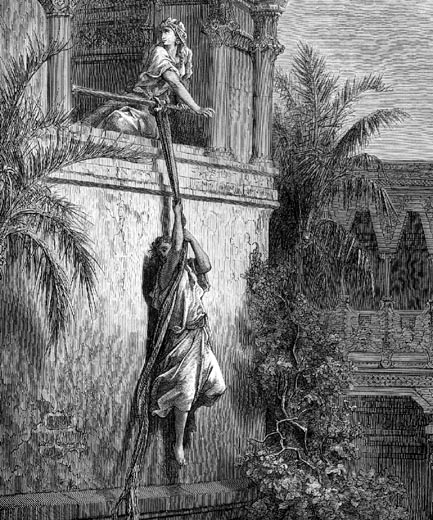
Michal lets David escape from the window. A painting by Gustave Doré, 1865. commons.wikimedia.org

Saul’s jealousy towards his son-in-law built. His rages became more violent and unpredictable and he vowed to kill him. Both Michal and Jonathan showed ‘hesed’ love by helping David escape at great personal risk. Jonathan warned David that Saul wanted to murder him and Michal let him out of the window and then duped her murderous father into thinking he was sick by putting a dummy in his bed and dressing it up. It’s was an incredibly brave act and gave David time to escape.

As David had fled Michal was given in marriage to ‘Paltiel son of Laish, who was from Gallim’, but once David became King he demanded she be brought back to him. Poor Paltiel was bereft and followed behind her weeping before being sent back home.

Any initial love that Michal had towards David was a distant memory by the end of their relationship.

David returned from war having claimed the Arc of the Covenant (the ancient symbol of God’s presence), and was so happy he danced in the streets with abandon:

David, wearing a linen ephod, danced before the Lord with all his might, whilst he and the entire house of Israel brought up the ark of the Lord

2 Samuel 6.14

Michal watched him from a window: she was not impressed. David had gone back home expecting a hero’s welcome from his wife, but instead he got the full force of her fury:

by Francesco de Rossi, 1552-1552 (Wikimedia)

When she saw King David leaping and dancing before the Lord, she despised him in her heart….How the king of Israel honoured himself today, uncovering himself today before the eyes of his servants’ maids, as any vulgar fellow might

2 Samuel 6.16, 20

The argument descended as so many marital rows do. He told her he could celebrate however he liked and warned her he could become even more undignified. She accused him of losing his clothes in front of the servants and he threw at her the fact her father lost the entire kingdom!

Hurtful words said in the heat of an argument can’t easily be taken back again.

Sadly, Michal and David’s relationship (if their union could ever have been called that) never recovers and the last we hear is:

Michal daughter of Saul had no children to the day of her death.

2 Samuel 6.23

Reflection and Prayer

Though the mountains be shaken and the hills be removed, 
yet my unfailing love (hesed) for you will not be shaken
 Isaiah 54:10

Michal is a great character isn’t she? I find it refreshing to read about a bible woman given a a full range of human emotions, from sacrificial love, to irritation, to downright hatred! She was willing to dedicate her life to David but by the end even the way he danced drove her mad with irritation.

Her story reminds us of the delicate nature of human love. It’s so easy to take one another for granted and to let the small irritations fester and grow. Let’s protect and nurture the loving relationships that we have, whether they be with a partner, friend or family member, and especially at this time of global and local anxiety. Remember that the love we have for one another is but a dim reflection of the sacrificial (hesed) love that our heavenly father has for each of us, a love that is revealed through the ultimate sacrifice of Jesus on the cross.

A blessing from the 2nd Century for us all:
O Sovereign God, bless all thy people, and all thy flock. Give thy peace, thy help, thy love unto us thy servants, the sheep of thy fold, that we may be united in the bond of peace and love, one body and one spirit, in one hope of our calling, in thy divine and boundless love. Amen

Liturgy of St Mark, 2nd Century

(1) From Jenni Williams, God Remembered Rachel, SPCK, 2014, chapter 6