Hannah: she rose

1 Samuel 1: 1-28, 2:1-11, 18-21
Here’s a quick quiz for you. How many women in the bible can you think of who were known to be infertile (at some stage)?

And how many men?

I thought so!

Hannah is one of several bible women whose story revolves around infertility and the longing for a child. She lived in Israel at the time when Eli was the High Priest. She was married to Elkanah who had a second wife called Penninah.

It’s perhaps worth giving a bit of background into the culture of the time. In the ancient world to be married and childless was a social disgrace. There wasn’t the understanding that fertility could also be a male issue, and it was believed that the woman who didn’t conceive wasn’t living up to the Creator’s command to be ‘fruitful and multiply’ (Genesis 1:28). The expectation was that women should become the mothers of sons, who would continue the family name and provide for them in their old age. It was of course a classic patriarchal society and women unable to do what was required of them were often shunned and excluded from society. And so with that background we can understand Hannah’s story better:

Peninnah had children, but Hannah had no children.

1 Samuel 1. 2

Elkanah was supportive and generous, even giving Hannah double portions of food during the annual sacrifice feast, ‘because he loved her’. But for Hannah, it was Penninah, the other woman, who seemed to cause her the most pain.

Her rival used to provoke her severely, to irritate her, because the Lord had closed her womb. So it went on year by year as often as she went up to the house of the Lord, she used to provoke her.

1 Samuel 1.6

Hannah became depressed, even getting to the stage that she couldn’t eat and spent her time in tears. Elikinah doesn’t seem to understand the depth of her sadness: of course, he already had children and so for him a child with Hannah wasn’t necessary:

Elkanah said to her, “Hannah, why do you weep? Why do you not eat? Why is your heart sad? Am I not more to you than ten sons?”

1 Samuel 1.8

Despite all of this sadness Hannah was a woman of deep faith and of hope, and the turning point in her story comes with two powerful words:

Hannah rose

Hannah rose up, went to the temple to pray day after day, even though she had to suffer Peninnah’s taunts on the way. One day she was praying so earnestly and with such passion that the priest at the temple (Eli) thought she must be drunk!
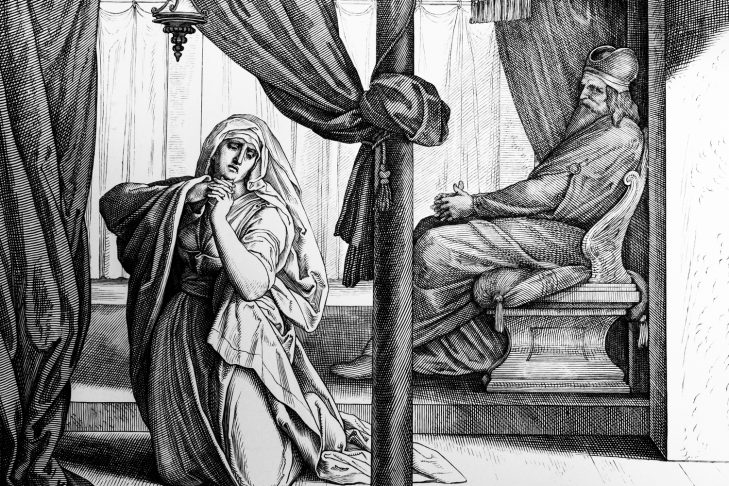
Hannah and Eli engraving by German painter Julius Schnorr von Carolsfeld

No, my lord, I am a woman deeply troubled; I have drunk neither wine nor strong drink, but I have been pouring out my soul before the Lord

(1 Samuel 1.15)

She vowed that if God gave her a child then she would repay this blessing by offering him back to God to live and work in the temple. She becomes pregnant and carried out her promise to the Lord. When her child Samuel (which means God has heard) is fully weaned (probably about 3 years old), she took him to the temple where he grew up under Eli’s guidance. She to visit him every year with clothes she had lovingly made for him, and went on to have five more children.

Samuel grew to be one of the greatest prophets in Israel.

Reflection and Prayer

For it is the God who said, “Let light shine out of darkness,” who has shone in our hearts to give the light of the knowledge of the glory of God in the face of Jesus Christ. But we have this treasure in clay jars, so that it may be made clear that this extraordinary power belongs to God and does not come from us. We are afflicted in every way, but not crushed; perplexed, but not driven to despair.
2 Corinthians 4: 6-8

There was a time in Hannah’s story when her longing was so great that ‘her heart was sad’. No amount of kind words or extra portions of food from her husband was going to make any difference to this. It must have been difficult for Elkanah to know how to support his beloved wife in her despair. What changed things in the end for Hannah was that she ‘rose up’ and somehow managed to find the strength to go the temple and pour out her heart to God. Sometimes even doing that seems impossible.

These are troubling days for so many people and so let us pray for all those whose hearts are sad at this time, for those who can’t even find the strength to eat or pray, and for those who stand beside them wondering how best to help.

O God, from whom to be turned is to fall,
to whom to be turned is to rise,
and in whom to stand is to abide for ever:
grant us in all our duties thy help,
in all our perplexities thy guidance,
in all our dangers thy protection,
and in all our sorrows thy peace;
through Jesus Christ our Lord. Amen
Augustine, 352-430

Why Why Why Delilah?

Judges 16. 1-31

Delilah ©MicahHayns
My my my Delilah
Why why why Delilah
I could see, that girl was no good for me
But I was lost like a slave that no man could free

I’m sure we’ve all crooned along to this Tom Jones classic. It’s a fantastically dark song about a woman caught in adultery who is murdered by her man:

She stood there laughing
I felt the knife in my hand and she laughed no more

The story of Delilah in the book of Judges is also a pretty dark tale, but this time the woman doesn’t end up dead. Delilah is a classic example of the female archetype that we see in both ancient and modern myths and stories:

 The Femme Fatale

The Femme Fatale is portrayed as seductive, sexual, intelligent and beautiful. She normally eschews family life and is considered dangerous. She uses her ‘seductive’ skills to bring about the fall of a man previously thought to be invincible. We might think of Salome (‘bring me the head of John the Baptist’), Cleopatra or Carmen. Or more recent examples are Christine Keeler of the Profumo scandal, or Villanelle in Killing Eve.

Samson was Judge in Israel at a time when they were under the dominion of the Philistines. He was waging a private battle against them which culminated in a massive Israelite victory, and Samson was seen as the strongest and most powerful hero of his time.

That is until he fell in love.

I could see, that girl was no good for me
But I was lost like a slave that no man could free

It is likely that Delilah was a Philistine – she’s certainly portrayed as a foreigner. Unlike most other women she isn’t defined by her relationship to another man – we aren’t told who her father or brother is – she just appears, which adds to her intrigue and danger.

The Philistines offered her an enormous amount of money (11,000 pieces of silver) in return for information about Samson’s weakness so they could beat him in battle. It’s the riddle that he doesn’t want anyone to find out: the secret to his strength.

Coax him and find out what makes his strength so great, and how we may overpower him, so that we may bind him in order to subdue him

Judges 16.5

We don’t know if Delilah agreed to betray Samson out of loyalty to her people, hatred of Samson, or for the money.

My my my Delilah
Why why why Delilah

But she agreed. This led to her using all of her wily skills to find out her lover’s secret. She pleaded – ‘please tell me what makes your strength so great’; she pretended to be hurt – ‘you have mocked me and told me lies’; she was assertive – ‘until now you have mocked me.. tell me how you could be bound’.

Samson played along for a while.

‘if they bind me with seven fresh bowstrings that are not dried out,’
‘if they bind me with new ropes that have not been used’
‘if you weave the seven locks of my head with the web and make it tight’
… then I shall become weak

Judges 16. 7-14

All those cords – it’s all rather kinky! But each time he broke free.

She then appealed to the heart and used persistence (which, when applied to women, is often called nagging).

How can you say, ‘I love you’ when your heart is not with me?…Finally, after she had nagged him with her words day after day, and pestered him, he was tired to death. So he told her’

Judges 15. 16-17
Samson and Delilah, by Lucas Cranach the Elder (1472 – 1553)

Once she had the secret she passed this on to the Philistines who paid her. She soothed him to sleep on her lap and another man came in and cut all his hair off: his strength left him. He was then blinded, thrown into prison and humiliated by being forced to ‘entertain’ his guards (we don’t know exactly what that means).

My my my Delilah
Why why why Delilah
I could see, that girl was no good for me


His hair grew back and his strength returned and so in a final act of revenge Samson pulled the pillars down on them all, killing himself and his Philistine captors. We don’t know if Delilah was amongst them. I think it’s unlikely she stuck around once she’d got her cash. She was far too wily for that!

Forgive me Delilah I just couldn’t take any more

Reflection and Prayer

If you’re now humming the Tom Jones song Delilah you might want to have a listen to it: https://www.youtube.com/watch?v=S87jWwzvwd8

If you’d like to listen to something a little more erudite then Camille Saint-Saëns’ opera Samson and Delilah has a fantastic aria called Bacchanale which you can listen to here: https://www.youtube.com/watch?v=mdITMksls0Y

Samson and Delilah had very different ways of showing strength didn’t they?Samson’s strength seemed to lie in his physical appearance, and yet even this powerful man had a weakness. On the surface, Delilah seemed the weaker of the two, but she demonstrated great strength through her cunning and powers of persuasion. It can be difficult to gauge the strength of others, we often don’t even know our own abilities – some of us look strong on the outside and yet inside are weak and vulnerable; and others are perceived to be weak and yet in adversity turn out to have nerves of steel and an ability to withstand all kinds of trials.

Finally, be strong in the Lord and in the strength of his power...
Therefore take up the whole armour of God...fasten the belt of truth around your waist, and put on the breastplate of righteousness. As shoes for your feet put on whatever will make you ready to proclaim the gospel of peace. With all of these, take the shield of faith, with which you will be able to quench all the flaming arrows of the evil one. Take the helmet of salvation, and the sword of the Spirit, which is the word of God.
Pray in the Spirit at all times in every prayer and supplication. To that end keep alert and always persevere in supplication for all the saints.
Ephesians.6:10,15-18 

As we pray for strength in these troubling times, perhaps we might like to pray the prayer of St Patrick, whose Saint’s Day was earlier this week, for ourselves and for our loved ones. Maybe we can imagine ourselves putting on the armour of God as we do so.

Christ be with me, Christ within me,
Christ behind me, Christ before me,
Christ beside me, Christ to win me,
Christ to comfort and restore me.
Christ beneath me, Christ above me,
Christ in quiet, Christ in danger,
Christ in hearts of all who love me,
Christ in mouth of friend and stranger.
St Patrick’s Breastplate

Deborah: the warrior judge

Deborah ©MicahHayns

Judges 4 and 5

One of the memorable moments of 2019 in the UK was of Judge Lady Brenda Hale, President of the Supreme Court, declaring Prime Minister Boris Johnson’s prorogation of parliament unlawful. She was cool, calm, and resplendent in her spider brooch!

Lady Brenda Hale

She is a powerful advocate for a more balanced gender representation on the UK’s highest court, and yet she objects to the idea of positive discrimination:

“no one wants to feel they have got the job in any way other than on their own merits” [1]

Deborah Beneath the Palm Tree, c. 1896-1902, by James Jacques Joseph Tissot (French, 1836-1902) or followers

It is unlikely that there was any semblance of positive discrimination going on in (around) 12th Century BC to enable Deborah to become a judge, and so we must assume that her position came about due to her own merits.

At that time Deborah, a prophetess, wife of Lappidoth, was judging Israel. She used to sit under the palm of Deborah between Ramah and Bethel in the hill country of Ephraim; and the Israelites came up to her for judgment

Judges 4.4-5

The book of Judges chronicles a cycle of rebellion and deliverance which follows this basic pattern: the people are unfaithful to God (Yahweh) and He delivers them into the hands of their enemies; the people repent and cry out for mercy, which He sends in the form of a leader or champion (a “judge”); the judge delivers them from oppression and they prosper; then after a while they fall back into unfaithfulness and the cycle is repeated.

The story of Deborah follows this pattern but is unique in the Hebrew bible as she is the only female judge.

A battle had broken out between the Israelites (with their general Barak) and Sisera, the general of Jabin’s army. Deborah summoned Barak and commanded him to go to Mount Tabor with 10,000 soldiers from the tribes of Naphatili and Zebulun. However, Barak refuses to go without her by his side.

If you will go with me, I will go; but if you will not go with me, I will not go.

Judges 4.8

She goes with him but not before warning him that if they won the battle then he won’t receive the glory for it as it would always be known that, ‘the Lord will sell Sisera into the hand of a woman’. (Judges 4. 9)

The battle is won and Sisera and his army of 900 chariots retreat with Sisera running away on foot into Jael’s tent (more on her and the fate of Sisera in tomorrow’s blog!).

The ‘Song of Deborah’ in Judges 5 is perhaps the oldest example of Hebrew poetry and is a victory hymn that retells the story and celebrates a military victory brought about by two women.

‘The peasantry prospered in Israel,
They grew fat on plunder,
Because you arose, Deborah,
Arose as a mother in Israel….
Awake, awake, Deborah!
Awake, awake, utter a song!’   

Judges 5. 7, 12

Reflection and Prayer

Here is my servant, whom I have chosen,
    my beloved, with whom my soul is well pleased.
I will put my Spirit upon him,
    and he will proclaim justice to the Gentiles.
Matthew 12.18

Let us remember all those who work in judicial systems around the world: for the police, lawyers, barristers, judges and for all those who create our laws and work to ensure justice and peace. We particularly remember parts of the world where these systems have broken down, where justice isn’t administered with equality, and where the poor continue to suffer because of this.

O God of righteousness, lead us we pray, in the ways of justice and peace: Inspire us to break down all oppression and wrong, to gain for everyone their due reward, and from everyone their due service, that each may live for all, and all may care for each, in the name of Jesus Christ our Lord. Amen
A Prayer of Archbishop William Temple, 1881-1944)

[1] From Wikipedia,
 Bowcott, Owen (1 January 2019). “White and male UK judiciary ‘from another planet’, says Lady Hale”. The Guardian. ISSN 0261-3077Archived from the original on 1 January 2019. Retrieved 1 January 2019.

The Daughters of Zelophehad: girl power

Daughters of Zelophehad ©MicahHayns

Numbers 27

One of our family treats is going to see musical theatre, and we recently enjoyed seeing Trevor Nunn’s production of Fiddler on the Roof at the Playhouse Theatre in London. It was wonderful. The story, for those who don’t know it, revolves around Jewish patriarch Tevye and his five daughters, all who need husbands and dowries, which Tevye, as much as he pleads to God (remember ‘if I were a rich man’), can’t afford.

One man, five daughters, no sons. This is a rather similar situation for Zelophehad, who who lived at time when the Israelites were in exile, wandering in the wilderness with Moses as their leader.

Now Zelophehad son of Hepher had no sons, but daughters: and the name of the daughters of Zelophehad were Mahlan, Noah, Hoglah, Milcah, and Tirzah

Numbers 26.13

Five women that you’re unlikely to have ever heard of but whose chutzpah transformed the lives of women down the centuries.

Zelophehad was the son of Hepher, son of Gilead, son of Machir, son of Manasseh, son of Joseph (another great musical!), son of Jacob, son of Isaac, son of Abraham.

Sons. It was a classic patriarchal society and every father needed a son in  order to ensure the family line continued, and land was apportioned accordingly as inheritance. Now Zelophehad had died and the tradition was that if a man had no sons then his land and possessions would be inherited by his brother, and his family name would be lost.

But these women had another idea.

The daughters of Zelophehad came forward 

Numbers 27.1

They decided that this wasn’t good enough and so, as a group, they ‘came forward’ to argue their case before Moses, Eleazar the Priest and the other elders. Their argument was forthright, concise, personal, persuasive and ends with their plea:

why should the name of our father be taken away from his clan because he had no son? Give to us a possession among our father’s brothers.

Numbers 27.4
The Daughters of Zelophehad, illustration from The Bible and Its Story Taught by One Thousand Picture Lessons. Edited by Charles F. Horne and Julius A. Bewer. 1908.

And Moses prays about it. And the Lord speaks to Moses.

The daughters of Zelophehad are right in what they are saying; you shall indeed let them possess an inheritance.

Numbers 27.4

The daughters are right. Wow. The inheritance laws are duly changed and from then on daughters could inherit if there were no sons – provided they don’t marry someone outside of their fathers’ clan.

Reflection

We cannot underestimate the importance of the actions of these brave women in changing the lives of so many others down the generations.

Gender inequality in inheritance law and land ownership rights is still a current issue and One of the Sustainable Development Goals (SDG’s) of the United Nations is Achieve Gender Equality and Empower Women and Girls and a sub-category of this is Realising Women’s Right to Land in the Law. The report makes interesting reading on why land rights for women is still vitally important: http://www.fao.org/3/I8785EN/i8785en.pd

It’s never easy to ‘come forward’ to tackle injustice and to speak up for something you believe in. Sometimes it’s easier to do this in a group that on our own isn’t it? The sisters might not have had the courage to speak to Moses on their own, and it’s unlikely they would have had a hearing. Let’s give thanks for women’s groups and support networks which have been so important over the centuries for standing up for justice for women and children. I’m involved in a wonderful clergy women’s support group, and frankly couldn’t do without it.

The Women’s Institute Prayer

The Women’s Institute Prayer. The Women’s Institute (WI) was formed in 1915 to revitalise rural communities and encourage women to become more involved in producing food during the First World War. Since then the organisation’s aims have broadened and the WI is now the largest voluntary women’s organisation in the UK. The WI celebrated its centenary in 2015 and currently has almost 220,000 members in approximately 6,300 WIs

Miriam: The Joyful Prophet

Exodus 2.4-6, Exodus 15.20-21, Numbers 12.1, Micah 6.4, Numbers 20:1

This blog series all began because of Miriam.

I was in a shop getting some pictures framed whilst wearing my clerical collar and the man at the desk said: ‘you’ll know the answer to this as you’re a Vicar’.

Church leaders may know the feeling of dread at that statement!

'So, Miriam from the Bible, who was she then?' 

I floundered. I knew she was in the Old Testament and had something to do with Moses. Nothing else. Another customer came in so I took the time to hide behind the frames to google her! I came away determined I’d find out more about Miriam, and also all the other wonderful women of scripture: hence this blog.

So, who was Miriam? She was Moses and Aaron’s sister, the daughter of Amran (one of the Israelite leaders) and Jochebed. That was the simple answer I gave the framer. But there is so much more to her. She was also the first women to be described as a prophetess, a leader of women, a musician and the very first worship leader mentioned in scripture!

Jocheved, Miriam, and Moses, an illustration from the 1897 Bible Pictures and What They Teach Us: Containing 400 Illustrations from the Old and New Testaments, by Charles Foster

We first hear of her when Moses is a baby in the bulrushes having been hidden by his mother to protect him from Pharaoh’s wicked plans to kill the male children. Jochebed (another fabulous woman) placed Moses in the river and Miriam stands at a distance to keep watch. When Pharaoh’s daughter comes and scoops Moses out of the river Miriam steps forward and suggests an ingenious plan.

Shall I go and get you a nurse from the Hebrew women to nurse the child for you?

Exodus 2.7

Miriam suggests Moses’ mother, who is then paid a wage to look after her own son!

Miriam’s Song, by John Edward Poynter (The Bible and Its Story, 1910)

We next hear of Miriam after Pharoah’s army has been defeated and the Israelites escape from Egypt across the red sea into the wilderness. She leads the defiant ‘song of the sea’, a song of triumph which is still recited in jewish daily prayers to this day.

[Miriam] took a tambourine in her hand; and all the women went out after her with tambourines and with dancing:

“Sing to the Lord, for he has triumphed gloriously; horse and rider he has thrown into the sea.”

Exodus 15.20-21

I love the fact that when Miriam and the women fled Egypt, when they didn’t even have time to wait for the bread to rise, they took with them their musical instruments. It’s as if they knew there would be a time to celebrate again one day, and they wanted to make sure they were ready.

It is likely that she was one of the community leaders whilst the Israelites were in exile, and we hear that she wasn’t afraid to confront Moses when she disapproved of a relationship of his (Numbers 12.1). Her forthright nature leads to her being accused of being jealous of Moses and she contracts leprosy (which was understood as a punishment) and is ostracised for a week.

She died at a time of drought in the wilderness of Zin and she was remembered many years later by the prophets as having been one of the three (with Moses and Aaron) who were sent by God to deliver his people from slavery (see Micah 6.4).

So, who was Miriam? A courageous sister, a leader of women, a musician, a worship leader, a dancer, and so much more!

Reflection and Prayer

There is a fantastically catchy song by Debbie Friedman which is sung at Jewish children’s camps in America (and maybe in the UK) called Miriam’s Song. I love this version as it’s rough and ready but totally joyful and the clips of Jewish kids enjoying themselves is a delight. Have a listen. https://youtu.be/1dcBTze-T4o

And Miriam the prophet took her timbrel in her hand
And all the women followed her just as she had planned
And Miriam raised her voice in song
She sang with praise and might
We’ve just lived through a miracle: We’re going to dance tonight!!

Miriam was first to lead the community in joyful praise after many years of hardship. Sometimes it’s good to remember to be thankful, whatever else is going on in our lives. Perhaps you might like to think of five things you are thankful for right now? You might like to say them out loud, boldly, remembering Miriam as you do so.

May we accept this day at your hand, O Lord
as a gift to be treasured,
a life to be enjoyed,
a trust to be kept
and a hope to be fulfilled:
and all for your glory. Amen

(A prayer of Stanley Pritchard)

Shiprah and Puah: the rebel midwives

Exodus 1

Rebel Midwives ©MicahHayns

One of my favourite TV shows to watch when my husband is out (he’s not so keen) is BBC’s Call the Midwife. I love the drama of it. The Sisters are just fabulous and they balance the stark reality of daily life with a deep faith so well. I love the way the programme focuses on the every day details of each family, and the mix of pain, struggle and endurance that leads to new life.

Sometimes it’s pretty gruesome, but birth is like that.

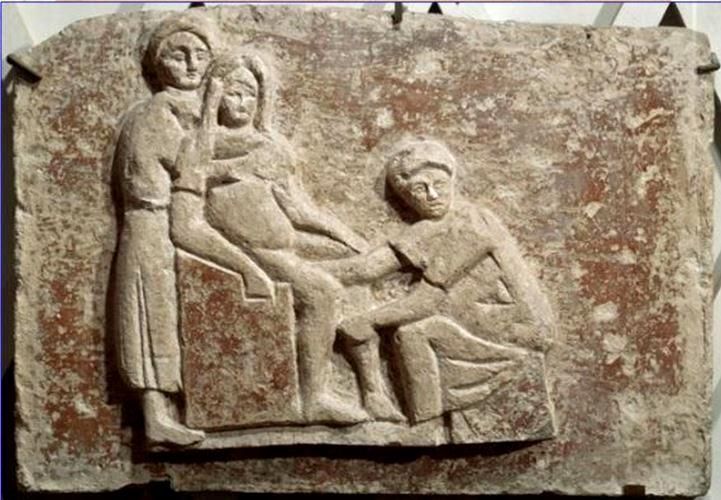
Funerary relief of a midwife, Ostia Antica (Roman Art)

I’ve always admired midwives. Having given birth three times I know it’s a messy business and these women (I know, I know, there are of course male midwives) are willing to be at the gritty end. Midwives are the kind of people you want in a crisis: unflustered, clear thinking, plain talking, patient and encouraging, even willing to be shouted and sworn at in the course of their work!

There must have been many midwives in the Bible but only two are mentioned by name: Shiprah and Puah. (Exodus 1.15).

We have come to the end of our readings from Genesis. The Israelites were now living in Egypt having settled there during the time of Joseph. A new Pharaoh had taken the throne who didn’t remember Joseph and his economic success, and he began to oppress them, forcing them into hard labour. Despite this the Israelites had grown in number and Pharoah was afraid they would rise up against him and so he brought Shiprah and Puah to him and made a terrible demand of them:

When you act as midwives to the Hebrew women, and see them on the birthstool, if it is a boy, kill him; but if it is a girl, she shall live.

Exodus 1.16

In what is no doubt the first act of civil disobedience in recorded history, the midwives refused to follow this murderous edict: [i]

But the midwives feared God; they did not do as the king of Egypt had commanded them, but they let the boys live.

Exodus 1.17

They knew that they could not openly disobey the order of their King, and so they were clever about it: they made up a racially charged explanation!

The Hebrew women are not like other women (they told the king) for they are vigorous and give birth before the midwife comes to them.

Exodus 1.19

Ingenious. It seems that Pharoah fell for this explanation, and because of the cunning bravery of these women the Israelites continued to procreate, the boy babies lived, and Moses, who would later lead them into freedom, was born.

Reflection

The two psalms below use imagery of the midwife to describe God.

“Yet it was you who took me from the womb;
you kept me safe on my mother’s breast.
On you I was cast from my birth,
and since my mother bore me
you have been my God.”
(Psalm 22:9-10)

“For you, O Lord, are my hope,
my trust, O Lord, from my youth.
Upon you I have leaned from my birth;
it was you who took me from my mother’s womb.
My praise is continually of you.”
(Psalm 71: 5-6)

How beautiful to think of the midwives, doctors, nurses and doulas who attend to women and babies at birth as being God-like in their work, bringing forth new life into the world.

Apparently 2020 has been designated ‘Year of the Nurse and the Midwife’ and Pope Francis said that “midwives carry out perhaps the noblest of the professions”.

Let us remember them today and pray for them in their work.

Mother God, as a midwife brings forth new life into the world, You long to nurture new life in us today. Help us to trust in your love and protection, knowing that we are safe in your loving arms. Amen

For more stories of incredible women see our book Unveiled: women of the Old Testament and the choices they made’ – https://www.brfonline.org.uk/products/unveiled

[i]

Francine Klagsbrun said that the refusal of Shiphrah and Puah to follow the Pharaoh’s genocidal instructions “may be the first known incident of civil disobedience in history” (Voices of WisdomISBN 0-394-40159-X).

Rachel: the sister who was loved

This post is a bit longer than usual because it’s a complex story, but I’ve tried to condense it as much as possible.

We probably all know the story of Jacob and his numerous sons, even if only from Joseph and his Amazing Technicolour Dreamcoat.

But what do we know of Joseph’s mother, and the mothers of the many other sons of Jacob, for there were at least four? Rachel and Leah, who were sisters, and Bilhah and Zilphah (their maids).

If anyone thinks the Old Testament is dull, they haven’t read the story of Rachel and Leah. It involves two women wounded by the actions of their father, mistaken identity, sisterly jealousy, fierce rivalry, and even curious aphrodisiac plants!

Dante’s Vision of Rachel and Leah 1855 Dante Gabriel Rossetti 1828-1882 (Bequeathed by Beresford Rimington Heaton 1940 http://www.tate.org.uk/art/work/N05228)

I’ll cover both women over the next two days, but first some background.  

Leah and Rachel were the daughters of Laban (Rebekah’s brother) and lived with him in Haran. Leah is the eldest and we’re told, ‘her eyes were lovely (or in some versions of the bible ‘weak’), whereas Rachel ‘was graceful and beautiful’.

Jacob, one of the sons of Isaac and Rebekah, was on the run from his twin brother Esau (as we read yesterday). He had fled to his Uncle Laban in hope that he might find a wife.

He found two!

Firstly, Rachel’s story. 

Jacob and Rachel at the Well, c. 1896-1902, by James Jacques Joseph Tissot , at the Jewish Museum, New York

Rachel was looking after her sheep when she first saw Jacob by the well. In a wonderfully romantic encounter (or maybe a rather clunky way in which a man shows off to a woman he fancies?), Jacob sees Rachel, leaps off his camel, rolls back the large stone over the well (showing off his rippling muscles?) to water her sheep.

Then Jacob kissed Rachel, and wept aloud. 

Genesis 29.9-11

Gloriously romantic, or all a bit much, depending on your perspective!

From this moment on Jacob loves Rachel, but in order to marry her he has to work for her wily father Laban for seven years:

..and they seem to him but a few days because of the love he had for her

Genesis 29.20

When the time was up there was an engagement feast and, in an action that would change the course of the sisters’ lives forever, Laban sent older sister Leah into the tent to have sex with Jacob. In that culture, that meant that they were then married. Jacob didn’t realise what had happened until the morning and was understandably horrified. I don’t imagine Rachel was particularly pleased either!

Laban allowed Jacob to marry Rachel the next week after making him pledge to work for him for another seven years. The sisters had no say in all of this of course. Having multiple wives was common in the culture of the time, but it isn’t hard to imagine how difficult it must have been for the sisters.

Jacob loved Rachel more than Leah, but Leah was able to have children. A recipe for disaster! Rachel wanted children more than anything and as time went on she envied Leah and got so low that she cried out to her husband:

give me children or I shall die!

Genesis 30.1

This didn’t go down well, Jacob got angry and Rachel, in her desperation, came up with a plan which involved sending her maid Bilhah to have sex with Jacob so that she could have a child through her as a surrogate. Her plan worked and two sons were born.

Eventually Rachel had a son of her own: Joseph.

Rachel hides the teraphim in a camel’s saddle and sits on it, Giovanni Volpato, from Wikipedia Commons

The family left Laban’s household and headed back to Canaan where Jacob was eventually reunited with his brother Esau. The journey turned out to be calamitous for Rachel. But before this there is a wonderful demonstration of her strength of character in the tale of the missing idols. Laban was enraged that someone in the fleeing party had stolen his ‘household Gods’ so he searched everywhere until he came to Rachel’s tent. She had them but managed to foil him by putting them in her camel’s saddle, sitting on it, and telling him she had her period!

Let not my Lord be angry that I cannot rise before you, for the way of the woman is on me

Genesis 31.35

I love this!

Rachel had her longed for second child whilst on the journey. It was a difficult pregnancy and she didn’t survive the birth. Her final act was to name her son Ben-oni, which means ‘son of my sorrow’, a name that revealed so much about this beautiful but deeply sad woman who never seemed to be able to find contentment in life.

Thankfully for the baby Jacob overruled the name and called him Benjamin which means ‘son of my right hand’. The tribe of Benjamin became one of the most significant tribes for the people of Israel, and it was from here that the first king of Israel (Saul) emerged.

Rachel was buried on the way to Bethlehem, and her tomb is a significant site for pilgrims to this day.

PRAYER

God, you are my God, early will I seek you, My Soul thirsts for You, my flesh longs for You,  in a barren and dry land where no water is'. 
Psalm 63

Rachel’s life wasn’t easy and she faced many challenges and sorrows along the way. I wonder if she was happiest when looking after her sheep as a child. Women in the ancient world were expected to produce offspring and their prosperity and happiness depended upon this. Let’s pray for all those who continue to be defined by their fertility, and for those who never seem to find contentment in life.

Holy and Eternal God,
give us such trust in your sure purpose,
that we measure our lives
not by what we have done or failed to do,
but by our faithfulness to you. Amen
From A New Zealand Prayer Book