Why Why Why Delilah?

Judges 16. 1-31

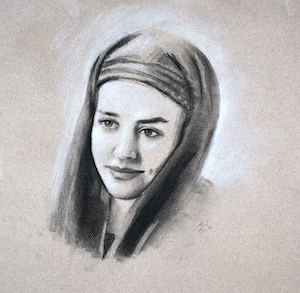
Delilah ©MicahHayns
My my my Delilah
Why why why Delilah
I could see, that girl was no good for me
But I was lost like a slave that no man could free

I’m sure we’ve all crooned along to this Tom Jones classic. It’s a fantastically dark song about a woman caught in adultery who is murdered by her man:

She stood there laughing
I felt the knife in my hand and she laughed no more

The story of Delilah in the book of Judges is also a pretty dark tale, but this time the woman doesn’t end up dead. Delilah is a classic example of the female archetype that we see in both ancient and modern myths and stories:

 The Femme Fatale

The Femme Fatale is portrayed as seductive, sexual, intelligent and beautiful. She normally eschews family life and is considered dangerous. She uses her ‘seductive’ skills to bring about the fall of a man previously thought to be invincible. We might think of Salome (‘bring me the head of John the Baptist’), Cleopatra or Carmen. Or more recent examples are Christine Keeler of the Profumo scandal, or Villanelle in Killing Eve.

Samson was Judge in Israel at a time when they were under the dominion of the Philistines. He was waging a private battle against them which culminated in a massive Israelite victory, and Samson was seen as the strongest and most powerful hero of his time.

That is until he fell in love.

I could see, that girl was no good for me
But I was lost like a slave that no man could free

It is likely that Delilah was a Philistine – she’s certainly portrayed as a foreigner. Unlike most other women she isn’t defined by her relationship to another man – we aren’t told who her father or brother is – she just appears, which adds to her intrigue and danger.

The Philistines offered her an enormous amount of money (11,000 pieces of silver) in return for information about Samson’s weakness so they could beat him in battle. It’s the riddle that he doesn’t want anyone to find out: the secret to his strength.

Coax him and find out what makes his strength so great, and how we may overpower him, so that we may bind him in order to subdue him

Judges 16.5

We don’t know if Delilah agreed to betray Samson out of loyalty to her people, hatred of Samson, or for the money.

My my my Delilah
Why why why Delilah

But she agreed. This led to her using all of her wily skills to find out her lover’s secret. She pleaded – ‘please tell me what makes your strength so great’; she pretended to be hurt – ‘you have mocked me and told me lies’; she was assertive – ‘until now you have mocked me.. tell me how you could be bound’.

Samson played along for a while.

‘if they bind me with seven fresh bowstrings that are not dried out,’
‘if they bind me with new ropes that have not been used’
‘if you weave the seven locks of my head with the web and make it tight’
… then I shall become weak

Judges 16. 7-14

All those cords – it’s all rather kinky! But each time he broke free.

She then appealed to the heart and used persistence (which, when applied to women, is often called nagging).

How can you say, ‘I love you’ when your heart is not with me?…Finally, after she had nagged him with her words day after day, and pestered him, he was tired to death. So he told her’

Judges 15. 16-17
Samson and Delilah, by Lucas Cranach the Elder (1472 – 1553)

Once she had the secret she passed this on to the Philistines who paid her. She soothed him to sleep on her lap and another man came in and cut all his hair off: his strength left him. He was then blinded, thrown into prison and humiliated by being forced to ‘entertain’ his guards (we don’t know exactly what that means).

My my my Delilah
Why why why Delilah
I could see, that girl was no good for me


His hair grew back and his strength returned and so in a final act of revenge Samson pulled the pillars down on them all, killing himself and his Philistine captors. We don’t know if Delilah was amongst them. I think it’s unlikely she stuck around once she’d got her cash. She was far too wily for that!

Forgive me Delilah I just couldn’t take any more

Reflection and Prayer

If you’re now humming the Tom Jones song Delilah you might want to have a listen to it: https://www.youtube.com/watch?v=S87jWwzvwd8

If you’d like to listen to something a little more erudite then Camille Saint-Saëns’ opera Samson and Delilah has a fantastic aria called Bacchanale which you can listen to here: https://www.youtube.com/watch?v=mdITMksls0Y

Samson and Delilah had very different ways of showing strength didn’t they?Samson’s strength seemed to lie in his physical appearance, and yet even this powerful man had a weakness. On the surface, Delilah seemed the weaker of the two, but she demonstrated great strength through her cunning and powers of persuasion. It can be difficult to gauge the strength of others, we often don’t even know our own abilities – some of us look strong on the outside and yet inside are weak and vulnerable; and others are perceived to be weak and yet in adversity turn out to have nerves of steel and an ability to withstand all kinds of trials.

Finally, be strong in the Lord and in the strength of his power...
Therefore take up the whole armour of God...fasten the belt of truth around your waist, and put on the breastplate of righteousness. As shoes for your feet put on whatever will make you ready to proclaim the gospel of peace. With all of these, take the shield of faith, with which you will be able to quench all the flaming arrows of the evil one. Take the helmet of salvation, and the sword of the Spirit, which is the word of God.
Pray in the Spirit at all times in every prayer and supplication. To that end keep alert and always persevere in supplication for all the saints.
Ephesians.6:10,15-18 

As we pray for strength in these troubling times, perhaps we might like to pray the prayer of St Patrick, whose Saint’s Day was earlier this week, for ourselves and for our loved ones. Maybe we can imagine ourselves putting on the armour of God as we do so.

Christ be with me, Christ within me,
Christ behind me, Christ before me,
Christ beside me, Christ to win me,
Christ to comfort and restore me.
Christ beneath me, Christ above me,
Christ in quiet, Christ in danger,
Christ in hearts of all who love me,
Christ in mouth of friend and stranger.
St Patrick’s Breastplate
The First Mrs Samson

Judges 14

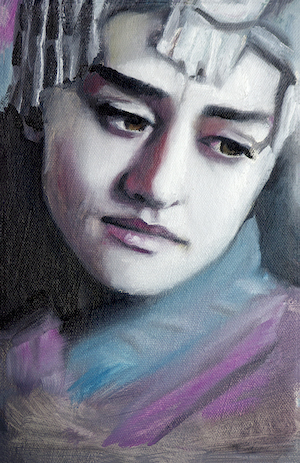
The First Mrs Samson ©MicahHayns

The next woman was meant to be Delilah but once I’d re-read the story of Samson I couldn’t miss out the first Mrs Samson. Most people have never heard of her and she isn’t given a name. She was a Philistine woman from Timnah. Samson, the hirsute Nazarite prophesied to be saviour of Israel from the Philistines, sees her from afar and decides that he wants her as his wife.

It isn’t the most romantic start to a relationship:

Get her for me [he tells his father]. She’s the right one for me.

Judges 14.3

It’s important to remember that at the time the Philistines were enemies of the Israelites and so this was an unusual match, and both families are wary of the union.

We all know tales of weddings that go awry with fights breaking out amongst guests or badly behaved relatives. A vicar friend of mine dropped the bridal ring down the church grate during the vows and they had to use a bridesmaid’s ring until after the service when they could get in a plumber!

However, I don’t think anyone will have had a worst engagement and wedding celebration that the poor first Mrs Samson.

It began badly. On the way to meet her for the first time Samson encountered a lion and ripped it apart with his bare hands. We can only hope he washed his hands before he saw her! He later found that the carcass has filled up with bees and scooped out some honey, ate it and took some as a gift for his folks.

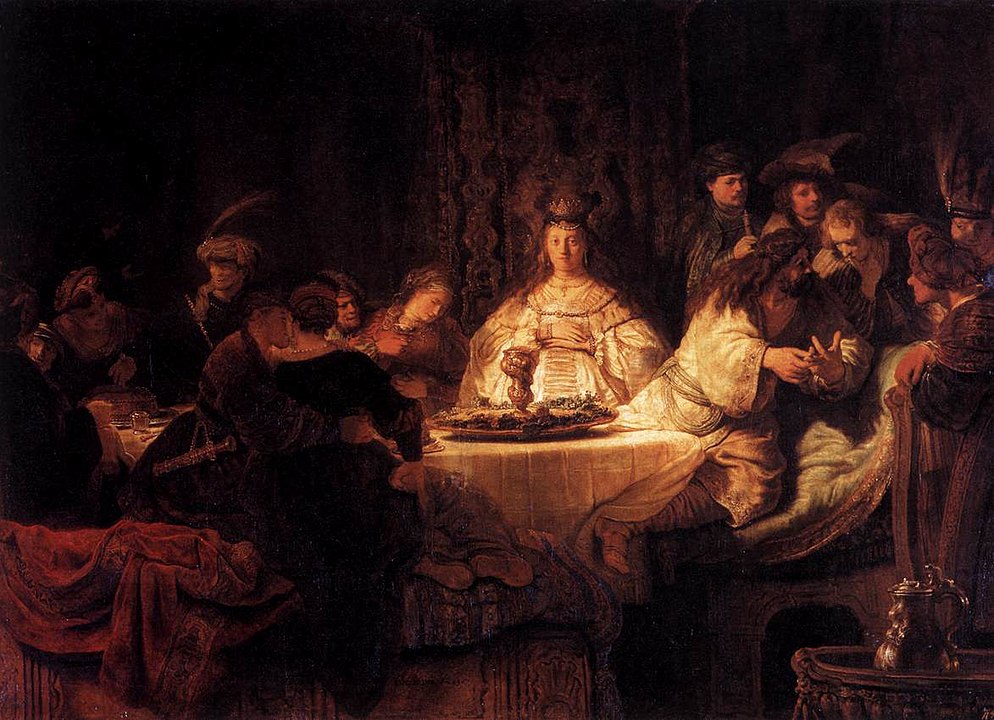
The Wedding of Samson by Rembrandt van Rijn, between 1625 and 1669

But things really began going wrong during the wedding reception, which in those days lasted several days. Many of the most serious arguments begin with something really quite small, and this was the case for the Samsons. 

It all began with a simple riddle.

We probably all know that Samson’s defining features are his long hair and his strength, but he was also keen on riddles and gambling. The Philistines provided Samson with 30 young men to be his companions during the festivities, and Samson decided to set them up with a riddle using fine linens as a wager.

Fun Fact: jars of Tate and Lyle’s Golden Syrup feature the lion and bees with the quote ‘out of the strong came forth sweetness’ from Judges

Out of the eater, something to eat; Out of the strong, something sweet.

Judges 14.14

This drove the young men mad. So mad in fact that they threatened to murder the bride and burn her family home if she didn’t tell them the answer!

She cried for the whole seven days of her ‘celebrations’ and eventually persuaded her new husband to give her the answer (Lion. Honey). Sadly, this didn’t end the matter. Samson was so furious that he’d lost the riddle that he paid back his debt by stealing the clothes off the backs of another group of men and then angrily went back to his family home abandoning his new bride.

She was then given in marriage to one of the companions, and one can image she might have been pretty relieved to be rid of the unpredictable Nazarene.

However the next year Samson went back to reclaim his bride and, finding she was already married, a cycle of violence began between the two clans which led to arguably the most bizarre act of revenge in the entire Bible.

Samson caught three hundred foxes (how on earth did he manage this?!), tied their tails together, set them alight and let them loose in the Philistines’ fields, where they ran around and burned down all their crops. It sounds like something out of a Roald Dahl novel!

They then retaliated by murdering the fated first Mrs Samson, her father, and many of her people.

And it all began with a riddle!

Prayer and Reflection

In the Church of England marriage service there is a promise that the congregation make to support the couple:

Will you, family and friends of x and x support and uphold them now and in the years to come’. 
ALL: We Will.

What can we do to support and uphold relationships that are struggling at this time?

A blessing often used at the end of wedding services – a prayer for us all perhaps.

God the Holy Trinity make you strong in faith and love,
defend you on every side, and guide you in truth and peace;
and the blessing of God almighty,
the Father, the Son, and the Holy Spirit,
be among you and remain with you always.
Amen.

Jael: Malicious in Tent

Judges 4 and 5

One of my favourite Netflix series for 2019 was the spy thriller and darkly comic ‘Killing Eve’. The star was Villanelle, the beautiful and almost child-like assassin who comes up with weird and macabre ways to bump off her victims.

If Deborah defied our expectations of women in the Bible by being a judge and prophet then this next woman shatters any illusions that women are the ‘gentler sex’.

Yesterday’s tale ended with Sisera, the commander of the King of Cannaan’s army, in retreat. He had oppressed the people of Israel for many years and Barak, with Deborah at his side had gone to fight for justice. Sisera began the battle with 900 chariots and ended with an enormous defeat. He fled on foot to the tent of the Bedouin family of Heber the Kenite, who he knew was a long-time ally of his.

Heber the Kenite may well have been an ally, but Sisera didn’t consider Heber’s wife. Jael, it seems, was not an ally – very far from it in fact:

 Jael saw him coming, so she went out to meet him and said, “Sir, come into my tent. Come in. Don’t be afraid.”

Judges 4.18 (ERV)
Jael and Sisera, ca 1690, Lucas Jordán, Luca Jordanus, Luca Fa Presto, 1632-1705

She was generous and hospitable, gave him some milk and a warm bed and tucked him in for the night. After a full day’s battle Sisera must have been exhausted and so he soon fell sound asleep.

She went softly to him and drove the peg into his temple, until it went down into the ground – and he died.

Judges 4.21

Bedouin people lived in tents and so Jael must have been a good hand with a peg and a mallet! She uses what she knows. Villanelle couldn’t have done it better herself!

Jael even gets a mention in Deborah’s triumphant song which isn’t the most romantic of ditties!

Most blessed women be Jael,
The wife of Heber the Kenite,
Of tent dwelling women be blessed….
She put her hand to the tent peg and her right hand to the work-men’s mallet;
She struck Sisera a blow, she crushed his head,
She shattered and pierced his temple.
He sank, he fell, he lay still at her feet;
At her feet he sank, he fell,
Where he sank, there he fell dead.

Judges 5:24-27

Nice!

It’s an odd tale, and brings up moral issues of whether violence such as this can ever be justified or claimed to be part of God’s will. It’s hard from our perspective to judge the decisions of those in conflicts so many centuries ago. Do the ends justify the means? It’s very hard to tell, but what we are told is the actions of Deborah and Jael led to peace:

there was peace in the land for forty years’

Judges 5.31

That is, until the people rebelled again and war broke out once more (Judges 6).

Reflection and Prayer

Put away from you all bitterness and wrath and anger and wrangling and slander, together with all malice, and be kind to one another, tenderhearted, forgiving one another, as God in Christ has forgiven you.
Ephesians 4.31-32

Aggression and violence is more often considered to be a male issue, and men are certainly more likely to be physically violent than women. However research shows that women are more likely to use indirect aggression, such as spreading false rumours, excluding others from a social group, making insinuations without direct accusation, and criticising others’ appearance or personality (1).  Jael’s actions are shocking because of the physical nature of her actions, but perhaps we can all recognise ways in which we can be aggressive at times, and when our anger can result in harm to others.

I love this prayer by Harry Williams as it’s so real and honest:

O God, I am hellishly angry; I think so and so is a swine; I am tortured by worry about this or that; I am pretty certain things can’t get worse; this or that has left me feeling terribly depressed. But nonetheless here I am like this, feeling both bloody and bloody minded, and I’m going to stay here for ten minutes. You are most unlikely to give me anything. I know that. But I am going to stay here for ten minutes nonetheless. Amen

(1) Frontiers – Behavioural Neuroscience, 02 May 2018 – Aggression in Women: Behaviour, Brain and Hormones https://doi.org/10.3389/fnbeh.2018.00081

Deborah: the warrior judge

Deborah ©MicahHayns

Judges 4 and 5

One of the memorable moments of 2019 in the UK was of Judge Lady Brenda Hale, President of the Supreme Court, declaring Prime Minister Boris Johnson’s prorogation of parliament unlawful. She was cool, calm, and resplendent in her spider brooch!

Lady Brenda Hale

She is a powerful advocate for a more balanced gender representation on the UK’s highest court, and yet she objects to the idea of positive discrimination:

“no one wants to feel they have got the job in any way other than on their own merits” [1]

Deborah Beneath the Palm Tree, c. 1896-1902, by James Jacques Joseph Tissot (French, 1836-1902) or followers

It is unlikely that there was any semblance of positive discrimination going on in (around) 12th Century BC to enable Deborah to become a judge, and so we must assume that her position came about due to her own merits.

At that time Deborah, a prophetess, wife of Lappidoth, was judging Israel. She used to sit under the palm of Deborah between Ramah and Bethel in the hill country of Ephraim; and the Israelites came up to her for judgment

Judges 4.4-5

The book of Judges chronicles a cycle of rebellion and deliverance which follows this basic pattern: the people are unfaithful to God (Yahweh) and He delivers them into the hands of their enemies; the people repent and cry out for mercy, which He sends in the form of a leader or champion (a “judge”); the judge delivers them from oppression and they prosper; then after a while they fall back into unfaithfulness and the cycle is repeated.

The story of Deborah follows this pattern but is unique in the Hebrew bible as she is the only female judge.

A battle had broken out between the Israelites (with their general Barak) and Sisera, the general of Jabin’s army. Deborah summoned Barak and commanded him to go to Mount Tabor with 10,000 soldiers from the tribes of Naphatili and Zebulun. However, Barak refuses to go without her by his side.

If you will go with me, I will go; but if you will not go with me, I will not go.

Judges 4.8

She goes with him but not before warning him that if they won the battle then he won’t receive the glory for it as it would always be known that, ‘the Lord will sell Sisera into the hand of a woman’. (Judges 4. 9)

The battle is won and Sisera and his army of 900 chariots retreat with Sisera running away on foot into Jael’s tent (more on her and the fate of Sisera in tomorrow’s blog!).

The ‘Song of Deborah’ in Judges 5 is perhaps the oldest example of Hebrew poetry and is a victory hymn that retells the story and celebrates a military victory brought about by two women.

‘The peasantry prospered in Israel,
They grew fat on plunder,
Because you arose, Deborah,
Arose as a mother in Israel….
Awake, awake, Deborah!
Awake, awake, utter a song!’   

Judges 5. 7, 12

Reflection and Prayer

Here is my servant, whom I have chosen,
    my beloved, with whom my soul is well pleased.
I will put my Spirit upon him,
    and he will proclaim justice to the Gentiles.
Matthew 12.18

Let us remember all those who work in judicial systems around the world: for the police, lawyers, barristers, judges and for all those who create our laws and work to ensure justice and peace. We particularly remember parts of the world where these systems have broken down, where justice isn’t administered with equality, and where the poor continue to suffer because of this.

O God of righteousness, lead us we pray, in the ways of justice and peace: Inspire us to break down all oppression and wrong, to gain for everyone their due reward, and from everyone their due service, that each may live for all, and all may care for each, in the name of Jesus Christ our Lord. Amen
A Prayer of Archbishop William Temple, 1881-1944)

[1] From Wikipedia,
 Bowcott, Owen (1 January 2019). “White and male UK judiciary ‘from another planet’, says Lady Hale”. The Guardian. ISSN 0261-3077Archived from the original on 1 January 2019. Retrieved 1 January 2019.

Ruth: faithful friendship

The Book of Ruth

As a young Christian I was transfixed by the story of Jackie Pullinger. In 1966, when she was in her early twenties, she was called by God to leave her home and family in London and she set off on a boat with a one way ticket to Hong Kong without any idea of what she would do when she got there. She then lived and worked in the infamous Kowloon walled city amongst drug users and triad gangs and developed a ministry which continues to this day. She was one of the first female role models I can remember, and what attracted me was her bravery and willingness to go where she believed God was calling her, even though that came with huge risks to her own life. In her book, ‘Chasing the Dragon’ she writes:

‘God wants us to have soft hearts and hard feet. The trouble with so many of us is that we have hard hearts and soft feet.’

I think we can be sure that Ruth had both a soft heart and hard feet. She was a non-Jewish women from Moab whose Jewish husband had died leaving her with a bitterly grieving mother-in-law, Naomi and a sister-in-law, Orpah, whose husband had also died. When her mother-in-law chose to return to her homeland, Ruth made the brave decision to move away from all she knew to go with her. She was determined and in deciding to bind herself to Naomi she also made a commitment to Naomi’s community, and to God. Her prayer of conversion is beautiful:

‘Where you go, I will go; where you lodge, I will lodge; your people shall be my people, and your God my God. Where you die, I will die – there will I be buried.

Ruth 1.16-17

What a powerful declaration of loving commitment from one person to another.

Ruth and Naomi’s journey from Moab to Bethlehem

Ruth chose to accompany Naomi and was willing to step out into the unknown, into a life that was unpredictable and precarious, to go to a foreign land where she would be vulnerable and unprotected. Her motivations for doing this are unclear. Did she stay with Naomi because of her deep love and affection for this older and in many ways bitter woman? Or did Ruth have a sense of God’s call on her life that meant that she knew deep down in her soul that she should leave Moab.

Whatever her reason, Ruth’s brave decision led her to Bethlehem where, whilst in the fields gathering food, she meets Boaz, a distant relative of Naomi’s. Boaz protects her from harm and Naomi encourages their blossoming romance and even gives her a few tips as to how to secure his affection: ‘Now wash and anoint yourself, and put on your best clothes and go down to the threshing floor’ (Ruth 3.3). Ruth and Boaz eventually marry, her future is secured, and they have a child, Obed, who will one day be the Grandfather of King David.

Ruth becomes one of the small number of  women, alongside Tamar, Rahab and Bathsheba to be named in the genealogy of Jesus.

Reflection

Not many people are called by God to leave everything they’ve ever known in the way Jackie Pullinger or Ruth were, but we may be able to identify a time when we have been asked to take a step of faith. When I first felt God was calling me to be a priest, knew that this would mean we would have to leave our comfortable home in an Oxfordshire village, a decision that was harder to make because we had three young boys at the time. It’s tempting at times to wonder what might have been if we had taken other paths in life, but Jesus’ call to his disciples is always to follow, to look forward, to put the hand to the plough and not look back. (Luke 9.62).

Loving God,
We thank you for the joy and comfort of friendships:
For those who have been there for us through the ups and downs of life;
For those who have walked beside us even when we’ve not been great company;
For those who have given us advice and guidance;
and for those friends who are no longer with us and who we long to meet again.
Amen

Rahab: harlot, heroine or both?

Joshua 2, 6

Depending on the version in the Bible you read, our next woman is described as either a harlot or a  prostitute (although some Rabbinic texts describe her as an Innkeeper). Yet despite her likely profession, and even though she wasn’t an Israelite, she is one of the few women named in the genealogy of Jesus at the beginning of Matthew’s Gospel.

Abraham was the father of Isaac….and Salmon the father of Boaz by Rahab, …and Jesse the father of King David…and Jacob the father of Joseph the husband of Mary, of whom Jesus was born, who is called the Messiah

Matthew 1

So, who was she?

Some background. Moses had died and his assistant Joshua had taken over the leadership of the Israelites, who were still in exile in the wilderness. God had promised them that they would be led into the Promised Land and they had camped in the Jordan valley opposite the City of Jericho in hope that this was indeed the land they had waited for for so long. But first they needed to check out the city and so Joshua sent some spies on a reconnaissance mission.

Rahab was a citizen of Jericho and she lived literally on the edges of the City:

..her house was on the outer side of the city wall and she resided within the wall itself.

Joshua 2.15

Joshua’s spies went to stay at Rahab’s house ‘and spent the night there’. We don’t hear whether they were doing so because she had an Inn or because of her other profession… we can only imagine! The King of Jericho found out about them and ordered that they be brought to him. Rahab was cunning though. She had heard about their God and also realised these men might be useful to her and her family. And so she hid them in her room, lied to the King’s men by sending them in the wrong direction, and then hatched a plan.

Before the men are allowed to sleep, Rahab went up to the roof to  speak to them:

I know that the Lord has given you the land…. we have heard how the Lord dried up the water of the Red Sea… The Lord your God is indeed God in heaven above and earth below.

Joshua 2.8
Rahab Helping the Two Israelite Spies., Frederick Richard Pickersgill, illustrator of the 1897 Bible Pictures and What They Teach Us by Charles Foster

She defied the orders of the King (rather like Shiprah and Puah, the midwives), and made a pact with the spies. She would help them escape and in return they were to ensure that all her family would be unharmed when they eventually come to take the land. The Israelites would know them because of the red cords tied on their windows. The pact is made and the spies escape.

A little while later the City of Jericho was surrounded by the Israelites who marched round the city walls for seven days blowing their trumpets and processing the Arc of the Covenant.  They eventually took the city killing all those who lived there, but Rahab and all her family were spared and they become incorporated into the Jewish people.

This blog is not the place to defend or attack the actions of the ancient people of Israel in the time of Joshua, though it’s hard imagine that the God of love and justice ever commanded the destruction of a city and its people.

Instead, let us focus on this remarkable woman who comes to be named in the New Testament as a hero of faith (Hebrews 11) and as an example of faith in action (Book of James ). She used her position, her (perhaps intimate) knowledge of people both within and outside of her culture, her home, persuasive powers, charm and wily intellect, to protect the Israelite spies and to secure the lives of her entire family, a family that would in time include Jesus of Nazareth. It is an impressive feat.

Rahab: harlot or heroine? Perhaps she was both.

Reflection and Prayer

Which of the two did the will of his father?” They said, “The first.” Jesus said to them, “Truly I tell you, the tax collectors and the prostitutes are going into the kingdom of God ahead of you.
Matthew 21.31 (from the parable of the two sons in the vineyard)

Jesus was criticised by the religious leaders for spending time with those they considered to be ‘sinners’ and ‘unclean’, the prostitutes, tax collectors and lepers. Yet they were often the first to recognise that He was the Saviour, the one who would bring healing and wholeness. Rahab’s story reminds us that we too often make judgements about people because of their lifestyle, profession or values. She also reminds us that God often chooses the most unlikely people to bring about His purposes, even women like Rabah, and you and me!

Many of us are fearful for families and friends at this time of Covid 19. Let us pray for God’s protection, especially for those who are sick, and those who care for them. Perhaps we might think about what we can do to support someone who is fearful.

Father, give to us, and to all your people,
in times of anxiety, serenity;
in times of hardship, courage;
in times of uncertainty, patience;
and at all times, a quiet trust in your wisdom, protection and love; through Jesus Christ our Lord. Amen
A Prayer from New Every Morning

Tamar: ruin and righteousness

Genesis 38

Written by Alannah Jeune, Doctoral student in History, University of Canterbury, New Zealand

I was ten when prostitution became legal in New Zealand, my home country. I remember the debates and news coverage surrounding the decision and the sudden increased visibility of street prostitution in my part of the city. My understanding of prostitution was very limited – largely derived from biblical passages and stories, and I think I had assumed it was something that only happened in ‘olden times’.

I can only faintly recall hearing the story of Tamar in Church, and the little I did remember was that she was characterised as a prostitute. But Tamar is far from the deceptive temptress that this label implied – her story is that of a remarkable woman who was to become one of only four women named in Jesus’s ancestral line.

Tamar’s story falls in the middle of the Genesis account of Joseph and his brothers. Chapter 38 begins with Judah and his three sons Er, Onan and Shelah. Tamar is married first to Er:

But Er, Judah’s firstborn, was wicked in the sight of the Lord, and the Lord put him to death.

Genesis 38:7

Judah then instructs his second son, Onan to marry Tamar according to levirate custom. This custom stated that any children born to the couple would be legally Er’s and inherit on his behalf. Therefore, Onan ensured that Tamar would not become pregnant, with the result that he too was put to death by the Lord.

Judah, probably a little nervous about Tamar by this point, ordered her to return to her father’s house telling her to wait there until Shelah was old enough to marry. Tamar does this and lives as a young widow in her father’s household, but Judah does not send for her once Shelah is grown.

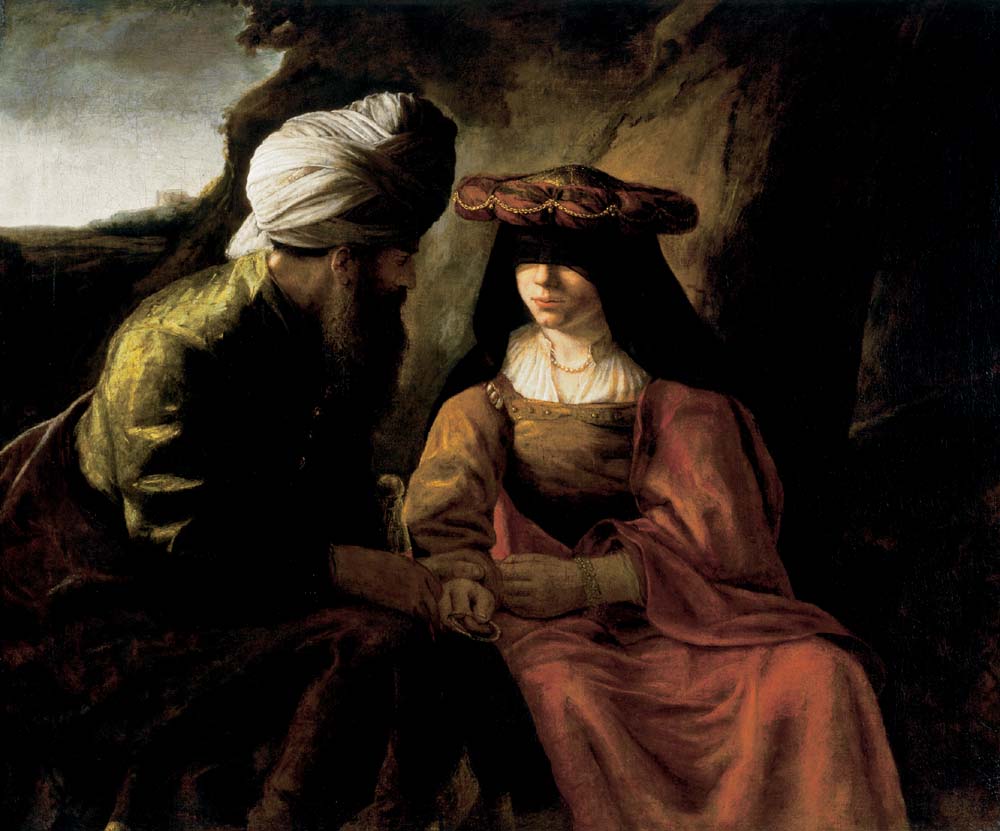
Judah and Tamar, School of Rembrandt, 1650-1660

By this point Judah’s own wife has died, and when Tamar hears he is going on a journey to Timnah, she decides to take control of the situation. She dresses herself as a prostitute and sits at the entrance of Enaim, a town on the way to Timnah. Judah propositions her, sleeps with her, and leaves his signet and staff as a pledge till he can send a young kid to her as payment. However, Judah is unable to find the prostitute when he returns to recover his identifying belongings.

Meanwhile, Tamar has become pregnant by Judah and this is soon noticed. Judah is informed and he orders that she be brought out and burned. Tamar shows Judah his own signet and staff and tells him she is pregnant by the owner of these items.

Then Judah acknowledged them and said, ‘she is more in the right than I, since I did not give her to my son Shelah.’

Genesis 38:26

The tale concludes with the birth of Tamar’s twins: Perez and Zerah.

Tamar’s story is messy. She is passed as property from one man to another, from her father via Judah to Er then to Onan, then back to her father. At no point does Tamar have any choice or control. Her future is bleak – as a childless widow she has no societal standing, nor the security of someone to care for her in her old age. Hers is a situation in which women across the generations have found themselves caught – in a patriarchal society, the worst thing to be is a woman alone.

While emotional details are scant, Tamar’s story reveals a lot about her relationships with the men who control her life. Tamar’s first husband is put to death by the Lord for wickedness… it is no stretch to assume that this was not the happiest of marriages for Tamar, and that she may have suffered at his hands. But being married to a wicked man and all the trials that comes with such a union, was preferable to no marriage at all. And her father-in-law not only cheats her out of a marriage with Shelah, but seems to have been a man of questionable morals – Tamar chose the disguise of a prostitute implying she knew that Judah would be likely to use such services.

This is not a family anyone would choose to join willingly, but Tamar has few options so takes control of her own future through the only means she has. She has nothing to barter with but her own body, and her capacity to bear children, so this is the way provides herself with some security.

And yet this dysfunctional family is one that God has chosen to bless. Matthew’s gospel recounts Jesus’ genealogy and there in verse 3 is Tamar:

and Judah the father of Perez and Zerah by Tamar, and Perez the father of Hezron, and Hezron thefather of Aram

Matthew 1:3

Tamar could not have known that through her son Perez, she would be an antecedent of Jesus. Her actions were designed only to ensure her own survival in a deeply patriarchal world – with few options open to her, she makes a difficult choice and tries to gain some control over her life. She changes her narrative  from that of a desperate victim of circumstance to a woman who is praised for her righteousness by her family.

Tamar’s story is difficult, but that is why it is powerful. The Bible does not edit out the difficult parts, just as we cannot edit out the painful, messy and difficult parts of our lives, no matter how much we might want to. Because God is there in the difficulties, in the mess. He works through imperfect and flawed people like Tamar and her family, just as he works in our lives in both the bad times as well as the good.

It is easy to feel God with us and working through us when things are going well – when we are succeeding, loving our neighbours and full of hope. But Tamar reminds us that He is also with us in the depths of our despair, in the lowest moments of our lives or those times when we feel we are falling short.

Prayer

Tamar’s story does not belong in ‘olden times’, she embodies the female experience of so many women around the world who live under oppressive political or social systems. But she also embodies that hope for us all – that even in the worst of times, God is with us and working through us.

A Prayer for International Women’s Day (which is tomorrow)

God of all, God of hope,
We pray for women and girls today.
That they will be all they can be.
Give us courage to speak and work
For equality and justice
Until the earth is filled
With righteousness and love.
Amen.

Potiphar’s Wife: the seductress

Genesis 39

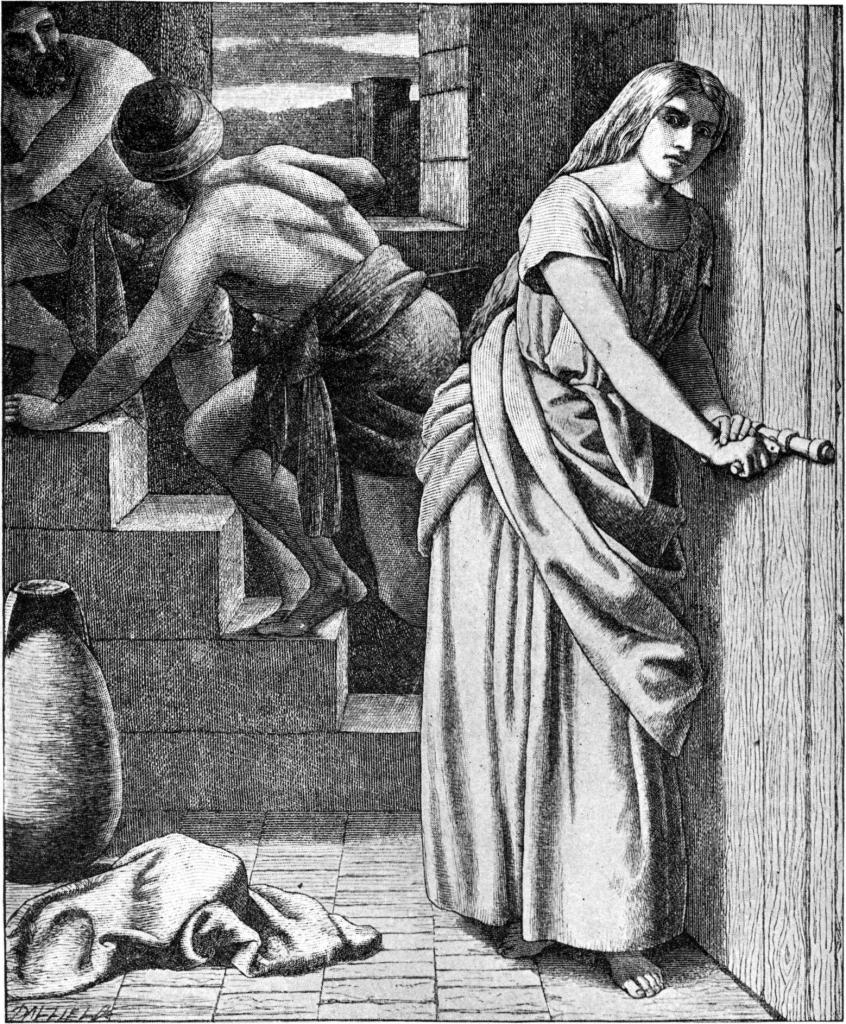
Potiphar’s Wife ©MicahHayns
Potiphar was cool and so fine
But his wife would never toe the line
It's all there in chapter 39 of Genesis
She was beautiful but evil
Saw a lot of men against his will
(from Joseph the Musical)

One of the things you quickly notice when reading about the women in scripture is often they are often only allowed one characteristic (jealous sister, childless woman, whore), whilst the men are able to be complex and multi-faceted.

Take the story in Genesis about Joseph – he’s a good example. Joseph, sold by his jealous and deceitful brothers into slavery in Egypt, had been the favoured and much beloved son of Jacob and Rachel. He was a dreamer and rather vain (he loved that coat!), but was also resourceful and cunning, fearful and faithful.

Potiphar’s Wife, on the other hand, was only one thing:

A Seductress.

We don’t find out anything much about her life and we don’t even get to know her name.  We don’t know whether she had children, whether she was a kind or demanding mistress, or what Potiphar, an Officer of the King of Egypt (Pharaoh), was like as a husband.

It’s likely that she lived in luxury. They had servants and a large household, within which Joseph had worked his way up the ranks to become the overseer, like a young Mr Carson (from Downton Abbey).

Now Joseph was handsome and good-looking. And after a time his master’s wife cast her eyes on Joseph

Genesis 39.6-7

Mrs Potiphar was clearly very taken by this handsome young Hebrew man. She began to pay him ‘special attention’ and then one day propositioned him:

Lie with me

Genesis 39.7

The story is told as if this attraction was entirely one way but this may well not have been the case. It has all the hallmarks of a Downton Abbey upstairs-downstairs affair. She was certainly infatuated with Joseph and he may well have been attracted by his mistress, but he would have known that if he slept with her he risked his job, his place in the household, and even his life: adultery was punishable by death. He was also faithful to God:

How then could I do this great wickedness, and sin against God?

Genesis 39.9

So, Joseph resisted but Mrs P persisted, until one day they found themselves alone.  She made a pass at him and even got some of his clothes off, but Joseph ran out of the house leaving her holding his ‘garment’.

Joseph wanted to resist her till
One day she proved too eager
Joseph cried in vain
"Please stop, I don't believe in free love"
1910 comic caricature of Joseph and Potiphar’s wife by Joseph Kuhn-Régnier,
Notice the chilled wine bottle and glasses on the small table at the left!

She was furious. How dare he, a slave, spurn her. She turned against him, and in her fury accused him of attacking her: she had his coat as proof. Joseph was thrown into prison.

Poor, poor Joseph, what'cha gonna do?
Things look bad for you, hey, what'cha gonna do?

Once in Prison Joseph began to interpret dreams and this led to him being introduced to Pharaoh himself, and becoming the Egyptian King’s right hand man. We hear nothing more of Potiphar’s wife.

Her role as ‘the seductress’ has been fulfilled and she’s no longer necessary for the rest of the story.

Reflection and Prayer

I pray, O Lord, that I will not fall into temptation; for the spirit is willing, but the flesh is weak
Matthew 26.41 (Good News Version, adapted)

Many of the women in the Hebrew Scriptures are portrayed as innocent victims and so it’s surprising and rather refreshing to come across a woman like Potiphar’s wife, a powerful protagonist and an instigator, and who desired love rather than children. Perhaps today we can pray for all those whose love is unrequited, for those who are tempted into adultery, and for those who continue to resist.

O God our Father, hear me, who am trembling in this darkness, and stretch forth thy hand unto me; hold forth thy light before me; recall me from my wanderings; and thou be my guide, may I be restored to myself and to thee
Augustine, 354-430

Dinah: The Voiceless One

Genesis 34

We have been lost to each other for so long. My name means nothing to you. My memory is dust. This is not your fault, or mine. The chain connecting mother to daughter was broken and the word passed to the keeping of men, who had no way of knowing.

From The Red Tent by Anita Diamant, page 1

The Red Tent is a wonderful novel by Anita Diamant which imagines Dinah’s story rather differently to the text we are given in Genesis 34.

There is a problem with the story of Dinah. We hear about an horrific crime committed against her, but the difficulty is that as everything is told from the point of view of either the accused (Shechem), or the accusers (her brothers), it’s hard to know the truth of the matter. She doesn’t get to say a word.

It’s a gruesome tale and needs a trigger warning as it contains a rape.

Dinah was the only daughter of Jacob and Leah and so we know that she had six brothers and six half-brothers. The story we are told in Genesis 34 is that Dinah went to visit the local women and whilst there she encountered the son of the local ruler called Shechem.

[he] saw her, he took her and raped her

Genesis 34. 2

This is a despicable crime and we deplore any violence towards women of this kind, whether happening now or thousands of years ago in the ancient world.

Shechem then ‘falls in love’ with Dinah, ‘speaks tenderly to her’, and asks his father Hamor if he can marry her. At that time it was unheard for women from the Abrahamic tribes to intermarry with local people, and so this was a bold request.

Hamor went to speak with Jacob to ask for his daughter’s hand in marriage for his son but at this point her brothers turned up, hear what had happened and fly into a rage. 

They were filled with grief and fury, because Shechem had done a disgraceful thing in Israel by lying with Jacob’s daughter – a thing that should not be done.

Genesis 34. 7

Shechem and Hamor pleaded with Jacob and offered a dowry for Dinah’s hand in marriage. But the brothers refused. This time their refusal was because Shechem was ‘uncircumcised’ and therefore considered unclean. They claimed that the marriage would be ‘a disgrace to us’.

They hatched a plan. They tell Shechem that the marriage (and other marriages between the Israelites and the locals) can go ahead only if all the men in their community are circumcised.

And Shechem agrees to this, and in fact does so with gusto:

the young man.. lost no time in doing what they said, because he was delighted with Jacob’s daughter.

Genesis 24. 19

The circumcision of the Shechemites. Engraving by J. Muller 1571-1628. Credit: Wellcome Collection

And all the men get circumcised. Imagine what that must have been like. Imagine the groans of pain emanating from every household as all the men nurse their tender nether regions!

Three days later Simeon and Levi, two of the brothers, take matters into their own hands. Whilst all the Canaanite men were in pain they went into the town and attacked them, killing them all and looting from their homes. It’s another terrible crime.

 Shechem and Hamor are murdered, and Dinah is ‘rescued’.

What is so brilliant about Anita Diamond’s book ‘The Red Tent’ is that she imagines this story differently. She imagines that Dinah falls in love with Shechem, sleeps with him and then hopes to marry him. Dinah pleads with her father that the marriage might go ahead, and encourages Shechem and the Canaanites to be circumcised as she shares her faith. Her brothers are so blinded by their rage, pride and assumptions about their sister – she couldn’t possibly have willingly have had sex with an outsider, it therefore must have been forced – that they don’t listen to her and carry out a terrible atrocity against her will.

Was Dinah a woman who was raped and held against her will? Or was she a woman who loved someone who her family disapproved of and paid a terrible price?

We can never know for sure. Without the voice of the woman in the story being heard we are only getting half the truth, which isn’t truth at all.

It's a wonder that any mother ever called a daughter Dinah again. But some did. Maybe you guessed that there was more to me than the voiceless cipher in the text. Maybe you heard it in the music of my name: the first vowel high and clear, as when a mother calls to her child at dusk; the second sound soft, for whispering secrets on pillows. Dee-nah.
The Red Tent, Anita Diamant

Refection and Prayer

This is a difficult passage to reflect on, but sometimes we need to focus prayerfully on the darkness in our world. We remember all women (and men) who have suffered from sexual violence and rape. We also remember women who are prevented from marrying the people they love by their family members, and recall that ‘honour killings’ are sadly still going on every day in our world. And we remember all those whose voices aren’t heard and whose stories will never be told.

Let us pray for light in the darkness.

Eternal Light, shine into our hearts,
Eternal Goodness, deliver us from evil,
Eternal Power, be our support,
Eternal Wisdom, scatter the darkness of our ignorance,
Eternal Pity, have mercy upon us;
that with all our heart and mind and soul and strength
we may seek thy face and be brought by thine infinite mercy
to thy holy presence;  through Jesus Christ our Lord.  Amen

A prayer of Alciun of York, 735-804

Leah: The Other Sister

Genesis 29. 15-35, 30.1-20

In the previous post we heard about Rachel, the wife who Jacob loved the most but who never seemed to find contentment. Now we hear of her sister Leah, the wife Jacob never really loved but who was blessed with a huge number of sons.

Me and my sister, Milly (plus Layla and Koru)

Much of my childhood was spent in arguments with my sister. I was a couple of years older and was deeply jealous of her. Apparently when I was around three I used to sleep outside my parents’ bedroom door so I was first to be seen in the morning! I don’t look back on those years with much pride as I was pretty vile. I even cut her beautiful red hair and made her promise not to tell anyone! One of the greatest blessings in my life is that she forgave me and we’re now the best of friends.

This certainly wouldn’t be the case if we were married to the same man!!

Leah knew from the beginning of her marriage to Jacob that she wasn’t the one that Jacob loved most. But she did have lots of boys (something we share as Milly and I have 5 boys between us), and boys in those days were a sign of God’s blessing.

When the Lord saw that Leah was unloved, he opened her womb

Genesis 29.31

She had four sons in quick succession (Rueben, Simeon, Levi and Judah)

Surely now my husband will love me

Genesis 29. 32

But sadly for Leah this doesn’t seem to be the case and Jacob continued to prefer her sister, even though she had even more sons via her handmaid Zilpah (Gad and Asher).

Although neither Rachel nor Leah had much power over who they were to marry, it seems that they did have agency within their relationship. They were able to name their sons for example. And it seems that they were also able to control which of them Jacob slept with. Here is an example:

Illustration of Mandragora officinalis (Mandrake)
Fun Fact: In the Odyssey, the Greek enchantress Circe used Mandragora in a brew to turn Odysseus’ men into swine!
Fun Fact 2: Mandrakes are used in Harry Potter (Herbology) as a powerful restorative.

After Leah has stopped having children her eldest son Rueben finds some mandrake plants, a known ancient aphrodisiac said to possess natural stimulants. When you see the plants it’s not surprising why they became known as an ancient form of viagra!

Leah gave Rachel the plants in return for a night in Jacob’s bed.

When Jacob came in from the field in the evening Leah went out to meet him, and said, “you must come in to me; for I have hired you with my son’s mandrakes.” So Jacob lay with her that night

Genesis 30.16

The result of this led to her fifth son, Isaachar. She went on to have two more children, Zebulun and last but not least a daughter… Dinah (who we will hear about tomorrow).

Leah may not have been Jacob’s most beloved wife, but she seemed to have been more contented that her sister, and she was blessed with a quiver full of sons who then went on to be the foundation tribes of Israel.

We don’t hear if the sisters were ever fully reconciled but I like to think that their passionate jealousy and fierce rivalry ran alongside a deep love for one another. They were in an impossible situation and one that would have tested even the most dedicated siblings.

Jacob may not have favoured her in life, but in death she was honoured and buried alongside Abraham and Sarah in a place where Jacob would be eventually laid to rest.[1] United in death if not in life.  


[1] Genesis 49.31 – ‘There Abraham and his wife Sarah were buried; their Isaac and his wife Rebekah were buried; and there I buried Leah.’

Prayer

Get rid of all bitterness, rage and anger.... be kind and compassionate to one another, forgiving each other, just as in Christ God forgave you
Ephesians 4.32

As we’ve reflected over the last couple of days on the complicated sibling relationship between Rachel and Leah perhaps we might think about our own relationship with a sibling or close family member. What do we appreciate about them? What is difficult?

Perhaps we can think of three things about them that we are thankful for. We may even like to send them a message to let them know. If your relationship is complex and damaged then perhaps you might like to pray for healing and forgiveness.

Be gracious to all that are near and dear to us, and keep us all in thy fear and love. Guide us, good Lord, and govern us by the same Spirit, that we may be so united to thee here as not to be divided when thou art pleased to call us hence, but may together enter into thy glory,
through Jesus Christ. Amen

A prayer of John Wesley, 1703-91