Queen Vashti: #MeToo

Queen Vashti ©MicahHayns

Esther 1

In October 2017 American actress Alyssa Milano posted on Twitter: “If all the women who have been sexually harassed or assaulted wrote #MeToo as a status, we might give people a sense of the magnitude of the problem”. This was in response to allegations relating to renowned film producer Harvey Weinstein, who was recently sentenced to 23 years in prison. The #MeToo became a global movement in a matter of days opening up an important conversation about women’s experiences, particularly in industries such as film and theatre.

The story of Queen Vashti is perhaps one of the earliest accounts of a woman standing up to a powerful man.

Vashti was the Queen of Persia, the first wife of powerful King Ahasuerus (Xerxes 1), and her story is told within the Book of Esther (which is named after another fabulous woman who we will look at tomorrow), during the days of Jewish captivity in Babylon.

For the Persian rulers it was a time of peace and prosperity which meant that there was plenty of time for the king to display the glory of his kingdom. King Ahasuerus was certainly a dedicated host. One of his parties, which gathered together officials, nobles and governors from across the kingdom, lasted nearly six months!

Vashti’s story begins with one such banquet, one that is so lavish that there were couches made from gold and silver, drinks were served in golden goblets, and the wine was so plentiful that:

by the king’s command each guest was allowed to drink with no restrictions, for the king instructed all the wine stewards to serve each man what he wished.

Esther 1.8

It was a party that Weinstein and his Hollywood crowd would have approved of!

At that time the men and women of the royal palace lived largely separate lives, and Queen Vashti had her own quarters. Whilst the king celebrated she hosted her own banquet for the women of the kingdom.

After seven days of revelry, and when the king was ‘in high spirits from wine’ he sent his seven eunuchs to bring Queen Vashti to the men’s banquet. He demanded she be brought to their party and displayed:

wearing the royal crown, in order to show the peoples and the officials her beauty.

Esther 1.11

Some theologians argue that this meant the king demanded she should wear nothing at all but her crown! It’s not clear if this is the case, but Queen Vashti was clearly distressed by the command.

She says no!

Queen Vashti refused to come at the king’s command.

Esther 1.12

What a risk to take! The king was furious and ‘anger burned within him’. He had wanted to impress his party by showing how beautiful his wife was; and instead she had humiliated him publicly.

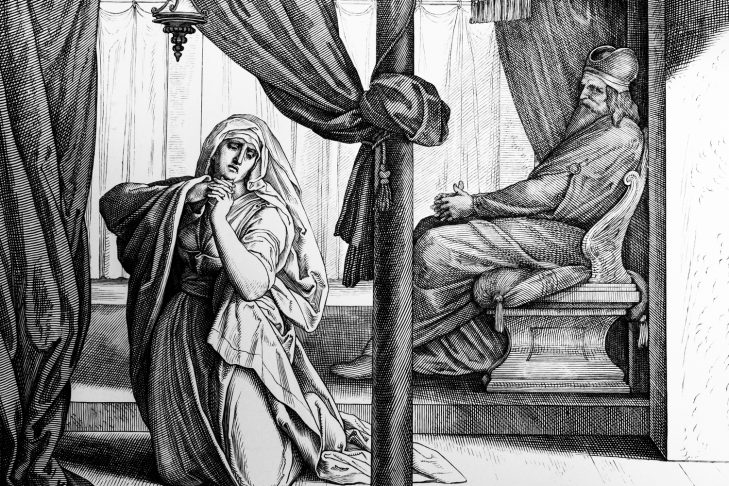
Vashti Deposed by Ernest Normand, 1859

He wanted revenge. And so, like Henry VIII, Weinstein and countless other despots since, he worked out a way to bring her down. He consulted his sages and lawyers and they found a by-law which said he could depose her as Queen because she has been disobedient to the king.

The nobles wanted to punish her to ensure the obedience of all their wives:

For this deed of the queen will be made known to all women, causing them to look with contempt on their husbands…. there will be no end of contempt and wrath.

Esther 1.17,18

The Queen was deposed and a letter was sent throughout the whole land to every province, in every local language, with the decree that:

every man should be master in his own house.

Esther 1.22

We hear no more of Vashti and she is replaced by a young Jewish woman, Esther, who we will hear about tomorrow.

Reflection and Prayer

One of the things I’ve enjoyed about this series is discovering how the stories of the women from Old Testament are at the same time ancient but also very modern and relevant to us today.

Queen Vashti said ‘no’ to the king at considerable cost to own life. We don’t get to hear why she did this. Some have argued that it was because of modesty (Midrash), others that she was unhappy with her appearance that day (Babylonian Talmud), and still others that she was a proto-feminist fighting for her integrity. Harriet Beecher Stowe (1878) says that her action was the ‘first stand for women’s rights’ (1).

Whatever the reason, she was certainly bold and you might be interested to hear that there is even an #IamVashti campaign which was started by feminist Jewish theologian Meredith Jacobs – you can read her excellent article here.

The Book of Esther is curious because it is the only book of the bible which doesn’t mention God, an odd choice perhaps as we begin Holy Week!

Let us pray for all those who continue to be exploited by the powerful, for all those who have the courage to stand up to power, and for ourselves, that we would use our own power well.

Lord Jesus, who hears the voices of the powerless,
and gives strength to those who speak up:
create safety for stories to emerge,
embolden our community to examine itself,
shine your light on abusive power, and
help us commit to holiness in every relationship,
In the name of Jesus Christ. Amen

  1. https://time.com/4269357/queen-vashti-feminist-history/

Huldah: prophetess of doom

2 Kings 22 and 2 Chronicles 34

Huldah ©MicahHayns

I confess I had never heard of Huldah before and yet she is one of the seven female prophets in Jewish tradition.*

Huldah had the ear of kings and rulers and interpreted the Jewish Law with authority, and yet unlike most other biblical prophets we hear nothing about her family history, journey of faith, or personality. The frustrating thing is we get to learn more about her husband’s genealogy than hers, and he does nothing of any consequence.

Huldah, (her name means weasel which is unfortunate!) was a prophetess from Judah at the time when King Josiah was on the throne. She lived in Jerusalem with her husband Shallum, who had the enigmatic job title, ‘keeper of the wardrobe’.**

You will remember from yesterday’s post about Queen Athaliah that this period of history was one of a seemingly endless cycle of corrupt and cruel rulers of the divided nations of Israel and Judah. During this period (around sixty years) the temple in Jerusalem had been allowed to fall into ruin, the people turned to idolatry, and the laws and statutes given to Moses had been largely forgotten.

King Josiah was one of the few kings who ‘did what was right in the eyes of the Lord’. (2 Kings 22.2). He became king when he was only eight year old and he ruled with justice and equity, ensuring those who worked on the restoration of the temple were being paid and that all the temple funds were accounted for properly.

Whilst the building work to restore the temple was taking place one of the workers found an old copy of ‘the Book of the Law’ in the rubble. This would have been a collection of rolls of parchment containing sections of the Torah. This was read aloud to the king who was convicted by what he heard realising with horror how far they had moved from the Lord’s will:

When the king heard the words of the Book of the Law, he tore his robes

2 Kings 22.11

He wanted to understand what he was hearing and so he sent his high priest (Hilkiah) and scribe (Shaphan) to ask Huldah the Prophetess for guidance. She interprets the text with authority, clarity and boldness, and speaks to them of God’s judgment towards the people:

Because they have forsaken me and burned incense to other gods and provoked me to anger by all the idols they have made, my anger will burn against this place and will not be quenched.

2 Kings 22.17

She then tells them that God had seen and heard Josiah’s repentance on receiving the Law:

Because your heart was responsive and you humbled yourself before the Lord…because you tore your robes and wept in my presence, I have heard you.

2 Kings 22.18

God used Huldah’s prophetic voice to promise King Josiah protection and peace. The king responded by restoring God’s word to temple worship, renewing their vows to obey God’s law, and bringing back long forgotten Jewish festivals such as Passover. Alongside this he destroyed all the idols and shrines, sacked all the pagan priests and mediums, and pulled down the altars to Baal.

Neither before or after Josiah was there a king like him who turned to the Lord as he did – with all his heart and with all his soul and with all his strength, in accordance with the Law of Moses. 

2 Kings 23.25

And this remarkable transformation came about through the words of a female prophet who very few have ever heard of… Huldah.

* the others are Sarah, Miriam, Deborah, Hannah, Abigail and Esther
** the job probably involved looking after the robes of the priests, rather like a verger would in our churches today.

Reflection and Prayer

The gifts he gave were that some would be apostles, some prophets, some evangelists, some pastors and teachers, to equip the saints for the work of ministry, for building up the body of Christ, until all of us come to the unity of the faith and of the knowledge of the Son of God, to maturity,
 to the measure of the full stature of Christ. 
Ephesians 4.11-13

What is remarkable about this story is that King Josiah clearly had other learned temple priests and scribes he could call upon, and yet none of them were able to interpret scripture and explain the Book of the Law in the way that Huldah could. Is this the first example of biblical interpretation in scripture? I think it may be.

As we learn of Huldah’s gifts for prophetic teaching perhaps we can give thanks for all those women and men who have opened up scripture to us and have taught us something of God’s word.

Lord Jesus, merciful and patient, grant us grace
ever to teach in a teachable spirit;
learning along with those we teach,
and learning from them when it pleases you.
Word of God, speak to us, speak by us, what you will.
Wisdom of truth, instruct us, instruct by us, if and whom you will.
Eternal truth, reveal yourself to us, reveal yourself by us,
in whatsoever measure you will;
that we and they may all be taught of God. Amen

A prayer for teachers by Christina Rossetti (1830-94)

Athaliah: the vengeful queen

Athalia ©MicahHayns

2 Kings 11

I tried reading Anna Karenina by Dostoyevky once but remember getting utterly confused by the similarity of so many of the names, with the added complexity that at times characters were called by their middle names. Our next woman, Queen Athaliah appears in a similarly confounding section of the Bible where the characters have names that sound the same and most seemed to begin with the letter J (or A).

We have Joram, Jehoram, Jehosophat, Jehosheba, Jehoash, Jehoida and they live in Jezreel. It is further confused by the fact it is a time when the kingdom is split into the Kingdoms of Judah and Israel, and at one stage the kings of both nations had the same name (Jehoram, but sometimes called Joram, in the same passage)!

Athaliah from Guillaume Rouillé’s Promptuarii Iconum Insigniorum, 1553

Athaliah was the daughter of King Ahab and Queen Jezebel of Israel and lived in around c. 841 – 835 BC. She was married to King Jehoram of Judah and it is likely that the marriage was intended to be a union to unite the two rival kingdoms: it doesn’t work out that way. Her husband was a brutal man who had killed his six brothers in order to obtain the throne. Her brother is the other Jehoram, the one that was King of Israel at the time (you can see it’s confusing!).

Athaliah and Jehoram have children but tragedy struck when a rival faction of rebels seeking independence raided their palace and captured her entire family, leaving only her youngest son, Ahaziah, who eventually succeeded his father to the throne. Ahaziah’s rule only lasted a year as he was assassinated during a state visit to Israel by Jehu (King of Israel) who not only orders the killing of Athaliah’s son but also her entire extended family. In a gruesome additional detail we are told that the heads of the 70 murdered royal princes were placed in a basket and sent as a grizzly package to King Jehu.

On hearing what had happened to her family Athaliah doesn’t seem to grieve their demise: she is more concerned for power. She proclaims herself Queen of Judah and executed all those who had any royal claim, even killing the women and children: it is a truly horrific period of Israel’s history.

Her sister Jehosheba managed to rescue one of Athaliah’s grandchildren (Joash) from her purge, and he is brought up in secret by a priest named Jehoiada. The priest instigated a rebellion and proclaimed the child King when he was only seven years’ old.

Queen Athaliah was furious when she saw what had happened.  

…all the people of the land were rejoicing and blowing trumpets. Then Athaliah tore her robes and called out, “Treason! Treason!’.

2 Kings 11.14

Her cries were useless. She was taken out and summarily executed at the gates of the palace.

‘..and the City was quiet, because Athaliah had been slain’.

2 Kings 11.20

Reflection

Two other men, both criminals, were also led out with him to be executed. When they came to the place called the Skull, 
they crucified him there, along with the criminals—one on his right,
 the other on his left. Jesus said,
 “Father, forgive them, for they do not know what they are doing.”
Luke 23.32-34

Athaliah is the only women in this lent series about whom I’ve struggled to find a single thing that is commendable or likeable. She was brutal, power hungry, and attempted to wipe out the entire line of Judah. Her sister even had to hide one of her own grandchildren from her for fear that she would commit murder. The only defence is that Athaliah was born into a violent world where both parents were brutally killed and her husband was similarly violent. Perhaps this might give us some context for her actions, but it is important to remember that women can be thoroughly evil and that some terrible crimes have been committed by women not just against them.

On reflecting on her I realise that I find it easier to consider women who are abused, victimised and enslaved than those who are powerful, vengeful and cruel. I wonder why that is?

Next week we will be heading into Holy Week where we will reflect again on Jesus’ final journey into Jerusalem, a journey which leads to his violent death on the cross. Whilst on the cross Jesus took all the pain, violence and suffering of the world onto himself and, surrounded by criminals, cried out, “Father, forgive them, for they do not know what they are doing”.

Perhaps that is all we can do when faced with cruelty and violence in our world. We can pray for forgiveness. We can remember that Jesus died for the criminal and cruel as well as for those who nurture and care. And we can recognise that each one of us has the capacity to be cruel and violent as well, even if we aren’t quite as evil as Queen Athaliah!

Prayer

This beautiful prayer was found in the clothing of a dead child at Ravensbruck concentration camp

Lord, remember not only the men and women of good will, but also those of ill will. But do not remember all of the suffering they have inflicted upon us: instead remember the fruits we have borne because of this suffering – our fellowship, our loyalty to one another, our humility, our courage, our generosity, the greatness of heart that has grown from this trouble. When our persecutors come to be judged by you, let these fruits that we have bourne be their forgiveness. Amen

Naaman’s servant: faith in adversity

Naaman’s Servant ©MicahHayns

2 Kings 5

This next story is rather close to the bone as it involves a contagious disease. Those suffering from this illness were designated ‘unclean’ and were separated from society for the protection of others. The disease was known as leprosy, although in the bible the term actually describes a multitude of skin diseases, such as psoriasis and scabies as well as ‘Hansen’s Disease, which is what we now call leprosy. Leprosy was not a discriminating disease, it infected people across society – those living in poverty suffered alongside the wealthy and powerful.

Our next woman had no power, prestige or popularity. She was merely a servant girl and, like so many of our women, we don’t know her name, but she was an Israelite girl who had been captured during one of the many raids on Israel by their Aramean enemies to the north. She is described as ‘a young girl’ and so it is likely she was around 12 years old. She had been given as a servant to the wife of Naaman who was the commander of  King of Aram’s army and was known by all to be ‘a great man’ – he was highly respected, popular and had won battles for the King, but he suffered from this disease.

It might be useful to have a big of background to the political situation of the time. The year was around 930BC and Israel and Judah had been separate kingdoms for around 80 years. Israel had seen nine rebel kings who had turned to idolatry, worshipping golden calves, the god Baal, and other deities.

But despite this turbulent situation, there remained a ‘remnant’ within the kingdom who had continued to worship the true and living God, Yahweh (1 Kings 19.18). It is likely that our servant girl came from one of these families. She had a strong faith and perhaps it was this that enabled her to speak up when confronted with Naaman’s distress at his illness:

She said to her mistress, “If only my lord were with the prophet who is in Samaria! He would cure him of his leprosy.

1 Kings 5.3

It isn’t hard to imagine the terror of being captured in an armed raid and being taken to a foreign land to work as a slave in the household of the very person who had captured you. Perhaps she held her captors in contempt and might secretly have enjoyed watching her master suffer from his painful and debilitating skin disease. But whether she felt this way or not is immaterial because the young woman doesn’t act on this. She seeks to help him by pointing him towards someone who she knew had the power to heal: the prophet Elisha.

It is extraordinary that these few confident, faithful words from a servant girl had such power that they galvanised the whole family, and even the king, into action.

Naaman’s wife spoke to Naaman and then he went to the King of Aram who gave him permission to travel to Israel and sent him to the King of Israel with a supportive letter and gifts. The journey would have taken them several days and, although it doesn’t say this in the text, it is probable that Naaman’s wife and the servant girl would have gone along with them. What must it have been like for her to travel back to her homeland, a place where she was once free and loved, but this time with those who had captured her and killed her people?

I wonder if she witnessed Elisha the prophet who, to Naaman’s horror, sent out his servant to tell him that his healing would come if he washed himself in the river Jordan seven times:

I thought that for me he would surely come out, and stand and call on the name of the Lord his God, and would wave his hand over the spot, and cure the leprosy!

2 Kings 5.11

Naaman did not realise that his healing would be deeper than just being cured of his skin disease. He also needed to be healed of his own arrogance, pride, self-importance, and no doubt much else besides.

If the young girl had been there she may well have been worried whether those confident words said to her mistress and which sparked such a journey would be fulfilled. What if Naaman didn’t get healed by Elisha and the whole journey was in vain? What would be the consequences of this outcome for her?

If she had worried, she didn’t need to:

So [Naaman] went down and immersed himself seven times in the Jordan, according to the word of the man of God; his flesh was restored like the flesh of a young boy, and he was clean.

2 Kings 5.14

Naaman turns to God and they return to their home in peace:

 “Now I know that there is no God in all the earth except in Israel; 

2 Kings 5.15

Reflection and Prayer

Don’t let anyone look down on you because you are young, 
but set an example for the believers in speech, 
in conduct, in love, in faith and in purity. 
1 Timothy 4.12

The story of this faithful servant girl is a good reminder of the importance of having the courage to speak up about our faith at times. She could easily have believed that she was insignificant and that no-one would listen to what she had to say, and have kept quiet. Yet she shared her faith, and in doing so transformed the life of another person.

How often do we think that what we have to offer or share isn’t of much value? How often do we keep quiet about our faith in case we are ridiculed, mocked or ignored? Are there moments in your own life where you wished you had spoken up? Let us pray for the courage and faith of this young girl.

Prayer

Empower me
to be a bold participant,
rather than a timid saint in waiting,
in the difficult ordinariness of now;
to exercise the authority of honesty,
rather than to defer to power,
or deceive to get it;
to influence someone for justice,
rather than to impress anyone for gain;
and, by grace, to find treasures
of joy, friendship, healing and peace
hidden in the fields of the daily life
you have given me to plough.

The Widow of Zarephath: giving and receiving

The Widow of Zarephath ©MicahHayns

1 Kings 17. 7-24

Whenever I can I help out at the Community Emergency Foodbank in Oxford which is run by my wonderful mother. The Foodbank provides much needed sustenance to an ever growing number of families every week who struggle to provide food for themselves and their children.

Our next woman was in a similar position.

She’s known in the bible as ‘The Widow of Zarephath’ and she lived in a thriving trade centre in the province of Sidon at the time when the king of Israel was Ahab, ‘who did more evil in the eyes of the Lord than any of those before him’ (1 Kings 16.30). She had a young son to care for but as she had no husband she was vulnerable. Things were especially difficult as there was a drought in the land and she was at the point where she was down to her very last day of food, and she was close to giving up.

The prophet Elijah encountered her at the city gates where she was gathering sticks for her final meal with her son:

I am now gathering a couple of sticks, so that I may go home and prepare it [bread] for myself and my son, that we may eat it, and die.

1 Kings 17.12

Elijah had predicted the drought to King Abab and for some years had been living on the banks of a Wadi (stream) where he was said to have been fed by ravens (1 Kings 17.3). When the stream eventually dried up the Lord told Elijah to go to Zarephath, and it was here that the thirsty and hungry prophet met our widow.

He asked her for water, which she went to fetch for him, but then he asked for more that she could provide:

Bring me a morsel of bread

1 Kings 17.11

It may only have been a morsel, but even that meager amount was too much for her. Elijah told her to not be afraid, to go home and make two small cakes, one for him and then one for her and her son. He promised there would be enough, not just for that day, but until the drought ended.

She went and did as Elijah said, so that she as well as he and her household ate for many days. The jar of meal was not emptied, neither did the jug of oil fail.

1 Kings 17.15-16

There was plenty of food for them all.

The widow’s story doesn’t end there though, because even in the midst of this miracle, tragedy struck. Her beloved son became ill and died. She cried out to Elijah and in her grief looked to find someone to blame for her loss:

What have you against me, O man of God? You have come to me to bring my sin to remembrance, and to cause the death of my son!

1 Kings 17.18

Elijah had no answer for this. Instead he took hold of her son, carried him to an upper room, and cried out to God:

O Lord my God, have you brought calamity even upon the widow with whom I am staying, by killing her son?

1 Kings 17.20

In a remarkable act of faith Elijah stretched himself out on the boy and asked God for the boys’ life to return to him, which it did, ‘the life of the child came into him again, and he revived’.

Elijah Revives the Son of the Widow of Zarephath,
Julius Schnorr von Carolsfeld (1794 – 1872)

We can only imagine the joy this woman felt to see her son returned to her. Not only had the Lord provided her with enough food to sustain them through the drought, but even the death of her son was not the end of the story.

Now I know that you are a man of God, and that the word of the Lord in your mouth is truth.

1 Kings 17.24

Reflection and Prayer

Here is a boy with five small barley loaves and two small fish, 
but how far will they go among so many?...Jesus took the loaves, gave thanks, and distributed to those who were seated as much as they wanted'
John 6.9,11

There are numerous echoes from this encounter between Elijah and the Widow of Zarephath to the life of Jesus, and you can see why Jesus’ early disciples thought he was Elijah who had returned (John 1.21). Both Elijah and Jesus spent time in the wilderness before their ministry, and this particular story reminds us of the miracle of the feeding of the five thousand, where Jesus feeds a crowd with the small boy’s meagre offering of loaves and fishes. The widow was similarly generous with the little she had, and was rewarded with abundant blessings.

We are not in a time of literal drought (far from it considering the amount of rain we had this winter in the UK!), but we are in a time of wilderness and I don’t know about you, but it feels rather like a drought. In these times it is generally the poor who suffer the most. Perhaps this story is a reminder to us all to be generous with what we have, whether that is a great deal, or only the most meagre of morsels. We might also pray that God would transform what little we can give and and make it far more.

And let us support our local foodbanks at this time, remembering that just a tin or packet from each of us creates an abundance for other ‘widows’ in a time of need.

O Heavenly Father, who by thy blessed Son hast taught us to ask of thee our daily bread; have compassion on those who live in poverty and hunger; relieve their distress; make plain the way of help; and grant thy grace unto us all, that we bear each others’ burdens according to thy will; through Jesus Christ our Lord. Amen
George Appleton

Hannah: she rose

1 Samuel 1: 1-28, 2:1-11, 18-21

Here’s a quick quiz for you. How many women in the bible can you think of who were known to be infertile (at some stage)?

And how many men?

I thought so!

Hannah is one of several bible women whose story revolves around infertility and the longing for a child. She lived in Israel at the time when Eli was the High Priest. She was married to Elkanah who had a second wife called Penninah.

It’s perhaps worth giving a bit of background into the culture of the time. In the ancient world to be married and childless was a social disgrace. There wasn’t the understanding that fertility could also be a male issue, and it was believed that the woman who didn’t conceive wasn’t living up to the Creator’s command to be ‘fruitful and multiply’ (Genesis 1:28). The expectation was that women should become the mothers of sons, who would continue the family name and provide for them in their old age. It was of course a classic patriarchal society and women unable to do what was required of them were often shunned and excluded from society. And so with that background we can understand Hannah’s story better:

Peninnah had children, but Hannah had no children.

1 Samuel 1. 2

Elkanah was supportive and generous, even giving Hannah double portions of food during the annual sacrifice feast, ‘because he loved her’. But for Hannah, it was Penninah, the other woman, who seemed to cause her the most pain.

Her rival used to provoke her severely, to irritate her, because the Lord had closed her womb. So it went on year by year as often as she went up to the house of the Lord, she used to provoke her.

1 Samuel 1.6

Hannah became depressed, even getting to the stage that she couldn’t eat and spent her time in tears. Elikinah doesn’t seem to understand the depth of her sadness: of course, he already had children and so for him a child with Hannah wasn’t necessary:

Elkanah said to her, “Hannah, why do you weep? Why do you not eat? Why is your heart sad? Am I not more to you than ten sons?”

1 Samuel 1.8

Despite all of this sadness Hannah was a woman of deep faith and of hope, and the turning point in her story comes with two powerful words:

Hannah rose

Hannah rose up, went to the temple to pray day after day, even though she had to suffer Peninnah’s taunts on the way. One day she was praying so earnestly and with such passion that the priest at the temple (Eli) thought she must be drunk!

Hannah and Eli engraving by German painter Julius Schnorr von Carolsfeld

No, my lord, I am a woman deeply troubled; I have drunk neither wine nor strong drink, but I have been pouring out my soul before the Lord

(1 Samuel 1.15)

She vowed that if God gave her a child then she would repay this blessing by offering him back to God to live and work in the temple. She becomes pregnant and carried out her promise to the Lord. When her child Samuel (which means God has heard) is fully weaned (probably about 3 years old), she took him to the temple where he grew up under Eli’s guidance. She to visit him every year with clothes she had lovingly made for him, and went on to have five more children.

Samuel grew to be one of the greatest prophets in Israel.

Reflection and Prayer

For it is the God who said, “Let light shine out of darkness,” who has shone in our hearts to give the light of the knowledge of the glory of God in the face of Jesus Christ. But we have this treasure in clay jars, so that it may be made clear that this extraordinary power belongs to God and does not come from us. We are afflicted in every way, but not crushed; perplexed, but not driven to despair.
2 Corinthians 4: 6-8

There was a time in Hannah’s story when her longing was so great that ‘her heart was sad’. No amount of kind words or extra portions of food from her husband was going to make any difference to this. It must have been difficult for Elkanah to know how to support his beloved wife in her despair. What changed things in the end for Hannah was that she ‘rose up’ and somehow managed to find the strength to go the temple and pour out her heart to God. Sometimes even doing that seems impossible.

These are troubling days for so many people and so let us pray for all those whose hearts are sad at this time, for those who can’t even find the strength to eat or pray, and for those who stand beside them wondering how best to help.

O God, from whom to be turned is to fall,
to whom to be turned is to rise,
and in whom to stand is to abide for ever:
grant us in all our duties thy help,
in all our perplexities thy guidance,
in all our dangers thy protection,
and in all our sorrows thy peace;
through Jesus Christ our Lord. Amen
Augustine, 352-430

Deborah: the warrior judge

Deborah ©MicahHayns

Judges 4 and 5

One of the memorable moments of 2019 in the UK was of Judge Lady Brenda Hale, President of the Supreme Court, declaring Prime Minister Boris Johnson’s prorogation of parliament unlawful. She was cool, calm, and resplendent in her spider brooch!

Lady Brenda Hale

She is a powerful advocate for a more balanced gender representation on the UK’s highest court, and yet she objects to the idea of positive discrimination:

“no one wants to feel they have got the job in any way other than on their own merits” [1]

Deborah Beneath the Palm Tree, c. 1896-1902, by James Jacques Joseph Tissot (French, 1836-1902) or followers

It is unlikely that there was any semblance of positive discrimination going on in (around) 12th Century BC to enable Deborah to become a judge, and so we must assume that her position came about due to her own merits.

At that time Deborah, a prophetess, wife of Lappidoth, was judging Israel. She used to sit under the palm of Deborah between Ramah and Bethel in the hill country of Ephraim; and the Israelites came up to her for judgment

Judges 4.4-5

The book of Judges chronicles a cycle of rebellion and deliverance which follows this basic pattern: the people are unfaithful to God (Yahweh) and He delivers them into the hands of their enemies; the people repent and cry out for mercy, which He sends in the form of a leader or champion (a “judge”); the judge delivers them from oppression and they prosper; then after a while they fall back into unfaithfulness and the cycle is repeated.

The story of Deborah follows this pattern but is unique in the Hebrew bible as she is the only female judge.

A battle had broken out between the Israelites (with their general Barak) and Sisera, the general of Jabin’s army. Deborah summoned Barak and commanded him to go to Mount Tabor with 10,000 soldiers from the tribes of Naphatili and Zebulun. However, Barak refuses to go without her by his side.

If you will go with me, I will go; but if you will not go with me, I will not go.

Judges 4.8

She goes with him but not before warning him that if they won the battle then he won’t receive the glory for it as it would always be known that, ‘the Lord will sell Sisera into the hand of a woman’. (Judges 4. 9)

The battle is won and Sisera and his army of 900 chariots retreat with Sisera running away on foot into Jael’s tent (more on her and the fate of Sisera in tomorrow’s blog!).

The ‘Song of Deborah’ in Judges 5 is perhaps the oldest example of Hebrew poetry and is a victory hymn that retells the story and celebrates a military victory brought about by two women.

‘The peasantry prospered in Israel,
They grew fat on plunder,
Because you arose, Deborah,
Arose as a mother in Israel….
Awake, awake, Deborah!
Awake, awake, utter a song!’   

Judges 5. 7, 12

Reflection and Prayer

Here is my servant, whom I have chosen,
    my beloved, with whom my soul is well pleased.
I will put my Spirit upon him,
    and he will proclaim justice to the Gentiles.
Matthew 12.18

Let us remember all those who work in judicial systems around the world: for the police, lawyers, barristers, judges and for all those who create our laws and work to ensure justice and peace. We particularly remember parts of the world where these systems have broken down, where justice isn’t administered with equality, and where the poor continue to suffer because of this.

O God of righteousness, lead us we pray, in the ways of justice and peace: Inspire us to break down all oppression and wrong, to gain for everyone their due reward, and from everyone their due service, that each may live for all, and all may care for each, in the name of Jesus Christ our Lord. Amen
A Prayer of Archbishop William Temple, 1881-1944)

[1] From Wikipedia,
 Bowcott, Owen (1 January 2019). “White and male UK judiciary ‘from another planet’, says Lady Hale”. The Guardian. ISSN 0261-3077Archived from the original on 1 January 2019. Retrieved 1 January 2019.

Tamar: ruin and righteousness

Genesis 38

Written by Alannah Jeune, Doctoral student in History, University of Canterbury, New Zealand

I was ten when prostitution became legal in New Zealand, my home country. I remember the debates and news coverage surrounding the decision and the sudden increased visibility of street prostitution in my part of the city. My understanding of prostitution was very limited – largely derived from biblical passages and stories, and I think I had assumed it was something that only happened in ‘olden times’.

I can only faintly recall hearing the story of Tamar in Church, and the little I did remember was that she was characterised as a prostitute. But Tamar is far from the deceptive temptress that this label implied – her story is that of a remarkable woman who was to become one of only four women named in Jesus’s ancestral line.

Tamar’s story falls in the middle of the Genesis account of Joseph and his brothers. Chapter 38 begins with Judah and his three sons Er, Onan and Shelah. Tamar is married first to Er:

But Er, Judah’s firstborn, was wicked in the sight of the Lord, and the Lord put him to death.

Genesis 38:7

Judah then instructs his second son, Onan to marry Tamar according to levirate custom. This custom stated that any children born to the couple would be legally Er’s and inherit on his behalf. Therefore, Onan ensured that Tamar would not become pregnant, with the result that he too was put to death by the Lord.

Judah, probably a little nervous about Tamar by this point, ordered her to return to her father’s house telling her to wait there until Shelah was old enough to marry. Tamar does this and lives as a young widow in her father’s household, but Judah does not send for her once Shelah is grown.

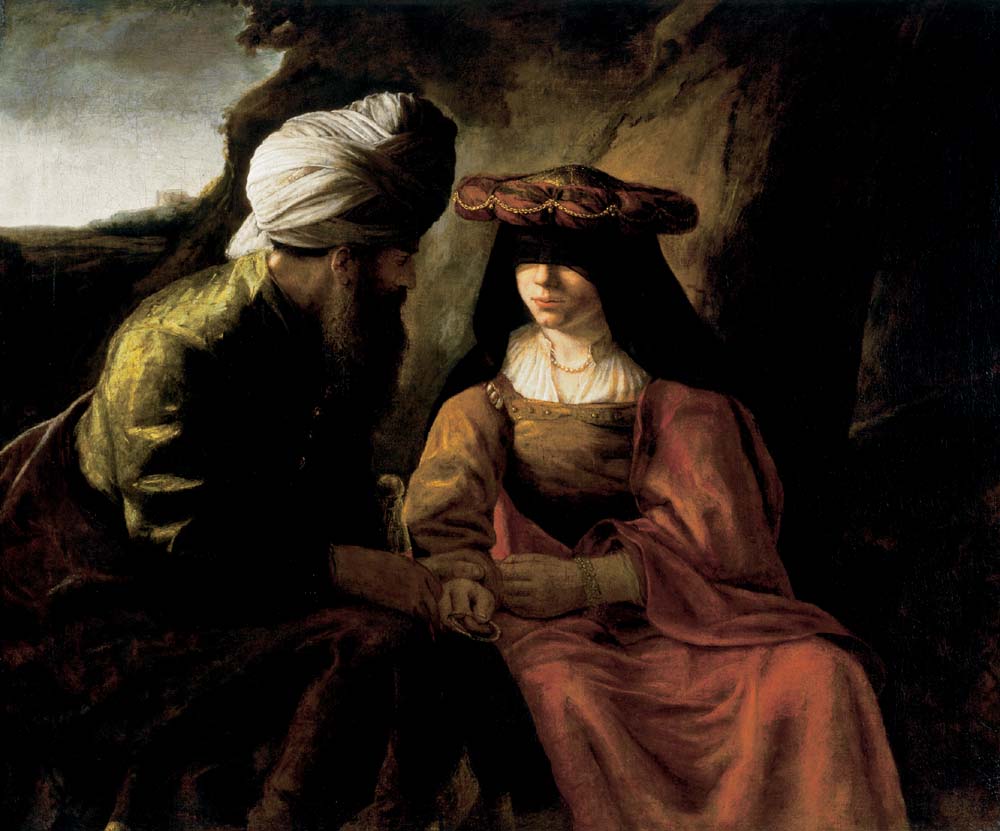
Judah and Tamar, School of Rembrandt, 1650-1660

By this point Judah’s own wife has died, and when Tamar hears he is going on a journey to Timnah, she decides to take control of the situation. She dresses herself as a prostitute and sits at the entrance of Enaim, a town on the way to Timnah. Judah propositions her, sleeps with her, and leaves his signet and staff as a pledge till he can send a young kid to her as payment. However, Judah is unable to find the prostitute when he returns to recover his identifying belongings.

Meanwhile, Tamar has become pregnant by Judah and this is soon noticed. Judah is informed and he orders that she be brought out and burned. Tamar shows Judah his own signet and staff and tells him she is pregnant by the owner of these items.

Then Judah acknowledged them and said, ‘she is more in the right than I, since I did not give her to my son Shelah.’

Genesis 38:26

The tale concludes with the birth of Tamar’s twins: Perez and Zerah.

Tamar’s story is messy. She is passed as property from one man to another, from her father via Judah to Er then to Onan, then back to her father. At no point does Tamar have any choice or control. Her future is bleak – as a childless widow she has no societal standing, nor the security of someone to care for her in her old age. Hers is a situation in which women across the generations have found themselves caught – in a patriarchal society, the worst thing to be is a woman alone.

While emotional details are scant, Tamar’s story reveals a lot about her relationships with the men who control her life. Tamar’s first husband is put to death by the Lord for wickedness… it is no stretch to assume that this was not the happiest of marriages for Tamar, and that she may have suffered at his hands. But being married to a wicked man and all the trials that comes with such a union, was preferable to no marriage at all. And her father-in-law not only cheats her out of a marriage with Shelah, but seems to have been a man of questionable morals – Tamar chose the disguise of a prostitute implying she knew that Judah would be likely to use such services.

This is not a family anyone would choose to join willingly, but Tamar has few options so takes control of her own future through the only means she has. She has nothing to barter with but her own body, and her capacity to bear children, so this is the way provides herself with some security.

And yet this dysfunctional family is one that God has chosen to bless. Matthew’s gospel recounts Jesus’ genealogy and there in verse 3 is Tamar:

and Judah the father of Perez and Zerah by Tamar, and Perez the father of Hezron, and Hezron thefather of Aram

Matthew 1:3

Tamar could not have known that through her son Perez, she would be an antecedent of Jesus. Her actions were designed only to ensure her own survival in a deeply patriarchal world – with few options open to her, she makes a difficult choice and tries to gain some control over her life. She changes her narrative  from that of a desperate victim of circumstance to a woman who is praised for her righteousness by her family.

Tamar’s story is difficult, but that is why it is powerful. The Bible does not edit out the difficult parts, just as we cannot edit out the painful, messy and difficult parts of our lives, no matter how much we might want to. Because God is there in the difficulties, in the mess. He works through imperfect and flawed people like Tamar and her family, just as he works in our lives in both the bad times as well as the good.

It is easy to feel God with us and working through us when things are going well – when we are succeeding, loving our neighbours and full of hope. But Tamar reminds us that He is also with us in the depths of our despair, in the lowest moments of our lives or those times when we feel we are falling short.

Prayer

Tamar’s story does not belong in ‘olden times’, she embodies the female experience of so many women around the world who live under oppressive political or social systems. But she also embodies that hope for us all – that even in the worst of times, God is with us and working through us.

A Prayer for International Women’s Day (which is tomorrow)

God of all, God of hope,
We pray for women and girls today.
That they will be all they can be.
Give us courage to speak and work
For equality and justice
Until the earth is filled
With righteousness and love.
Amen.

Potiphar’s Wife: the seductress

Genesis 39

Potiphar’s Wife ©MicahHayns
Potiphar was cool and so fine
But his wife would never toe the line
It's all there in chapter 39 of Genesis
She was beautiful but evil
Saw a lot of men against his will
(from Joseph the Musical)

One of the things you quickly notice when reading about the women in scripture is often they are often only allowed one characteristic (jealous sister, childless woman, whore), whilst the men are able to be complex and multi-faceted.

Take the story in Genesis about Joseph – he’s a good example. Joseph, sold by his jealous and deceitful brothers into slavery in Egypt, had been the favoured and much beloved son of Jacob and Rachel. He was a dreamer and rather vain (he loved that coat!), but was also resourceful and cunning, fearful and faithful.

Potiphar’s Wife, on the other hand, was only one thing:

A Seductress.

We don’t find out anything much about her life and we don’t even get to know her name.  We don’t know whether she had children, whether she was a kind or demanding mistress, or what Potiphar, an Officer of the King of Egypt (Pharaoh), was like as a husband.

It’s likely that she lived in luxury. They had servants and a large household, within which Joseph had worked his way up the ranks to become the overseer, like a young Mr Carson (from Downton Abbey).

Now Joseph was handsome and good-looking. And after a time his master’s wife cast her eyes on Joseph

Genesis 39.6-7

Mrs Potiphar was clearly very taken by this handsome young Hebrew man. She began to pay him ‘special attention’ and then one day propositioned him:

Lie with me

Genesis 39.7

The story is told as if this attraction was entirely one way but this may well not have been the case. It has all the hallmarks of a Downton Abbey upstairs-downstairs affair. She was certainly infatuated with Joseph and he may well have been attracted by his mistress, but he would have known that if he slept with her he risked his job, his place in the household, and even his life: adultery was punishable by death. He was also faithful to God:

How then could I do this great wickedness, and sin against God?

Genesis 39.9

So, Joseph resisted but Mrs P persisted, until one day they found themselves alone.  She made a pass at him and even got some of his clothes off, but Joseph ran out of the house leaving her holding his ‘garment’.

Joseph wanted to resist her till
One day she proved too eager
Joseph cried in vain
"Please stop, I don't believe in free love"
1910 comic caricature of Joseph and Potiphar’s wife by Joseph Kuhn-Régnier,
Notice the chilled wine bottle and glasses on the small table at the left!

She was furious. How dare he, a slave, spurn her. She turned against him, and in her fury accused him of attacking her: she had his coat as proof. Joseph was thrown into prison.

Poor, poor Joseph, what'cha gonna do?
Things look bad for you, hey, what'cha gonna do?

Once in Prison Joseph began to interpret dreams and this led to him being introduced to Pharaoh himself, and becoming the Egyptian King’s right hand man. We hear nothing more of Potiphar’s wife.

Her role as ‘the seductress’ has been fulfilled and she’s no longer necessary for the rest of the story.

Reflection and Prayer

I pray, O Lord, that I will not fall into temptation; for the spirit is willing, but the flesh is weak
Matthew 26.41 (Good News Version, adapted)

Many of the women in the Hebrew Scriptures are portrayed as innocent victims and so it’s surprising and rather refreshing to come across a woman like Potiphar’s wife, a powerful protagonist and an instigator, and who desired love rather than children. Perhaps today we can pray for all those whose love is unrequited, for those who are tempted into adultery, and for those who continue to resist.

O God our Father, hear me, who am trembling in this darkness, and stretch forth thy hand unto me; hold forth thy light before me; recall me from my wanderings; and thou be my guide, may I be restored to myself and to thee
Augustine, 354-430

Leah: The Other Sister

Genesis 29. 15-35, 30.1-20

In the previous post we heard about Rachel, the wife who Jacob loved the most but who never seemed to find contentment. Now we hear of her sister Leah, the wife Jacob never really loved but who was blessed with a huge number of sons.

Me and my sister, Milly (plus Layla and Koru)

Much of my childhood was spent in arguments with my sister. I was a couple of years older and was deeply jealous of her. Apparently when I was around three I used to sleep outside my parents’ bedroom door so I was first to be seen in the morning! I don’t look back on those years with much pride as I was pretty vile. I even cut her beautiful red hair and made her promise not to tell anyone! One of the greatest blessings in my life is that she forgave me and we’re now the best of friends.

This certainly wouldn’t be the case if we were married to the same man!!

Leah knew from the beginning of her marriage to Jacob that she wasn’t the one that Jacob loved most. But she did have lots of boys (something we share as Milly and I have 5 boys between us), and boys in those days were a sign of God’s blessing.

When the Lord saw that Leah was unloved, he opened her womb

Genesis 29.31

She had four sons in quick succession (Rueben, Simeon, Levi and Judah)

Surely now my husband will love me

Genesis 29. 32

But sadly for Leah this doesn’t seem to be the case and Jacob continued to prefer her sister, even though she had even more sons via her handmaid Zilpah (Gad and Asher).

Although neither Rachel nor Leah had much power over who they were to marry, it seems that they did have agency within their relationship. They were able to name their sons for example. And it seems that they were also able to control which of them Jacob slept with. Here is an example:

Illustration of Mandragora officinalis (Mandrake)
Fun Fact: In the Odyssey, the Greek enchantress Circe used Mandragora in a brew to turn Odysseus’ men into swine!
Fun Fact 2: Mandrakes are used in Harry Potter (Herbology) as a powerful restorative.

After Leah has stopped having children her eldest son Rueben finds some mandrake plants, a known ancient aphrodisiac said to possess natural stimulants. When you see the plants it’s not surprising why they became known as an ancient form of viagra!

Leah gave Rachel the plants in return for a night in Jacob’s bed.

When Jacob came in from the field in the evening Leah went out to meet him, and said, “you must come in to me; for I have hired you with my son’s mandrakes.” So Jacob lay with her that night

Genesis 30.16

The result of this led to her fifth son, Isaachar. She went on to have two more children, Zebulun and last but not least a daughter… Dinah (who we will hear about tomorrow).

Leah may not have been Jacob’s most beloved wife, but she seemed to have been more contented that her sister, and she was blessed with a quiver full of sons who then went on to be the foundation tribes of Israel.

We don’t hear if the sisters were ever fully reconciled but I like to think that their passionate jealousy and fierce rivalry ran alongside a deep love for one another. They were in an impossible situation and one that would have tested even the most dedicated siblings.

Jacob may not have favoured her in life, but in death she was honoured and buried alongside Abraham and Sarah in a place where Jacob would be eventually laid to rest.[1] United in death if not in life.  


[1] Genesis 49.31 – ‘There Abraham and his wife Sarah were buried; their Isaac and his wife Rebekah were buried; and there I buried Leah.’

Prayer

Get rid of all bitterness, rage and anger.... be kind and compassionate to one another, forgiving each other, just as in Christ God forgave you
Ephesians 4.32

As we’ve reflected over the last couple of days on the complicated sibling relationship between Rachel and Leah perhaps we might think about our own relationship with a sibling or close family member. What do we appreciate about them? What is difficult?

Perhaps we can think of three things about them that we are thankful for. We may even like to send them a message to let them know. If your relationship is complex and damaged then perhaps you might like to pray for healing and forgiveness.

Be gracious to all that are near and dear to us, and keep us all in thy fear and love. Guide us, good Lord, and govern us by the same Spirit, that we may be so united to thee here as not to be divided when thou art pleased to call us hence, but may together enter into thy glory,
through Jesus Christ. Amen

A prayer of John Wesley, 1703-91