Jephthah’s Daughter: A Girl Without Angels

Judges 10-11

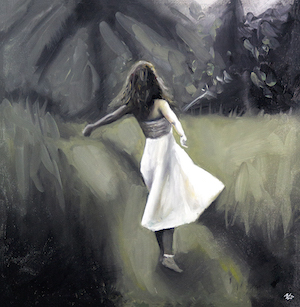
Jephthah’s Daughter ©MicahHayns
Hamlet:    O Jephthah, judge of Israel what a treasure hadst thou!
Polonius:  What a treasure had he, my Lord?
Hamlet:    One fair daughter and no more; The which he loved passing well.

William Shakespeare, Hamlet

TW/CW: Domestic Violence/Abuse

The story of Jephthah’s daughter is a grim tale that has echoes throughout literature across the ages, from Iphigenia in Greek mythology to Offenbach’s operettas to Shakespeare’s Hamlet. It is the story of a proud father, an innocent daughter and a misguided vow.

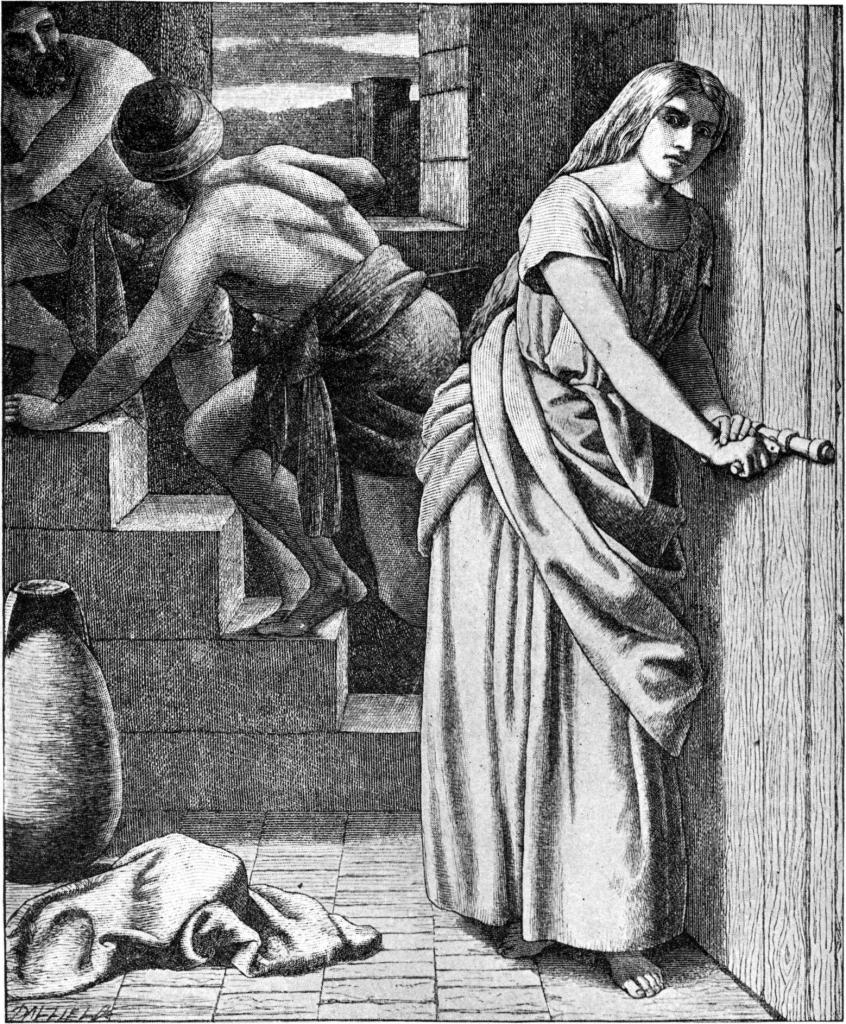
Although we don’t know her name we know that Jephthah’s daughter loved to dance and this is how we first meet her. Her father is returning from battle and she goes out to greet him ‘dancing to the sound of tambourines.

She was the only child of Jephthah, who was an exile from the Gileadite tribe having been sent away by his brothers as his mother had been a prostitute (or perhaps that’s just what they called her!). He’d made a home for himself in Tob and had become a successful leader of ‘a gang of scoundrels’.

War had broken out and the Gileadites decided they needed Jephthah’s fighting skills and so they begged him to return to join them, which he reluctantly agreed to. However, rather than relying on his skill and on prayer he made a rash vow to God which would be his undoing:

If you give the Ammonites into my hands, whatever comes out of the door of my house to meet me when I return in triumph.. will be the Lord’s, and I will sacrifice it as a burnt offering. 

Judges 11. 31

What was he thinking!

Perhaps he imagined a goat would come out of the house first, or a servant he had no regard for.

But he can’t surely have intended for it to be his beloved only child. And so when his daughter came out of the house singing and dancing he cried out in dismay. Not, as you might think, in concern for her, but for himself!

When he saw her he tore his clothes and cried, ‘Oh no, my daughter! You have brought me down and I am devastated. I have made a vow to the Lord that I cannot break.

Judges 11.35

So she’s to blame… nice!

Her reaction was remarkable. She told him he shouldn’t revoke his vow to the Lord but asked him for two months freedom to mourn all that she was about to lose. She spent that time with her friends in the hills and then went back to her death:

and he did to her as he had vowed

We might recall a similar story from Genesis where Isaac was to be sacrificed by his father Abraham. Isaac was saved because an angel appeared just before the final deed and a goat was sacrificed in his place.

Sadly, no there was no angel to save Jephthah’s daughter.

Reflection and Prayer

‘As the Father has loved me, so I have loved you; abide in my love’ 
  John 15.9

Was this sacrifice something that God ordained, or was it just the foolishness and pride of a father unwilling to back down on a promise? My view is that this tale that reminds us that many terrible things have been done in the name of religion but which are nothing to do with God’s will. Jephthah’s daughter showed remarkable courage and strength in the face of a terrible injustice done to her by the very person who should have protected her. It’s another hard story to reflect on, but it’s also important to remember in prayer all those who are harmed at the hands of those they trust.

Let us pray:
For those who suffer at the hands of fathers who harm them;
For those who work with survivors of domestic abuse;
For those who do use God’s name to justify their own destructive actions; And let us remember that we have a heavenly father who loves us and will do us no harm, and He calls us to rest in that love. Amen

Jael: Malicious in Tent

Judges 4 and 5

One of my favourite Netflix series for 2019 was the spy thriller and darkly comic ‘Killing Eve’. The star was Villanelle, the beautiful and almost child-like assassin who comes up with weird and macabre ways to bump off her victims.

If Deborah defied our expectations of women in the Bible by being a judge and prophet then this next woman shatters any illusions that women are the ‘gentler sex’.

Yesterday’s tale ended with Sisera, the commander of the King of Cannaan’s army, in retreat. He had oppressed the people of Israel for many years and Barak, with Deborah at his side had gone to fight for justice. Sisera began the battle with 900 chariots and ended with an enormous defeat. He fled on foot to the tent of the Bedouin family of Heber the Kenite, who he knew was a long-time ally of his.

Heber the Kenite may well have been an ally, but Sisera didn’t consider Heber’s wife. Jael, it seems, was not an ally – very far from it in fact:

 Jael saw him coming, so she went out to meet him and said, “Sir, come into my tent. Come in. Don’t be afraid.”

Judges 4.18 (ERV)
Jael and Sisera, ca 1690, Lucas Jordán, Luca Jordanus, Luca Fa Presto, 1632-1705

She was generous and hospitable, gave him some milk and a warm bed and tucked him in for the night. After a full day’s battle Sisera must have been exhausted and so he soon fell sound asleep.

She went softly to him and drove the peg into his temple, until it went down into the ground – and he died.

Judges 4.21

Bedouin people lived in tents and so Jael must have been a good hand with a peg and a mallet! She uses what she knows. Villanelle couldn’t have done it better herself!

Jael even gets a mention in Deborah’s triumphant song which isn’t the most romantic of ditties!

Most blessed women be Jael,
The wife of Heber the Kenite,
Of tent dwelling women be blessed….
She put her hand to the tent peg and her right hand to the work-men’s mallet;
She struck Sisera a blow, she crushed his head,
She shattered and pierced his temple.
He sank, he fell, he lay still at her feet;
At her feet he sank, he fell,
Where he sank, there he fell dead.

Judges 5:24-27

Nice!

It’s an odd tale, and brings up moral issues of whether violence such as this can ever be justified or claimed to be part of God’s will. It’s hard from our perspective to judge the decisions of those in conflicts so many centuries ago. Do the ends justify the means? It’s very hard to tell, but what we are told is the actions of Deborah and Jael led to peace:

there was peace in the land for forty years’

Judges 5.31

That is, until the people rebelled again and war broke out once more (Judges 6).

Reflection and Prayer

Put away from you all bitterness and wrath and anger and wrangling and slander, together with all malice, and be kind to one another, tenderhearted, forgiving one another, as God in Christ has forgiven you.
Ephesians 4.31-32

Aggression and violence is more often considered to be a male issue, and men are certainly more likely to be physically violent than women. However research shows that women are more likely to use indirect aggression, such as spreading false rumours, excluding others from a social group, making insinuations without direct accusation, and criticising others’ appearance or personality (1).  Jael’s actions are shocking because of the physical nature of her actions, but perhaps we can all recognise ways in which we can be aggressive at times, and when our anger can result in harm to others.

I love this prayer by Harry Williams as it’s so real and honest:

O God, I am hellishly angry; I think so and so is a swine; I am tortured by worry about this or that; I am pretty certain things can’t get worse; this or that has left me feeling terribly depressed. But nonetheless here I am like this, feeling both bloody and bloody minded, and I’m going to stay here for ten minutes. You are most unlikely to give me anything. I know that. But I am going to stay here for ten minutes nonetheless. Amen

(1) Frontiers – Behavioural Neuroscience, 02 May 2018 – Aggression in Women: Behaviour, Brain and Hormones https://doi.org/10.3389/fnbeh.2018.00081

Rahab: harlot, heroine or both?

Joshua 2, 6

Depending on the version in the Bible you read, our next woman is described as either a harlot or a  prostitute (although some Rabbinic texts describe her as an Innkeeper). Yet despite her likely profession, and even though she wasn’t an Israelite, she is one of the few women named in the genealogy of Jesus at the beginning of Matthew’s Gospel.

Abraham was the father of Isaac….and Salmon the father of Boaz by Rahab, …and Jesse the father of King David…and Jacob the father of Joseph the husband of Mary, of whom Jesus was born, who is called the Messiah

Matthew 1

So, who was she?

Some background. Moses had died and his assistant Joshua had taken over the leadership of the Israelites, who were still in exile in the wilderness. God had promised them that they would be led into the Promised Land and they had camped in the Jordan valley opposite the City of Jericho in hope that this was indeed the land they had waited for for so long. But first they needed to check out the city and so Joshua sent some spies on a reconnaissance mission.

Rahab was a citizen of Jericho and she lived literally on the edges of the City:

..her house was on the outer side of the city wall and she resided within the wall itself.

Joshua 2.15

Joshua’s spies went to stay at Rahab’s house ‘and spent the night there’. We don’t hear whether they were doing so because she had an Inn or because of her other profession… we can only imagine! The King of Jericho found out about them and ordered that they be brought to him. Rahab was cunning though. She had heard about their God and also realised these men might be useful to her and her family. And so she hid them in her room, lied to the King’s men by sending them in the wrong direction, and then hatched a plan.

Before the men are allowed to sleep, Rahab went up to the roof to  speak to them:

I know that the Lord has given you the land…. we have heard how the Lord dried up the water of the Red Sea… The Lord your God is indeed God in heaven above and earth below.

Joshua 2.8
Rahab Helping the Two Israelite Spies., Frederick Richard Pickersgill, illustrator of the 1897 Bible Pictures and What They Teach Us by Charles Foster

She defied the orders of the King (rather like Shiprah and Puah, the midwives), and made a pact with the spies. She would help them escape and in return they were to ensure that all her family would be unharmed when they eventually come to take the land. The Israelites would know them because of the red cords tied on their windows. The pact is made and the spies escape.

A little while later the City of Jericho was surrounded by the Israelites who marched round the city walls for seven days blowing their trumpets and processing the Arc of the Covenant.  They eventually took the city killing all those who lived there, but Rahab and all her family were spared and they become incorporated into the Jewish people.

This blog is not the place to defend or attack the actions of the ancient people of Israel in the time of Joshua, though it’s hard imagine that the God of love and justice ever commanded the destruction of a city and its people.

Instead, let us focus on this remarkable woman who comes to be named in the New Testament as a hero of faith (Hebrews 11) and as an example of faith in action (Book of James ). She used her position, her (perhaps intimate) knowledge of people both within and outside of her culture, her home, persuasive powers, charm and wily intellect, to protect the Israelite spies and to secure the lives of her entire family, a family that would in time include Jesus of Nazareth. It is an impressive feat.

Rahab: harlot or heroine? Perhaps she was both.

Reflection and Prayer

Which of the two did the will of his father?” They said, “The first.” Jesus said to them, “Truly I tell you, the tax collectors and the prostitutes are going into the kingdom of God ahead of you.
Matthew 21.31 (from the parable of the two sons in the vineyard)

Jesus was criticised by the religious leaders for spending time with those they considered to be ‘sinners’ and ‘unclean’, the prostitutes, tax collectors and lepers. Yet they were often the first to recognise that He was the Saviour, the one who would bring healing and wholeness. Rahab’s story reminds us that we too often make judgements about people because of their lifestyle, profession or values. She also reminds us that God often chooses the most unlikely people to bring about His purposes, even women like Rabah, and you and me!

Many of us are fearful for families and friends at this time of Covid 19. Let us pray for God’s protection, especially for those who are sick, and those who care for them. Perhaps we might think about what we can do to support someone who is fearful.

Father, give to us, and to all your people,
in times of anxiety, serenity;
in times of hardship, courage;
in times of uncertainty, patience;
and at all times, a quiet trust in your wisdom, protection and love; through Jesus Christ our Lord. Amen
A Prayer from New Every Morning

The Daughters of Zelophehad: girl power

Daughters of Zelophehad ©MicahHayns

Numbers 27

One of our family treats is going to see musical theatre, and we recently enjoyed seeing Trevor Nunn’s production of Fiddler on the Roof at the Playhouse Theatre in London. It was wonderful. The story, for those who don’t know it, revolves around Jewish patriarch Tevye and his five daughters, all who need husbands and dowries, which Tevye, as much as he pleads to God (remember ‘if I were a rich man’), can’t afford.

One man, five daughters, no sons. This is a rather similar situation for Zelophehad, who who lived at time when the Israelites were in exile, wandering in the wilderness with Moses as their leader.

Now Zelophehad son of Hepher had no sons, but daughters: and the name of the daughters of Zelophehad were Mahlan, Noah, Hoglah, Milcah, and Tirzah

Numbers 26.13

Five women that you’re unlikely to have ever heard of but whose chutzpah transformed the lives of women down the centuries.

Zelophehad was the son of Hepher, son of Gilead, son of Machir, son of Manasseh, son of Joseph (another great musical!), son of Jacob, son of Isaac, son of Abraham.

Sons. It was a classic patriarchal society and every father needed a son in  order to ensure the family line continued, and land was apportioned accordingly as inheritance. Now Zelophehad had died and the tradition was that if a man had no sons then his land and possessions would be inherited by his brother, and his family name would be lost.

But these women had another idea.

The daughters of Zelophehad came forward 

Numbers 27.1

They decided that this wasn’t good enough and so, as a group, they ‘came forward’ to argue their case before Moses, Eleazar the Priest and the other elders. Their argument was forthright, concise, personal, persuasive and ends with their plea:

why should the name of our father be taken away from his clan because he had no son? Give to us a possession among our father’s brothers.

Numbers 27.4
The Daughters of Zelophehad, illustration from The Bible and Its Story Taught by One Thousand Picture Lessons. Edited by Charles F. Horne and Julius A. Bewer. 1908.

And Moses prays about it. And the Lord speaks to Moses.

The daughters of Zelophehad are right in what they are saying; you shall indeed let them possess an inheritance.

Numbers 27.4

The daughters are right. Wow. The inheritance laws are duly changed and from then on daughters could inherit if there were no sons – provided they don’t marry someone outside of their fathers’ clan.

Reflection

We cannot underestimate the importance of the actions of these brave women in changing the lives of so many others down the generations.

Gender inequality in inheritance law and land ownership rights is still a current issue and One of the Sustainable Development Goals (SDG’s) of the United Nations is Achieve Gender Equality and Empower Women and Girls and a sub-category of this is Realising Women’s Right to Land in the Law. The report makes interesting reading on why land rights for women is still vitally important: http://www.fao.org/3/I8785EN/i8785en.pd

It’s never easy to ‘come forward’ to tackle injustice and to speak up for something you believe in. Sometimes it’s easier to do this in a group that on our own isn’t it? The sisters might not have had the courage to speak to Moses on their own, and it’s unlikely they would have had a hearing. Let’s give thanks for women’s groups and support networks which have been so important over the centuries for standing up for justice for women and children. I’m involved in a wonderful clergy women’s support group, and frankly couldn’t do without it.

The Women’s Institute Prayer

The Women’s Institute Prayer. The Women’s Institute (WI) was formed in 1915 to revitalise rural communities and encourage women to become more involved in producing food during the First World War. Since then the organisation’s aims have broadened and the WI is now the largest voluntary women’s organisation in the UK. The WI celebrated its centenary in 2015 and currently has almost 220,000 members in approximately 6,300 WIs

Miriam: The Joyful Prophet

Exodus 2.4-6, Exodus 15.20-21, Numbers 12.1, Micah 6.4, Numbers 20:1

This blog series all began because of Miriam.

I was in a shop getting some pictures framed whilst wearing my clerical collar and the man at the desk said: ‘you’ll know the answer to this as you’re a Vicar’.

Church leaders may know the feeling of dread at that statement!

'So, Miriam from the Bible, who was she then?' 

I floundered. I knew she was in the Old Testament and had something to do with Moses. Nothing else. Another customer came in so I took the time to hide behind the frames to google her! I came away determined I’d find out more about Miriam, and also all the other wonderful women of scripture: hence this blog.

So, who was Miriam? She was Moses and Aaron’s sister, the daughter of Amran (one of the Israelite leaders) and Jochebed. That was the simple answer I gave the framer. But there is so much more to her. She was also the first women to be described as a prophetess, a leader of women, a musician and the very first worship leader mentioned in scripture!

Jocheved, Miriam, and Moses, an illustration from the 1897 Bible Pictures and What They Teach Us: Containing 400 Illustrations from the Old and New Testaments, by Charles Foster

We first hear of her when Moses is a baby in the bulrushes having been hidden by his mother to protect him from Pharaoh’s wicked plans to kill the male children. Jochebed (another fabulous woman) placed Moses in the river and Miriam stands at a distance to keep watch. When Pharaoh’s daughter comes and scoops Moses out of the river Miriam steps forward and suggests an ingenious plan.

Shall I go and get you a nurse from the Hebrew women to nurse the child for you?

Exodus 2.7

Miriam suggests Moses’ mother, who is then paid a wage to look after her own son!

Miriam’s Song, by John Edward Poynter (The Bible and Its Story, 1910)

We next hear of Miriam after Pharoah’s army has been defeated and the Israelites escape from Egypt across the red sea into the wilderness. She leads the defiant ‘song of the sea’, a song of triumph which is still recited in jewish daily prayers to this day.

[Miriam] took a tambourine in her hand; and all the women went out after her with tambourines and with dancing:

“Sing to the Lord, for he has triumphed gloriously; horse and rider he has thrown into the sea.”

Exodus 15.20-21

I love the fact that when Miriam and the women fled Egypt, when they didn’t even have time to wait for the bread to rise, they took with them their musical instruments. It’s as if they knew there would be a time to celebrate again one day, and they wanted to make sure they were ready.

It is likely that she was one of the community leaders whilst the Israelites were in exile, and we hear that she wasn’t afraid to confront Moses when she disapproved of a relationship of his (Numbers 12.1). Her forthright nature leads to her being accused of being jealous of Moses and she contracts leprosy (which was understood as a punishment) and is ostracised for a week.

She died at a time of drought in the wilderness of Zin and she was remembered many years later by the prophets as having been one of the three (with Moses and Aaron) who were sent by God to deliver his people from slavery (see Micah 6.4).

So, who was Miriam? A courageous sister, a leader of women, a musician, a worship leader, a dancer, and so much more!

Reflection and Prayer

There is a fantastically catchy song by Debbie Friedman which is sung at Jewish children’s camps in America (and maybe in the UK) called Miriam’s Song. I love this version as it’s rough and ready but totally joyful and the clips of Jewish kids enjoying themselves is a delight. Have a listen. https://youtu.be/1dcBTze-T4o

And Miriam the prophet took her timbrel in her hand
And all the women followed her just as she had planned
And Miriam raised her voice in song
She sang with praise and might
We’ve just lived through a miracle: We’re going to dance tonight!!

Miriam was first to lead the community in joyful praise after many years of hardship. Sometimes it’s good to remember to be thankful, whatever else is going on in our lives. Perhaps you might like to think of five things you are thankful for right now? You might like to say them out loud, boldly, remembering Miriam as you do so.

May we accept this day at your hand, O Lord
as a gift to be treasured,
a life to be enjoyed,
a trust to be kept
and a hope to be fulfilled:
and all for your glory. Amen

(A prayer of Stanley Pritchard)

Shiprah and Puah: the rebel midwives

Exodus 1

Rebel Midwives ©MicahHayns

One of my favourite TV shows to watch when my husband is out (he’s not so keen) is BBC’s Call the Midwife. I love the drama of it. The Sisters are just fabulous and they balance the stark reality of daily life with a deep faith so well. I love the way the programme focuses on the every day details of each family, and the mix of pain, struggle and endurance that leads to new life.

Sometimes it’s pretty gruesome, but birth is like that.

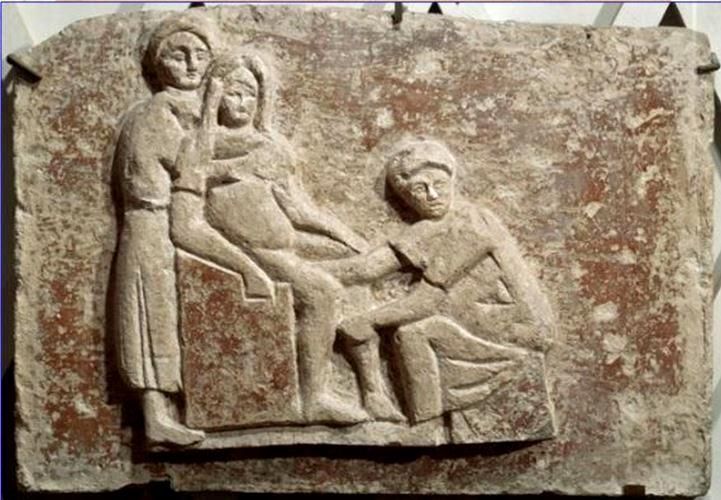
Funerary relief of a midwife, Ostia Antica (Roman Art)

I’ve always admired midwives. Having given birth three times I know it’s a messy business and these women (I know, I know, there are of course male midwives) are willing to be at the gritty end. Midwives are the kind of people you want in a crisis: unflustered, clear thinking, plain talking, patient and encouraging, even willing to be shouted and sworn at in the course of their work!

There must have been many midwives in the Bible but only two are mentioned by name: Shiprah and Puah. (Exodus 1.15).

We have come to the end of our readings from Genesis. The Israelites were now living in Egypt having settled there during the time of Joseph. A new Pharaoh had taken the throne who didn’t remember Joseph and his economic success, and he began to oppress them, forcing them into hard labour. Despite this the Israelites had grown in number and Pharoah was afraid they would rise up against him and so he brought Shiprah and Puah to him and made a terrible demand of them:

When you act as midwives to the Hebrew women, and see them on the birthstool, if it is a boy, kill him; but if it is a girl, she shall live.

Exodus 1.16

In what is no doubt the first act of civil disobedience in recorded history, the midwives refused to follow this murderous edict: [i]

But the midwives feared God; they did not do as the king of Egypt had commanded them, but they let the boys live.

Exodus 1.17

They knew that they could not openly disobey the order of their King, and so they were clever about it: they made up a racially charged explanation!

The Hebrew women are not like other women (they told the king) for they are vigorous and give birth before the midwife comes to them.

Exodus 1.19

Ingenious. It seems that Pharoah fell for this explanation, and because of the cunning bravery of these women the Israelites continued to procreate, the boy babies lived, and Moses, who would later lead them into freedom, was born.

Reflection

The two psalms below use imagery of the midwife to describe God.

“Yet it was you who took me from the womb;
you kept me safe on my mother’s breast.
On you I was cast from my birth,
and since my mother bore me
you have been my God.”
(Psalm 22:9-10)

“For you, O Lord, are my hope,
my trust, O Lord, from my youth.
Upon you I have leaned from my birth;
it was you who took me from my mother’s womb.
My praise is continually of you.”
(Psalm 71: 5-6)

How beautiful to think of the midwives, doctors, nurses and doulas who attend to women and babies at birth as being God-like in their work, bringing forth new life into the world.

Apparently 2020 has been designated ‘Year of the Nurse and the Midwife’ and Pope Francis said that “midwives carry out perhaps the noblest of the professions”.

Let us remember them today and pray for them in their work.

Mother God, as a midwife brings forth new life into the world, You long to nurture new life in us today. Help us to trust in your love and protection, knowing that we are safe in your loving arms. Amen

For more stories of incredible women see our book Unveiled: women of the Old Testament and the choices they made’ – https://www.brfonline.org.uk/products/unveiled

[i]

Francine Klagsbrun said that the refusal of Shiphrah and Puah to follow the Pharaoh’s genocidal instructions “may be the first known incident of civil disobedience in history” (Voices of WisdomISBN 0-394-40159-X).